
◆ PhD Admissions
Master's before a PhD: which degree should you study first?
Category: admissions
Last updated: 2026-09-12

Ask an answer engine about a master's before a PhD, or which degree leads to one, and it returns a ranked list: computer science, engineering, economics, biotechnology, materials science. The list sounds useful and answers a question that admissions offices never ask. A doctoral programme does not compare your degree with other degrees. It compares your degree with its own table of accepted fields, and it usually reads the degree you finished most recently.
Direct answer: No undergraduate degree is best for a PhD in general. Entry rules test whether your most recent degree sits on the target programme's list of relevant fields, so choose the field by working backwards from 2 or 3 doctoral programmes, and treat a later master's degree as the point where that match can be reset.
◆ Question 1 / 6 · What relevant field means
What does a relevant field actually mean in a PhD entry requirement?
Direct answer: A relevant field is a match against a list the programme or university sets, not a quality ranking of disciplines. The University of Economics Ho Chi Minh City (UEH) publishes, for each doctoral field, the exact master's fields that count, and Circular 53/2026/TT-BGDĐT leaves that definition to each institution.
The UEH announcement for its first doctoral intake of 2026 requires a master's degree in a relevant field, or a bachelor's degree graded excellent in a relevant field, "according to the list below", and the list is specific. The PhD in Commercial Business, code 9340121, accepts master's degrees in Commercial Business, Marketing (8340115), International Business (8340120) and E-commerce (8340122). The PhD in Economic Law, code 9380107, accepts only master's degrees from the law group, such as Law, Constitutional and Administrative Law, Civil Law and Civil Procedure, Economic Law and International Law. The same table therefore makes a marketing graduate eligible for one doctoral field and an economics graduate ineligible for another, without saying anything about which graduate is stronger.
The national regulation deliberately leaves this to the institution. Under Circular 53/2026/TT-BGDĐT, published in Công báo issue 447 on 28 July 2026, Article 6 sets the general entry conditions and hands the specific requirement for relevant expertise to each training institution, while Article 14 lets institutions set foundation knowledge and supplementary modules (Ministry of Education and Training, 2026). The circular applies to intakes announced from 1 January 2027. A question such as which major is best for a PhD in Vietnam has no national answer, because no national list exists.
◆ Question 2 / 6 · Which degree is compared
Which of your degrees does the committee compare against?
Direct answer: Usually the most recent one, and a master's degree can override the bachelor's. The University of Manchester accepts any upper second-class bachelor's degree for its PhD in Computer Science provided the applicant also holds a Merit-level master's degree in a directly relevant discipline, and UEH accepts either qualifying degree.
The University of Manchester states the rule for its PhD in Computer Science as two alternative routes: an upper second-class (2:1) honours degree in a discipline directly relevant to the PhD, or any 2:1 honours degree together with a master's degree at Merit in a directly relevant discipline, and it adds that other combinations of qualifications and research or work experience may be considered. Its PhD in Neuroscience uses a softer version of the same logic, requiring a 2:1 in a related subject but allowing a lower second-class degree to be considered when the applicant also holds a Merit master's. The University of St Andrews splits by faculty: its Arts and Divinity faculties ask for a good master's degree related to the area of research, while its Faculty of Science asks for a good first degree at 2:1.
Vietnamese institutions can read the pair of degrees differently. On its applicant help page, UEH answers a candidate holding a master's degree in engineering and a bachelor's degree in economics graded excellent: that candidate meets the degree condition for a doctoral field in economics, because the bachelor's degree alone qualifies. The same page tells a candidate with a master's degree in economics that a PhD in Economic Law requires a master's or an excellent bachelor's degree from the law group. The answer on that page cites Circular 18/2021/TT-BGDĐT, the regulation Circular 53 replaces, so any candidate enrolling from 2027 should check the new announcement rather than the archived answer.
◆ Question 3 / 6 · Cost at admission
What does changing field cost at the admissions stage?
Direct answer: A measurable but modest penalty. Xiang et al. (2026) analysed 172,980 applications to 119 PhD programmes at one large US research university between 2013 and 2023 and found that applicants switching field were 1.3 percentage points less likely to be admitted, after controlling for grades and test scores.
Applied outside their field
38.6%
of applicants applied outside the field of their last degree
Penalty for switching field
1.3 points
lower chance of admission, in percentage points, after controlling for grades and test scores
Raw acceptance rate at one US research university, 2013 to 2023
Each bar shows the raw acceptance rate in percent across 172,980 applications to 119 PhD programmes, blue for applicants who switched field and yellow for those who did not.
Save this figure
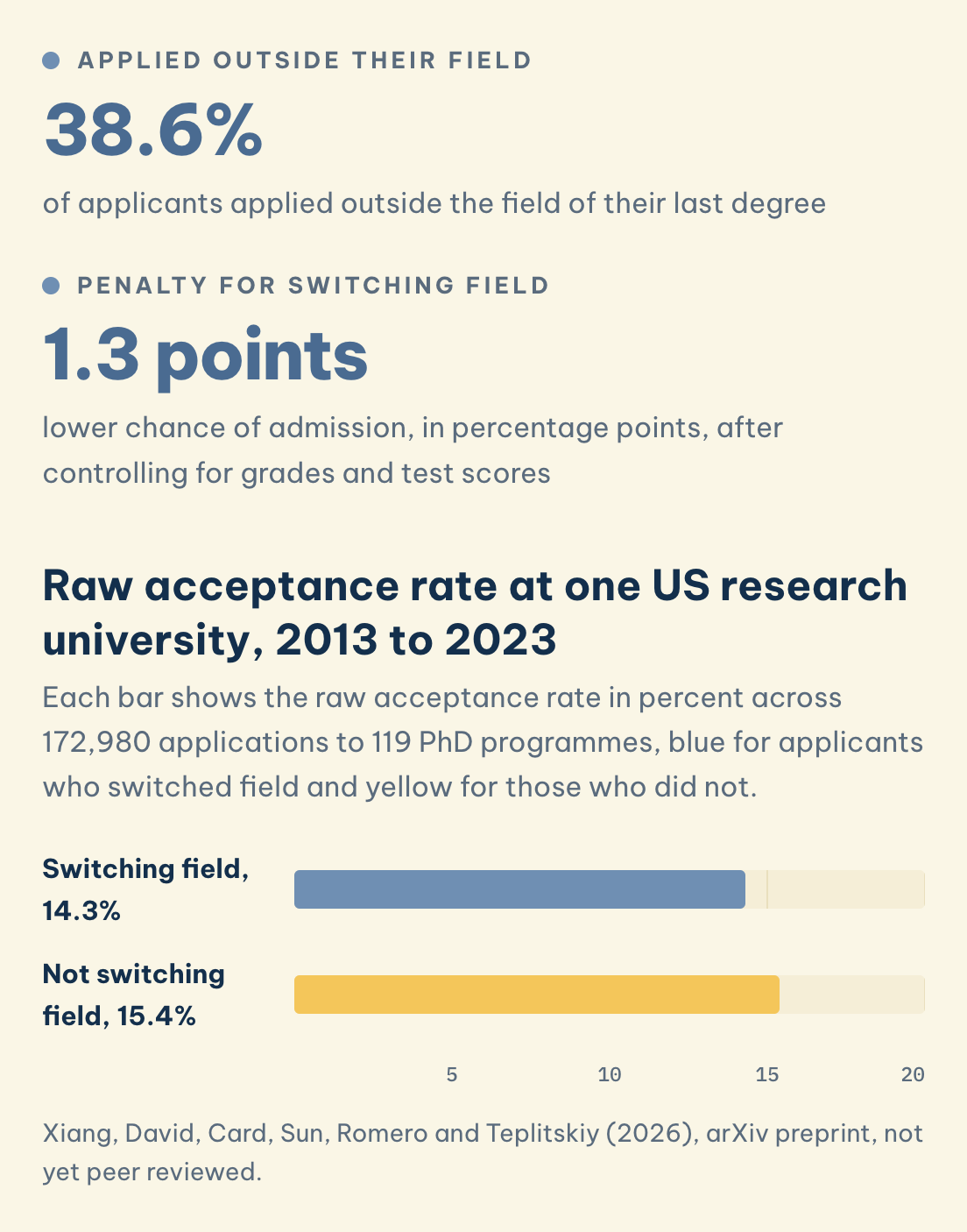
The study defines a pivot exactly the way entry rules read a file, by comparing the subject of the applicant's most recent prior degree with the subject of the target programme across 119 programmes and the application cycles from 2013 to 2023, after grouping 1,690 raw subject labels into 84 clusters (Xiang et al., 2026). Pivoting was common, since 38.6% of applicants applied outside the field of their last degree, and the raw acceptance rate was 14.3% for pivoters against 15.4% for non-pivoters (Xiang et al., 2026). Among 4,861 applicants who applied to several programmes in the same cycle, the same person was 1.7 percentage points less likely to be admitted to the programmes that represented a pivot, which the authors present as suggestive evidence that the switch itself carries the penalty (Xiang et al., 2026).
Two limits matter before these figures travel. The paper is an arXiv preprint dated 11 August 2026 in its current version and has not been peer reviewed, and all 172,980 applications come from a single American university, so the authors themselves note that smaller or less selective institutions may treat pivoters more leniently (Xiang et al., 2026). The authors put the penalty of 1.3 points at about 8% of the non-pivoter acceptance rate in relative terms, which is large enough to plan around and small enough that a switch of field is rarely the reason a strong file fails on its own.
◆ Question 4 / 6 · Cost after admission
Does a change of field still cost you after admission?
Direct answer: The study suggests it can. Among enrolled students, Xiang et al. (2026) estimated a graduation hazard ratio of 0.871 for pivoters, meaning they were 12.9% less likely to graduate at any given point, with no compensating advantage in publications or citations.
The graduation estimate comes from Cox proportional hazards models covering 9,506 enrolled students in the baseline model and 5,191 in the fully controlled model, where the hazard ratio of 0.871 means pivoters were 12.9% less likely to graduate by a given point, and the pivoters did not show the high-risk, high-reward pattern sometimes attributed to outsiders, since they were less likely to reach the top 20% of citations in their programme-year cohort (Xiang et al., 2026). The authors state plainly that they lack a credible causal design for outcomes after enrolment, so an unobserved trait, such as a weaker sense of disciplinary identity, could explain both the switch and the lower completion.
Qualitative research describes where that friction appears. Gardner et al. (2012) interviewed 18 doctoral students on a federally funded interdisciplinary sustainability project at one US university, where each student was expected to keep one home discipline while working with two advisors from two different disciplines, and the students "struggled to identify the line between mastery of one discipline and multiple disciplines" (Gardner et al., 2012, p. 383). A student who has moved field carries a milder version of the same problem: the home discipline is the new one, while the training sits in the old one.
◆ Question 5 / 6 · Reducing the cost
What reduces the cost of moving into a new field?
Direct answer: Visible contact with the target discipline before you apply. In the same dataset, having at least one recommender who publishes in the target field shrank the admissions penalty for pivoters from 1.9 to 0.6 percentage points, a reduction of about 68% (Xiang et al., 2026).
That recommender result, a fall in the penalty from 1.9 to 0.6 percentage points or about 68%, is the most practical figure in the study, because it describes something an applicant can build over one or two years. A recommender inside the target field implies that the applicant has already taken coursework or done research there, and it signals endorsement from someone the committee reads as an insider (Xiang et al., 2026). How that referee's letter should be supplied with evidence is covered in what a PhD referee needs from you; the point here is who the referee is.
Supervisor fit follows the same logic from the student's side. Gube et al. (2017) surveyed 87 doctoral students in an education faculty at a regional Australian university and received 28 responses, a 32.2% response rate, and 22 of those 28 respondents (78.6%) said that supervisor expertise aligned with their topic was important to their supervision experience. The authors summarise that "doctoral students nominate their supervisors on the basis of their discipline expertise" (Gube et al., 2017, p. 1). A candidate arriving from another field therefore needs a topic that a specialist in the new field can recognise, which is where narrowing a research direction by taking a side becomes the next step.
◆ Question 6 / 6 · Choosing a degree
So how should you choose a degree if a PhD is the goal?
Direct answer: Start from the doctoral end. Name 2 or 3 programmes you would realistically apply to, read which prior fields each one accepts, and choose the bachelor's or master's degree that keeps the most of those doors open, rather than a field that tops a general ranking.
A workable order takes 5 steps. First, write down the research question you care about as a plain sentence. Second, find 2 or 3 doctoral programmes that work on that question, in Vietnam, the United Kingdom or elsewhere. Third, copy each programme's accepted-field rule word for word, including routes such as Manchester's any-degree-plus-relevant-master's. Fourth, mark which of those rules your planned degree satisfies, and which would require a second degree or supplementary modules; at UEH, candidates admitted with a bachelor's degree must complete all master's-level modules of the doctoral specialisation except foreign language and thesis, inside a 48-month training period. Fifth, if your planned field does not match, plan research contact with the target field early enough to earn a referee there. If you are also weighing a professional doctorate, DBA vs PhD sets the two apart by research question.
The order also explains why the question has no universal answer. A student aiming at a PhD in Commercial Business at UEH can reach it through a master's in Marketing, while a student aiming at Economic Law cannot reach it through any economics degree. Candidates without a master's degree at all face a different set of rules, set out in PhD admission without a master's degree, and candidates worried about whether a taught master's counts will find that question in taught master's and PhD eligibility. Whether a doctorate fits the work you want at all is an earlier question, set out in what a PhD actually certifies. Applicants aiming at a professional doctorate in clinical psychology face a stricter entry check, which is explained in how to get a doctorate in clinical psychology in the UK or Australia.
If you want a second reader on whether your degree path actually matches the programmes you are aiming at, MAAS works with applicants as academic advisors: you read the entry rules, MAAS experts challenge the match between the two, and you approve every document and submit the application yourself. You can see the full pathway in our PhD application guide, and the scope of the advisory work in PhD supervisor search and application strategy.
Frequently asked questions
Is there a single best major for a future PhD?
No. Doctoral programmes check your degree against their own list of relevant fields, so a major that qualifies you for one programme can disqualify you for another, as the UEH table does for Commercial Business and Economic Law.
Can I do a PhD in a different field from my bachelor's degree?
Often yes, especially through a relevant master's degree. The University of Manchester accepts any 2:1 bachelor's degree for its PhD in Computer Science when the applicant also holds a Merit master's in a directly relevant discipline.
Does switching field lower my chance of admission?
In one large US dataset of 172,980 applications, pivoters were 1.3 percentage points less likely to be admitted after controls, according to a 2026 preprint that has not yet been peer reviewed and covers a single university.
How can I reduce the penalty for switching field?
Build contact with the target field before applying. In the same study, a recommender who publishes in the target discipline cut the admissions penalty from 1.9 to 0.6 percentage points.
Does Vietnam have a national list of relevant fields for doctoral admission?
No. Circular 53/2026/TT-BGDĐT hands the definition of relevant expertise to each institution, so the list you need is the one printed in the admissions announcement of the university you apply to.
Related MAAS guides
References
Gardner, S. K., Jansujwicz, J., Hutchins, K., Cline, B., & Levesque, V. (2012). Interdisciplinary doctoral student socialization. International Journal of Doctoral Studies, 7, 377-394. https://doi.org/10.28945/1743
Gube, J., Getenet, S., Satariyan, A., & Muhammad, Y. (2017). Towards "operating within" the field: Doctoral students' views of supervisors' discipline expertise. International Journal of Doctoral Studies, 12, 1-16. https://doi.org/10.28945/3641
Ministry of Education and Training. (2026). Circular 53/2026/TT-BGDĐT on the regulation for graduate admissions and training. Công báo, issue 447, 28 July 2026. https://congbao.chinhphu.vn/van-ban/thong-tu-so-53-2026-tt-bgddt-470098/67203.htm
Xiang, S., David, N., Card, D., Sun, W., Romero, D. M., & Teplitskiy, M. (2026). The costs of early-career disciplinary pivots: Evidence from Ph.D. admissions [Preprint]. arXiv. https://doi.org/10.48550/arXiv.2603.22805
Tools & resources
- University of Manchester, PhD Computer Science entry requirements: https://www.manchester.ac.uk/study/postgraduate-research/programmes/list/02954/phd-computer-science/
- University of Manchester, PhD/MPhil Neuroscience entry requirements: https://www.manchester.ac.uk/study/postgraduate-research/programmes/list/10947/phd-mphil-neuroscience/
- University of St Andrews, entry requirements for postgraduate research: https://www.st-andrews.ac.uk/study/postgraduate-research/entry/
- UEH, doctoral admissions announcement, first intake 2026: https://tuyensinh.ueh.edu.vn/bai-viet/ueh-thong-bao-tuyen-sinh-dao-tao-trinh-do-tien-si-dot-1-nam-2026-va-chuong-trinh-nghien-cuu-sinh-toan-thoi-gian-tai-ueh-tp-ho-chi-minh-va-ueh-mekong/
- UEH, applicant Q&A for doctoral candidates: https://hotro.ueh.edu.vn/bai-viet/q-a-nghien-cuu-sinh-tien-si-11892
A free 20-minute consultation is a conversation about your situation and whether your degree path matches the programmes you are aiming at.
Book a free consultation ▸