
◆ PhD application
Does a taught master's qualify you to apply for a PhD?
Usually yes, and the more useful observation is that the question is aimed at the wrong thing. It treats eligibility as a property of the label on your certificate, when the people who decide are reading something else: what you personally did inside that degree, and whether it can be talked about as research.
The distinction matters because of who ends up in this conversation. Applicants who ask whether a taught master's counts are, in most cases, already holding the evidence they think they lack. It is sitting in their transcript under a different name.

◆ Question 1 / 5 · What "taught" excludes
What does "taught" actually exclude?
Direct answer: Less than the word suggests, because a taught master's in the UK system normally contains a substantial supervised research project of its own, and it sits at Level 7 in the Framework for Higher Education Qualifications (FHEQ), one level below the doctorate it feeds into.
The UK sector groups master's degrees into three categories: research master's such as the MPhil, MLitt and MRes; specialised or advanced study master's; and professional or practice master's (Quality Assurance Agency for Higher Education, 2020). The second category is what most people mean by "taught". Of it, the same statement records that such courses are usually predominantly composed of structured learning opportunities, and that frequently at least a third of the course is devoted to a research project leading to a dissertation or comparable research output. For an MRes, at least half the course is commonly given over to research projects (Quality Assurance Agency for Higher Education, 2020).
A third of a master's degree is not a token exercise. It is a supervised piece of work with a question, a method, data of some kind, and a defence of what it concluded, which is a recognisable miniature of the thing a doctorate asks for over a longer horizon.
One qualification is worth stating plainly rather than glossing over, because it decides whether any of this applies to you. The same document is direct about the limit: "Most master's degrees include a research project, leading to the production of a dissertation or other output, but this is not the case in all master's" (Quality Assurance Agency for Higher Education, 2020, p. 8). "Most" is not "all". The check takes about 1 minute, and it is your own transcript, not a guide, that settles it.
◆ Question 2 / 5 · What is the answer
If the label is not the answer, what is?
Direct answer: Four specifics about that project, which is what a supervisor will ask for within the first few messages.
What a supervisor asks about your dissertation
Tap a question to see what it tests and where your answer comes from, in the order the post gives them.
Item 1 of 4
The topic
They ask what the dissertation was about, to test whether you can state a research question rather than a topic. Your answer comes from the question as you actually framed it, not the title.
Item 2 of 4
The method
They ask what method you used, to test whether you have handled a method end to end. Your answer comes from your methods chapter.
Item 3 of 4
The supervision
They ask who supervised it, and how closely, to test whether you have worked inside a supervisory relationship. Your answer comes from your own recollection, honestly reported.
Item 4 of 4
The marking
They ask how it was marked, as independent evidence of research capability. Your answer comes from the transcript, read as written rather than as remembered.
Save this figure
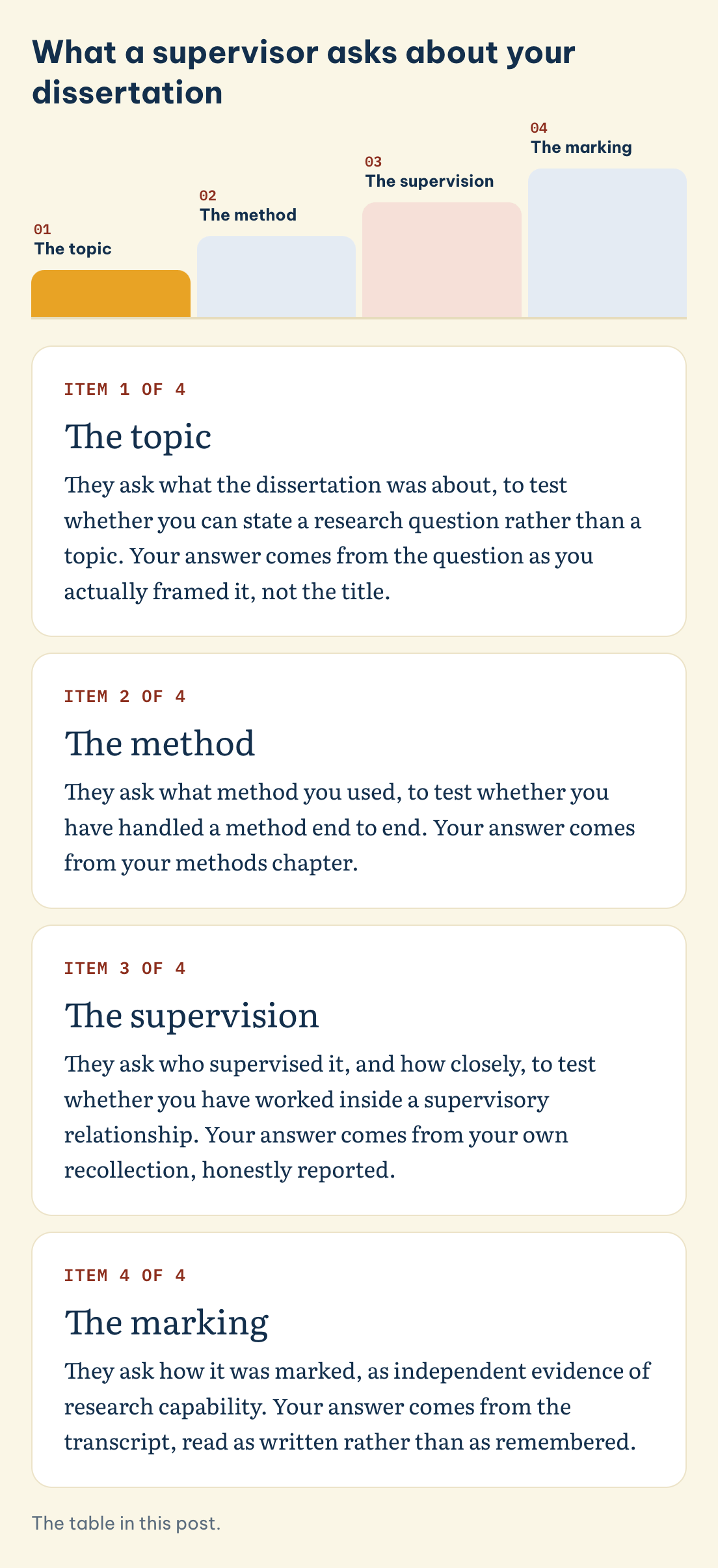
| What they ask | What they are testing | Where your answer comes from |
|---|---|---|
| What was the dissertation about | Whether you can state a research question rather than a topic | The question as you actually framed it, not the title |
| What method did you use | Whether you have handled a method end to end | Your methods chapter |
| Who supervised it, and how closely | Whether you have worked inside a supervisory relationship | Your own recollection, honestly reported |
| How was it marked | Independent evidence of research capability | The transcript, read as written rather than as remembered |
What counts as evidence of having worked inside a supervisory relationship overlaps with the skills mapped in Vitae's Researcher Development Framework (RDF), the standard UK reference for what independent researchers are expected to demonstrate, and the UK Council for Graduate Education (UKCGE) publishes separate guidance aimed at the supervisors themselves. Wisker (2012) makes the same point from the supervisor's side, arguing that what gets assessed in that first exchange is whether a structured, question-first conversation is even possible with you.
That last row is worth dwelling on, because applicants get it wrong in a consistent direction. In advisory casework it is far more common for someone to understate their own record than to inflate it, typically by reporting an overall figure while omitting a strong mark on the dissertation itself, which is the single most relevant number in the file for a research degree. That pattern is drawn from MAAS casework rather than from published research, so treat it as a prompt to reread your own documents rather than as a finding about applicants generally.
◆ Question 3 / 5 · Why it feels decisive
Why does the label feel decisive when it mostly is not?
Direct answer: Because a small number of visible cases genuinely do turn on it, and those are the cases people encounter in forums.
The concern is not irrational. Some funding schemes are written specifically around research master's qualifications, and some programmes state a preference for applicants who have completed one. In the UK, UK Research and Innovation (UKRI), established in 2018, funds a large share of studentships through Doctoral Training Partnerships (DTPs) and Centres for Doctoral Training (CDTs), delivered through its constituent councils such as the Economic and Social Research Council (ESRC), the Arts and Humanities Research Council (AHRC), the Engineering and Physical Sciences Research Council (EPSRC), or Research England, and it is these funder-specific rules, not a general convention, that occasionally require a research master's. Where that wording exists it is binding, and no amount of reframing changes it.
What the concern misjudges is where the sorting happens. Research on how doctoral supervisors engage with prospective applicants before formal admissions finds that a considerable amount of assessment occurs in this informal pre-application contact, well before a committee reads a file (Henderson et al., 2025). In that exchange nobody is holding your certificate. They are reading a message about a project and forming a view on whether they could supervise it, and the qualification appears only as background. Henderson et al. (2025) also flag the cost of that informality: because this contact happens before any formal process, applicants who do not know to write to a supervisor first can be screened out before they ever apply.
The reframing is therefore practical, not consoling. If the decisive conversation happens before formal eligibility is ever checked, time spent worrying about a category is time not spent on what that conversation is actually about.
A different question sits one step earlier: whether a master's is needed at all. Vietnamese regulation now admits good-classification bachelor's graduates who meet supplementary requirements on research output or work experience, which our guide to entering a PhD without a master's sets out.
◆ Question 4 / 5 · When it is not yet
When is the honest answer "not yet"?
Direct answer: When your master's genuinely contained no independent research component, which is a real situation in coursework-only systems rather than a hypothetical one.
Advance HE's annual Postgraduate Research Experience Survey (PRES) covers UK doctoral programmes and specifically tracks how well-prepared new starters felt for independent research, which is a useful frame for thinking about your own starting point. Some master's routes are built entirely from taught modules and examinations, with no dissertation at any point. This occurs in coursework master's degrees in several systems and in a number of domestic programmes. The Higher Education Statistics Agency (HESA) publishes sector-wide data on how postgraduate students are distributed across these routes, though the exact mix varies by discipline and institution, and if any of this describes yours then the gap is real and worth naming early rather than discovering at the shortlist stage.
The gap is also bridgeable, and the routes are ordinary. A research master's such as an MRes or MPhil is designed for exactly this position, and many UK doctoral students in fact start out registered as an MPhil before upgrading to PhD status after an initial period of roughly 9 to 18 months. So is a period of supervised research work, a conference paper, or a publication in progress, each of which produces the same thing the missing dissertation would have produced, which is evidence that you have carried a question through a method to a defensible conclusion. A doctorate is defined by the creation and interpretation of new knowledge through original research of a quality to satisfy peer review (Quality Assurance Agency for Higher Education, 2024). Trafford and Leshem (2008) frame that same standard from the candidate's side, arguing that a workable doctoral project has to be defensible at a viva from its earliest design rather than only once the writing is finished, and what an admissions reader wants is a reason to believe you can begin that. The dissertation is the usual reason. It is not the only one.
◆ Question 5 / 5 · This week
What is worth doing this week?
Direct answer: Convert your dissertation from a line on a transcript into two sentences you can send to a stranger.
Open the document and write down the research question as you would put it now, then the method in one sentence, in the vocabulary of the field rather than the vocabulary of the coursework. Most people find that this takes longer than expected, and the difficulty is itself informative, because a project you cannot summarise in two sentences is a project you will struggle to reference in an approach to a professor.
Then check the transcript for the mark on that component specifically, separately from the overall classification. If it is strong, it belongs in the first paragraph of any approach you send. If it is modest, that is worth knowing before you build a strategy that leans on it.
This week's work requires no decision about which system to target, which is why it is the right work to do first. It is the same preparation whichever direction the shortlist eventually goes.
Frequently asked questions
My master's was taught but the dissertation was small, perhaps 8,000 words. Does that still count?
It counts as a supervised research project, and length is not the measure a reader applies. What is examined is whether the question was yours, whether the method was appropriate, and whether you can discuss its limitations. A short project handled well reads better than a long one you cannot account for.
Would doing an MRes first make me a stronger applicant?
It can, and it is a genuine cost. It is the right move when your master's contained no research component at all, and rarely the right move when it did, because in that case you would be buying evidence you already possess. The decision turns on what is actually in your transcript.
My master's is from a system where coursework degrees are common. Will a reader know the difference?
Not automatically, which is why you should say it rather than assume it. State that the degree included a supervised dissertation, give the topic and method, and remove the ambiguity yourself instead of leaving a reader to guess at an unfamiliar system.
Does a professional or practice master's count?
It depends on whether it contained an independent research element, which varies by programme. Read your own course structure first, and where it is unclear, ask the department directly rather than inferring from the degree title.
How long before someone can look at my case with me?
Within 48 hours when our network already covers that field. If it does not, MAAS opens a dedicated recruitment round for your case, which usually takes about 2 weeks. About 23% of the MAAS mentor network holds a doctorate, so a supervisor-level read on your dissertation is usually available rather than only a general admissions read.
Related MAAS guides
- Is there a PhD programme with lower entry requirements? for how a published minimum differs from fit
- Why does a PhD offer hinge on your lowest IELTS band? for the other requirement that is read per component
- Do you need the GMAT or GRE for a PhD? for how admissions tests behave at doctoral level
- Can you just email the professor yourself? for what that first approach actually costs
- PhD application guide for admissions systems and contact order
- PhD Application Strategy and Execution for what an engagement covers
References
Henderson, E. F., Akkad, A., Kier-Byfield, S., Burford, J., & Dangeni. (2025). Seeking supervisability: The inclusivity implications of doctoral supervisors' engagement with prospective applicants prior to formal admissions. Research Papers in Education, 40(2), 167-187. https://doi.org/10.1080/02671522.2024.2349989
Quality Assurance Agency for Higher Education. (2020). Characteristics statement: Master's degree. https://www.qaa.ac.uk/en/the-quality-code/characteristics-statements/characteristics-statement-masters-degrees
Quality Assurance Agency for Higher Education. (2024). The frameworks for higher education qualifications of UK degree-awarding bodies (2nd ed.). https://www.qaa.ac.uk/docs/qaa/quality-code/the-frameworks-for-higher-education-qualifications-of-uk-degree-awarding-bodies-2024.pdf
Trafford, V., & Leshem, S. (2008). Stepping stones to achieving your doctorate: By focusing on your viva from the start. McGraw-Hill/Open University Press.
Wisker, G. (2012). The good supervisor: Supervising postgraduate and undergraduate research for doctoral completion (2nd ed.). Palgrave Macmillan.
A free 20-minute consultation with a MAAS adviser, to read your dissertation and transcript together and plan what you will say to a supervisor. You write and send every message yourself.
Book Free Discovery ▸