
◆ PhD Admissions
PhD in Law, JD or SJD: which law doctorate do you need?
Category: admissions
Last updated: 2026-10-20
Search for a doctorate in law and three sets of letters come back almost at once: PhD (or DPhil at Oxford), JD and SJD. They sit in the same results and look like three rungs of one ladder, so many applicants assume that a JD is the first rung, an SJD the second and a PhD the sort of thing you do in Britain. That reading is wrong in almost every part. The three titles belong to three different kinds of programme, and the confusion can cost applicants time, because they plan an application for a degree that was never meant for them.
Direct answer: A PhD or DPhil in Law is a research degree built around a thesis of roughly 75,000 to 100,000 words. A JD is a professional law degree for practice, and in Australia it is not a doctorate at all. An SJD is an American research doctorate aimed at future legal academics.
◆ Question 1 / 6 · What is a PhD in Law
What is a PhD in Law, and what does it ask of you?
Direct answer: A PhD in Law is a research degree in which you write a long thesis that makes an original contribution to the field. Melbourne sets the thesis at 80,000 to 100,000 words, and Oxford, which calls its degree a DPhil, sets it at 75,000 to 100,000 words.
The Australian Qualifications Framework Council (2013) describes the Doctoral Degree as the qualification that "qualifies individuals who apply a substantial body of knowledge to research, investigate and develop new knowledge, in one or more fields of investigation, scholarship or professional practice". The same framework names two forms: a Doctoral Degree (Research), which is typically the PhD, and a Doctoral Degree (Professional), which is typically a "Doctor of [field]". Research is the defining characteristic of all doctoral degrees in the framework, and the typical volume of learning is 3 to 4 years at level 10 (Australian Qualifications Framework Council, 2013).
Two universities show what this looks like in law. The University of Melbourne (n.d.) lists its Doctor of Philosophy in Law as up to 4 years full time or 8 years part time, with a thesis of 80,000 to 100,000 words that makes an original and substantial contribution to knowledge of law, at AQF level 10. The University of Oxford Faculty of Law (n.d.) describes the DPhil in Law in a similar way: a thesis of 75,000 to 100,000 words that makes a "significant and substantial contribution to its field", taken over 3 to 4 years full time or 6 to 8 years part time. Oxford admits students first as Probationer Research Students, and the first two terms include a Course in Legal Research Method (University of Oxford Faculty of Law, n.d.).
Notice what is missing from both descriptions. Neither programme teaches you to practise law, and neither is a taught course with a fixed set of units. You arrive with a research question, and the thesis is the programme. Students who studied law in a structured curriculum may find this a large adjustment, because the doctorate is judged on the argument you build alone rather than on how much of a syllabus you cover.
◆ Question 2 / 6 · Is a JD a doctorate
Is a JD a doctorate?
Direct answer: Not in Australia, where the framework says so in writing. The Australian Qualifications Framework Council (2013, p. 72) states: "The use of the qualification title 'Juris Doctor' is permitted for a Masters Degree (Extended) for legal practice." The title is allowed, but the qualification is a master's.
The wording matters because the letters "Doctor" in the title lead people to file the JD with the research doctorates. The framework closes that door in the same section on qualification titles, where it says the qualification "may not be referred to as a Doctoral Degree in any written, oral or electronic information" (Australian Qualifications Framework Council, 2013, p. 72). An Australian JD is therefore a professional route into legal practice that carries a doctor-style title, and it sits at master's level.
The framework is not a dead document either. The Australian Qualifications Framework Council (2024) issued Addendum No. 5 to the Second Edition, and that addendum amends a note to the noted exceptions on page 72, which is the page that carries the JD exception. The list of exceptions is still being maintained, so the rule is not a historical leftover.
The American picture is described through its accreditor. The American Bar Association Section of Legal Education and Admissions to the Bar (2023) records, in a memo on recommended revisions, that Standard 311(a) requires a JD programme to include not fewer than 83 credit hours, with at least 64 of them in regularly scheduled classroom or direct faculty instruction. That is a description of a taught professional programme measured in credits, and it has nothing in common with a thesis of 80,000 words. The same memo proposed deleting the time limits that sat alongside that standard, so this guide does not quote them as current.
Put simply, the JD answers the question "how do I become a lawyer?" and the PhD answers "what new thing can I show about the law?". If your goal is a research career, a JD does not replace a PhD, and for an Australian-trained candidate it should not be described as a doctorate when you write your application.
◆ Question 3 / 6 · What an SJD is
What is an SJD, and who actually gets in?
Direct answer: An SJD is the research doctorate offered by some American law schools, and at Harvard it is the most advanced law degree, designed for aspiring legal academics (Harvard Law School, n.d.-a). Entry is small: the school's admissions page puts the intake at roughly a dozen a year (Harvard Law School, n.d.-b).
Harvard Law School (n.d.-b) sets out the route in plain terms. Applicants should ordinarily have completed the Harvard LL.M. first, and those without an LL.M. from Harvard or another leading US law school "are virtually never admitted". The school expects prior law degrees earned with distinction, and the LL.M. includes a 50-page LL.M. Paper.
Once admitted, the work is closer to a PhD than to a JD. The dissertation is usually completed within three years of the oral exam, and the majority run to approximately 250 to 300 pages, in the form of a monograph or at least three related essays plus a synthesizing essay (Harvard Law School, n.d.-a).
Two practical points follow. First, the SJD is not a shortcut around the PhD: it is another way to a research doctorate, with its own gate, and the gate is narrow. With only 10 to 12 places a year, it is worth reading the admissions page twice before you plan around it. Second, an SJD at Harvard ordinarily follows the Harvard LL.M., so applicants who hope to apply straight from a first law degree should read "ordinarily" as a strong signal.
◆ Question 4 / 6 · Entry compared
How do the entry requirements compare?
Direct answer: Oxford asks for a first-class law degree or a distinction-level master's, Harvard asks for a Harvard LL.M. or an equivalent from a leading US law school, and Melbourne publishes a course structure and a thesis range. The three sit in very different places, so compare them rule by rule.
Oxford is the most explicit. The University of Oxford (n.d.) sets the minimum as a first-class undergraduate honours degree in law (exceptionally, other subjects) or a postgraduate diploma or master's in law at distinction. Most admitted applicants have a master's, though it is not a formal requirement. The application includes a research proposal of 600 to 1,000 words and written work of a maximum of 2,000 words on a legal topic, and the University of Oxford (n.d.) says the finished thesis is examined by two examiners in an oral examination, the viva. The deadline for 2027-28 entry is 27 January 2027, and the DPhil thesis must not exceed 100,000 words including footnotes.
Melbourne's published course page concentrates on structure: up to four years full time or eight part time, a thesis of 80,000 to 100,000 words and AQF level 10 (University of Melbourne, n.d.). It gives you the shape of the degree, and you should check the faculty's own research degree pages for the admission conditions that apply to you, since this guide has not verified them.
Harvard's SJD, as the section above showed, filters first on the LL.M. and the LL.M. Paper (Harvard Law School, n.d.-b). The table below puts the three degrees side by side using only the facts quoted in this guide.
| PhD / DPhil in Law | JD | SJD | |
|---|---|---|---|
| Purpose | Research degree: original contribution to knowledge of law | Professional law degree for legal practice | Research doctorate for aspiring legal academics (Harvard) |
| Is it a doctorate? | Yes, AQF level 10 (Melbourne) | Not in Australia: a Masters Degree (Extended) per AQF p. 72 | Yes, described by Harvard as the most advanced law degree |
| Typical length | Melbourne: up to 4 years full time, 8 part time. Oxford: 3 to 4 full time, 6 to 8 part time | Measured in credits in the US: not fewer than 83 (ABA Standard 311(a)) | Dissertation usually within three years of the oral exam (Harvard) |
| Entry | Oxford: first-class law degree or distinction-level master's, proposal, written work | Set by each law school and not covered in this guide | Ordinarily a Harvard LL.M. first, with prior law degrees at distinction |
| Output | Thesis of 75,000 to 100,000 words (Oxford) or 80,000 to 100,000 words (Melbourne) | Qualification to enter legal practice | Dissertation of about 250 to 300 pages, or three related essays plus a synthesizing essay |
Harvard SJD
250 to 300 pages
the length most dissertations reach, with no prescribed limit
US JD
83 credits
the minimum course of study under ABA Standard 311(a), with no thesis
Length of each law degree's main requirement
Each bar shows the thesis word range in thousands of words, blue for the Oxford DPhil in Law and yellow for the Melbourne PhD in Law.
Save this figure
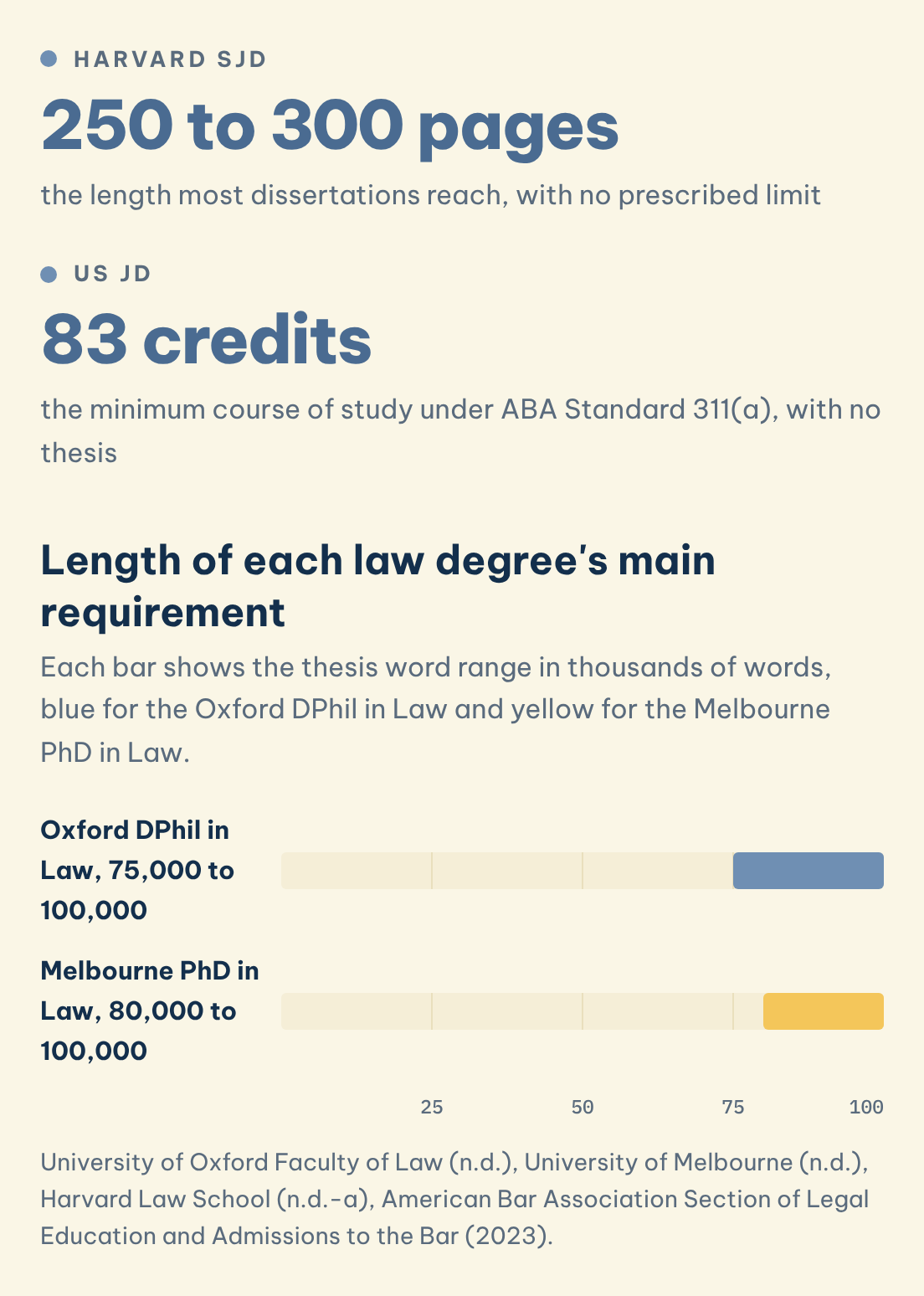
The pattern in the table is that two columns describe research and one describes training. If you read the JD column as another doctorate, your plan for the next two years will be built on the wrong degree.
◆ Question 5 / 6 · Practice or academia
Which one fits your goal: practice or academia?
Direct answer: Choose the JD route if the goal is to practise as a lawyer, and a PhD, DPhil or SJD if the goal is to produce research and teach. The AQF classes the Australian JD as a master's degree for legal practice, while Harvard describes the SJD as being for aspiring legal academics.
Start from the job you want in ten years and work back. A candidate who wants to advise clients, appear in court or work inside a firm is asking for a professional qualification, and the sources above place the JD there. A candidate who wants to hold a lectureship, write for law reviews and supervise students is asking for a research doctorate, and the PhD or DPhil in Law, or at Harvard the SJD, is built for that.
Two situations deserve a second look. The first is the candidate who holds a law degree from Vietnam and wonders whether a JD abroad would "upgrade" it to a doctorate. In Australia the framework answers that directly: it would not, because the Juris Doctor is a Masters Degree (Extended) for legal practice (Australian Qualifications Framework Council, 2013, p. 72). The second is the candidate who already practises and wants to move into research. That person does not need to repeat a professional degree, and the better question is whether the master's they hold satisfies a target programme's rule. Oxford, for example, accepts a distinction-level master's in law in place of a first-class degree (University of Oxford, n.d.), and our guide to taught master's and PhD eligibility explains how that kind of rule is read.
If you are still deciding whether a research doctorate suits the work you want, which degree you should study for a PhD sets out how admissions offices match your earlier degrees against their own list, and how long a PhD programme takes covers the time commitment in more detail. Professional doctorates in other fields are covered in DBA vs PhD, which makes a similar split between practice and research.
◆ Question 6 / 6 · Before you apply
What should you prepare before you apply?
Direct answer: Prepare a research proposal, a short sample of legal writing and a clear reason for choosing the programme. Oxford asks for a proposal of 600 to 1,000 words and written work of up to 2,000 words, so drafting both early gives you time to refine them.
A workable order has five steps. First, decide whether you want practice or research, using the table above. Second, if the answer is research, write the question you want to answer in one plain sentence and test it against what each target programme already supports. Third, read each programme's entry rule word for word: the Oxford rule, the Harvard rule and the Melbourne structure differ enough that one document cannot serve all three. Fourth, check the deadline, since Oxford's 27 January 2027 date for 2027-28 entry is worth planning around early, since references and written work take time to collect. Fifth, give the proposal and the writing sample to a reader who has never seen them, because both are judged by strangers.
Applicants from Vietnam may need a sixth step: reading the English-language rule against the qualification they hold, and working out what a Vietnamese law degree or master's corresponds to for a given university. Where a university has not published that mapping, the safest move is to ask the admissions office before you pay a fee.
If you want a second reader on whether your qualifications, proposal and documents match the programmes you are targeting, MAAS offers expert advisory support: the advisors plan the application with you and draft the documents, and you approve every document and submit the application yourself. You can read the full pathway in our PhD application guide, and the scope of the advisory work in PhD Application Strategy. If your situation involves no master's degree at all, the guide to PhD admission without a master's degree covers that case.
Frequently asked questions
Is a JD a doctorate?
Not in Australia. The Australian Qualifications Framework Council (2013, p. 72) allows the title "Juris Doctor" for a Masters Degree (Extended) for legal practice and says the qualification may not be described as a Doctoral Degree.
What is the difference between a PhD in Law and an SJD?
Both are research doctorates. The PhD or DPhil is offered by universities such as Melbourne and Oxford and centres on a thesis of 75,000 to 100,000 words (University of Oxford Faculty of Law, n.d.; University of Melbourne, n.d.), while Harvard's SJD is described as the most advanced law degree for aspiring legal academics and ordinarily follows a Harvard LL.M.
How many people does Harvard admit to the SJD each year?
Harvard Law School (n.d.-b) says it admits approximately 10 to 12 applicants per year, and applicants without an LL.M. from Harvard or another leading US law school are virtually never admitted.
How long is a PhD in Law?
Melbourne lists up to 4 years full time or 8 years part time, and Oxford lists 3 to 4 years full time or 6 to 8 years part time (University of Melbourne, n.d.; University of Oxford Faculty of Law, n.d.).
What does Oxford require for the DPhil in Law?
A first-class undergraduate law degree or a postgraduate diploma or master's in law at distinction, a research proposal of 600 to 1,000 words and written work of a maximum of 2,000 words (University of Oxford, n.d.).
Can a Vietnamese law graduate apply directly for a research doctorate in law?
It depends on the programme's own entry rule. The sources in this guide set out the rules for Oxford and Harvard, and a Vietnamese applicant should compare their degree and grades with that exact wording and ask the admissions office where the rule is silent.
Related MAAS guides
References
American Bar Association Section of Legal Education and Admissions to the Bar. (2023). Memo on recommended revisions for notice and comment (Standards Committee, August 2023). https://www.americanbar.org/content/dam/aba/administrative/legal_education_and_admissions_to_the_bar/council_reports_and_resolutions/aug23/23-aug-sc-memo-recommended-revisions-for-notice-and-comment.pdf
Australian Qualifications Framework Council. (2013). Australian Qualifications Framework (2nd ed.). https://www.aqf.edu.au/download/405/aqf-second-edition/3/aqf-second-edition/pdf
Australian Qualifications Framework Council. (2024). Addendum No. 5 to the AQF Second Edition January 2013. https://www.aqf.edu.au/download/454/addendum-no-5-aqf-second-edition-january-2013/60/document/pdf
Harvard Law School. (n.d.-a). Graduate program handbook: Academics, S.J.D. candidates. https://hls.harvard.edu/graduate-program/gphandbook/academics-sjd-candidates/
Harvard Law School. (n.d.-b). S.J.D. admissions. https://hls.harvard.edu/graduate-program/graduate-program-admissions-and-financial-aid/s-j-d-admissions/
University of Melbourne. (n.d.). Doctor of Philosophy - Law (DR-PHILLAW). https://study.unimelb.edu.au/find/courses/graduate/doctor-of-philosophy-law/structure/
University of Oxford. (n.d.). DPhil in Law: Graduate admissions. https://www.ox.ac.uk/admissions/graduate/courses/dphil-law
University of Oxford Faculty of Law. (n.d.). DPhil in Law. https://www.law.ox.ac.uk/content/course/dphil-law
Tools & resources
- University of Oxford Faculty of Law, DPhil in Law: https://www.law.ox.ac.uk/content/course/dphil-law
- University of Oxford, DPhil in Law graduate admissions: https://www.ox.ac.uk/admissions/graduate/courses/dphil-law
- Harvard Law School, S.J.D. admissions: https://hls.harvard.edu/graduate-program/graduate-program-admissions-and-financial-aid/s-j-d-admissions/
- University of Melbourne, Doctor of Philosophy - Law: https://study.unimelb.edu.au/find/courses/graduate/doctor-of-philosophy-law/structure/
- Australian Qualifications Framework, Second Edition: https://www.aqf.edu.au/download/405/aqf-second-edition/3/aqf-second-edition/pdf
Not sure how this guide applies to your own case? Talk it through with MAAS in a free 20-minute consultation.
Book a free consultation ▸