
◆ PhD Admissions
What is the difference between a DBA and a PhD?
Category: admissions
Last updated: 2026-09-28

A Doctor of Business Administration (DBA) and a PhD in business are both doctorates, and the usual way of telling them apart is that one is applied and the other is theoretical. That line does not survive a look at the theses themselves. The difference that holds up is where the research question comes from and what the examiners are allowed to accept as the contribution, and at some universities even that second part is written into the same regulation for both degrees.
Direct answer: A DBA is a professional doctorate for experienced managers whose research question usually starts inside their own organisation or profession. A PhD starts from a gap in the academic literature. Both are examined at doctoral level, usually with a thesis and a viva. The contribution a DBA may claim is to practice as well as to knowledge.
Asked on 28 September 2026, both the Bing AI answer and ChatGPT in guest mode described the split as practical versus theoretical research. ChatGPT added that the two overlap substantially and depend on the programme. The overlap is the more accurate half, and it is measurable.
◆ Section 1 / 8 · DBA versus PhD
Is the difference between a DBA and a PhD applied versus theoretical research?
Direct answer: Not on the evidence of the theses. MacLennan, Piña and Gibbons (2018) compared 147 DBA and 151 PhD dissertations in business and found no significant difference in methodology, sample size or research type, applied or basic. The only significant difference they report concerns how many PhD and DBA dissertations came from R1-classified research universities.
The same research group had earlier compared the curricula, accreditation and faculty qualifications of DBA and PhD programmes, and MacLennan et al. (2018) report that none of that work supported a theoretical difference between the two degrees either. The 2018 study then went to the output itself, 147 DBA and 151 PhD dissertations, and again found no separation on the three variables a reader would expect to differ if one degree were applied and the other theoretical. The classification of each dissertation as applied or basic research did not correlate with the degree it was written for.
That result does not mean the degrees are identical. It means the label on the degree predicts less about the thesis than it is usually assumed to, and the one variable that did differ was the kind of university the thesis came from. A DBA written at an R1 business school may look very like a PhD, and a PhD written inside a company partnership may look very like a DBA. For someone choosing between them, the practical consequence is that "I want to do applied research" is not by itself a reason to pick either one, because both can accommodate it.
◆ Section 2 / 8 · Where a DBA question comes from
Where does the research question of a DBA come from?
Direct answer: From the candidate's own profession or organisation. The Quality Assurance Agency for Higher Education (QAA) says research projects in professional doctorates are normally located within the candidate's profession or practice, and that the candidate's research may directly produce organisational or policy change. A PhD question is normally framed first as a gap in the literature.
The QAA (2020, p. 8) places the DBA in its third category of doctorates, professional and practice-based, and describes their purpose in one sentence: they "provide an opportunity for individuals to situate professional knowledge developed over time in a theoretical academic framework". The direction of travel in that sentence is the whole difference. A PhD candidate usually reads into a field until a gap appears and then designs a study to fill it. A DBA candidate usually starts with a problem they already know from years of work and then has to locate it in the literature well enough that examiners accept it as more than a consultancy report.
Perry and Cavaye (2004), writing about Australian programmes, put the same contrast in terms of research domain: the domain of a DBA dissertation is management practice, while the PhD's is the academic literature. Foster et al. (2024), who interviewed 36 DBA students and alumni, describe DBA candidates as practitioners working at a senior level who want to investigate a work-based problem through doctoral research. The QAA (2020, p. 9) adds the consequence that most distinguishes the professional route: completing the degree normally leads to professional or organisational change that is often direct, rather than achieved through the implementation of subsequent research findings.
◆ Section 3 / 8 · How a DBA is examined
Is a DBA examined differently from a PhD?
Direct answer: Often less differently than the programme brochures suggest. Perry and Cavaye (2004) found that 4 of 6 Australian universities with DBA graduates used the same examination forms for both degrees. At Sheffield Hallam University one regulation, R1.5, sets the award objectives for every doctorate and adds one clause for professional doctorates.
Sheffield Hallam's Research Degree Regulations, revised in September 2024, state that a doctorate is awarded to a candidate who has critically investigated and evaluated an approved topic, "resulting in an independent and original contribution to knowledge, and/or professional practice for Professional Doctorate candidates" (Sheffield Hallam University, 2024, p. 4). When examiners indicate in their preliminary reports whether a thesis provisionally meets the degree requirements, regulation R14.1 points them to R1.4 and to that same R1.5 for every doctorate (Sheffield Hallam University, 2024, p. 27). The words "and/or professional practice" are the formal difference: a DBA candidate may claim a contribution to practice, while a PhD candidate's contribution has to be to knowledge. Checked on 28 September 2026.
Of the 6 Australian universities they examined, Curtin's form stated that professional doctorates were subject to the same criteria as the PhD thesis, while USQ and Swinburne had written separate DBA forms. The QAA (2020, p. 9) confirms that professional doctorates in the United Kingdom are assessed through a thesis or portfolio and, in the vast majority of cases, an oral examination, and that, as for the PhD, examiners' criteria may include how well the candidate understands current techniques in the subject and how research methods inform professional practice. Before applying, ask to see the examiners' report form for the DBA you are considering, because that document, not the brochure, tells you what your thesis will be judged on.
◆ Section 4 / 8 · Thesis length
Is a DBA thesis shorter than a PhD thesis?
Direct answer: Usually somewhat, though the gap is smaller than people expect. Sheffield Hallam sets a maximum of 70,000 words for a monograph DBA thesis and 80,000 for a monograph PhD. Perry and Cavaye (2004) reported DBA dissertations of about 50,000 words at Southern Cross University and a minimum of 45,000 at Swinburne.
Article-based DBA
35,000 words
plus published material expected to add a further 17,500 to 35,000 words
Article-based PhD
40,000 words
plus 20,000 to 40,000 words of publications
Sheffield Hallam word limits for a DBA and a PhD thesis
The bars show the maximum for a monograph thesis. The cards show the article-based format.
Save this figure
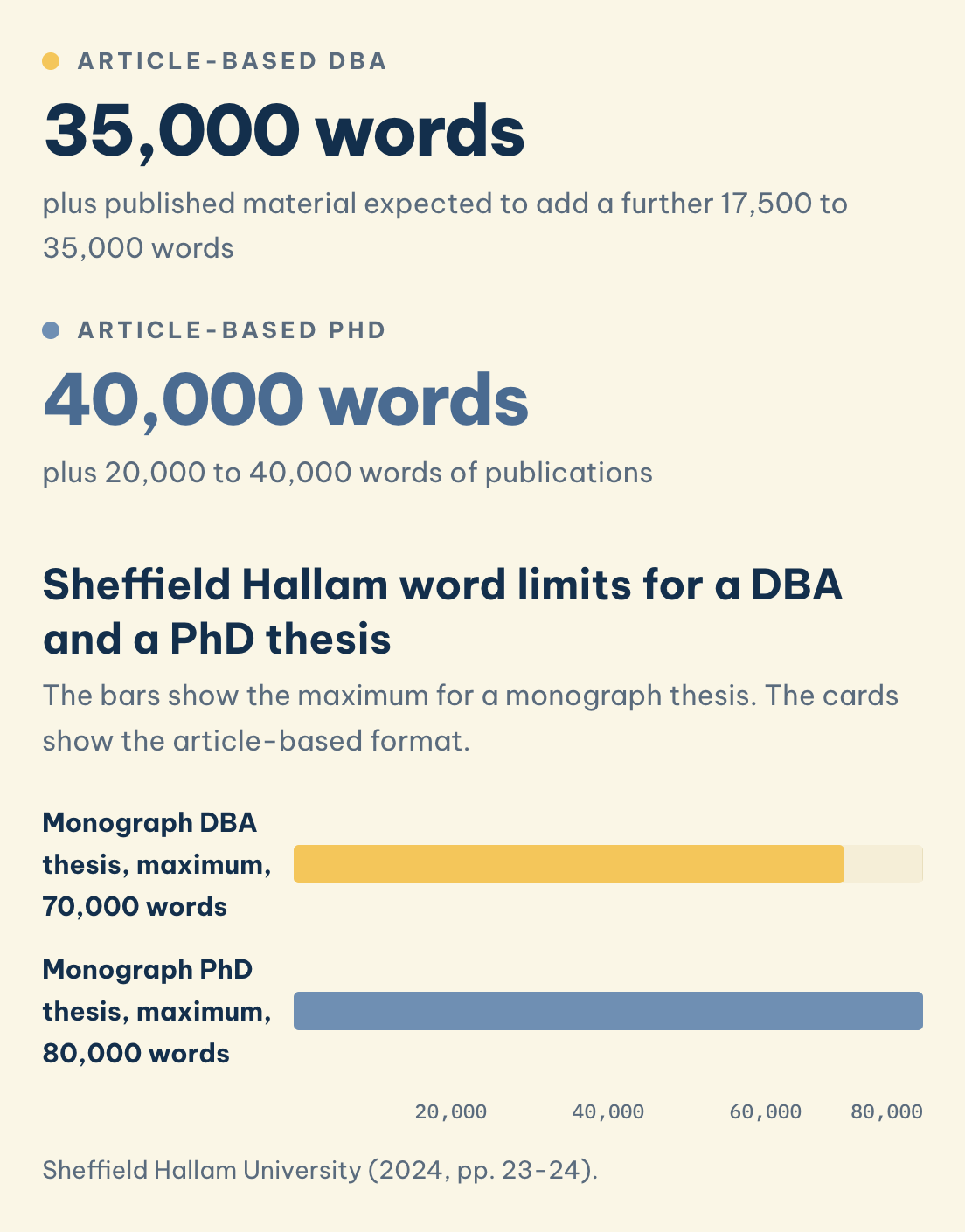
The Sheffield Hallam limits of 70,000 words for the DBA and 80,000 for the PhD come from regulation R12.9, which counts references and citations inside the main text and sets no minimum (Sheffield Hallam University, 2024, p. 23). The same table, continuing on the next page, allows an article-based DBA of 35,000 words plus published material expected to add a further 17,500 to 35,000 words, against 40,000 words plus 20,000 to 40,000 of publications for an article-based PhD (Sheffield Hallam University, 2024, pp. 23-24). The ratio between the two degrees stays close to 7 to 8 in both formats.
Perry and Cavaye (2004) concluded that length was not an important difference, since a DBA dissertation, about 50,000 words at Southern Cross and at least 45,000 at Swinburne, often ran past its usual length and a PhD thesis could be well under its maximum of about 100,000 words. The QAA (2020, p. 15) makes the general point for all doctorates: a discursive thesis may run to 100,000 words and a mathematics thesis may be short, and "such variations do not indicate different levels of achievement". What a DBA dissertation usually spends fewer words on is the literature and methodology chapters. Perry and Cavaye (2004) recommended that those chapters may be less extensive than in a PhD, and that implications for managers take a prominent place in the final chapter.
◆ Section 5 / 8 · Time and working
How long does a DBA take, and can you do it while working?
Direct answer: A DBA is normally designed for part-time study alongside a job, and it is not a short route. At Sheffield Hallam the DBA is listed as part-time only, and the confirmation of doctorate, the formal check that a project can reach doctoral standard, falls between month 24 and month 28 of registration.
Regulation R8.2 at Sheffield Hallam sets the window for a first confirmation attempt at 12 to 15 months for a full-time PhD, 24 to 27 months for a part-time PhD, and 24 to 28 months for a part-time DBA (Sheffield Hallam University, 2024, p. 15). A DBA candidate who misses that window is referred automatically and must apply within 34 months of starting, under regulation R8.4 (Sheffield Hallam University, 2024, p. 16). The confirmation is where the university decides whether the candidate continues on the doctorate at all, so a DBA's first two years are spent reaching that decision, not completing the degree. The QAA (2020, p. 9) also notes that professional doctorates usually contain taught elements with significant lecture and seminar content, while the award itself rests on a supervised research project, so the taught part is a further component of the programme rather than a substitute for the research.
When a programme is advertised as finishing in two years, read its regulations for where the confirmation, the thesis submission and the viva fall. Those three dates tell you more about the real length than the headline figure, and they are set by the awarding university, not by the recruiter.
◆ Section 6 / 8 · What you need to apply
What do you need to apply for a DBA compared with a PhD?
Direct answer: A DBA usually asks for a master's degree, often an MBA, plus significant managerial or professional experience. PhD entry commonly rests on research preparation, such as an honours or research degree, with no work experience required. A master's degree in another field can trigger extra MBA-level coursework for DBA entry.
Perry and Cavaye (2004) described Australian DBA entry as requiring an MBA or equivalent and significant management experience, with applicants holding a master's in a non-management field usually asked to complete several MBA-level subjects first, and some universities, Swinburne among them, not accepting an Honours degree as the basis for entry at all. PhD entry in the same universities, by contrast, usually required only an honours award and no work experience of any kind (Perry & Cavaye, 2004). The QAA (2020, p. 8) calls professional doctorates "often post-experience qualifications" and frequently the doctoral degree of choice for mid-career professionals. The experience requirement is therefore not a formality: the candidate's professional context is where the research question will come from, so a DBA proposal without a real organisational problem behind it is missing its starting point.
For a PhD the equivalent starting point is the literature, and the proposal has to show that you have read a field closely enough to name what is missing. The PhD application resource hub explains how PhD admission panels read that proposal and how the routes differ by country.
◆ Section 7 / 8 · The same topic
Can the same research topic work for a DBA or a PhD?
Direct answer: Often yes, but it will be framed differently. The same organisational problem can support either degree. As a DBA, the question asks what should change in practice and why. As a PhD, it asks what the case reveals that current theory does not explain. The framing decides which examiners' criteria you will meet.
Take a retail chain losing its store managers in their second year. As a DBA project, the manager who faces that problem studies it inside the organisation, and the contribution claimed is a tested change to how the chain selects or supports managers, together with what other firms can take from it. As a PhD project, the same attrition data becomes a case for testing or extending a theory of managerial turnover, and the contribution claimed is to that theory. Perry and Cavaye (2004) describe exactly this boundary when they say a DBA dissertation must still place the problem in the academic literature and draw implications for managers in other firms, which is what separates it from a consultant's report on one company.
Moving between the two degrees after enrolment is a question for the regulations of the specific university, since each degree has its own registration and confirmation rules; at Sheffield Hallam they sit in separate rows of the same timetable (Sheffield Hallam University, 2024, p. 15). Deciding the framing before you apply is cheaper than changing it at confirmation.
◆ Section 8 / 8 · Choosing between them
Choosing between them before you apply
Start from the question, not the title. If your research question already exists inside your work and you want the result to change that work, the DBA's allowance for a contribution to practice fits it. If the question comes from what you have read and you want the result to change what a field knows, a PhD fits it. Then read the regulations and the examiners' form of the programmes on your list, because the difference between the two degrees is written there, sometimes in a single clause.
When the next step is turning a professional problem into a doctoral research question, MAAS works with you through PhD application strategy: your expert drafts the proposal from your own account of your research, you review, edit and approve it and attend the interviews, and the expert challenges the question, the design and the fit with the programme you are applying to. Where our network already includes a suitable expert we introduce them within 48 hours, and where it does not we open a dedicated search, which usually takes about two weeks.
References
Foster, C., Kirk, S., Kougiannou, N. K., & Scurry, T. (2024). Mind the gap: DBA students, knowledge generation, transfer and impact. Studies in Higher Education, 49(4), 623-638. https://doi.org/10.1080/03075079.2023.2247437
MacLennan, H., Piña, A., & Gibbons, S. (2018). Content analysis of DBA and PhD dissertations in business. Journal of Education for Business, 93(4), 149-154. https://doi.org/10.1080/08832323.2018.1438983
Perry, C., & Cavaye, A. (2004). Australian universities' examination criteria for DBA dissertations. International Journal of Organisational Behaviour, 7(5), 411-421. https://fac.flinders.edu.au/bitstreams/84f3b08d-d3c6-422b-bd10-211046630f21/download
Quality Assurance Agency for Higher Education [QAA]. (2020). Characteristics statement: Doctoral degree. https://www.qaa.ac.uk/docs/qaa/quality-code/doctoral-degree-characteristics-statement-2020.pdf
Sheffield Hallam University. (2024). Research degree regulations (revised September 2024). Retrieved September 28, 2026, from https://www.shu.ac.uk/-/media/home/myhallam/university-life/rules-and-regs/research-regulations/research-degree-regulations-2024-25.pdf
A free 20-minute consultation is a conversation about your situation and your research question.
Book a free consultation ▸