
◆ PhD Admissions
Doctorate degree in education: EdD or PhD for a teacher?
Direct answer: A doctorate degree in education is usually an EdD or a PhD, and the published gaps between them are modest. Foster et al. (2023) found that, across 188 US higher education programmes, PhDs required 8.02 more post-master's credit hours than EdDs at institutions offering both. Choose by where your question comes from, then check finishing evidence before you apply.
Most pages that rank for this topic describe the difference in words. This guide instead lines up what published studies measured, in the order a teacher has to decide: what the titles mean, how programmes differ on paper, how admissions treat experience, how many people finish, and which choice fits a working life. Every study below comes from the education research database ERIC, so you can open the abstract through the link beside each finding. Where a study sits outside teaching, such as health education or physical therapy, the text says so, because a result from another field is a hint and not a rule for your own application.
◆ Question 1 / 5 · Titles
What counts as a doctorate degree in education?
Direct answer: Two titles dominate: the Doctor of Education (EdD), a practice-focused doctorate, and the PhD in Education, a research doctorate. Reyes and Zhang (2024) describe the choice between them as hard because programmes are ambiguous and inconsistent, so read each programme page and not only the degree name.
The Doctor of Education and the Doctor of Philosophy are both terminal degrees, and the professional doctorate family grew up around the EdD. The confusion is itself a research finding. The abstract of Reyes and Zhang (2024) states that "Prospective doctoral students face a daunting challenge choosing between Doctor of Education (EdD) programs and Doctor of Philosophy (PhD) in Education" (Reyes & Zhang, 2024), and adds that they found significant differences not only between EdD and PhD features but also between different EdD programmes. Two programmes that carry the same title can therefore ask for different things.
Some of the EdD side is organised. Becton et al. (2020) report in their ERIC abstract that faculty at a Carnegie Project on the Education Doctorate convening surveyed more than 65 CPED-informed programmes, and that the framework they built draws on data from more than 200 participants. The framework lists 12 considerations, four primary outcomes and five quality indicators. That is a sign that many EdD programmes share design principles, though it does not tell you that your target programme follows them. For a teacher the useful question is not which title sounds grander. It is whether the project starts from a problem in a workplace or from a gap in the literature, and the next section shows how far the paper requirements diverge.
◆ Question 2 / 5 · Measured differences
How do EdD and PhD programmes differ in published data?
Direct answer: The gaps are measurable but not huge. Lamont-Manfre et al. (2025) compared 34 university websites offering both degrees in leadership and found significant differences in total credits (d = -0.5), research credits (d = -1.32) and culminating projects (d = -0.44), reported as printed.
Dissertation required for graduation
17 of 17 programmes
Health education doctoral programmes, a different field from teaching
Master's GPA of 3.0 required to apply
11 of 17 programmes
Same sample; credit hours ranged from 70 to 73
How large the EdD and PhD gaps are in leadership programmes
Effect sizes from 34 university websites offering both degrees, shown without the minus sign printed in the abstract. The cards come from a separate health education sample.
Save this figure
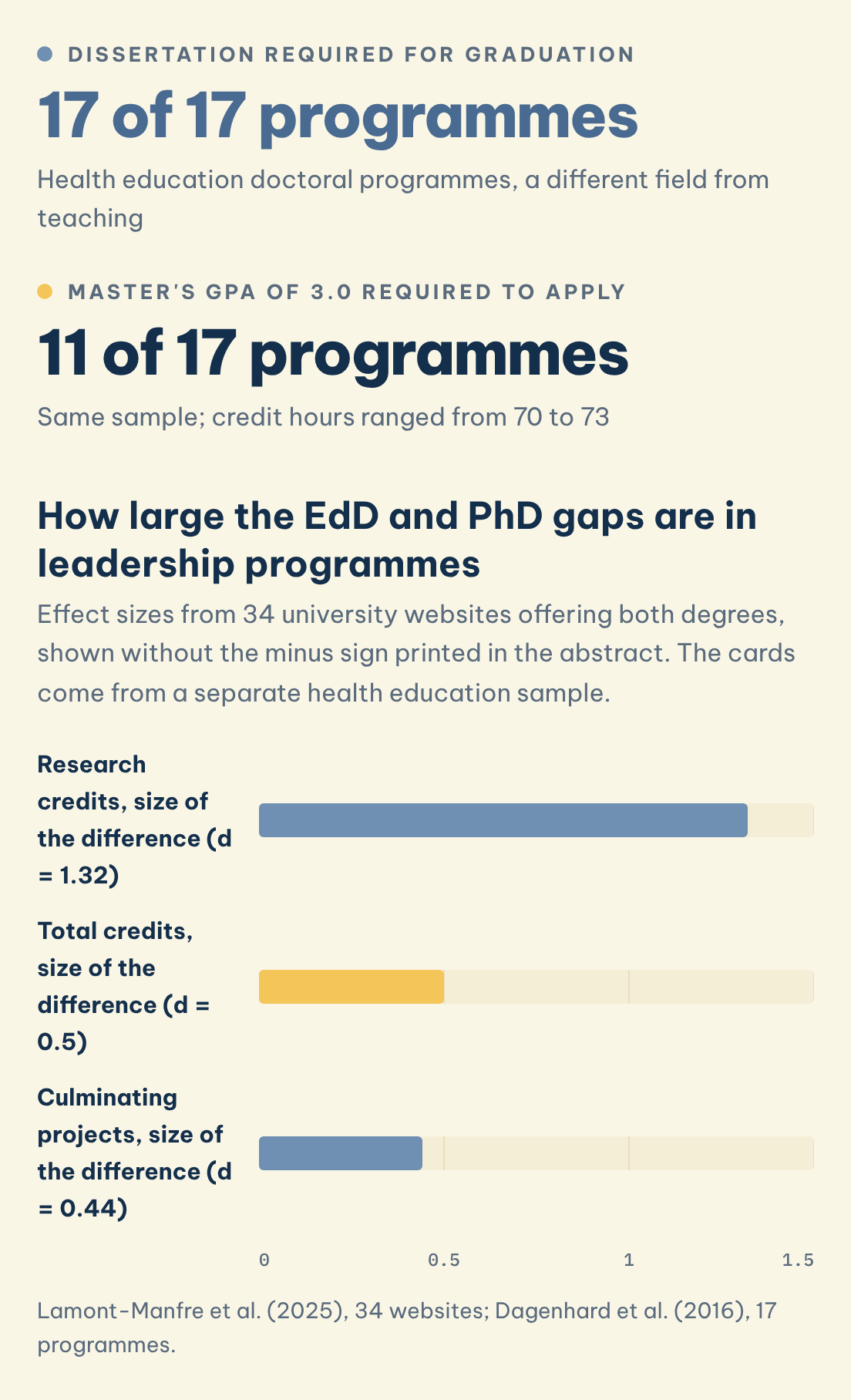
Lamont-Manfre et al. (2025) collected data from 34 university websites where a school of education offered both a PhD and an EdD in leadership. Their abstract reports t(66) = -2.05, p = 0.022 for total credits, t(50.38) = -5.38, p < .001 for research credits and t(63) = -1.79, p = 0.039 for culminating projects. The abstract does not say which degree sits on which side of the sign, so read the effect sizes as the size of a gap and not its direction. An effect size near 0.5 is moderate and one above 1.0 is large, which makes research credits the widest gap of the three.
A wider US sample points the same way. Foster et al. (2023) reviewed 188 higher education doctoral programmes and reported that, at institutions offering both degrees, PhDs required 8.02 more post-master's credit hours than EdDs on average.
Another sample shows how much a PhD-style programme can ask for. Dagenhard et al. (2016) reviewed 17 health education doctoral programmes, a different field from teaching: all 17 required a dissertation, 11 required a master's GPA of 3.0 when applying, and credit hours ranged from 70 to 73. They also stress significant variation between programmes, which matches what Reyes and Zhang (2024) found for education.
| Study and sample | What was measured | Reported result |
|---|---|---|
| Lamont-Manfre et al. (2025), 34 leadership websites | Total credits | t(66) = -2.05, p = 0.022, d = -0.5 |
| Lamont-Manfre et al. (2025), 34 leadership websites | Research credits | t(50.38) = -5.38, p < .001, d = -1.32 |
| Lamont-Manfre et al. (2025), 34 leadership websites | Culminating projects | t(63) = -1.79, p = 0.039, d = -0.44 |
| Dagenhard et al. (2016), 17 health education programmes | Dissertation required | 17 of 17 |
| Dagenhard et al. (2016), 17 health education programmes | Master's GPA of 3.0 required | 11 of 17 |
Source: ERIC abstracts of Lamont-Manfre et al. (2025) and Dagenhard et al. (2016), read 2026-11-02.
◆ Question 3 / 5 · Admission rules
How do admission rules and prior experience affect the choice?
Direct answer: Experience helps less automatically than teachers expect. Tombers et al. (2025) found in 17,862 physical therapy applicants that paid work experience went with lower odds of acceptance (p = 0.006), and Jones et al. (2020) report that top economics PhD programmes weight letters of recommendation heavily.
Admission evidence comes mostly from other doctoral fields, so treat it as a caution and not as a ruling for education. Tombers et al. (2025) analysed all 17,862 applicants to a centralised physical therapy application system in 2021 to 2022, of whom 32% had relevant work experience. Their abstract reports that applicants with paid work experience were less likely to be accepted (p = 0.006). Years in a job were therefore not a guaranteed advantage in that setting. Jones et al. (2020) surveyed economics PhD admissions and report in their abstract that top-25 programmes place more value on undergraduate programme rank and on the strength of recommendation letters.
Test policies also move outcomes. Kim et al. (2026) used 182,638 admissions records from 117 PhD programmes at one flagship US public university and found that GRE-optional policies lowered acceptance rates, so programmes became more selective, while changes in applicant and enrollee demographics were mostly not significant. A GRE waiver, in other words, did not make that university easier to enter.
For the EdD side, Nyunt et al. (2023) interviewed 14 students in one Ed.D. in higher education at a public research university in the midwestern United States and describe both external and internal influences on their motivations. One case cannot settle your decision, but it shows that candidates weigh career context along with research interest. If you are applying, our PhD application resource hub explains how panels read a proposal.
◆ Question 4 / 5 · Finishing
How many doctoral students finish, and what helps them?
Direct answer: Many do not finish. Gittings et al. (2018) cite research that 40% to 60% of doctoral students do not persist to graduation, and Bottomley et al. (2020) say about 50% of those who start complete. Funding, employment and supervision all show measurable links to finishing.
Gittings et al. (2018) open their abstract by noting that research has continually shown that 40% to 60% of doctoral students do not persist, and Bottomley et al. (2020) report roughly half completing. Denis et al. (2019) interviewed 20 supervisors and 20 students from 8 faculties, linking supervision to completion rates near 50%. Zhou and Okahana (2019) analysed American National Research Council data, and their abstract states that "a department's financial support significantly predict doctoral completion and time-to-degree" (Zhou & Okahana, 2019), while no overarching link appeared for academic support.
Employment is the question a teacher cannot avoid. Bekova (2021) followed doctoral students enrolled between 2008 and 2017 and reports in the abstract that "on-campus employment increases the chances to defend the thesis and off-campus employment is negatively associated with the completion" (Bekova, 2021). Horta et al. (2019) found that PhD funding increased time to complete. Soar et al. (2022) add a New Zealand view: average full-time PhD time exceeded the three-year scholarship tenure, and the average scholarship in 2019 was $11,238 below the Living Wage.
Supervision shapes the experience too. Wichmann-Hansen and Nielsen (2024) surveyed 1,243 doctoral students at a Danish university, and their abstract states that "student independence is affected positively by advising and negatively by controlling" (Wichmann-Hansen & Nielsen, 2024). Demchuk and Rainey (2024) interviewed eight Ed.D. completers, whose accounts include self-sabotaging thoughts among the barriers. Before applying, ask who supervises and how often you meet, and see part-time PhD study while working for the workload side.
◆ Question 5 / 5 · Which one fits
Which is better for a teacher, the EdD or the PhD?
Direct answer: Neither wins on rank. The evidence shows overlap in research content and large variation between programmes. Choose the EdD if your question comes from your workplace and you need part-time study, and the PhD if your question comes from the literature and you can commit to a research-led route.
Use three tests. First, ask where the question comes from. A feedback routine in your own school fits the pattern of a practice-focused EdD, while a gap in a theory of assessment fits a PhD, and the Lamont-Manfre et al. (2025) gap of d = -1.32 in research credits tells you the PhD route usually asks for more research training. Second, ask how you will fund and schedule study, using the evidence above on employment and funding, because Bekova (2021) ties off-campus work to lower completion. Third, ask what you want afterwards. None of the studies here measures hiring outcomes, so ask the employers you care about. For a business-side version of the same test, read the guide to the DBA and the PhD, and for typical durations see how long a PhD programme takes. Write the answers down before you open any application form, because a short note on each test is also the skeleton of a proposal.
Two worked examples
Both examples are illustrations written by MAAS. Their numbers are assumptions, not research results. First, a study-hours check. Suppose you can study 10 hours a week for 44 weeks a year, which is 440 hours. If the programme and project need about 1,800 hours in total (an assumption, so ask the programme), you need 1,800 / 440 = about 4.1 years. At 6 hours a week the same work takes 1,800 / 264 = about 6.8 years, and a registration limit may not allow that. Second, a funding gap. If a scholarship lasts 3 years but you finish in 4.5 years, 1.5 years are unfunded. At 24,000 a year in living costs, the gap is 36,000, which echoes the tenure gap Soar et al. (2022) describe. Run both checks with your own figures, and add a row for the school holidays you plan to use for writing, because that is where part-time candidates usually find their extra hours or discover they have none.
Three mistakes the evidence warns about
First, choosing by title. Reyes and Zhang (2024) found significant differences between EdD programmes, so compare the credits and final projects of the two or three programmes on your list and not the degree names. Second, treating classroom years as an admissions advantage. Tombers et al. (2025) found lower odds for applicants with paid work experience in physical therapy, a different field, so build the proposal and the referee letters first, and treat Jones et al. (2020) on recommendation letters as a reminder of where panels look. Third, planning hours but not income. Bekova (2021) and Horta et al. (2019) tie employment and funding to completion and time, so write the funding plan before the application, and compare it with the completion rates that Gittings et al. (2018) and Bottomley et al. (2020) report, so that you judge the commitment with realistic odds, not with the optimism of an application week.
Frequently asked questions
Is a PhD more prestigious than an EdD?
No source in this guide ranks them. Both are doctoral degrees, and prestige depends on who reads your CV, so ask the people who will.
Can a teacher do a PhD in education?
Yes. The admission evidence above points to the proposal and referee letters, not years in school, as what panels weigh, so build those first.
Do EdD programmes require a dissertation?
Often yes, though the form varies. Lamont-Manfre et al. (2025) found a significant difference in culminating projects across 34 university websites offering both degrees, so read each programme's final-project rule.
Is an EdD easier than a PhD?
The evidence does not say so. Gittings et al. (2018) cite 40% to 60% non-persistence across doctoral students, and no study here shows EdD students finishing more easily.
Is it a doctorate in education or a doctorate of education?
Both phrasings appear in print. Check the exact degree title on the programme page, because that is the title on your certificate.
Planning a doctoral application in education
If you have chosen between the EdD and the PhD and need to shape the research question, MAAS offers PhD application strategy, an advisory service. Experts prepare drafts of the proposal, CV and motivation letter, you review, edit and submit them, and it is not tied to a score target or an admission promise. If the expert is not the right fit, you can ask for a different expert.
A useful first step is to bring the three tests from the previous section, your funding sketch from the study-hours example and the two or three programme pages you are comparing. The expert asks where your question comes from, which credits and final-project rules each programme sets, and which referees can speak to your research preparation, and you decide what goes into the draft. Allow several weeks before a deadline so that the proposal can be revised after the first read, and so that you have time to ask a programme director a question if a page is unclear.
Related guides
These guides cover the neighbouring questions a teacher meets after choosing between the EdD and the PhD: how long study takes, how to fit it around a job, and how the same professional-versus-research choice looks in business.
- How long is a PhD programme: typical durations that you can set against the completion evidence above.
- Part-time PhD while working: the workload and funding questions that a working teacher faces.
- DBA vs PhD research question: the same professional-versus-research choice for business candidates.
References
- Becton, Y. J., Bogiages, C., Currin, E., D'Amico, L., Jeffries, R., Lilly, T., & Tamim, S. (2020). An Emerging Framework for the EdD Activist. Impacting Education: Journal on Transforming Professional Practice, 5(2), 43–54. https://doi.org/10.5195/ie.2020.131
- Bekova, S. (2021). Does Employment during Doctoral Training Reduce the PhD Completion Rate?. Studies in Higher Education, 46(6), 1068–1080. https://doi.org/10.1080/03075079.2019.1672648
- Bottomley, K., Schumacher, J., Burleigh, C., & Lindsay, P. (2020). Supporting Online Doctoral Students to Increase Persistence and Completion. Online Journal of Distance Learning Administration, 23(4). https://eric.ed.gov/?id=EJ1278706
- Dagenhard, P., Castor, T., Brookins-Fisher, J., & Thompson, A. (2016). Health Education Doctoral Degree Programs: A Review of Admission and Graduation Requirements. Health Educator, 48(2), 16–22. https://eric.ed.gov/?id=EJ1153003
- Demchuk, T., & Rainey, E. A. (2024). Hearing Their Stories: A Phenomenological Study in Understanding Ed.D. Completion. Texas Education Review, 12(2), 111–131. https://eric.ed.gov/?id=EJ1441299
- Denis, C., Colet, N. R., & Lison, C. (2019). Doctoral Supervision in North America: Perception and Challenges of Supervisor and Supervisee. Higher Education Studies, 9(1), 30. https://doi.org/10.5539/hes.v9n1p30
- Foster, H. A., Chesnut, S., Thomas, J., & Robinson, C. (2023). Differentiating the EdD and the PhD in higher education: A survey of characteristics and trends. Impacting Education: Journal on Transforming Professional Practice, 8(1), 18-26. https://doi.org/10.5195/ie.2023.288
- Gittings, G., Bergman, M., Shuck, B., & Rose, K. (2018). The Impact of Student Attributes and Program Characteristics on Doctoral Degree Completion. New Horizons in Adult Education & Human Resource Development, 30(3), 3–22. https://doi.org/10.1002/nha3.20220
- Horta, H., Cattaneo, M., & Meoli, M. (2019). The Impact of Ph.D. Funding on Time to Ph.D. Completion. Research Evaluation, 28(2), 182–195. https://doi.org/10.1093/rev/rvz002
- Jones, A., Schuhmann, P., Soques, D., & Witman, A. (2020). So You Want to Go to Graduate School? Factors That Influence Admissions to Economics PhD Programs. Journal of Economic Education, 51(2), 177–190. https://doi.org/10.1080/00220485.2020.1731385
- Kim, H., Bastedo, M., Gonzalez, J., Flaster, A., & Bai, Y. (2026). GRE-Optional Policies in PhD Admissions: Impacts on Student Applications, Yield, and Structural Diversity. Educational Evaluation and Policy Analysis, 48(3), 1004–1023. https://doi.org/10.3102/01623737251392929
- Lamont-Manfre, M., Munnelly, P., Leech, N. L., & Haug, C. A. (2025). Differences between EdD and PhD Programs: A Mixed Methods Study. Impacting Education: Journal on Transforming Professional Practice, 10(2), 19–26. https://eric.ed.gov/?id=EJ1471290
- Nyunt, G., Brown, D., Jensen, A., & Schaefer, C. (2023). Motivations to Pursue an Ed.D. in Higher Education: A Qualitative Case Study. Journal of Student Affairs Research and Practice, 60(5), 688–701. https://doi.org/10.1080/19496591.2022.2111521
- Reyes, C., & Zhang, J. (2024). A Systematic Comparative Analysis of Doctor of Education (EdD) Programs: Unraveling Inconsistencies and Informing Student Choices. Impacting Education: Journal on Transforming Professional Practice, 9(2), 42–50. https://eric.ed.gov/?id=EJ1425998
- Soar, M., Stewart, L., Nissen, S., Naepi, S., & McAllister, T. (2022). Sweat Equity: Student Scholarships in Aotearoa New Zealand's Universities. New Zealand Journal of Educational Studies, 57(2), 505–523. https://eric.ed.gov/?id=EJ1357044
- Tombers, N., Pfeifer, R., Froemke, K., & Marc, D. (2025). The Relationship between Physical Therapy Work Experience, Demographics, and DPT Admissions. Discover Education, 4(1). https://doi.org/10.1007/s44217-025-00918-4
- Wichmann-Hansen, G., & Nielsen, K.-J. S. (2024). Can Hands-On Supervision Get out of Hand? The Correlation between Directive Supervision and Doctoral Student Independence in a Danish Study Context. Scandinavian Journal of Educational Research, 68(6), 1121–1136. https://doi.org/10.1080/00313831.2023.2204113
- Zhou, E., & Okahana, H. (2019). The Role of Department Supports on Doctoral Completion and Time-to-Degree. Journal of College Student Retention: Research, Theory & Practice, 20(4), 511–529. https://doi.org/10.1177/1521025116682036
This article is part of the MAAS Journal series for students. MAAS is an academic support partner: experts guide students through each stage of their own work, and we do not complete assessed work on a student's behalf.
Not sure how this guide applies to your own case? Talk it through with MAAS in a free 20-minute consultation.
Book a free consultation ▸