
Category: admissions
Last updated: 2026-09-09

Two of the most widely used answer engines were asked the same question on 9 September 2026, in Vietnamese, about studying for a doctorate while holding a job. One replied that the law forbids it. The other replied that part-time doctoral programmes are common and named four Vietnamese universities that run them. Both cited regulation. They cannot both be right, and the reason they diverge is the whole of this article.
Direct answer: Part-time is a category of registration that an institution grants, not a way of arranging your week. Whether you may work depends on which registration category your programme offers, what that category does to your funding and your immigration status, and whether the institution will move you between categories once you are enrolled. Ask about the category first.
The applicants who get burned here are rarely the ones who underestimated the workload. They are the ones who assumed a category existed, planned a career around it, and discovered at enrolment that the box they wanted to tick was not on the form. Our guide to how long a PhD programme runs covers what the advertised duration measures; this article covers the enrolment status that sits underneath it.
◆ Question 1 / 6 · Vietnam's regulation
Does Vietnam's doctoral regulation allow part-time study while working full time?
Direct answer: The phrase "part-time" does not appear in Vietnam's doctoral regulation at all. Circular 53/2026/TT-BGDĐT permits only one form of doctoral training, the formal form, but splits it into two modes of participation. Only one of those two modes carries a ban on full-time employment elsewhere. The other sets a credit threshold instead.
The two ways to take part in formal doctoral training under Circular 53/2026
Each row sets what route (a) requires beside what route (b) requires, including the employment condition and the standard duration.
Route (a)
Route (b)
Study and research full time at the institution
Enough time at the institution under the approved whole-programme plan
Participation in departmental duties, including teaching assistance and laboratory supervision
At least 30 credits registered in one academic year
No full-time work at another agency or organisation during the period of study
No employment condition
A standard duration of 36 to 48 months, decided by the institution
The same standard duration of 36 to 48 months
Save this figure
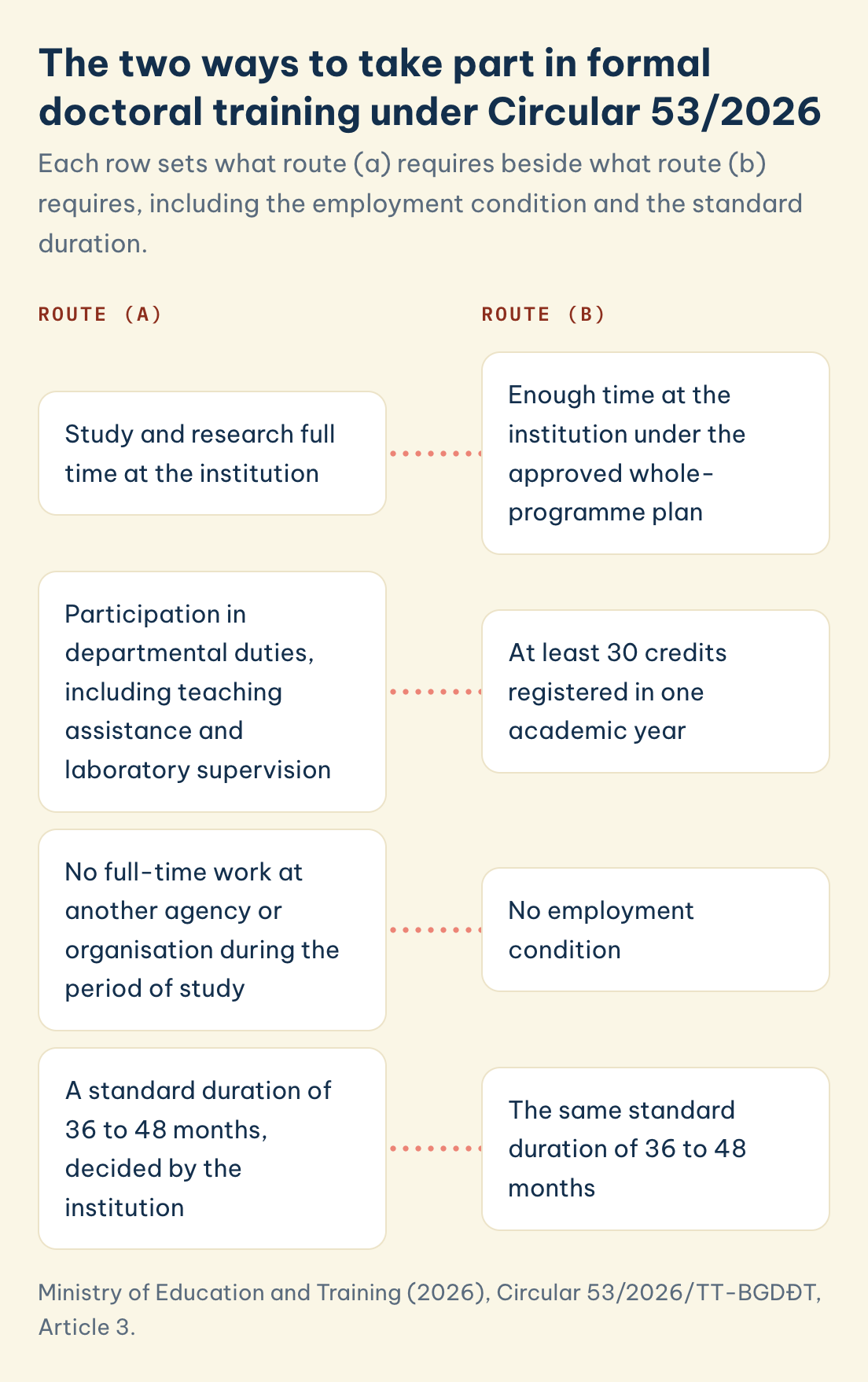
Article 3, clause 2 of Circular 53/2026/TT-BGDĐT (Ministry of Education and Training, 2026), issued on 30 June 2026 and published in Công báo issue 447 on 28 July 2026, states that doctoral training is organised only in the formal mode, then lists two ways a candidate may participate. Route (a) requires study and research full time at the institution, participation in departmental duties including teaching assistance and laboratory supervision, and carries the explicit condition of "no full-time work at another agency or organisation during the period of study". Route (b) requires enough time at the institution under the approved whole-programme plan, "in which at least 30 credits are registered in one academic year", and attaches no employment condition whatsoever.
The asymmetry between route (a) and route (b) is the answer, and it is invisible in every summary we checked. A candidate who registers 30 credits in the year has satisfied route (b) on its own terms. The regulation does not then reach into their employment contract. The candidate under route (a) is the one who cannot hold a full-time job elsewhere. Searching both documents confirms the absence: the string "bán thời gian" occurs zero times in Circular 53/2026 and zero times in the circular it replaced.
The 30-credit figure also carries a history that explains the confusion. Circular 18/2021/TT-BGDĐT, the regulation Circular 53 replaces, used the same number for a different purpose. Its Article 3, clause 3 said that a candidate registering 30 credits in an academic year "is determined to be concentrated full time". In 2021 the number was a label. In 2026 it is a qualifying threshold for a distinct mode. An answer engine trained on the older corpus reproduces the 2021 framing and calls it part-time, which inverts the meaning.
Neither route changes the clock the regulation sets. Article 3, clause 3, point (b) fixes the standard doctoral duration at 36 to 48 months, decided by the institution, and point (c) sets the floor at two thirds of that standard and the ceiling at 2.5 times it. A programme with a 36-month standard therefore runs a 90-month ceiling and a 24-month floor, and a candidate on route (b) consumes that same ceiling while working. The regulation took effect on 30 June 2026 but applies to admission rounds announced from 1 January 2027, so the two-route structure is a 2027 fact for most applicants reading it now.
One more clause decides which regulation applies to you. Article 34, clause 1 keeps candidates admitted under an earlier announcement, and enrolled before 1 January 2027, under Circular 18/2021 for the remainder of their studies. So the correct first question is not what the rule says but which rule you fall under, and any answer that omits your enrolment date is half an answer.
◆ Question 2 / 6 · What counts as part-time
What counts as part-time registration at a university?
Direct answer: There is no shared definition. Institutions set the threshold themselves, usually by credit load or by a declared proportion of full-time effort, and the same candidate can be classified differently at two universities in the same country. This is why national statistics on part-time doctoral study are unreliable and why programme pages disagree with each other.
Gardner and Gopaul (2012) put the problem plainly in their study of ten part-time doctoral students in the United States: "the complexity of merely defining what it means to be a part-time doctoral student may explain the lack of literature about this population" (Gardner & Gopaul, 2012, p. 64). They note that a student registering fewer than nine credits per semester is part time at one institution while a different number applies elsewhere, and that the Survey of Earned Doctorates, which reaches every graduating doctoral candidate in the country, does not ask about enrolment status at all. The normative pull runs the other way as well: the Council of Graduate Schools argued in 2005 that full-time study is what allows a candidate to concentrate exclusively on coursework or research and to work closely with professors and other students, a position that shapes how departments read a part-time application before they read its content.
The proportions differ enough between systems to change what is normal. Gardner and Gopaul report estimates of part-time doctoral enrolment in the United States running from 6 per cent through 10 per cent to 12 per cent depending on which national source is used, against 38 per cent on one Australian count and 47 per cent on another, and up to 63 per cent in the United Kingdom. Within a single country the split follows discipline: professional fields such as education and social work carry high part-time enrolment, while in the laboratory sciences it is close to non-existent, because the research itself is tied to equipment and to other people's schedules.
◆ Question 3 / 6 · Stipend if part time
What happens to a studentship stipend if you study part time?
Direct answer: The stipend is reduced in proportion. UK Research and Innovation sets a minimum stipend of £21,805 from 1 October 2026, up from £20,780 for the year running to September 2026, with London weighting at £23,805. Those figures are for full-time candidates. UKRI states that part-time students receive a pro-rated amount.
The arithmetic matters more than it looks. A half-time registration turns the £21,805 minimum into roughly £10,900 a year, and the £23,805 London figure into roughly £11,900, but it does not halve the cost of living, and the same arithmetic applied to the outgoing £20,780 rate gives roughly £10,390, and it roughly doubles the number of years over which fees and living costs accumulate. A candidate who moves to part-time study in order to work is often trading a smaller guaranteed income for a larger uncertain one, over a longer exposure. That is a defensible trade, but it should be made with the multiplication done.
UKRI also allows something applicants routinely miss in the other direction: a funded full-time candidate may be able to do a small amount of paid work, kept separate from the studentship. Where the goal is income rather than a different pace of research, the smaller change may be the right one.
◆ Question 4 / 6 · Changing mode mid-PhD
Can you change between full-time and part-time part way through a PhD?
Direct answer: You can ask, at any point, as many times as you need. You cannot compel the institution to agree. UKRI states that a funded candidate may request a change in mode of study at any time and does not limit the number of requests, while leaving the decision with the university.
The wording is worth reading exactly as published: "If you want to change between part-time and full-time, you can request a change in mode of study at any time. We do not limit how many times you can request a change in mode of study, but your university or provider does not have to accept your request." The funder sets the entitlement to ask. The institution holds the decision, and the supervisory capacity, laboratory access and examination scheduling behind that decision are institutional facts, not funder facts.
The split of authority between funder and institution is the practical reason to raise mode of study during the supervisor conversation rather than after admission. A supervisor who has never taken a part-time candidate is not being obstructive when they hesitate; they are describing a group they have no experience of managing, and in the laboratory sciences that group may be close to empty. The timing point is concrete. Under Circular 53 a Vietnamese candidate on a 48-month standard programme holds a 120-month ceiling, and a UK candidate moving to half-time typically doubles a 36-month expectation into 72 months. In both cases the request to change mode arrives years before the ceiling binds, which is exactly when an institution has the least incentive to say no. That conversation belongs in the same sequence as the other fit questions we set out in our PhD application resource hub.
◆ Question 5 / 6 · Part-time on a student visa
Can an international student do a part-time PhD on a student visa?
Direct answer: Generally no, in the United Kingdom. The Student visa eligibility page lists the courses the route covers, and at degree level and above it names a full-time course. An applicant who needs that visa is choosing between full-time registration and not studying in the country at all, which removes the part-time option before any academic discussion begins.
We checked the published eligibility list on 9 September 2026 and the qualifying courses at RQF level 6, 7 or 8 are described as full time. This single line reorders the entire decision for an international applicant. The question stops being whether the university permits part-time registration and becomes whether the candidate has any other basis to be in the country, such as work or family status, that does not depend on the study route. Domestic candidates and candidates already resident face no such constraint, which is precisely why advice written for one group misleads the other.
◆ Question 6 / 6 · Which clock moves
Which clock does part-time study actually move?
Direct answer: Two clocks run at once and they point in opposite directions. Elapsed calendar time lengthens, which is the effect applicants fear. Time measured in full-time equivalent effort tends to shorten, which is the effect the measured evidence keeps finding and which almost no prospectus mentions.
On the calendar, Van Lill (2024) analysed South African national data and found that mode of enrolment was the strongest predictor of completion time, with part-time candidates recording a statistically significantly longer time to degree than full-time candidates, against a mean of 4.25 years across the five disciplines studied for the period 2000 to 2021. On the effort clock, Rodwell and Neumann (2007) analysed Graduate Destinations Survey responses from 347 doctoral graduates of Macquarie University for the years 2000 to 2005, 178 of them mainly part time and 169 mainly full time, and found the pattern reversed once time was weighted by attendance. Their full-time cohort sat against a median target of five full-time-equivalent years; the part-time cohort's median fell at 3.25 full-time-equivalent years, and the authors concluded that part-time candidates work at slightly faster than half the speed of full-time candidates.
Read together, the two findings say something useful and slightly uncomfortable. Part-time candidates are not slower researchers. They are researchers spending fewer hours per year on a project whose calendar exposure is therefore longer, and longer exposure is where funding lapses, supervisors move institutions and research questions age. The risk of part-time study is a duration risk, not a capability risk, and it is managed by shortening the calendar wherever the calendar can be shortened rather than by working harder inside a given week.
MAAS advises on this decision the same way we advise on any other part of the application: we set out what each route obliges you to do, we press on the assumptions that will not survive contact with a registry office, and you make the choice. Where a candidate needs a supervisor whose department actually admits candidates in their intended mode, that search is part of our PhD application strategy service.
Frequently asked questions
Does Circular 53/2026 allow part-time doctoral study?
The phrase "part-time" does not appear in Circular 53/2026. Only route (a) carries the ban on full-time work elsewhere, while route (b) requires 30 credits registered in one academic year and states no employment condition (Ministry of Education and Training, 2026).
What happens to a studentship stipend in the UK if I study part time?
The stipend is reduced in proportion. UKRI states that part-time students receive a pro-rated amount of the full-time minimum of £21,805 from 1 October 2026.
Can I change between full-time and part-time once I am enrolled?
You can request a change at any time and the number of requests is not limited, but the university does not have to accept, according to UKRI.
Can an international student do a part-time PhD on a UK Student visa?
Generally no, because the Student visa eligibility page describes courses at RQF level 6, 7 or 8 as full time.
Does part-time study make the time to degree longer?
Van Lill (2024) found elapsed calendar time is longer, while Rodwell and Neumann (2007) found time measured in full-time-equivalent effort tends to be shorter.
References
Gardner, S. K., & Gopaul, B. (2012). The part-time doctoral student experience. International Journal of Doctoral Studies, 7, 63-78. https://doi.org/10.28945/1561
Ministry of Education and Training. (2026). Circular 53/2026/TT-BGDĐT on the regulation for graduate admissions and training. Công báo, issue 447, 28 July 2026. https://congbao.chinhphu.vn/van-ban/thong-tu-so-53-2026-tt-bgddt-470098/67203.htm
Rodwell, J., & Neumann, R. (2007). Predicting timely doctoral completions: An institutional case study of 2000-2005 doctoral graduates. Australasian Association for Institutional Research Forum. https://aair.org.au/app/webroot/media/pdf/AAIR%20Fora/Forum2007/Rodwell.pdf
Van Lill, M. H. (2024). A study of doctoral time-to-degree in selected disciplines at South African public universities. South African Journal of Higher Education, 38(1), 168-188. https://doi.org/10.20853/38-1-6268
Tools and resources
UK Research and Innovation. (2026). Get a studentship to fund your doctorate. https://www.ukri.org/what-we-offer/developing-people-and-skills/find-studentships-and-doctoral-training/get-a-studentship-to-fund-your-doctorate/
UK Government. (2026). Student visa: eligibility. https://www.gov.uk/student-visa/eligibility
A free 20-minute consultation is a conversation about your situation and the registration category you would need while working.
Book a free consultation ▸