

Other UKRI terms 01
£5,238
minimum fee for 2026 to 2027, which moves from the grant to the research organisation and never passes through the student.
◆ PhD Admissions
Category: admissions
Last updated: 2026-09-02
Two applicants send near-identical files to two universities in the same country. One hears back from a professor within a week and has a funded place by December. The other is admitted in March and told to keep watching the scholarship page. Neither file was stronger. The money reached the two departments by different routes, and each route put the decision in a different pair of hands.
Direct answer: PhD funding usually arrives by one of four routes, and each places the decision with a different party. A national research agency block-grants the institution, which then allocates places. A university or faculty ranks candidates through its own panel. A named academic recruits into a project grant. A foreign government or foundation scheme decides through its own national committee.
So the first useful question is not whether your file is strong enough. It is which route carries the place you want, because that is what tells you who you are actually addressing, and an email sent to the wrong party is effort that changes nothing.
◆ Question 1 / 5 · Where does PhD scholarship
Direct answer: Doctoral funding comes from national research agencies, from a university's or faculty's own budget, from a project grant held by an individual academic, and from foreign government or foundation schemes. These are not four labels for the same thing. They differ in who applies, who decides, and what the money obliges the recipient to do.
The University of Manchester sorts its advertised doctoral projects into three categories on its postgraduate research funding page: directly-funded projects, competition-funded projects, and self-funded projects. The page defines the middle category in one line that repays close reading: "Competition-funded projects are projects that are in competition for funding with other projects. Usually the project which receives the best applicant will be successful"; verified on 2 September 2026. A directly-funded project already has money attached to it. A competition-funded project does not yet exist as a funded post, and the applicant is part of what determines whether it comes into existence. The same page also notes that the university awards 100 studentships a year under its President's Doctoral Scholar Award, which is a separate, centrally held pot with its own competition.
The distinction between a directly-funded and a competition-funded place matters more than the label on the advert. If a place is directly funded, you are being assessed against a standard. If it is competition funded, you and the academic proposing the project are on the same side of the table, and your file is evidence in their case rather than only in yours.
For UKRI-funded studentships the London weighting stands at £22,780 to September 2026 and £23,805 from 1 October 2026, and the terms are set out in the next section. Once you know which party holds the money, the next question is what the money actually covers, which our guide to what makes up the cost of a PhD programme sets out stream by stream. Schemes outside the UK follow their own rules, and in Europe the EU share often arrives as a salaried post rather than a scholarship, as explained in whether an Erasmus PhD scholarship still exists.
◆ Question 2 / 5 · Who holds and manages
Direct answer: In the block grant model, the funder pays the institution and the institution selects the student. UK Research and Innovation states the arrangement plainly: it gives training grants to providers, who use them to offer studentships, and "students cannot apply directly to UKRI." Applications go to the university, institute or research organisation offering the place.
The published terms show how much is fixed by the funder and how much is left to the provider. UKRI sets a minimum stipend of £20,780 for the year running to September 2026 and £21,805 from 1 October 2026, with a London weighting of £22,780 and £23,805 respectively; the minimum fee contribution for academic year 2026 to 2027 is £5,238, drawn by the research organisation from the UKRI grant. UKRI contributes only up to the home fee rate, which it states may leave an international student making a contribution to fees that the provider will quantify. All verified on 2 September 2026, and worth rechecking each season, since the figures are annual. Two further terms in the same conditions shape the calendar rather than the bank balance. A part-time award "should not be less than 50% of the full-time equivalent", and UKRI's training grant guidance states that Councils expect doctoral projects to be designed and supervised so that students can submit within the funded period as defined at the outset, both verified on 8 September 2026.
Read those two facts together and the practical instruction follows. The floor of your income is set by an agency you will never write to, and the decision about whether you receive it is made by people you can write to. Correspondence aimed at the funder is wasted; correspondence aimed at the department is not. Our guide to the PhD application process sets out where that correspondence sits in the wider sequence.
◆ Question 3 / 5 · Can a professor
Direct answer: In the project grant model the academic is the applicant to the funder, not you. The Deutsche Forschungsgemeinschaft restricts its Research Grants programme to qualified researchers, as a rule those holding a doctorate, working at German research institutions, and funds a defined topic for a limited period. The grant holder then staffs the project.
A professor in that position therefore controls a budget line, but controls it within terms that someone else wrote and that they cannot vary for you.
The grant holder's limited room to manoeuvre is why the useful question in a first exchange is narrow and factual rather than evaluative. Not whether your profile is competitive, which the academic cannot answer for a panel they do not sit on, but whether the post is already funded, which route funds it, and when that route reports. Verified on 2 September 2026 on the DFG programme page: a first proposal may be submitted at any time, and a renewal proposal should arrive at least six months before approved funds are exhausted. A rolling submission window means an academic's answer about money can genuinely change between March and September, which is a reason to ask again rather than to read silence as refusal.
Where this shapes MAAS work, it shapes it at the level of preparation rather than representation. Your expert drafts the proposal from your own account of your research, you review, edit and approve it and submit the application yourself, and the expert challenges the argument and helps map which funding route each target is on. The PhD supervisor search service is built around that division of labour, and it makes no claim about admission or funding outcomes, because those decisions belong to the panels and grant holders described above.
◆ Question 4 / 5 · How is a PhD scholarship
Direct answer: An offer letter often bundles three separate items: fees that the provider does not charge you, a stipend paid to you for living costs, and in some systems a salaried research or teaching position. Only the second and third reach your bank account. Reading the headline total as income is the most common misreading of a funded offer.
UKRI minimum stipend
£21,805
from 1 October 2026, the part that reaches the student, and it continues during leave
minimum fee for 2026 to 2027, which moves from the grant to the research organisation and never passes through the student.
of annual leave a year including bank holidays.
of medical leave in a 12-month rolling period, capped at 52 weeks across the studentship.
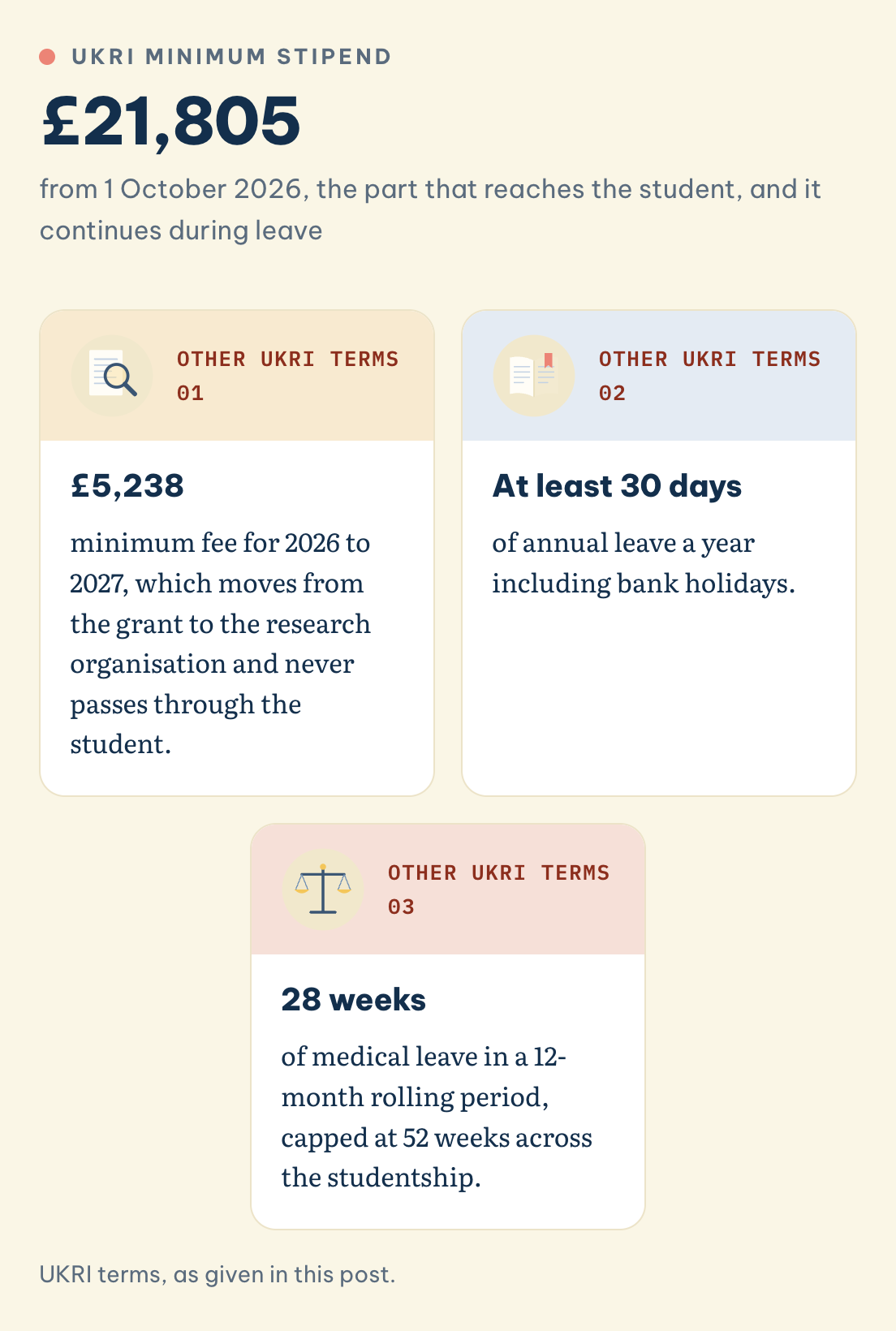
Two further terms in the same document show how far the funder reaches into daily conditions. UKRI-funded students receive a minimum of 30 days of annual leave a year including bank holidays, pro-rated for part-time study, and the stipend continues during that leave. UKRI also states that a provider may not ask a student to do work outside the studentship in return for the stipend, and may not charge additional tuition fees during the funded period other than some international fees.
The UKRI figures illustrate the split precisely. The £5,238 minimum fee for 2026 to 2027 moves from the grant to the research organisation and never passes through the student. The £21,805 minimum stipend from 1 October 2026 does. UKRI also states that stipend payments continue during leave, that funded students are entitled to a minimum of 30 days annual leave including bank holidays, and that medical leave is available for up to 28 weeks in a 12-month rolling period, capped at 52 weeks across the studentship. Those are terms of employment in all but name, and they are set by the funder rather than negotiated with the supervisor.
Singapore sits between the two shapes: the NUS Research Scholarship pays international candidates S$3,000 a month as a tax-free stipend but attaches 416 unpaid assistantship hours, and we read its conditions line by line in what a Singapore PhD scholarship asks back. Where the money is a salary rather than a stipend, the shape changes again. Wichmann-Hansen and Herrmann (2017) describe the Danish system, in which studentships are three-year full-time positions carrying teaching obligations, departments must document a complete financing plan before a candidate can be enrolled, and the average completion time for a three-year programme is 3.58 years. That gap between a programme's nominal term and its measured completion is a general pattern rather than a Danish quirk, and we set out the three separate periods a university publishes in how long a PhD is and what that number measures. A financing plan required before enrolment is a different administrative object from a scholarship awarded after admission, and it explains why some systems appear to decide funding and admission in a single step. The United States is the clearest case of that single step, and we set out how it works in where the funding decision sits in US PhD admissions.
The four English words used for these awards (scholarship, fellowship, studentship, assistantship) are not interchangeable either; Scholarship, fellowship, studentship, assistantship: what differs? sets out what each one is tied to.
◆ Question 5 / 5 · Does the funding route
Direct answer: Yes, and the effect is measurable in both directions. Funding that follows the student loosens the supervisor's hold on how their time is spent. Funding that the supervisor raised tends to tighten it. Neither pattern is uniformly better, which is why the route is worth understanding before you accept rather than after.
Denton et al. (2025) interviewed 23 fellowship-funded engineering doctoral students across four departments, of whom 18 were funded primarily by external fellowships and 8 primarily by internal ones, with 3 holding both, in a field where research assistantships fund as many as 56% of STEM doctoral candidates against 19% on fellowships and 8% on teaching assistantships. The interviews ran through autumn 2019, lasted between 31 and 77 minutes, and covered students from year 1 to year 7 of their programmes. One participant described the shift in a single sentence: "he can't tell me not to because he doesn't pay for me anyway" (Denton et al., 2025, p. 12). The authors read this as reduced interdependency, noting that at the individual level the faculty member wields less power over the student.
The mirror finding comes from Denmark. Wichmann-Hansen and Herrmann (2017) surveyed doctoral students and found that those whose salary came from external funding their supervisor had applied for rated their supervision as more directive than internally funded peers, a mean of 3.05 against 2.72 on a five-point scale, t(1504) = -7.26, p < .001, d = .37.
How common each route is depends heavily on the field. In the same Danish sample, the share of doctoral students funded from external sources ran at 20% in the humanities, 20% in the social sciences, 44% in the health sciences and 66% in the natural sciences, so the question of who pays is answered differently by discipline before it is answered by institution.
Two limits belong with those numbers rather than after them. In the Danish study the difference held only in the health sciences once discipline was controlled for, and was not significant in the natural sciences, so it is not a general law of funding. And the same fellowship autonomy that Denton et al. record as a benefit also appears in their data as a cost: participants described lost time under advisors who became too hands off, and internal fellowships, being shorter, sometimes reduced agency instead of increasing it. Feizi and Elgar (2023), drawing on 18,822 doctoral respondents to the Canadian Graduate and Professional Student Survey, add a further wrinkle in the same direction: teaching assistantships were negatively associated with programme satisfaction while research assistantships were positively associated with progress, so the funding instrument is doing work on the doctorate long after the offer letter.
To put the funding questions to a supervisor in an interview, see What should you ask the professor at a PhD interview?.
No, and assuming so wastes effort in systems where it is untrue. Where a national agency block-grants an institution, the provider selects; UKRI states that students cannot apply to it directly. Where an academic holds a project grant, that academic recruits within the grant's terms. Ask which arrangement applies before deciding who to write to.
Not necessarily, because funding cycles move. The DFG accepts first proposals at any time, and university competitions run to their own calendars. What is over is that specific route on that date. Asking when the position would next be reviewed is a factual question the academic can answer.
An external fellowship changes the arithmetic, since a student who arrives with their own money does not consume the group's budget. The published evidence suggests it also changes the working relationship, and not only favourably: Denton et al. (2025) record both greater freedom and lost time under insufficiently engaged advisors.
Because the money is structured as a post rather than an award. Wichmann-Hansen and Herrmann (2017) note that Danish departments must document a complete financing plan as a prerequisite for enrolling a doctoral student, which merges the two decisions by design.
Read the advert for the funder's name, then read that funder's own page rather than the university's summary of it. Our article on scholarship eligibility rules explains why the funder's stated purpose, not the university's phrasing, governs what the conditions mean.
Denton, M., Chasen, A., Fleming, G. C., Borrego, M., & Knight, D. (2025). Agentic actions and agentic perspectives among fellowship-funded engineering doctoral students. Education Sciences, 15(10), 1378. https://doi.org/10.3390/educsci15101378
Feizi, S., & Elgar, F. J. (2023). Satisfaction, research productivity, and socialization in doctoral students: Do teaching assistantship, research assistantship and the advisory relationship play a role? Heliyon, 9(9), e19332. https://doi.org/10.1016/j.heliyon.2023.e19332
Wichmann-Hansen, G., & Herrmann, K. J. (2017). Does external funding push doctoral supervisors to be more directive? A large-scale Danish study. Higher Education, 74(2), 357-376. https://doi.org/10.1007/s10734-016-0052-6
A free 20-minute consultation is a conversation about your situation and the funding routes you are looking at. In the PhD application service, an expert drafts your application documents and you review, edit, approve and submit them.
Book a free consultation ▸