
Category: admissions
Last updated: 2026-10-08

Asked this question on 8 October 2026, Google returned an AI Overview with three headings: funding, supervision and authorship. Perplexity, in guest mode, cited ten sources. Both tell you what to ask. Neither result I read pointed to where the answer is written down, and that decides whether an answer is worth anything.
Direct answer: Ask about funding, meeting rhythm, feedback time and authorship, and for each one ask where the answer is written. Ulster University, for example, asks for monthly supervisor meetings and feedback in about three weeks, normally under six (Ulster University, n.d.). A rule on paper can be checked; a promise made in a room cannot.
This guide draws on university policies and published guidance, not on a survey of supervisors. The panel's own questions are covered in What do PhD interviewers ask about your methodology?.
Why ask the professor questions at all?
Direct answer: The interview runs both ways. The University of Queensland says a first meeting with a potential supervisor is a two-way conversation, and Prospects lists meeting frequency, a second supervisor, expectations and funding as the topics to raise (University of Queensland, 2025; Prospects, 2026).
A doctorate normally runs three to four years in the UK, and DiscoverPhDs puts it plainly: you are also interviewing the professor for the role of supervisor (Zebastian D., 2020). The same author adds that some answers can be found on a university profile, so spend interview time on what a web page cannot tell you.
MAAS reading, not a published rule: sort every question by whether its answer already exists in a document. If it does, ask for the document. If it does not, the answer is a personal promise, and you should weigh it accordingly.
Which questions have an answer you can check on paper?
Direct answer: Meeting frequency, feedback time and authorship usually have a written home. Ulster asks supervisors to hold monthly meetings and return feedback in about three weeks, normally under six, while the University of Oslo's ITS department lists reply times from the same day to one month on a form completed in the first week (Ulster University, n.d.; Engelstad, 2024).
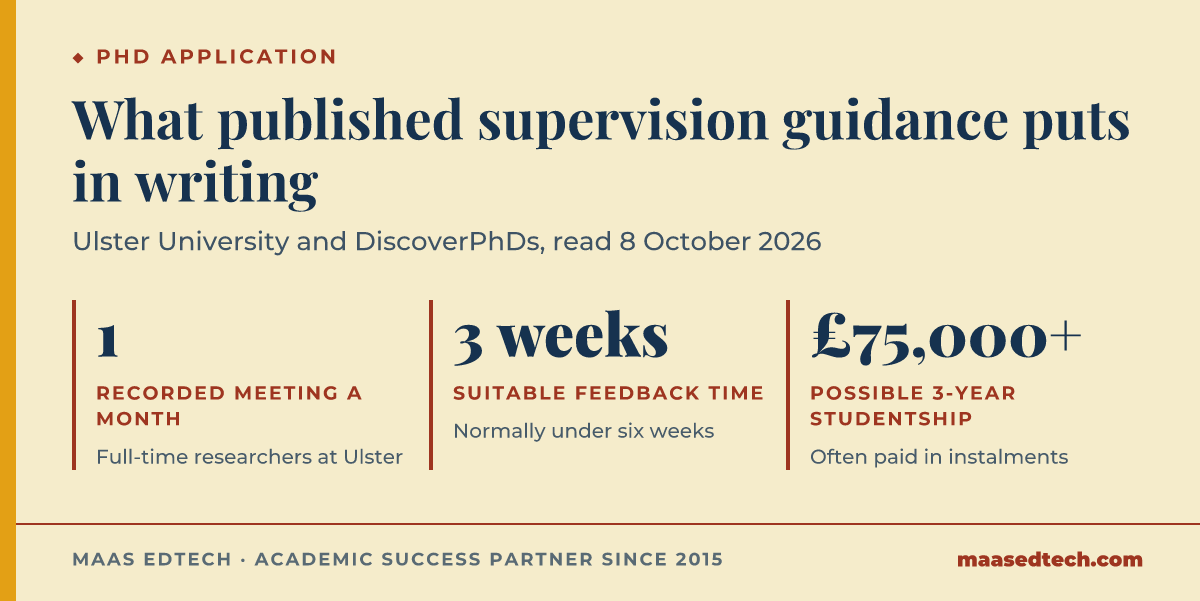
Ulster's guidance is the clearest example. It sets at least one recorded monthly meeting for full-time researchers, every other month for part-time, and says that although about three weeks is a suitable feedback time, researchers should normally expect to wait less than six weeks for a constructive response. It also names the target for submission: normally three years full-time and six years part-time (Ulster University, n.d.).
Oslo's ITS department goes one step further. Its "expectation dialogue" is a form for the candidate and supervisor to work through in the candidate's first week of employment. It asks who plans meetings, how quickly a supervisor reads a manuscript (same day, one week, two weeks, one month), who decides publication channels, who has the right to publish results, and who applies for conference travel funds (Engelstad, 2024). The form comes from an NTNU document that was based on work by Johan Bijnens at Lund University.
Two lessons follow, in MAAS's reading. A department that publishes such a form treats these questions as normal, so asking about them signals preparation, not suspicion. And a department with no form leaves the answers to the individual, so your question becomes the only record. Ask early whether a supervision agreement exists, and request a copy before you accept.
What should you ask about funding?
Direct answer: Ask what the funding covers, for how many years, and what happens if the grant behind it ends. EPIC, the EPFL doctoral students' association, lists three: is funding guaranteed for the whole PhD, what if it runs out, and does it carry obligations such as a fixed topic (EPIC, n.d.).
DiscoverPhDs explains why the second question is not paranoid. Most often funding bodies do not release the whole sum at once, which can exceed £75,000 for a three-year studentship, and may pay in instalments tied to milestones. Industry-funded projects can carry a service element that must be delivered for the university to keep receiving money. A complete loss is unlikely, the author notes, but you should ask whether it is possible (Zebastian D., 2020).
For a funded place, split the question in two. Ask the department what the studentship guarantees in writing, such as stipend, fees and length. Then ask the supervisor about everything outside that guarantee: conference travel, publication fees, and what happens if the project runs past the funded years. The first answer comes from a policy and the second from a person. For the funders behind these arrangements, see Who decides PhD studentship funding?.
How do you ask about authorship?
Direct answer: Ask how author order is decided and whether students lead papers from their own thesis. Ulster University (n.d.) says authorship should be “discussed and agreed between PhD researchers and their supervisors at an early stage”, and that researchers typically lead on work from their PhD, although supervisors may act as corresponding authors.
Google's own results for this query carried a "Missing: authorship" note on two of the pages it listed, a Reddit thread and a YouTube video. The note only shows that the word was absent from those pages, not that their advice is wrong, so treat it as a small hint that authorship gets less space than money and meetings.
Ulster's wording leaves room for variation by subject, so a supervisor who says "it depends on the paper" is not necessarily dodging. A better test is whether they can describe how it was decided for their last two students. Oslo's form asks the same thing in a different way, by listing who has the right to publish the results (Engelstad, 2024). Raise it as a routine matter, early in the process, and in plain words.
Should you ask current students instead?
Direct answer: Yes, in addition. EPIC advises talking to current students on their own, without the advisor present, so you hear their account. DiscoverPhDs adds that you can judge a supervisor's record by asking how many students finished and why those who left did so (EPIC, n.d.; Zebastian D., 2020).
Students can answer what a policy cannot: whether the monthly meeting actually happens, how long feedback really takes, and how the last authorship disagreement was settled. Ask the programme coordinator for a way to contact two or three students, preferably including one who has finished. DiscoverPhDs also notes that a student can succeed despite a supervisor's lack of support, so completion counts alone mislead (Zebastian D., 2020).
What does a vague answer tell you?
Direct answer: A vague answer to a fair, specific question is information, not rudeness. In MAAS's reading it may mean the arrangement is undefined, the gap a form like Oslo's fills. The cautious step is to ask for the agreement, a department policy page, or a student who can confirm the practice (Engelstad, 2024; Ulster University, n.d.).
Do not turn a vague answer into a verdict at the first meeting. Supervisors differ, and DiscoverPhDs notes that some supervisors are very hands-off and that this suits some students (Zebastian D., 2020). The point is to leave the room knowing which of your answers are rules, which are habits and which are hopes.
Where do these questions fit in the application?
Direct answer: MAAS reading, not a published rule: put fit and research questions in the first contact, and funding terms and authorship at interview. UQ's guidance quotes an academic advising contact at least 8 to 12 weeks before application deadlines (University of Queensland, 2025).
The reason for the order is that each stage can answer a different kind of question. At first contact the professor does not yet know you and cannot say much about money for an applicant with no file, while at interview both sides have enough information to be specific.
MAAS reviews a candidate's list of questions and helps arrange them by priority; the candidate asks them and attends every meeting personally. See PhD Application Strategy and Execution for what the service covers.
Frequently asked questions
What questions should I ask at a PhD interview?
Ask about meeting rhythm, feedback time, funding length and what happens if it ends, and authorship. For each, ask where the answer is written, since Ulster and Oslo publish theirs (Ulster University, n.d.; Engelstad, 2024).
How often should a PhD student meet their supervisor?
It varies. Ulster sets at least one recorded monthly meeting, while DiscoverPhDs suggests every two weeks as a good balance, so ask what the lab does (Ulster University, n.d.; Zebastian D., 2020).
Is it rude to ask about funding at an interview?
No. DiscoverPhDs says it may feel awkward but you need to be clear on the stipend and any conference or publication money (Zebastian D., 2020).
Who decides authorship order on a PhD paper?
It depends on the university and subject. Ulster says it should be agreed early, and that the researcher typically leads work from their own PhD (Ulster University, n.d.).
Should I bring a written list of questions?
Yes, a short one. UQ's sample meeting plan gives five minutes each to supervision, programme and career questions, so a prioritised list fits better than a long script (University of Queensland, 2025).
Related MAAS guides
- What do PhD interviewers ask about your methodology?
- Who decides PhD studentship funding?
- Can you cold email a professor yourself?
- How do you shortlist a PhD supervisor?
- PhD application resources
- PhD Application Strategy and Execution
References
Engelstad, P. (2024). Managing expectations in meetings between PhD candidates and their supervisors (Version 07.03.2024) [Form]. Department of Technology Systems, University of Oslo. Retrieved October 8, 2026, from https://www.mn.uio.no/its/english/phd-education/phd-expectations-dialogue-at-its-2024-03-07.pdf
EPIC. (n.d.). Questions for advisors. EPIC Guide, EPFL IC PhD students' association. Retrieved October 8, 2026, from https://epic-guide.github.io/applying/questions-for-advisors
Prospects. (2026, June 24). How to choose a PhD supervisor. Retrieved October 8, 2026, from https://www.prospects.ac.uk/postgraduate-study/phd-study/choosing-your-phd-supervisor/
Ulster University. (n.d.). PhD researcher/supervisor relationship. Doctoral College. Retrieved October 8, 2026, from https://www.ulster.ac.uk/doctoralcollege/supervisors/supervisor-guidance-and-resources/phd-researchersupervisor-relationship
University of Queensland. (2025, June 20). How to approach a PhD supervisor. UQ Study. Retrieved October 8, 2026, from https://study.uq.edu.au/stories/how-approach-phd-supervisor
Zebastian D. (2020, August 22). Questions to ask during your PhD interview. DiscoverPhDs. Retrieved October 8, 2026, from https://www.discoverphds.com/blog/questions-to-ask-during-your-phd-interview
Tools & resources
- Ulster University Doctoral College guidance on the researcher and supervisor relationship: https://www.ulster.ac.uk/doctoralcollege/supervisors/supervisor-guidance-and-resources/phd-researchersupervisor-relationship
- University of Oslo ITS expectation dialogue form: https://www.mn.uio.no/its/english/phd-education/phd-expectations-dialogue-at-its-2024-03-07.pdf