

Also in the review 01
22.6%
of English-taught master's programmes in Europe use interviews.
◆ PhD Admissions
Last updated: 2026-08-26
Category: admissions
Direct answer: PhD admission interviewers ask why you chose this method over the alternatives, what your design cannot show, what happens if a core assumption fails, and how you would know your result is real. These 4 questions want a conditional answer rather than a recital, which is why 3 of the 4 interview blocks can be memorised and this one cannot.
Last checked: 26 August 2026.
A doctoral interview usually runs 4 blocks: your proposal, your methods, your reasons for this department and this academic, and your plan for the 3 to 4 years plus money. The introduction block asks you to report a past that has already happened, which is why it can be rehearsed smooth and still decide nothing. The methodology block asks you to reason about a study that does not exist yet, under questioning, in front of the person who would supervise it for 3 or 4 years. Candidates who prepare by memorising answers arrive fluent for 3 of the 4 blocks and stall in the 1 that counts. MAAS runs 2 mock interviews inside its PhD application service, and the rule from those sessions is that the failure point is block 2, not the introduction. For the wider sequence of proposal, shortlist and outreach, start at the PhD application resource hub.
◆ Question 1 / 9 · Why do interviewers push
Direct answer: Methodology is the only block that shows how you will work over the next 3 or 4 years. Transcripts record finished work and proposals record intentions, so panels use live questioning to see whether you can hold a design, find its weak joint and repair it, which is the judgement Posselt (2016) shows committees relying on.
Methodology is the only part of the conversation that shows how you will work for the next 3 to 4 years. A transcript records what you finished and a proposal records what you plan, so only live questioning shows whether you can hold a design in your head, see where it breaks, and say what you would do about it. In Inside Graduate Admissions, published by Harvard University Press, Posselt (2016) conducted 86 interviews with 62 faculty and 6 graduate students and observed admissions committee meetings in 6 of 10 doctoral programmes across 3 research universities, 2 public and 1 private, spanning paradigmatic fields such as economics, physics and philosophy alongside fields with less internal consensus. In her opening scene a philosophy committee deadlocked for 3 hours, then debated admitting everyone rated 1.8 or higher to reach a cohort of 13, with 2.4 floated as a faster cut. One senior professor answers, "I have a hard time drawing lines because wherever we draw it, it's going to look arbitrary" (Posselt, 2016, p. 1). Committees fall back on judgement, and the interview is where that judgement collects its evidence.
Hernández-Colón et al. (2021) suggest what the panel goes looking for. Their vignette experiment in Frontiers in Psychology randomly assigned 271 tenured or tenure-track faculty to 3 instructional conditions, labelled Control, Diamond in the Rough and Weed Out, and to 1 of 2 vignettes describing a first-generation applicant with either high or average GRE scores. Faculty rated competence on a 3-item survey analysed by 2×3 factorial ANOVA, and were then asked what further information they would want before deciding. Faculty were more likely to ask about grades and research skills than about the psychosocial factors that might explain a candidate's record (Hernández-Colón et al., 2021). Research skill is the thing a file cannot certify, so it is the thing the interview is used to test.
◆ Question 2 / 9 · What are interviewers
Direct answer: They test feasibility, rigour and judgement together. Feasibility asks whether the study fits your real time, data and ethics constraints. Rigour asks whether you understand validity, sampling and measurement. Judgement asks whether you can defend a trade-off aloud, which none of the 10 selection methods catalogued by Kurysheva et al. (2023) can capture.
Three things a methodology question tests at once
Tap an item to see what the panel is checking.
Item 1 of 3
Feasibility
Whether the study fits the time, data access and ethics approvals you will actually have.
Item 2 of 3
Rigour
Whether you understand validity, sampling and measurement well enough not to produce a result that means nothing.
Item 3 of 3
Judgement
Whether you can defend a trade-off out loud.
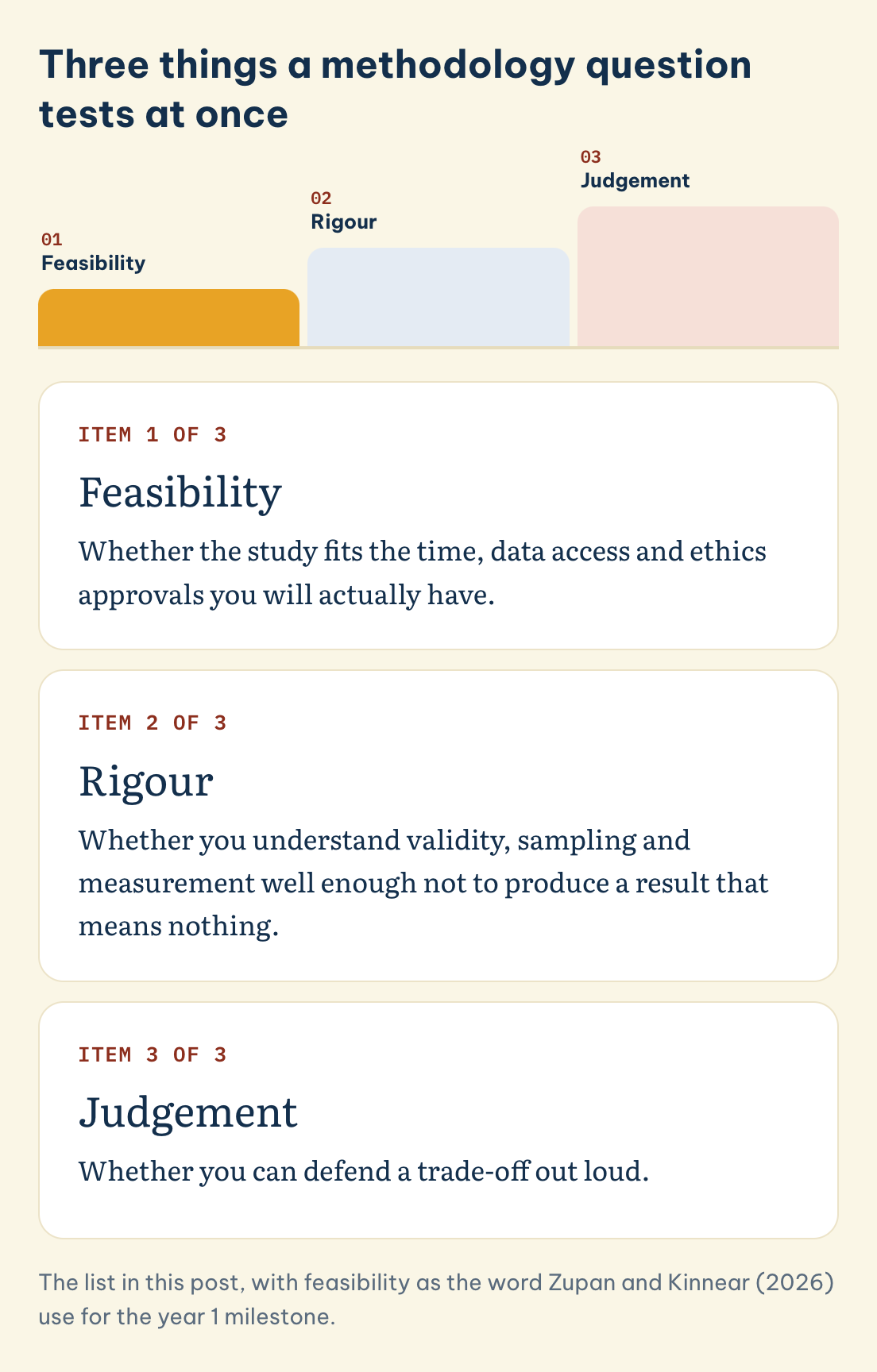
They test 3 things at once. Feasibility asks whether the study fits the time, data access and ethics approvals you will actually have, and it is the same word Zupan and Kinnear (2026) use for the year 1 milestone that follows admission. Rigour asks whether you understand validity, sampling and measurement well enough not to produce a result that means nothing; validity and reliability are also 2 of the 4 quality principles Kurysheva et al. (2023) apply to selection methods themselves. Judgement asks whether you can defend a trade-off out loud.
Zupan and Kinnear (2026) put a number on the gap this exposes. In a mixed-methods study at a regional Australian university, reported in The Australian Educational Researcher, they interviewed 11 experienced supervisors of higher degree by research candidates, then surveyed 40 supervisors and 118 students. Average student ratings of their own initial capabilities were significantly higher than supervisors' ratings of the same capabilities, and the gaps clustered in critical thinking, writing and foundational research knowledge (Zupan & Kinnear, 2026). Interviewers have watched that gap open repeatedly. The methodology block is where they check for it before committing.
The same study describes the milestone that follows admission. That university introduced mandatory coursework in 2015 to develop research skills. Its Confirmation of Candidature portfolio, due before the end of year 1, exists "to confirm the feasibility of the research design and the candidate's capacity to undertake the research" (Zupan & Kinnear, 2026), and requires a literature analysis plus a detailed description of methodology and methods. An admission interview is a compressed rehearsal of that same test, held before anyone has agreed to fund you.
◆ Question 3 / 9 · Why did you choose this
Direct answer: Name the rejected alternative first, then what it would have given you, then what you traded away. A method is only a choice if something else was on the table, and the trade-off is the part your file cannot carry, whichever of the 2 disciplinary clusters you apply into (Inouye et al., 2025).
Answer with the rejected option first, because a method is a choice only if something else was on the table. "I chose semi-structured interviews" is a label, and labels are what the written file already carries: Kurysheva et al. (2023) catalogue 10 selection methods, and none of them records reasoning. "I considered a survey because it would have given me a larger sample, but my question asks how people justify a decision, and a fixed-response instrument cannot record a justification, so I traded sample size for depth" is a defence, and it supplies exactly the judgement Posselt (2016) shows committees reaching for when files leave them deadlocked.
The discipline you apply into changes the ground under your feet here. Inouye et al. (2025), writing in Higher Education, interviewed 65 academic staff involved in doctoral admissions at the University of Oxford and the University of Cambridge and found 2 broad clusters. In humanities and social science the doctorate is treated as knowledge production, so your proposed project carries the case. In STEM and medical science it is treated as skills formation and a licence to research, so you more often join a project that already exists (Inouye et al., 2025). The same study records how differently supervisory capacity operates across the 2 clusters: in humanities and social science it can turn on whether a member of staff already supervises too many students, is going on sabbatical, is retiring, or holds a contract shorter than the 3 to 4 years a UK doctorate is designed to take, while in STEM it affects which project you are matched to rather than whether an offer arrives at all (Inouye et al., 2025). In cluster 1, "why this method" means defend your design. In cluster 2, it often means show you could run the group's existing design competently. Read 2 or 3 recent papers by the academic interviewing you before deciding which question you are being asked.
◆ Question 4 / 9 · What are the limitations
Direct answer: Give the real boundary of your conclusion, then your response to it. A limitation states what you will not be able to claim when the data is in, such as frequency in a wider population, followed by what a later study would need to establish it (Zupan & Kinnear, 2026).
State the real limit, then what you do about it. Candidates lose ground by offering a limitation so mild it is a boast, such as "my sample is quite specific", which describes a design decision rather than a boundary on the claims you can make. In the 2 clusters Inouye et al. (2025) identify, a stated boundary reads differently but never badly. It is also where a panel gets the research-skill evidence it says it wants: of the 271 faculty in Hernández-Colón et al. (2021), more asked for grades and research skills than for psychosocial context.
The strong version has 2 clauses. The boundary: "with 20 purposively selected participants I cannot claim frequency in the wider population." Then the response: "so my claims are about mechanism, and a follow-up survey would be needed to say how common it is." Zupan and Kinnear (2026), surveying 40 supervisors and 118 students, report gaps in institutional and foundational research knowledge among incoming candidates, which is why panels want a limit stated early rather than a design claimed complete. The panel is looking for someone who already knows where their own study stops.
◆ Question 5 / 9 · What would you do if a key
Direct answer: Identify your 2 or 3 load-bearing assumptions in advance and prepare a branch for each. Recruitment and data access fail most often, so say what route B costs in months and how far it narrows your claim, rather than admitting only that a problem exists, since 3 or 4 years of work depend on it.
This question cannot be answered in the past tense at all. It asks you to hold your design, break it deliberately, and repair it live, which is the licence-to-research capacity Inouye et al. (2025) describe the STEM cluster selecting for across their 65 interviews at 2 UK universities.
Identify your 2 or 3 load-bearing assumptions and write a branch for each. Recruitment is the most common: if you assume access to 30 practitioners through a partner organisation and it withdraws, what is route B, and does the question survive the switch? Data access is the second: if the archive is closed for 3 more years, does your question shrink or move? "Then I would have a problem" announces that you will bring that problem to a supervisor. "Then I move to route B, which costs roughly 2 months and narrows the claim from national to single-sector" demonstrates the licence to research that Inouye et al. (2025) describe the STEM cluster selecting for.
◆ Question 6 / 9 · How would you know your
Direct answer: Name the validation check your own field uses, such as double-coding with reported agreement, a held-out sample, or a pre-registered analysis plan. Then state the finding that would force you to abandon your hypothesis, because a study that cannot disappoint you is an illustration (Zupan & Kinnear, 2026).
Name the specific check your field uses, not the general word, since a generic term signals a candidate who has read about methods rather than done any. Validation vocabulary is 1 of the clearest markers of the foundational research knowledge Zupan and Kinnear (2026) found supervisors rating lowest in year 1. In qualitative work that might be member checking, an audit trail, or double-coding a subset and reporting agreement between 2 coders; in quantitative work, a held-out sample, a pre-registered analysis plan, or a sensitivity analysis showing the result survives a different specification. Then say what would count as being wrong, because a design that cannot produce a disappointing result is an illustration rather than a study. Naming the finding that would force you to abandon your hypothesis takes 1 sentence and speaks to the critical thinking that Zupan and Kinnear (2026) found supervisors rating lower than the 118 students rated themselves.
◆ Question 7 / 9 · Does the interview actually
Direct answer: Not by itself. Reviews rate traditional interviews as weak predictors of later success, and committees report a poor interview causes rejection in fewer than 5% of cases (Kurysheva et al., 2023). It still decides whether a supervisor wants 3 or 4 years with your reasoning.
of cases
Fewer than 5%
a poor interview was the reason for rejection, according to committee members (Kurysheva et al., 2023)
of English-taught master's programmes in Europe use interviews.
reviewed studies examined interview validity in STEM graduate programmes.
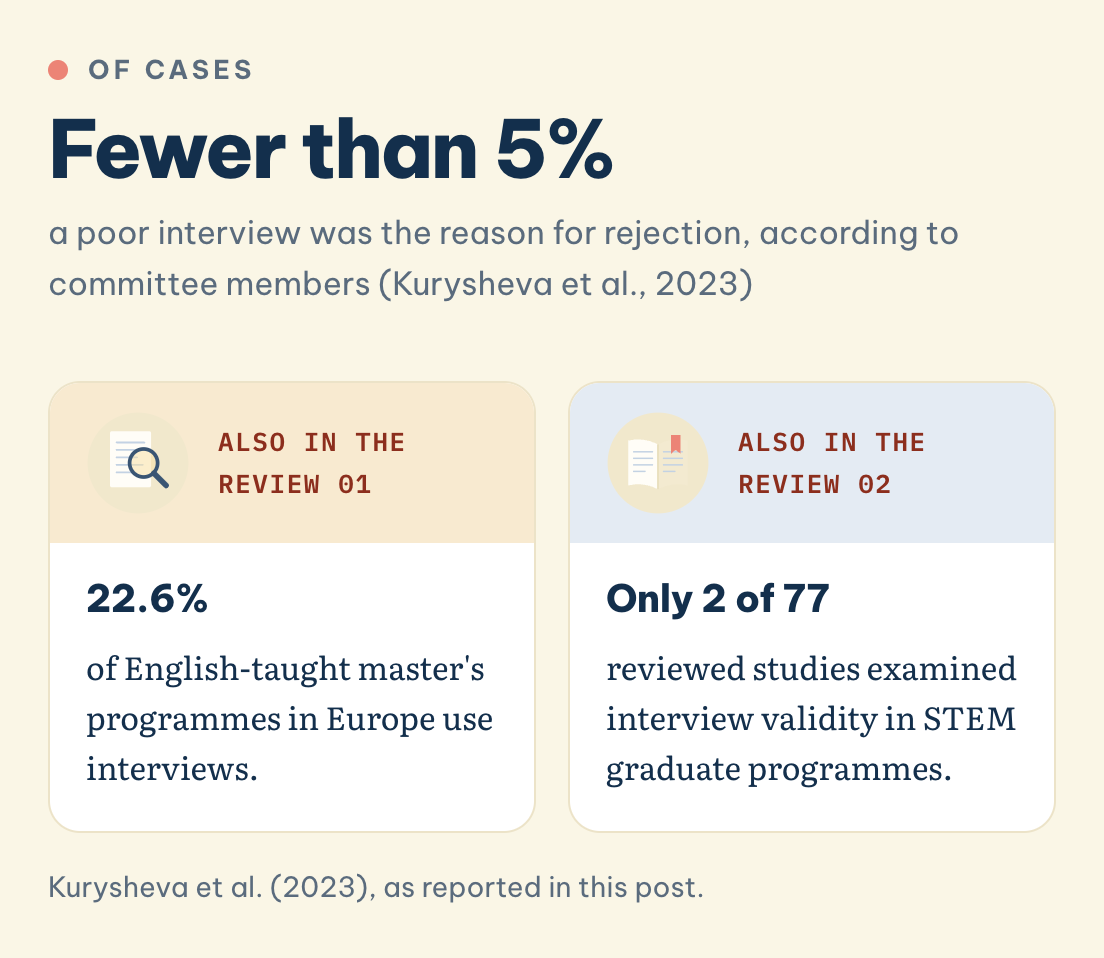
Not on its own, and the evidence urges caution here. Kurysheva et al. (2023), reviewing 77 studies in the International Journal of STEM Education, sorted graduate selection into 10 categories and rated each on predictive validity, acceptability, procedural issues and cost. Only 2 of those 77 studies examined interview validity in STEM graduate programmes, and 1 reported that traditional interviews could not distinguish the most from the least productive students by time to degree or number of first-author papers (Kurysheva et al., 2023). Their verdict on traditional interviews is unflattering: they classify personal statements and traditional interviews as invalid predictors of graduate study success, while prior research experience and multiple mini-interviews showed relationships with some success dimensions (Kurysheva et al., 2023). The review also reports that interviews are used by 22.6% of English-taught master's programmes in Europe, and that committee members said a poor interview is the reason for rejection in fewer than 5% of cases (Kurysheva et al., 2023).
Kurysheva et al. (2023) rate prior grades, the GRE General, intelligence assessments and conscientiousness as medium-to-strong predictors of graduate study success, and letters of recommendation and language proficiency tests as weak-to-medium. They also flag that interviews are susceptible to bias on gender, disability status and ethnicity, from rapport building through to post-interview evaluation, and that structure is the main correction available (Kurysheva et al., 2023). Where a panel runs a structured format with identical questions for every candidate, the methodology block is scripted and scored, which argues for rehearsing 4 answers rather than a personality.
Read that as calibration, not permission to relax. A weak interview rarely sinks a strong file, but it is where a supervisor decides whether to spend 3 or 4 years with your thinking, a judgement Posselt (2016) shows committees making in the room.
◆ Question 8 / 9 · How is a PhD admission
Direct answer: A viva defends completed work with data behind it, and examiners test your justifications. An admission interview defends work that does not exist, so every methodological answer is conditional and the panel is forecasting your judgement instead of auditing 3 or 4 years of decisions (Inouye et al., 2025).
A viva defends work that exists; an admission interview defends work that does not. In a viva you hold data, a thesis and 3 or 4 years of decisions you actually made, and 2 or 3 examiners test whether you can justify them, against the standard Zupan and Kinnear (2026) trace back to a year 1 confirmation of candidature. In an admission interview nothing sits behind you, so every methodological answer is conditional by construction and the panel assesses a forecast of your judgement rather than a record of it.
That changes what confidence looks like. In a viva, hedging can read as weakness; in an admission interview an unhedged claim about a study that has not started reads as naivety, because the plan will change, and in the Oxford and Cambridge sample of Inouye et al. (2025) fit with departmental research was cited as a reason even strong applicants were rejected. The register you want sits between the 2: firm about why the question matters, precise about the design you would start with, provisional about whatever depends on access, ethics approval or funding.
◆ Question 9 / 9 · What can you prepare
Direct answer: Prepare 4 things: rejected alternatives, load-bearing assumptions with a branch each, your field's validation vocabulary, and the boundary of your claim. Leave the 3-year plan open, because a supervisor who wants you will reshape it and expects you to absorb the suggestion across a 3 or 4 year programme.
Prepare the 4 parts that do not depend on the panel: your rejected alternatives, your 2 or 3 load-bearing assumptions with a branch each, your validation check named in your field's own vocabulary, and the boundary of your claim. All 4 are forms of the research skill that the 271 faculty in Hernández-Colón et al. (2021) asked about before anything contextual. Each fits in 3 or 4 sentences you have said out loud at least once.
Leave open whatever depends on them. Do not arrive with a fixed 3-year plan, because a supervisor who wants you will want to shape it, and a candidate who cannot absorb a suggestion in the interview looks like one who will not absorb it in year 2. The 2 MAAS mock sessions follow that split: session 1 exposes which of the 4 prepared items are still hollow, and session 2 reruns the questions in the style of the academic you will face, inferred from 2 or 3 of their recent papers, given the weight Inouye et al. (2025) record for fit. Each session runs 60 minutes of practice plus 30 minutes of preparation and written feedback, so the 2 together come to 3 hours. You remain the one who approves the proposal and the person in the interview, and MAAS supplies the adversarial reading and a transcript of where you went vague.
The questions you ask back are a separate preparation task; see What should you ask the professor at a PhD interview?.
Commonly 30 to 60 minutes, with the methodology block usually in the middle rather than at the start. Check the invitation for whether a short research presentation is required, since formats differ between programmes and a presentation moves the methodology questions to the front.
Say so plainly, then show the decision structure: what the choice is between, what would decide it, and when. An unsettled method with a clear decision rule reads better than a settled method you cannot defend, and the 40 supervisors in Zupan and Kinnear (2026) rated critical thinking among the capabilities they most wanted developed.
Yes, and 3 methodological ones land well: what data infrastructure the group holds, whether the ethics route for your population is established, and how methods training is organised. Methods training arrangements differ by institution, and Zupan and Kinnear (2026) describe 1 university that made such coursework mandatory from 2015.
They expect you to know the limits of what you have been taught and to say where they are. Claiming a technique you cannot explain is the most damaging move available in this block, because it converts a gap in knowledge into a question about judgement.
Hernández-Colón, I. R., Caño, A., Wurm, L. H., Sanders, G., & Nava, J. (2021). Instructional set moderates the effect of GRE on faculty appraisals of applicant competence: A vignette study with implications for holistic review. Frontiers in Psychology, 12, 749621. https://doi.org/10.3389/fpsyg.2021.749621
Inouye, K., Robson, J., Rodriguez Anaiz, P., Baker, S., & Ilie, S. (2025). Assessing the person or the project? How disciplinary ontological and epistemological assumptions shape doctoral admissions in elite UK institutions. Higher Education, 91(2), 701-721. https://doi.org/10.1007/s10734-025-01438-8
Kurysheva, A., van Rijen, H. V. M., Stolte, C., & Dilaver, G. (2023). Validity, acceptability, and procedural issues of selection methods for graduate study admissions in the fields of science, technology, engineering, and mathematics: A mapping review. International Journal of STEM Education, 10, Article 55. https://doi.org/10.1186/s40594-023-00445-4
Posselt, J. R. (2016). Inside graduate admissions: Merit, diversity, and faculty gatekeeping. Harvard University Press. https://grad.uw.edu/wp-content/uploads/Posselt-Gatekeeping-Reconsidered.pdf
Zupan, B., & Kinnear, S. (2026). Foundational research skills: Perspectives from supervisors and students in a regional Australian university on graduate research education. The Australian Educational Researcher, 53(2), Article 32. https://doi.org/10.1007/s13384-026-00950-9
A free 20-minute consultation is a conversation about your application situation. In the PhD application service, an expert drafts your application documents and you review, edit, approve and submit them.
Book a free consultation ▸