
◆ Student Success
How do you answer interview questions with the STAR technique?
Direct answer: Pick one real example and tell it in four parts: the situation, the task you were given, the action you took, and the result. The University of Reading (n.d.) says the action is the longest part of the answer, and that you should say "I" rather than "we" when describing what you did.
The guide was written on 23 October 2026 from careers pages at UK and Australian universities, the UK National Careers Service and one peer-reviewed review of interview research. It is aimed at international students applying for internships and graduate jobs, and it builds answers from student life: group projects, part-time work and societies. It is not a list of every question an employer might ask.

◆ Question 1 / 8 · What STAR is
What is the STAR technique?
Direct answer: STAR is a four-part structure for answering questions about past experience. The University of Reading (n.d.) defines it as Situation, Task, Action and Result, and says it is a useful way to highlight examples of your experience in both application forms and interview answers.
The National Careers Service (n.d.) gives the same four parts and adds what each one means: the situation you had to deal with, the task you were given, the action you took, and what happened as a result, including what you learned. It also says the method works on a CV, a cover letter, an application form and in an interview, so one prepared example can be reused in several places.
Employers ask for stories because of a simple idea about prediction. The University of Edinburgh Careers Service (n.d.) explains that this type of questioning treats your past behaviour as a likely predictor of future performance. Southern Cross University (n.d., p. 1) states the same assumption in one line: "Employers believe the best predictor of future achievement is past success."
◆ Question 2 / 8 · Basic questions
What are the basic STAR questions?
Direct answer: Basic STAR questions are behavioural questions that ask for a real past example. The University of Sydney (n.d.) says they often start with "Tell me about a time when...", "Describe a situation where..." or "Give an example of...", and that internship and graduate recruiters use them commonly.
The University of Sydney (n.d.) also calls this style competency-based interviewing. A peer-reviewed review of structured interviews gives the logic: these questions are based on the premise that past behaviour predicts future behaviour, and "PBQs ask applicants to describe what they did in past job-related situations" (Levashina et al., 2014, p. 267). The same review reports that this kind of question has become one of the two most popular types in structured interviews.
Which skills a question tests (teamwork, leadership, handling pressure) depends on the employer, and a catalogue of those competencies is a separate topic. What stays constant is the shape of a good reply. Whatever the competency, you are being asked for one specific episode, so a general statement such as "I work well in teams" will not answer it.
◆ Question 3 / 8 · Building an answer
How do you build a STAR answer part by part?
Direct answer: Keep the situation short, say clearly what the task was, spend most of your time on what you personally did, and finish with a result you can measure. Edinburgh describes the action as the longest part of the answer and asks you to quantify outcomes where possible.
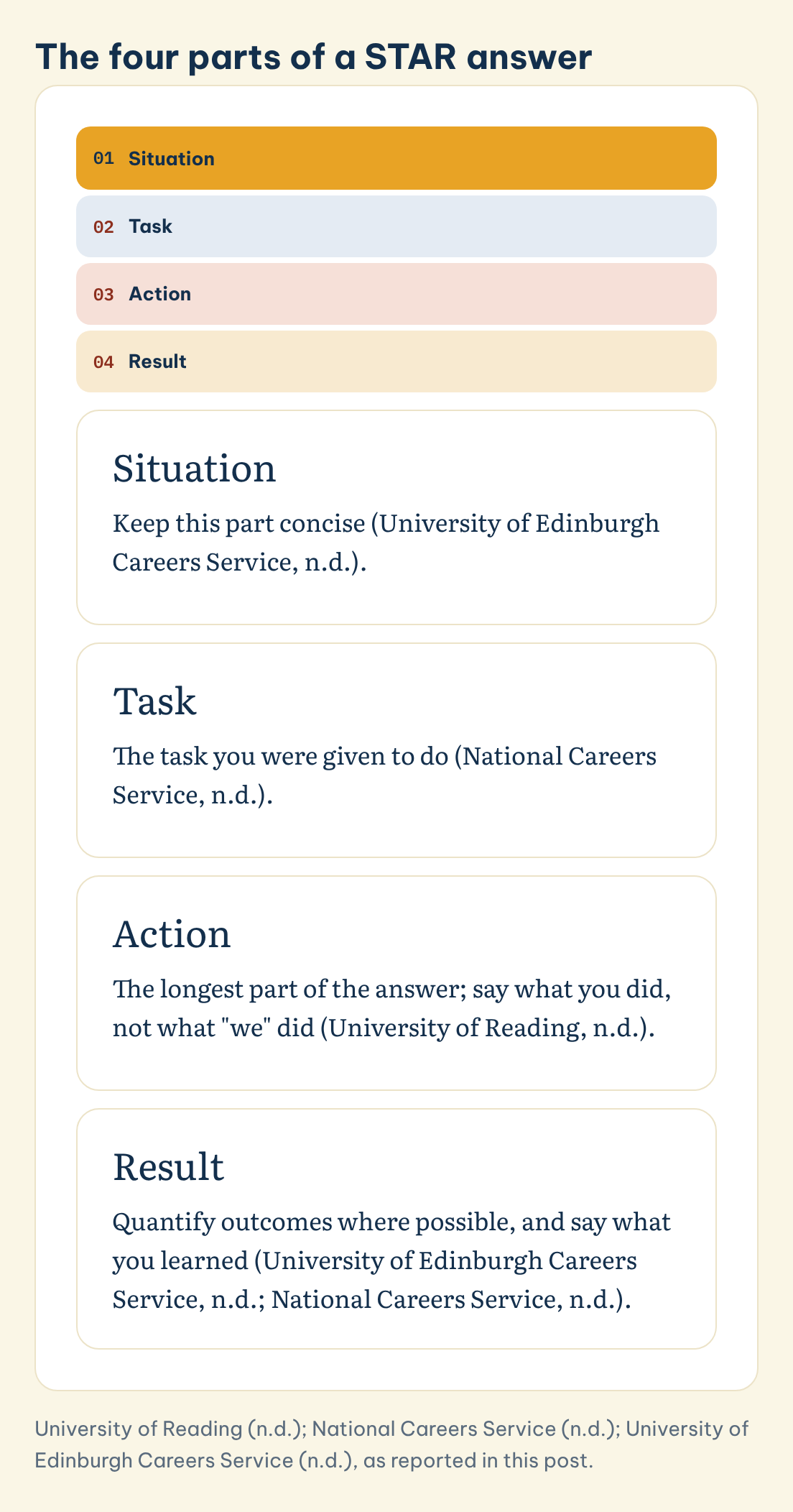
The four parts of a STAR answer
Tap each part to see what the sources say about it.
Situation
Keep this part concise (University of Edinburgh Careers Service, n.d.).
Task
The task you were given to do (National Careers Service, n.d.).
Action
The longest part of the answer; say what you did, not what "we" did (University of Reading, n.d.).
Result
Quantify outcomes where possible, and say what you learned (University of Edinburgh Careers Service, n.d.; National Careers Service, n.d.).
Save this figure
| Part | What to say | What the sources add |
|---|---|---|
| Situation | The context, in a sentence or two | Edinburgh: "keep this part of your answer concise" |
| Task | What you were responsible for | National Careers Service: the task you were given |
| Action | What you did, step by step | Reading: the longest part; say "I", not "we" |
| Result | What happened and what you learned | Edinburgh: quantify outcomes where possible |
The Australian National University (n.d.) adds detail to the action step. It asks you to be explicit and specific about the actions you took and to include qualifiers, meaning relevant information about how much, how many or how long. It explains why: you are giving the interviewer evidence they need to judge your skill level and depth.
The reason numbers help is not only style. Levashina et al. (2014) report that probing questions which ask for quantities, such as how many people were in your team and what outcomes were achieved, are more likely to reduce faking, because they make the question harder to answer with a vague story or increase accountability. A result with a figure in it pre-empts that follow-up. None of the sources gives a fixed percentage of the answer that the action should take, so treat "longest part" as the rule rather than a stopwatch target.
◆ Question 4 / 8 · Student examples
Which student examples work in a STAR answer?
Direct answer: Almost any experience can work if it shows what you did. The University of Sydney (n.d.) says you can usually use examples from work, studies, extracurricular activities, volunteering, sports or travel, and the University of Reading (n.d.) adds clubs, societies and university projects.
You do not need a corporate job to have material. The National Careers Service (n.d.) suggests examples from work, home or volunteering, and its own teamwork sample is a school netball team bake sale. Edinburgh's sample answers use a camp counsellor job and a university project team assigned at random, while Southern Cross University (n.d.) models answers on a group research assignment and a volunteer student leader role.
The example below is invented, written by MAAS to show the shape and not taken from any source, for a question about handling a team problem.
Situation: In my second-year marketing module, four of us had a group report due in three weeks, and one member had not sent his section two weeks in.
Task: As the person who had volunteered to compile the final document, I needed the missing section without damaging the team's working relationship.
Action: I messaged him privately to ask what was blocking him, learned he was unsure about the referencing format, and sent him two examples. I then agreed a new internal deadline with the group, four days before the real one, and checked in once midway.
Result: His section arrived on the new date, we submitted on time, and I now ask every group to set an internal deadline in the first meeting.
Notice the details that follow the sources. The answer uses "I" for the actions, describes the teammate's behaviour and not his character (the University of Sydney, n.d., recommends "frequently late" over "lazy"), and ends with something learned. If a question asks about a difficult situation, the Reading page recommends adding a reflection on what you learned and what you would do differently next time.
For international students, the choice of example matters. The Australian National University (n.d.) advises choosing examples most relevant to the job and organisation, so a society treasurer role may suit a finance internship better than a sports story, even if both are true.
◆ Question 5 / 8 · STAR, STARR, CARL
What is the difference between STAR, STARR and CARL?
Direct answer: The three frameworks share one idea with a different last step. STARR adds a second R for reflection, as the University of Reading (n.d.) and Southern Cross University (n.d.) describe it, while CARL stands for Context, Actions, Results and Learning, according to the University of Edinburgh Careers Service (n.d.).
Reading says the second R is useful when you are asked for a difficult situation, because it lets you say what you learned and what you would do differently. Edinburgh offers CARL as an alternative and says it helps you feel more confident if you are nervous and prone to waffling. Southern Cross University (n.d.) gives STARR in a fact sheet on written selection criteria and recommends an active voice such as "I managed the change process..." to keep the writing assertive.
Pick one version and stay with it. The choice matters less than keeping the four or five elements in order and keeping the action as the main part.
◆ Question 6 / 8 · Weaknesses
How do you answer a question about your weaknesses?
Direct answer: The sources read for this guide do not give a script for weakness questions, so this is a MAAS reading and not a published rule. Treat it as a small STARR story: a real shortfall, what you did about it, and what changed.
The structure fits because the Reading page says reflection is useful for a difficult situation, and Edinburgh asks for a range of examples from different contexts. A weakness answer that stops at "I am a perfectionist" gives the interviewer no evidence. An answer that names a specific habit, describes one action you took to change it and reports what happened gives them the same kind of evidence as any other behavioural answer.
The University of Sydney (n.d.) also advises focusing on behaviour and not on personal judgements, which applies to you as much as to teammates. "I submitted my first group draft late" is something you can fix and explain, while "I am lazy" is not.
◆ Question 7 / 8 · Mistakes
What mistakes should you avoid?
Direct answer: The most common ones in the sources are saying "we" instead of "I", giving too much background, sounding rehearsed, and leaving the result vague. Each has a published fix, and most of them can be corrected during your preparation, well before the interview itself.
- Hiding behind "we". Reading says to talk through what you did, not what "we" did, and Sydney says to clarify your role in team activities.
- Too long. The National Careers Service (n.d.) asks you to keep examples short and to the point.
- Sounding scripted. The same page recommends a conversational delivery so that you do not appear too rehearsed, and asks you to be ready for follow-up questions about the example.
- No numbers. Edinburgh says to quantify outcomes where possible, and the Australian National University (n.d.) asks for qualifiers such as how many and how long.
- One example for everything. Edinburgh asks for a range of examples from different contexts, so prepare more than one story.
Application forms add a limit of their own. Reading notes that forms can have word limits, so prepare a short version of each story as well as a spoken one.
◆ Question 8 / 8 · Practice
How can you practise your STAR answers?
Direct answer: Write each example in the four parts, say it aloud, and time it against your own sense of "short and to the point". Then ask someone who was not in the story to question you, because follow-up questions are where prepared answers usually fall apart.
MAAS does not write interview answers for you and does not promise any hiring outcome. What it offers is 1-on-1 university subject tutoring, where a MAAS expert can talk through the academic projects you plan to use as examples, so that you describe the work accurately. If you are applying for roles in the UK after your degree, our guide to the UK Graduate Route visa explains how long you can stay to job-hunt, and the Australia Temporary Graduate visa (subclass 485) covers the same question for Australia. For a different kind of interview, see What should you ask the professor at a PhD interview?.
Frequently asked questions
What does STAR stand for in an interview?
Situation, Task, Action and Result (University of Reading, n.d.). Some universities add a second R for reflection (Southern Cross University, n.d.).
Which part of a STAR answer should be longest?
The action. Reading and Edinburgh both call it the longest part of the answer (University of Reading, n.d.; University of Edinburgh Careers Service, n.d.).
Can I use university or society examples if I have no work experience?
Yes. Sydney lists studies, extracurricular activities, volunteering, sports and travel as usable examples (University of Sydney, n.d.).
Should I say "I" or "we"?
Say "I" for your own actions and clarify your role in team activities (University of Reading, n.d.; University of Sydney, n.d.).
How long should a STAR answer be?
Keep it short and to the point, and keep the situation concise (National Careers Service, n.d.; University of Edinburgh Careers Service, n.d.). The sources give no fixed number of minutes.
What if the interviewer asks a follow-up question?
Be prepared for it. The National Careers Service (n.d.) says to be ready to answer follow-up questions about the examples you give.
References
Australian National University. (n.d.). Answering questions. Student Learning and Development. Retrieved October 23, 2026, from https://www.anu.edu.au/students/careers-opportunities/careers/applications-interviews/interviews/answering-questions
Levashina, J., Hartwell, C. J., Morgeson, F. P., & Campion, M. A. (2014). The structured employment interview: Narrative and quantitative review of the research literature. Personnel Psychology, 67(1), 241-293. https://doi.org/10.1111/peps.12052
National Careers Service. (n.d.). The STAR method. Retrieved October 23, 2026, from https://nationalcareers.service.gov.uk/careers-advice/interview-advice/the-star-method
Southern Cross University. (n.d.). Addressing selection criteria [Fact sheet]. Retrieved October 23, 2026, from https://www.scu.edu.au/media/scu-dep/current-students/services/careers/7793b-AddressingSelectionCriteria-Fact-Sheet.V8WEB.pdf
University of Edinburgh Careers Service. (n.d.). Before your interview. Retrieved October 23, 2026, from https://careers.ed.ac.uk/interviews-and-assessment-centres/before-your-interview
University of Reading. (n.d.). STAR technique. Careers. Retrieved October 23, 2026, from https://www.reading.ac.uk/essentials/Careers/Applications-and-interviews/STAR-technique
University of Sydney. (n.d.). Interview tips. Careers. Retrieved October 23, 2026, from https://www.sydney.edu.au/careers/students/applying-for-jobs/interview-tips.html
Not sure how this guide applies to your own case? Talk it through with MAAS in a free 20-minute consultation.
Book a free consultation ▸