
◆ Admissions
What is the UK Graduate visa and is it still 2 years?
The UK Graduate visa lets international students stay and work after finishing an eligible UK degree, without an employer sponsoring them. GOV.UK (n.d.-a) says it lasts 2 years if you apply on or before 31 December 2026 and 18 months from 1 January 2027, with 3 years for doctoral graduates. This guide covers who qualifies, what it costs, when to apply, what you can do on it, and how to plan the move to a longer-term work visa.
◆ Question 1 / 7 · What it is
What is a graduate visa?
Direct answer: The Graduate visa, often called the Graduate route, is permission to stay in the UK after you complete an eligible course on a Student visa. GOV.UK (n.d.-a) says you can work in most jobs, look for work and be self-employed, and the white paper describes it as an unsponsored route (HM Government, 2025).
The route exists so that graduates can enter the UK labour market straight after study. The UK Government white paper on immigration (HM Government, 2025) describes it as an unsponsored route launched in July 2021 whose purpose is for international student graduates to work, or look for work, after successfully completing an eligible course. In practice that means the visa is tied to your own completed degree, not to an employer, so it does not depend on a job offer at the point of application. The same white paper reports that 62% of Graduate visa holders were earning in the first month of their visa and 90% within six months (HM Government, 2025, p. 34). Those figures describe earning, not the type of job, and the government has said it wants more holders to move into graduate-level roles.
◆ Question 2 / 7 · 2 years or 18 months
Is the graduate visa still 2 years?
Direct answer: Yes, for applications submitted up to the end of 2026. From 1 January 2027 GOV.UK (n.d.-a) shortens the standard length to 18 months, while anyone holding a PhD or other doctoral qualification still receives 3 years. The submission date decides which length applies.
The cut to 18 months was announced in the May 2025 immigration white paper, which states: "we will reduce the ability for Graduates to remain in the UK after their studies to a period of 18 months" (HM Government, 2025, p. 39). GOV.UK (n.d.-a) now shows the change with a clear date line, so the length you receive depends on the date you submit your application, not the date you started your course. On the published rule, a 2-year visa requires the completion report to be made and the application to be submitted on or before 31 December 2026, while Student permission is still valid. Students finishing in late 2026 can find both dates on their university's results timetable and their own visa record. Rules can change again, so read the GOV.UK page on the day you apply.
| Situation | Length of Graduate visa | Source |
|---|---|---|
| Eligible degree (non-doctoral), applied on or before 31 December 2026 | 2 years | GOV.UK (n.d.-a) |
| Eligible degree (non-doctoral), applied on or after 1 January 2027 | 18 months | GOV.UK (n.d.-a) |
| PhD or other doctoral qualification | 3 years | GOV.UK (n.d.-a) |
| Extending a Graduate visa | Not possible | GOV.UK (n.d.-a) |
◆ Question 3 / 7 · Requirements
What are the requirements for a graduate visa?
Direct answer: GOV.UK (n.d.-b) lists four conditions: you are in the UK, your current visa is a Student or Tier 4 (General) student visa, you studied an eligible UK bachelor's, postgraduate or other course for a minimum period, and your education provider has told the Home Office you completed it.
The four Graduate visa conditions
Tap a condition to see what GOV.UK and UKCISA say about it.
In the UK
You must be in the UK when you apply (GOV.UK, n.d.-b).
Student visa
Your current visa is a Student or Tier 4 (General) student visa (GOV.UK, n.d.-b).
Eligible course
A UK bachelor's, postgraduate or other eligible course, studied for the minimum period: the full course if 12 months or less, otherwise at least 12 months (UKCISA, n.d.).
Completion report
Your education provider has told the Home Office you completed the course. Apply only after that report (UKCISA, n.d.).
Save this figure
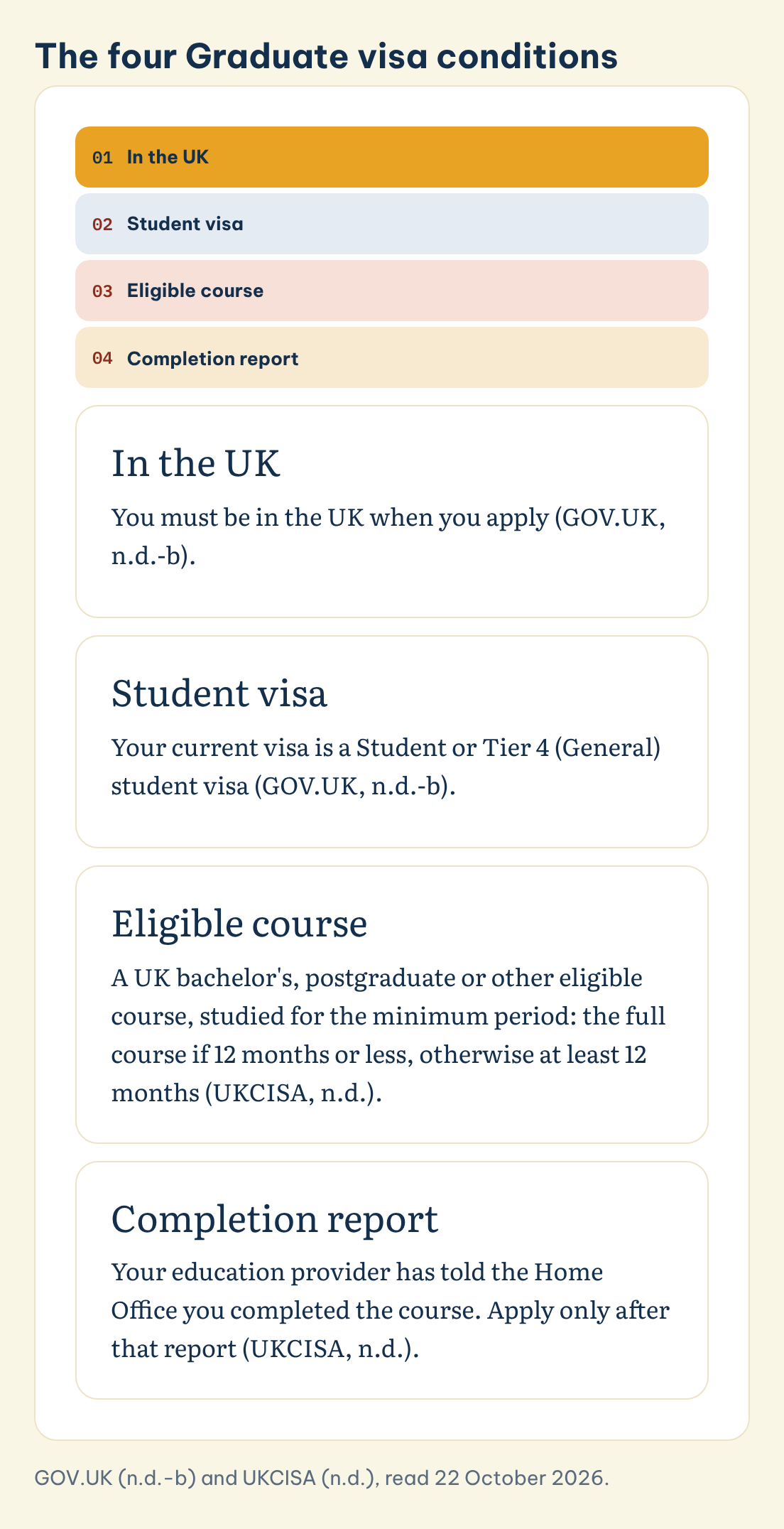
The minimum period is where students most often get caught out. UKCISA (n.d.) explains that for a course of 12 months or less you should have held Student permission for the full duration of the course, and for a longer course at least 12 months of Student permission, with the study done in the UK. UKCISA (n.d.) also says you can hold permission under the Graduate route only once. Successful completion is a formal step, not your graduation ceremony. Your education provider reports it to the Home Office (GOV.UK, n.d.-b), and UKCISA (n.d.) advises that you should not make your immigration application until you know your institution has made this report. Until that report exists, the completion condition is not met.
◆ Question 4 / 7 · Tier 4 and sponsorship
Is the graduate visa Tier 4 or Tier 2, and does it need sponsorship?
Direct answer: Neither. Tier 4 was the old name for the Student visa, which is the visa you must hold before applying, and Tier 2 is a common shorthand for sponsored work. The Graduate visa itself is unsponsored, so no employer has to back your application (HM Government, 2025).
The search phrase "graduate visa sponsorship" usually reflects a real planning question: what happens when the Graduate visa ends? GOV.UK (n.d.-a) is direct that you cannot extend a Graduate visa, but you may be able to switch to another visa such as the Skilled Worker visa. That route works differently. GOV.UK (n.d.-d) says a Skilled Worker must work for a UK employer approved by the Home Office, hold a certificate of sponsorship, and have a confirmed job offer before applying. Because the Graduate period will be shorter for applications from 2027, students who want to stay longer should treat the Graduate visa as a window to find a sponsoring employer, and should check early which employers in their field hold a sponsor licence rather than waiting until the final months.
◆ Question 5 / 7 · Cost
How much is a 2 year graduate visa?
Direct answer: GOV.UK (n.d.-a) lists a £937 application fee plus the Immigration Health Surcharge, usually £1,035 for each year you will be in the UK. By our calculation, a 2-year visa therefore comes to about £3,007 for the main applicant alone, before any partner or children apply.
Our own arithmetic for the common cases, based on the figures GOV.UK (n.d.-a) publishes, is that a 2-year visa costs £937 plus 2 × £1,035, or £3,007 and a 3-year doctoral visa costs £937 plus 3 × £1,035, or £4,042. The surcharge for an 18-month visa depends on how GOV.UK charges the part year, so use the official surcharge calculator rather than our estimate. Family members are separate. GOV.UK (n.d.-c) says each partner or child needs their own application and pays the fee, and a partner must usually have been your dependant on your Student visa already. Budget for the whole family before your final term, because you must apply before your Student visa expires (GOV.UK, n.d.-a).
◆ Question 6 / 7 · Apply and rules
How do you apply for the Graduate visa, and what can you do on it?
Direct answer: You apply from inside the UK, before your Student visa expires, once your university has reported your completion (GOV.UK, n.d.-a; UKCISA, n.d.). On the visa you can work in most jobs, look for work, be self-employed, travel and do approved volunteering.
GOV.UK (n.d.-a) also sets out what the visa does not allow. You cannot claim most benefits (public funds) or the State Pension, and you cannot work as a professional sportsperson. You can study on a Graduate visa, but only on a course that is not eligible for a Student visa (GOV.UK, n.d.-b). For individual questions about your own case, your university's international student team or a regulated immigration adviser is the right contact, and this post is general information only. If your plan after the visa is further study, such as a PhD, our guide to the difference between a statement of purpose and a motivation letter covers the application documents.
◆ Question 7 / 7 · MAAS support
How can MAAS help you plan study and career steps in the UK?
Direct answer: MAAS advisors help students plan study applications and the documents that go with them, such as a statement of purpose. MAAS does not give immigration advice and does not submit visa applications. For visa questions, use GOV.UK, your university's international student team, or a regulated immigration adviser.
MAAS's study abroad and statement of purpose consulting is an advisory service. An advisor works through your study goals with you, asks the questions that bring out your evidence, and gives feedback on drafts that you write yourself, whether that is an application for a UK master's or a later PhD. The service commits to guidance quality, not to any admission result. If you are still choosing where to apply, our guide to UCAS deadlines sets out the undergraduate timeline. You can book a free discovery call with MAAS, a Ho Chi Minh City company, to talk through your plans.
Frequently asked questions
Can I apply for the Graduate visa from outside the UK?
No. GOV.UK (n.d.-b) says you must be in the UK when you apply, and your current visa must be a Student or Tier 4 (General) student visa.
Can I extend my Graduate visa?
No. GOV.UK (n.d.-a) says you cannot extend it, but you may be able to switch to another visa such as the Skilled Worker visa, which needs a sponsoring employer and a confirmed job offer (GOV.UK, n.d.-d).
Can I have a second Graduate visa after another degree?
No. UKCISA (n.d.) says you can hold permission under the Graduate route only once.
Can my partner and children come with me on a Graduate visa?
They can apply if they are eligible. GOV.UK (n.d.-c) says a partner must usually have been your dependant on your Student visa, and each family member applies and pays separately.
When exactly does the 18-month rule start?
GOV.UK (n.d.-a) says the visa lasts 18 months if you apply on or after 1 January 2027. Applications on or before 31 December 2026 get 2 years, and doctoral graduates get 3 years.
Do I need a job offer to get the Graduate visa?
No. The white paper describes it as an unsponsored route for graduates to work or look for work (HM Government, 2025), and GOV.UK (n.d.-a) lists looking for work among what you can do.
References
GOV.UK. (n.d.-a). Graduate visa. Retrieved October 22, 2026, from https://www.gov.uk/graduate-visa
GOV.UK. (n.d.-b). Graduate visa: Eligibility. Retrieved October 22, 2026, from https://www.gov.uk/graduate-visa/eligibility
GOV.UK. (n.d.-c). Graduate visa: Your partner and children. Retrieved October 22, 2026, from https://www.gov.uk/graduate-visa/your-partner-and-children
GOV.UK. (n.d.-d). Skilled Worker visa. Retrieved October 22, 2026, from https://www.gov.uk/skilled-worker-visa
HM Government. (2025). Restoring control over the immigration system (CP 1326). Home Office. https://assets.publishing.service.gov.uk/media/6821aec3f16c0654b19060ac/restoring-control-over-the-immigration-system-white-paper.pdf
UKCISA. (n.d.). Graduate route. UK Council for International Student Affairs. Retrieved October 22, 2026, from https://www.ukcisa.org.uk/student-advice/working/graduate-route/
Not sure how this guide applies to your own case? Talk it through with MAAS in a free 20-minute consultation.
Book a free consultation ▸