
◆ UK undergraduate admissions
UCAS deadlines for 2027 entry and what happens if you miss them
UCAS lists 15 October 2026 and 13 January 2027 as the equal consideration dates for 2027 entry, and 30 June 2027 as the last main-cycle date. The October date applies to Oxford, Cambridge and most medicine, dentistry and veterinary courses, the January date to most other undergraduate courses, both at 18:00 UK time. The October date passed on 15 October 2026, so most applicants reading this are working towards January. Miss the January date and you can often still apply, because the main cycle runs to 30 June 2027 and Clearing follows, though a university is no longer obliged to weigh your application equally. UCAS says late applications to 15 October courses are rarely considered. This guide sets out the dates in a table, explains what each one means in practice, and covers what international applicants should note about individual university deadlines and visa timing.

◆ Question 1 / 7 · What are the UCAS deadlines
What are the UCAS deadlines for 2027 entry?
Direct answer: UCAS (n.d.-a) lists the key 2027 entry dates as 15 October 2026 and 13 January 2027 for equal consideration, 30 June 2027 for applications to be sent to universities, and 23 September 2027 as the last day to apply for 2027 entry. All times are 18:00 UK time.
The table below reproduces the dates that UCAS (n.d.-a) shows on its dates and deadlines page for the 2027 entry cycle. Always confirm them on ucas.com before you rely on them, because they can be updated and the page is the authority.
| Date | What UCAS says happens |
|---|---|
| 12 May 2026 | UCAS applications open for 2027 entry |
| 1 September 2026 | Completed applications can be submitted to UCAS |
| 15 October 2026, 18:00 | Equal consideration date for Oxford and Cambridge, and for most courses in medicine, dentistry and veterinary medicine or science |
| 13 January 2027, 18:00 | Equal consideration date for most undergraduate courses |
| 25 February 2027 | Extra opens |
| 30 June 2027, 18:00 | Applications received by this deadline are sent to universities and colleges |
| 1 July 2027 | Last day to add an Extra choice |
| 2 July 2027 | Clearing opens |
| 22 July 2027, 18:00 | Last day for undergraduate reply swaps |
| 23 September 2027, 18:00 | Final date for 2027 entry applications |
| 18 October 2027 | Last date to add a Clearing choice |
UCAS (n.d.-a) also lists a 15 December 2026 date for PGCE teacher training courses in Wales, which does not apply to most undergraduate applicants. The page, as we read it on 20 October 2026, lists 18 October 2027 as the last date to add a Clearing choice, the equivalent of 19 October in the 2026 cycle. It gives no general reply deadline other than the 22 July reply swap date, so check reply dates on ucas.com when you reach that stage.
Two cautions apply. First, the date that matters to you is the one for your particular course, which you can see in UCAS's search tool. Second, some courses start between January and July, and UCAS (n.d.-a) says their deadlines may be earlier than those above.
◆ Question 2 / 7 · Which courses have the 15
Which courses have the 15 October deadline, and what does "equal consideration" mean?
Direct answer: Oxford, Cambridge and most courses in medicine, dentistry and veterinary study use the 15 October date. "Equal consideration" means that a provider must consider every application received by the date equally, according to the wording on UCAS's 13 January event page (UCAS, n.d.-b).
The two equal consideration dates for 2027 entry
What each UCAS deadline covers and what changes if you miss it
15 October 2026 deadline
13 January 2027 deadline
Oxford, Cambridge and most medicine, dentistry and veterinary courses
Most other undergraduate courses
Applications must be complete, including the academic reference
Providers must consider applications received by the date equally
The date has already passed for 2027 entry
The date most applicants are now working towards
Later applications are not assured of equal consideration
Later applications may be considered if places remain
Check your course in UCAS's search tool
Some courses starting January to July have earlier dates
Save this figure
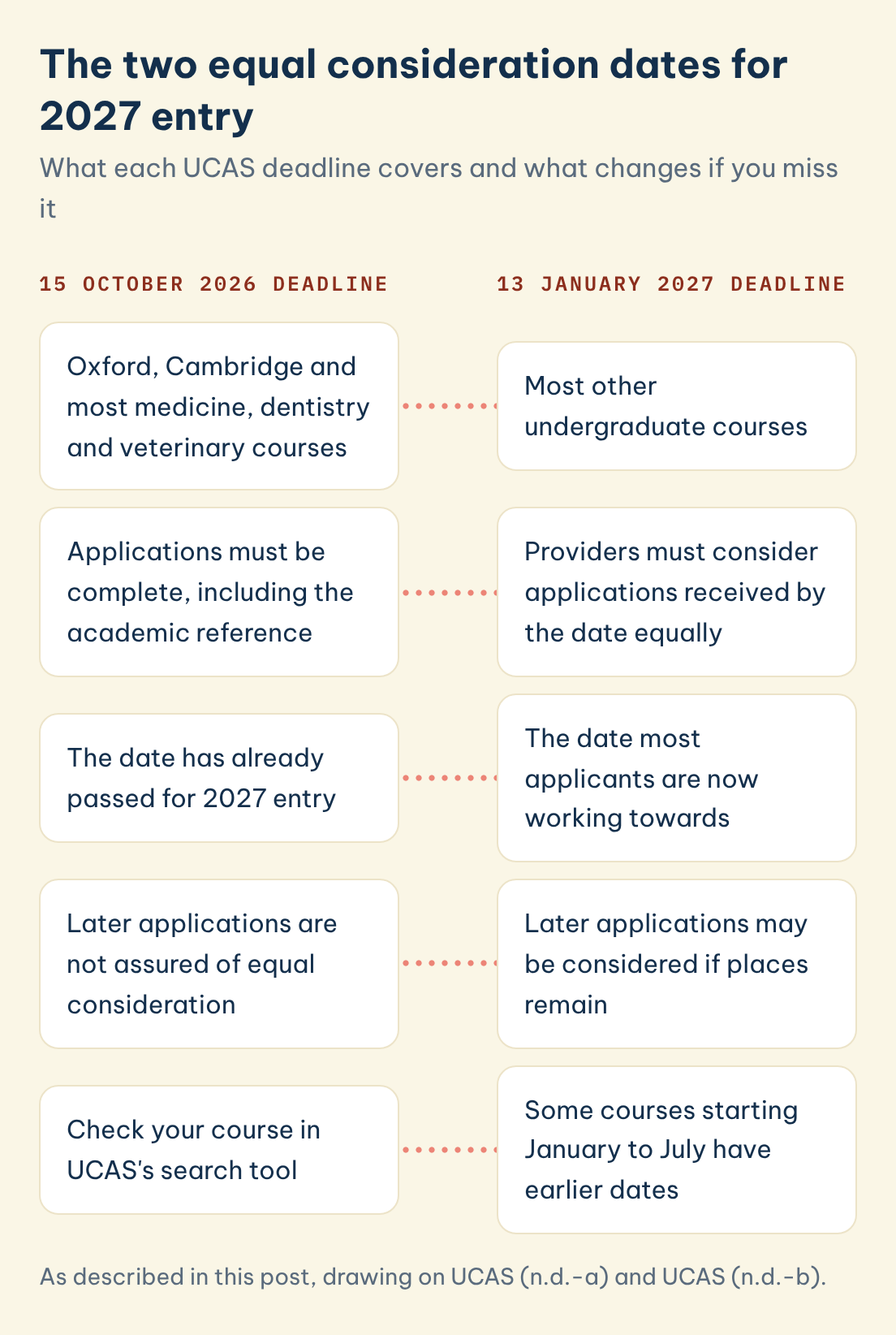
The same UCAS (n.d.-b) page explains the January version of the rule: course providers must consider all applications received by the deadline equally, and they do not have to consider applications that arrive afterwards, although they can if places remain. The deadline is therefore not a wall in the way a closing date for a job might be. It is a promise about fairness for those who apply on time.
UCAS (n.d.-a) attaches a condition to the October date. Applications submitted by 15 October are only assured of consideration if they are complete, and that includes the academic reference. A statement and course choices submitted on 14 October with no reference attached are not in the same position as a finished application. For that reason, plan the personal statement and the reference request well before the date. Our guide on the three-question UCAS personal statement explains the character limits and how to structure each answer.
◆ Question 3 / 7 · What happens if you miss
What happens if you miss the 13 January deadline?
Direct answer: You can often still apply until 30 June 2027, but providers do not have to consider late applications equally. UCAS (n.d.-b) says they may consider them if they have places left once on-time applications have been dealt with, so popular courses may already be full.
UCAS's international advisers' page on the equal consideration date makes the risk concrete: once the date has passed, universities can close a course if they think it is fully subscribed (UCAS, n.d.-c). That page was written around the 2026 cycle, so its dates are not ours, but the principle carries over. A late application to a course with few places may meet a closed door, while a late application to a course with spare capacity may be treated as normal.
If you miss the date, the sensible response is to check, course by course, whether the provider is still accepting applications. UCAS's search tool and the provider's own admissions pages are the places to look. You can also contact the admissions team directly and ask. Writing a short, polite email that names the course and your entry year is a normal request, and the answer will often settle whether it is worth applying.
◆ Question 4 / 7 · What happens after 30 June
What happens after 30 June: Extra and Clearing?
Direct answer: UCAS (n.d.-a) says applications received by 18:00 on 30 June 2027 will be sent to universities and colleges, and Clearing opens on 2 July 2027. UCAS (n.d.-a) also lists a stage called Extra, which opens on 25 February 2027 and lets you add a choice until 1 July.
UCAS (n.d.-a) states that applications received by the 30 June deadline will be sent to universities and colleges. What follows for later applicants is Clearing, which UCAS (n.d.-a) shows opening on 2 July 2027, with 18 October 2027 as the last date to add a Clearing choice and 23 September 2027 as the final date for 2027 entry applications.
UCAS (n.d.-a) says Extra may let you add another choice if you have used all five choices and are not holding any offers. What is clear from the dates is that Extra is a spring stage, open from 25 February, while Clearing is a summer stage for applications and choices that come after the main cycle.
◆ Question 5 / 7 · What should international
What should international applicants note about deadlines and visas?
Direct answer: UCAS (n.d.-a) says many universities and colleges take international applications nearer the start of the course, so check each university. The GOV.UK student visa page says you can apply from outside the UK no sooner than 6 months before your course begins (GOV.UK, n.d.).
Three points matter for students applying from outside the UK, including from Vietnam.
- Individual university deadlines can differ. The UCAS dates are national reference points. UCAS (n.d.-a) notes that many universities accept international applications later, but a later deadline is not a reason to wait. UCAS (n.d.-c) recommends applying earlier where possible, to clarify things such as visas and accommodation.
- Clearing is a poor fit if you need a visa. The same international advisers' page describes Clearing as having shorter timelines and being "not ideal for students who need a visa" (UCAS, n.d.-c).
- The visa clock starts from your course start date. GOV.UK (n.d.) says you must have been offered a place on a course by a licensed student sponsor and that, when applying from outside the UK, you will usually get a decision within 3 weeks. Faster decisions may be available for a fee. Because the earliest application date is 6 months before the course starts, a September start means the visa window opens in March, so check with each university when it can confirm your place, because the visa needs a confirmed offer from a licensed sponsor.
Check English language requirements at the same time. They are set on each course page and vary by provider, so they belong in your planning from the first month. If you are looking beyond undergraduate study, funding and scholarship deadlines for PhD applicants often fall before the programme deadline, and the same backwards planning applies.
◆ Question 6 / 7 · How should you plan
How should you plan backwards from the deadline?
Direct answer: Start from the date for your course and work back through the reference, the personal statement and your qualifications. Because the 15 October date has passed, a 13 January 2027 plan from late October gives about twelve weeks, enough for several drafts, which UCAS (n.d.-d) expects a personal statement to need.
The timings in this table are our own planning suggestion, not UCAS rules, and they assume a 13 January 2027 deadline. Applicants whose course has an earlier date should compress them or check with the provider.
| Step | Suggested timing before 13 January 2027 |
|---|---|
| Choose courses and check entry requirements, including English language | By the end of October |
| Ask the referee for the academic reference | Early November, so there are several weeks in hand |
| Draft the three personal statement answers | Several drafts through November and early December |
| Collect feedback from a teacher or adviser | One round before the final draft, in mid December |
| Submit a complete application | Aim for a few days before 13 January, not the final afternoon |
The point of the last row is practical. UCAS (n.d.-a) says its assurance on the 15 October date depends on a complete application, and a January application finished at 17:55 on the final day leaves no room for a technical problem or a missing reference.
Each of the three answers has to reach 350 characters and together they must not exceed 4,000 characters (UCAS, n.d.-d), so decide your split early. Our guide on how a statement of purpose differs from a motivation letter is useful if you are moving to postgraduate applications later.
◆ Question 7 / 7 · How can MAAS help
How can MAAS help with application timing?
Direct answer: A MAAS advisor builds a backwards timeline from your course deadlines, coaches you through your own personal statement and gives feedback on drafts you write. MAAS does not write the statement and cannot promise admission, which is decided by the university.
MAAS's admissions consulting service is advisory. In a first conversation the advisor looks at your target programmes, which deadline applies to each, and when the reference, the statement and any English test need to be finished. The words and the story stay yours. A free 20-minute discovery call with MAAS, a Ho Chi Minh City company, is a conversation about where you are, with no obligation. You can book one here.
Frequently asked questions
When is the UCAS deadline for 2027 entry?
UCAS (n.d.-a) lists 15 October 2026 for Oxford, Cambridge and most medicine, dentistry and veterinary courses, and 13 January 2027 for most other undergraduate courses, both at 18:00 UK time. Check your course in UCAS's search tool, because some courses have different dates.
Can I still apply after the 13 January deadline?
Often yes. UCAS (n.d.-b) says providers do not have to consider applications received after the deadline, but they can if they have places available. The final application date for 2027 entry is 23 September 2027, according to UCAS (n.d.-a).
What is the last date to apply in the main cycle?
UCAS (n.d.-a) shows 30 June 2027 at 18:00 UK time as the date by which applications will be sent to universities and colleges. Clearing opens on 2 July 2027.
Do international students have the same UCAS deadlines?
The UCAS dates are the same, but UCAS (n.d.-a) notes that many universities accept international applications later in the year, closer to course start dates. UCAS (n.d.-c) still recommends applying earlier, because it helps to clarify visas and accommodation.
When can I apply for a student visa?
GOV.UK (n.d.) says the earliest you can apply from outside the UK is 6 months before your course starts, and that you must have been offered a place by a licensed student sponsor. You will usually get a decision within 3 weeks.
References
GOV.UK. (n.d.). Student visa: Overview. https://www.gov.uk/student-visa
UCAS. (n.d.-a). Dates and deadlines for uni applications. https://www.ucas.com/applying/applying-to-university/dates-and-deadlines-for-uni-applications
UCAS. (n.d.-b). 2027 entry deadline for all undergraduate courses except those with a 15 October deadline. https://www.ucas.com/events/2027-entry-deadline-for-all-undergraduate-courses-except-those-with-a-15-october-deadline-475546
UCAS. (n.d.-c). Why students should apply by the equal consideration date (ECD). https://www.ucas.com/international/international-advisers/supporting-international-students/why-students-should-apply-by-the-equal-consideration-date-ecd
UCAS. (n.d.-d). How to write your personal statement: 2026 entry onwards. https://www.ucas.com/applying/applying-to-university/writing-your-personal-statement/how-to-write-your-personal-statement-for-2026-entry-onwards
Not sure how this guide applies to your own case? Talk it through with MAAS in a free 20-minute consultation.
Book a free consultation ▸