
◆ UK undergraduate admissions
UCAS personal statement 2026: the three-question format explained
The UCAS personal statement for 2026 entry onwards is three separate answers that share a limit of 4,000 characters, not one free-form essay. UCAS (n.d.-a) asks why you want to study the course or subject, how your qualifications and studies prepared you, and what you have done outside education and why it is useful. Each answer needs at least 350 characters, and you decide how to divide the rest. This guide walks through what each question is really asking, shows a worked structure you can adapt, lists the mistakes that waste characters, and explains what international applicants, including students applying from Vietnam, should keep in mind.

◆ Question 1 / 7 · What is the UCAS personal
What is the UCAS personal statement format for 2026 entry onwards?
Direct answer: The UCAS personal statement for 2026 entry onwards is a set of three questions, each with its own answer box, instead of one open essay. The total limit stays at 4,000 characters including spaces, and every answer has a minimum of 350 characters that is labelled on the question boxes (UCAS, n.d.-a).
UCAS (n.d.-a) publishes its guidance under the title "How to write your personal statement: 2026 entry onwards", so the three-question format applies to applications for courses that start in 2026 and later. That includes the 2027 entry cycle that is open now. The University of Cumbria (n.d.) describes the change as one of format rather than content: what admissions staff expect you to talk about has not changed, but the questions now tell you where to put it.
The three questions, in the order they appear, are these:
- Why do you want to study this course or subject?
- How have your qualifications and studies helped you to prepare for this course or subject?
- What else have you done to prepare outside of education, and why are these experiences useful?
UCAS (n.d.-a) adds two points that remove a lot of anxiety. There is no wrong place to put a piece of information across the three answers, and you may divide the 4,000 characters between them however you choose. Admissions staff read the statement as a whole, so the same example should not appear twice.
One practical warning concerns counting. Characters are not words, and spaces and punctuation count. The form's own counter is the reliable measure, so draft in a plain text file if you like, but check the final text in the application. As a rough guide of our own, 4,000 characters with spaces is somewhere around 600 to 700 words, which is shorter than many students expect.
◆ Question 2 / 7 · What should you put
What should you put in question 1, why this course or subject?
Direct answer: Question 1 is where you show genuine interest and knowledge of the course or subject. UCAS (n.d.-a) points to your motivations, what you know and have explored, including super-curricular activities, and your future plans and why this course suits them.
A super-curricular activity is something you do because of the subject, beyond what your lessons require: reading a book or paper, following a lecture series or podcast, entering a competition, or carrying out a small project of your own. A good way to build the answer is to start from what sparked your interest, show what you have read or done since, and finish by linking the course to your future plans.
A useful test is whether a sentence could appear in anyone else's statement. "I have always been fascinated by business" could. "After reading about how a local supplier changed its pricing during a shortage, I started comparing demand curves in the textbook with what I saw in my family's shop" could not. The second version names something you did and connects it to the subject, which is what UCAS (n.d.-a) means when it asks you to make your evidence relevant and specific to the subject.
Because UCAS (n.d.-a) tells you to expect several drafts, treat your first version of question 1 as a pile of raw material. Write down three moments or pieces of reading, keep the one you can discuss in the most detail, and let the others go to question 2 or 3 if they fit better.
◆ Question 3 / 7 · What belongs in questions 2
What belongs in questions 2 and 3?
Direct answer: Question 2 is about what your formal studies gave you for this subject, and question 3 is about everything else you have done. UCAS (n.d.-a) advises against repeating your grades in question 2 because universities see them elsewhere, and says question 3 can cover work experience, volunteering, personal experiences, hobbies and achievements.
What each UCAS answer should do, and what to leave out
The three questions of the 2026 entry format
Put it in the answer
Leave it out or move it
Question 1: what sparked your interest and what you have explored in the subject
A generic claim of lifelong fascination that anyone could write
Question 2: coursework or a project, the skill it built, an achievement such as a leadership role
A list of subjects and grades, which universities see elsewhere in the application
Question 3: work, volunteering or a responsibility, and why it is useful for the course
An activity listed with no explanation of what it taught you
Your own words, shaped by feedback from a teacher or adviser
AI-generated or copied text presented as your own
Each answer above 350 characters, 4,000 in total
The same example repeated across two answers
Save this figure
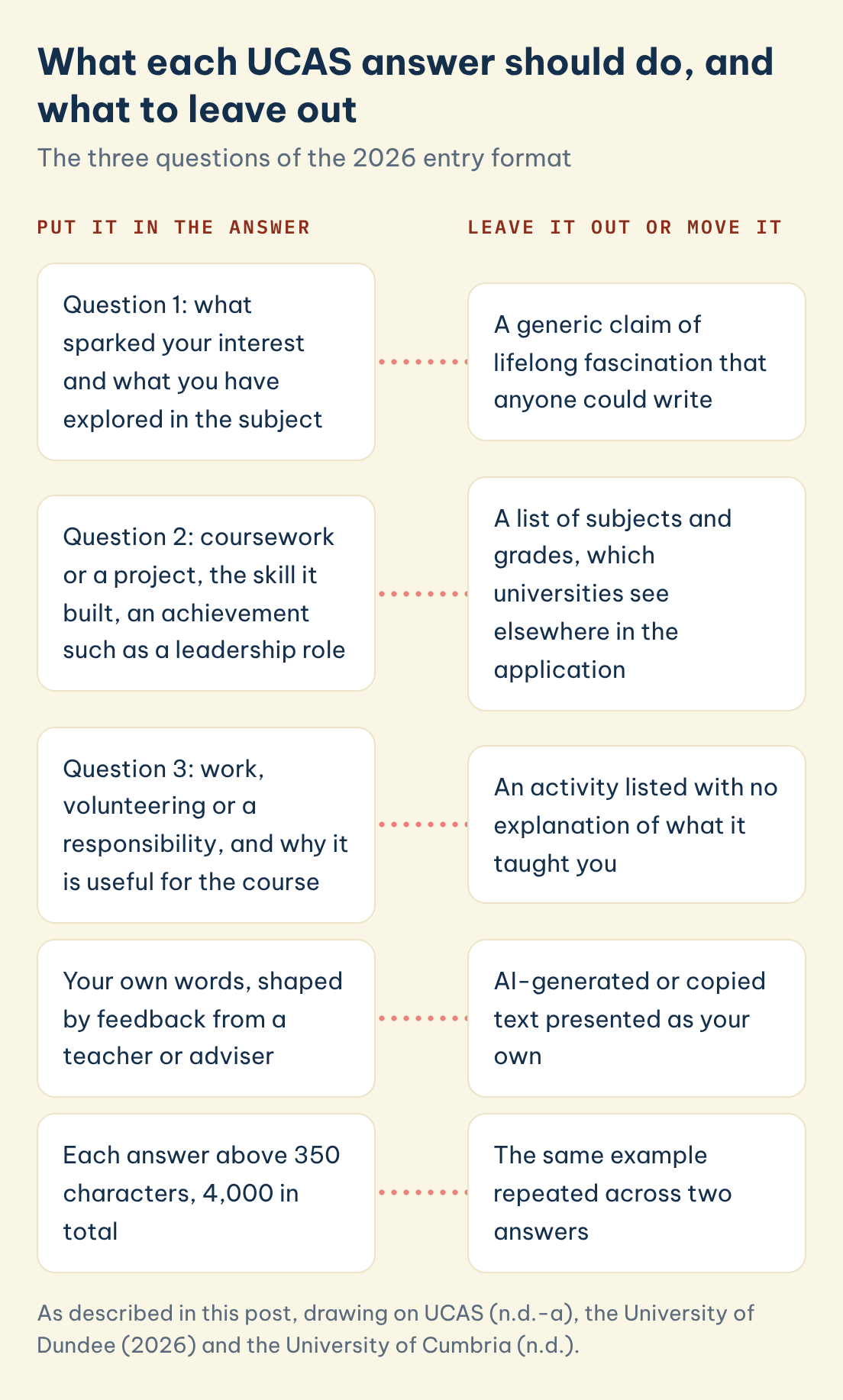
Question 2 is easy to misuse. Your qualifications already appear in the education section of the application, so a list of subjects and predicted results spends characters on information the reader has. The University of Cumbria (n.d.) makes the same point and suggests mentioning achievements such as leadership roles, awards, competition results or performances instead. The better use of the space is to connect a particular piece of coursework, project or essay to the course. UCAS (n.d.-a) lists coursework, essays and projects among the evidence you can draw on, and transferable skills such as analysis, communication or teamwork are worth naming when a project genuinely built them.
Question 3 covers what UCAS (n.d.-a) describes as activities outside formal education. UCAS (n.d.-a) gives examples that go beyond the obvious, including sport, summer schools, work and volunteering, and personal responsibilities such as caring for a family member. The second half of the question matters as much as the first. "Why are these experiences useful?" asks you to say what the activity taught you and how it prepares you for study, not just to list it. If you have left full-time education, UCAS (n.d.-a) says to describe what you have done since leaving.
If you are unsure whether a piece of evidence belongs in question 2 or 3, the rule from UCAS (n.d.-a) applies: it can go in either, so choose the answer where it does the most work and do not repeat it. Our guide on how a statement of purpose differs from a motivation letter covers how the same genre changes for postgraduate applications.
◆ Question 4 / 7 · How should you split
How should you split the 4,000 characters? A worked structure
Direct answer: UCAS (n.d.-a) sets only the minimum of 350 characters per answer and the 4,000 total, so the split is your decision. A common sensible starting point is to give question 1 slightly more space, then adjust once you see which answer has the strongest evidence.
The table below is an illustrative plan, not a UCAS requirement. It shows one way of dividing the limit and what each part might hold for an applicant to a business degree.
| Answer | Illustrative character budget | What it might contain |
|---|---|---|
| Question 1: why this course or subject | About 1,400 | The moment or reading that started your interest, one project you carried out yourself, and a sentence about where the course could take you |
| Question 2: qualifications and studies | About 1,300 | One piece of coursework or an extended project, the skill it built, and an achievement such as a leadership role or competition result instead of a grade list |
| Question 3: outside education | About 1,300 | One job, volunteering role or responsibility, what you did in it, and what it showed you about the subject |
| Spare for editing | About 0 to 100 | A small margin so that cutting and polishing never takes any answer below 350 |
These figures add up to 4,000, but you should not aim to fill every character. A tight 3,700 characters of specific evidence reads better than 4,000 of padding. What does matter is that each answer stays above the 350-character minimum shown on its box (UCAS, n.d.-a).
A short worked example of one answer shows how the pieces fit. The details below are invented for illustration. Suppose the applicant's question 3 begins: "For two years I have covered shifts at my uncle's electronics shop in Da Nang, where I handled stock counts and explained product differences to customers who were comparing prices." The next sentence should state why that matters: "Seeing how a small change in price moved sales from one model to another made the supply and demand diagrams from my economics class feel concrete, and it is the reason I want to study business economics formally." That pair of sentences gives a fact, then the use of the fact, which is exactly what the second half of the question asks for.
◆ Question 5 / 7 · What mistakes should you
What mistakes should you avoid, including with AI?
Direct answer: The most common mistakes are listing grades in question 2, repeating evidence across answers, leaving an answer under 350 characters, and submitting text that is not in your own words. UCAS (n.d.-b) says it checks for similarity and that you declare the statement is not copied, including from AI software.
UCAS (n.d.-a) lists the mistakes to avoid. Beyond those already mentioned, it advises writing several drafts and not posting your statement online, and UCAS (n.d.-b) explains that statements go through similarity checks, so copied material is likely to be spotted. UCAS (n.d.-a) also says that you should avoid exaggeration, quotations and clichés, and should not leave the statement to the last minute or rely on a spellchecker alone.
Where AI is concerned, UCAS (n.d.-b) is specific. Submitting AI-generated text as though it were your own may be treated as fraud, and UCAS (n.d.-b) says this "could in turn mean you don't receive any offers or have offers withdrawn". UCAS suggests AI can help with ideas, structure and readability, provided the final wording is yours. A safe habit is to use any tool only to ask questions of your own draft and never to supply sentences. For a wider view of what universities accept, see our guide to which AI tools are allowed in university work, and our explanation of what to do if you are accused of using AI.
Sharing is the last point. UCAS (n.d.-a) tells applicants not to post their statement online or pass it around, other than to people they trust for feedback. A teacher, adviser or mentor who reads your draft and asks questions is exactly that kind of reader.
◆ Question 6 / 7 · What should international
What should international students, including those from Vietnam, keep in mind?
Direct answer: The questions are the same for everyone, so the work is to answer them with evidence a UK admissions reader can follow. Check each course page for English language requirements, and apply early: UCAS (n.d.-c) notes that after the equal consideration date universities can close a course they consider fully subscribed.
The UCAS guidance for 2026 entry (n.d.-a) does not give separate advice for international applicants, so there is no special format to learn. What changes is context. A reader in the UK may not know what a particular national exam, school competition or club in your home country involves, so describe it briefly in terms of what you did. In question 2, for example, an applicant from Vietnam might say "a group project in which I analysed three years of sales data from a local business" rather than naming a school programme the reader cannot picture.
Evidence for question 3 is often stronger than students think. Helping with a family business, tutoring younger students, translating for relatives or organising a school event are all legitimate material when you explain what you learned. Avoid describing them as "responsibilities" without detail, because UCAS (n.d.-a) asks for evidence that is relevant and specific to the subject, and asks you to reflect on why you include each experience.
Timing matters too. UCAS (n.d.-c) says that applying earlier in the main cycle helps students clarify things such as visas and accommodation, while Clearing has shorter timelines and is not ideal for students who need a visa. Our companion guide on UCAS deadlines for 2027 entry sets out the dates. If you also plan postgraduate study later, using a sample statement without copying it applies the same principles at a higher level.
◆ Question 7 / 7 · How does MAAS support
How does MAAS support a personal statement without writing it?
Direct answer: A MAAS advisor coaches you through the three questions, asks the questions that bring out your evidence, and gives developmental feedback on drafts that you write. MAAS does not write the statement, and it cannot promise any admission outcome, because the decision belongs to the university.
MAAS's admissions consulting service is advisory and sits in the group of services where MAAS commits to guidance and process quality, not to a result. The advisor helps you choose which story goes in which answer, checks that you are not repeating evidence, and tells you honestly where a paragraph sounds generic. The words, the voice and the final submission remain yours. A free 20-minute discovery call with MAAS, a Ho Chi Minh City company, is a conversation about where you are in your application, with no obligation. You can book one here.
Frequently asked questions
How many characters is the UCAS personal statement now?
UCAS (n.d.-a) sets a total limit of 4,000 characters including spaces for 2026 entry onwards, shared across three answers. Each answer must have at least 350 characters, and you choose how to divide the rest.
What are the three UCAS personal statement questions?
They ask why you want to study the course or subject, how your qualifications and studies have prepared you, and what else you have done outside education to prepare and why it is useful (UCAS, n.d.-a).
Do I have to write the same amount for each question?
No. UCAS (n.d.-a) says you can divide the 4,000 characters between the answers as you wish, provided each reaches the 350-character minimum. Put the most space where your evidence is strongest.
Can I use AI to write my UCAS personal statement?
UCAS (n.d.-b) says submitting AI-generated text as your own may be treated as fraud and could cost you offers. It treats using AI for ideas, structure or readability more favourably, but the final wording must be yours and you must declare it is not copied.
Should I list my grades in question 2?
UCAS (n.d.-a) advises against it, because universities see your grades elsewhere in the application. Use the space for coursework, projects and achievements that connect to the subject, as the University of Cumbria (n.d.) also suggests.
References
UCAS. (n.d.-a). How to write your personal statement: 2026 entry onwards. https://www.ucas.com/applying/applying-to-university/writing-your-personal-statement/how-to-write-your-personal-statement-for-2026-entry-onwards
UCAS. (n.d.-b). A guide to using AI and ChatGPT with your personal statement. https://www.ucas.com/applying/applying-to-university/writing-your-personal-statement/a-guide-to-using-ai-and-chatgpt-with-your-personal-statement
UCAS. (n.d.-c). Why students should apply by the equal consideration date (ECD). https://www.ucas.com/international/international-advisers/supporting-international-students/why-students-should-apply-by-the-equal-consideration-date-ecd
University of Cumbria. (n.d.). The new UCAS personal statement, explained. https://www.cumbria.ac.uk/blog/articles/the-new-ucas-personal-statement-explained.html
Not sure how this guide applies to your own case? Talk it through with MAAS in a free 20-minute consultation.
Book a free consultation ▸