
◆ PhD Admissions
Should you use a PhD personal statement example?
Category: admissions
Last updated: 2026-10-07

Asked this question on 7 October 2026, Perplexity cited nine sites, five of them university pages and four that appear to sell writing or admissions help, and ChatGPT cited none. Both gave the same advice: read two or three examples, put them away, then draft your own. That advice is sensible, but it leaves out what an example cannot carry with it.
Direct answer: Read examples to see the choices other applicants made, and do not borrow their sentences. An example shows one finished text, not the programme prompt, the department or the rest of the file it was written for. Oxford also states that departments may screen statements with a plagiarism-detection system (University of Oxford, n.d.).
This guide draws on the published instructions of universities and on one corpus study of 100 statements of purpose. It does not rank commercial sample libraries, and it does not reproduce a sample statement.
◆ Question 1 / 7 · What an example shows
What can a PhD personal statement example show you?
Direct answer: A sample shows how one writer ordered the evidence. In a study of 100 statements of purpose by mainland Chinese applicants in five disciplines, the samples showed similar surface features, yet engineering and science statements argued from research experience while humanities, business and social science statements argued from Chinese socio-cultural background (Chen, 2017).
Sibo Chen collected the 100 statements from Chinese applicants on an online forum, 20 per discipline, and coded their rhetorical moves. The statements did what the genre literature predicts: nearly all established credentials and gave reasons for applying. What differed was the share of space. The share of space given to research experience differed significantly across the five corpora (p = 0.029), with the two science-division corpora giving it more (Chen, 2017).
The useful lesson from a sample is comparative. Put three examples from your own field side by side and you can see how much room each gives to research already done, to the programme and to future plans. Berkeley's Graduate Division suggests four parts: your interests and motivations, your previous academic career, the relevance of recent activities, and your academic interests in enough detail to show you know current research themes (UC Berkeley Graduate Division, n.d.).
◆ Question 2 / 7 · What it cannot show
What can an example not show you?
Direct answer: A sample cannot show the prompt it answered, the department that read it, or the application around it. Cornell University Graduate School (n.d.) tells applicants that every programme is different and some name topics to address, and UC Berkeley Graduate Division (n.d.) says to check the departmental website for additional or specific information.
Three gaps matter most.
The prompt. Berkeley's own Statement of Purpose prompt asks applicants to explain why the university would be "a good intellectual fit". A sample written for a different prompt answers a different question, even when it looks right (UC Berkeley Graduate Division, n.d.).
The reader. Duke's Writing Studio handout for humanities programmes gives four versions of one sentence about the Victorian novel and says only the one that engages a named professor's argument shows the applicant knows her work. No sample can supply that sentence for your target department (Ruch, n.d.).
The outcome. Chen notes that "authentic samples of successful SoPs are not readily accessible to prospective SoP writers", which makes the statement a "semi-occluded" genre (Chen, 2017). His own corpus was filtered by language scores (IELTS 6.5 or TOEFL 80) and length, so those statements passed a quality filter, not an admissions decision (Chen, 2017). A sample you find online carries the same doubt: you rarely know whether it worked.
Chen also reports that some applicants described China as inferior to the West in academic, social and cultural development. He warns that for programmes requiring in-depth thinking about socio-political issues, such as Asian studies and sociology, this one-sided reading may leave admissions committees with negative impressions (Chen, 2017). An example can therefore contain choices you should not copy.
◆ Question 3 / 7 · Is copying risky
Is copying from a sample really risky?
Direct answer: Yes. Oxford says supporting documents such as the statement of purpose must be entirely the applicant's own work, and that departments may run them through a plagiarism-detection system that can also detect AI use. A 2014 University of Regina notice treated a copied statement with a few details swapped as plagiarism (University of Oxford, n.d.; University of Regina, 2014).
Oxford's policy says it is essential that such documents are "entirely the applicant's own work (unless clearly indicated otherwise)" (University of Oxford, n.d.). The matching report is reviewed by department members, including academics with subject knowledge, and AI may help you research your materials but the ideas and their expression must be yours.
A University of Regina notice for applicants, last revised in May 2014, described the usual pattern: applicants find statements online, use all or part of one, or combine several, and replace a few details. The notice said the faculty investigated all applications and that the penalty for plagiarism found in an application was immediate rejection, with a ban from graduate study at that university. It said rewriting from scratch and citing an idea you drew from the web is not plagiarism (University of Regina, 2014). The notice is about twelve years old and its current policy was not checked for this guide, so read it as one institution's framing of the rule.
The Oxford policy and the Regina notice are two institutions' rules, not a rule for every country. The practical point is that a sample is a public text, and public texts are the easiest to match.
◆ Question 4 / 7 · Using an example
How do you use an example without copying it?
Direct answer: Build your answer to the programme's prompt from your own record first, then compare it with an example. MAAS editorial view, not a published rule: take notes on the example's choices, such as what evidence comes first, how much space goes to research and how it shows fit, and close the example before you draft anything.
MAAS view: the order matters because a sample read before you write tends to set your structure and sentences. MIT's career office says the essay is a sample of your writing ability and that you should tailor it to each school and the faculty committee (MIT Career Advising & Professional Development, n.d.).
A workable sequence, labelled as MAAS's view:
- Read the programme page and the exact prompt, and note the word limit.
- Draft from your own research record and your own reasons, without a sample open.
- Open two or three samples from your discipline and list what they do that your draft does not, such as a named project, a method or a specific reason for the department.
- Add those missing elements in your own words and from your own experience. Do not keep any sentence from a sample.
- Ask someone who knows the field to read it. Duke advises having at least one reader familiar with your field's conventions and, preferably, with the application process (Ruch, n.d.).
◆ Question 5 / 7 · Finding a sample
Where can you find a sample PhD personal statement?
Direct answer: Start with sources that have no reason to sell you a template: your department's alumni and supervisors, and university writing centres. MIT's career office points students to essay samples and an outlining guide inside its Handshake portal, which needs a login (MIT Career Advising & Professional Development, n.d.).
Ask the programme's graduate coordinator whether current students are willing to share a statement. Many applicants decline to share theirs because of the personal details in them, which is part of why the genre stays semi-occluded (Chen, 2017). If an example comes from a stranger on a forum, treat it as a record of one person's choices.
MAAS does not publish a sample statement here, and it does not circulate statements written for other applicants. A statement written for a web page becomes a template that many people can copy, which is the risk described above. See PhD Application Strategy and Execution for how the MAAS service works and what it covers.
◆ Question 6 / 7 · Statement length
How long should a PhD personal statement be?
Direct answer: It depends on the programme, and examples disagree. Berkeley calls roughly 500 to 1,000 well-selected words better than longer text with less clarity, while Cornell calls one to two pages typical unless the programme says otherwise. The limit beside your upload box governs (UC Berkeley Graduate Division, n.d.; Cornell University Graduate School, n.d.).
How two universities guide statement length
Each of the first two rows sets a university beside its length guidance. The last row says which limit governs.
Source
Length guidance
UC Berkeley Graduate Division
Roughly 500 to 1,000 well-selected words, which it calls better than longer text with less clarity.
Cornell University Graduate School
One to two pages is typical, unless the programme says otherwise.
Your own programme
The limit beside your upload box governs.
Save this figure
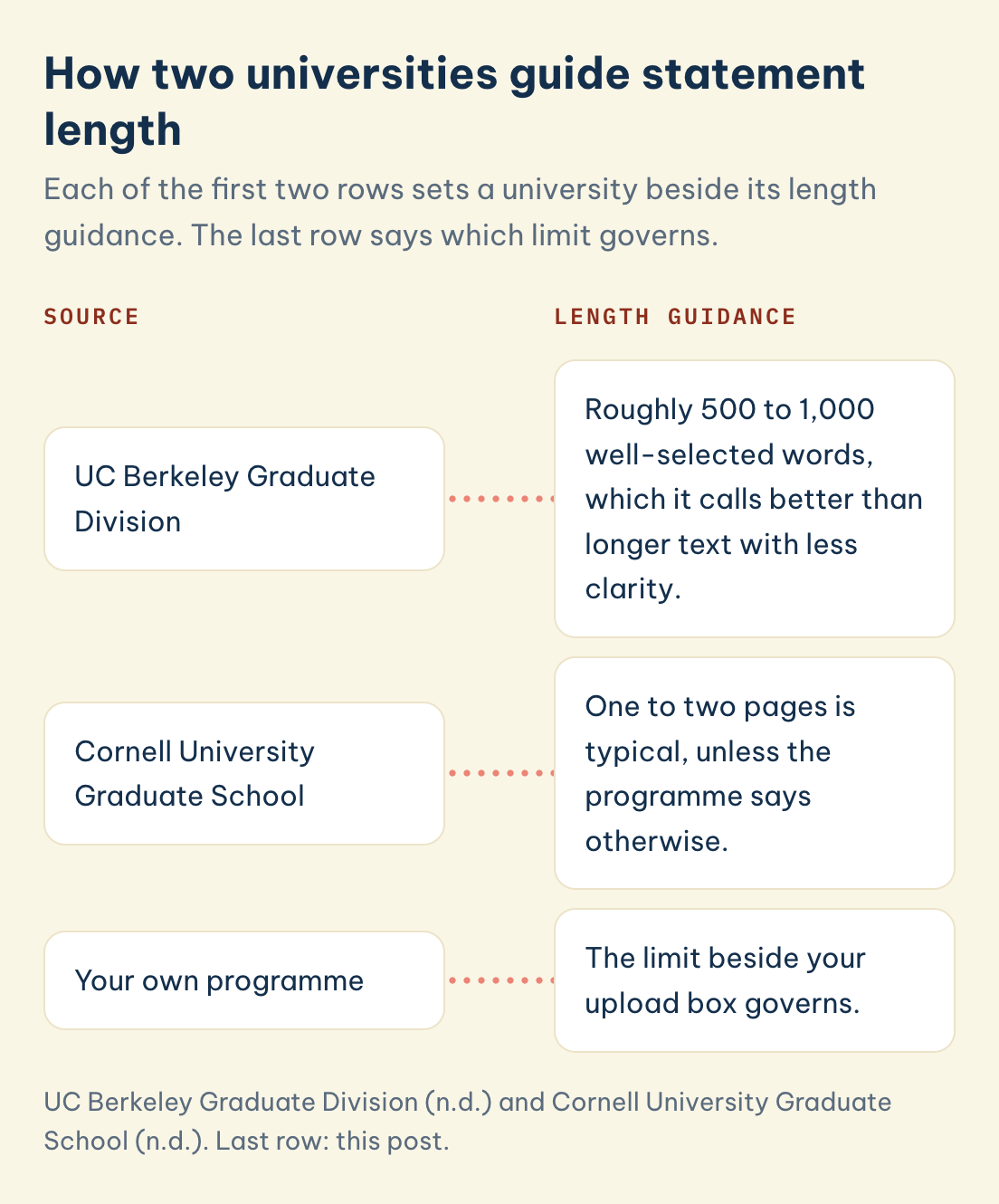
Two examples can therefore differ in length by a factor of two and both be correct for their programmes. A sample from another university tells you nothing about the limit on yours.
◆ Question 7 / 7 · Personal statement vs SoP
How is a PhD personal statement different from a statement of purpose?
Direct answer: MIT's career office separates the two: a personal statement narrates how your experiences shaped you, while a statement of purpose describes your research interests, plans and why a specific programme suits you. (MIT Career Advising & Professional Development, n.d.). MAAS reading: programmes use the names loosely, so the prompt outranks the label.
For how the two names behave across universities, see What is the difference between a statement of purpose and a motivation letter?. For the document that carries the research argument, see How do you write a PhD research proposal? and What is the difference between a research statement and a research proposal?.
Frequently asked questions
Is it okay to read a sample personal statement for a PhD?
Yes, as long as it informs your choices and not your wording. Oxford requires the statement to be entirely your own work, so read for structure and evidence order and write from your own record (University of Oxford, n.d.).
Do admissions committees check personal statements for copying?
Some do. Oxford says departments may screen statements with a plagiarism-detection system, and a 2014 Regina notice said it investigated all applications and rejected plagiarised ones immediately (University of Regina, 2014; University of Oxford, n.d.).
How long should a PhD personal statement be?
There is no single figure. Berkeley's guidance sits near 500 to 1,000 words and Cornell's at one to two pages, so the programme's own instruction settles it (Cornell University Graduate School, n.d.; UC Berkeley Graduate Division, n.d.).
Does a sample tell me what the committee wants?
Not by itself. Statements studied by Chen share a surface shape but argue from different evidence by discipline, and a sample cannot show its prompt or outcome (Chen, 2017).
Can I use AI to write the statement from a sample?
Oxford says AI may assist research but the ideas and expression must be yours, and inappropriate use may disadvantage your application (University of Oxford, n.d.).
Related MAAS guides
- What is the difference between a statement of purpose and a motivation letter?
- What is the difference between a research statement and a research proposal?
- How do you write a PhD research proposal?
- What should a CV for a PhD application include and omit?
- How does the UCAS personal statement work for undergraduate applicants?
- PhD application resources
- PhD Application Strategy and Execution
References
Chen, S. (2017). Disciplinary variations in academic promotional writing: The case of statements of purpose. Functional Linguistics, 4(1), Article 4. https://doi.org/10.1186/s40554-017-0041-9
Cornell University Graduate School. (n.d.). Write an academic statement of purpose. Retrieved October 7, 2026, from https://gradschool.cornell.edu/admissions/application-steps/statements-of-purpose/
MIT Career Advising & Professional Development. (n.d.). Graduate school application essays (with examples and tips): Personal statements, statements of purpose, and admission essays. Massachusetts Institute of Technology. Retrieved October 7, 2026, from https://capd.mit.edu/resources/graduate-school-application-essays/
Ruch, A. (n.d.). Personal statement for graduate programs in the humanities [Handout]. Duke University Writing Studio. Retrieved October 7, 2026, from https://wrp.duke.edu/sites/wrp.duke.edu/files/file-attachments/personal-statement-humanities-1.original.pdf
UC Berkeley Graduate Division. (n.d.). Writing your statements. University of California, Berkeley. Retrieved October 7, 2026, from https://grad.berkeley.edu/admissions/application-process/writing-your-statements/
University of Oxford. (n.d.). Plagiarism. Graduate admissions application guide. Retrieved October 7, 2026, from https://www.ox.ac.uk/admissions/graduate/application-guide/applicant-policies/plagiarism
University of Regina. (2014). Most common mistake applicants make that results in rejected applications [Notice]. Faculty of Graduate Studies and Research. Retrieved October 7, 2026, from https://www.uregina.ca/graduate-studies-research/assets/docs/plagiarism-applications.pdf
Tools & resources
- Oxford graduate admissions guidance on plagiarism in applications: https://www.ox.ac.uk/admissions/graduate/application-guide/applicant-policies/plagiarism
- UC Berkeley Graduate Division guidance on statements: https://grad.berkeley.edu/admissions/application-process/writing-your-statements/
A free 20-minute consultation is a conversation about your situation and the programmes you are applying to, and about how the PhD application service works and what it covers.
Book a free consultation ▸