
◆ PhD Admissions
PhD research proposal or research statement: which do you need?
Category: admissions
Last updated: 2026-09-29

The usual rule of thumb says that American PhD programmes ask for a research statement and British ones ask for a PhD research proposal. It is half right, and the wrong half can leave an applicant polishing a document the programme never asked for. The variable that decides is not the country. It is what you are being admitted into: a project you propose yourself, or a group and programme that already have research directions of their own.
Direct answer: A research proposal describes one future project, with a question, methods and a timetable, so a department can judge whether it has a supervisor for it. A research statement looks back at the research you have already done and then forward to your interests, so a programme can judge whether you fit a group it already runs.
Asked on 29 September 2026, both ChatGPT in guest mode and Perplexity gave the same outline. A statement is about who you are as a researcher across past, present and future, a proposal is a specific project with methods and a timeline, statements are more common in the United States, and proposals are more common in the United Kingdom, Europe and Australia. Both also warned that universities use the names inconsistently. The warning is the accurate part, and the school pages below show where the rule of thumb holds and where it breaks.
◆ Section 1 / 8 · Statement or proposal
What is the difference between a research statement and a research proposal?
Direct answer: They answer different questions. A proposal answers what you will research, how, and why it is worth doing. A statement answers what research you have done, what it found, and which of the programme's directions you fit. The first is written for a supervisor who must agree to host a project, the second for a panel choosing a person.
Punch (2016) describes a proposal as a document that says what the research will do, how it will be done and why it is worth doing, and one that must stand on its own, so that a reader who has never spoken to the student can still follow it. Punch (2016) also reports that in graduate study an approved proposal works as a "bond of agreement" between the student and the body that approves it. That is why departments that admit students to a project ask for one: the proposal is the thing they are agreeing to supervise.
A research statement has no such contractual role. The University of Pennsylvania, Perelman School of Medicine, Biomedical Graduate Studies (n.d.) asks applicants to describe meaningful research experiences and to highlight findings, including the goals of each project, the approaches used, the results obtained and what the findings imply. The verbs are past tense on purpose, because the statement is evidence of research ability, and the future part is a shorter step that follows from it.
◆ Section 2 / 8 · What a statement contains
What should a research statement contain?
Direct answer: Research done, in enough detail to be checked, followed by what you want to do next and why the programme fits. Iowa State University, Department of Computer Science (n.d.) asks for past research experience, intellectual interests, future research goals and a fit with current faculty research, within 1,000 words and two pages.
Iowa State University, Department of Computer Science (n.d.) splits its statement into two parts, the second being research goals and interests, and adds that admission committees look for demonstrated research potential, which is hard to replace with grades alone. Oregon Health & Science University, Neuroscience Graduate Program (n.d.) sets a maximum of two pages in three parts: scientific curiosity, an overview of up to two projects you took part in, covering the laboratory focus, the question, the methods and the results, and finally your research interests with two or three faculty members you would like to work with.
Three things recur across these pages. The evidence comes first, so a list of interests with no project behind it is the weakest version. Each project is described through its question, method and result, not through your job title in the lab. And the forward-looking part is short and names a direction rather than a full study. If you find yourself drafting a timetable, you have started writing a proposal.
◆ Section 3 / 8 · Length and methodology
How long should each document be, and how much methodology does a proposal need?
Direct answer: Statements are short and proposals are not, and the limits are strict. Most statements here run to about 1,000 words or two pages. Proposals run from 1,500 words at Manchester, counting references, to 5,000 in Surrey's longest layout. Methodology and a timetable belong in the proposal, not the statement.
Pennsylvania personal statement
about 500
words, asked for separately in addition to the research statement
Word limits for research statements and research proposals
Each bar shows a word limit, with yellow for research statements and blue for proposals. A bar that starts away from zero is a range. The card shows a separate document and uses no bar colour.
Save this figure
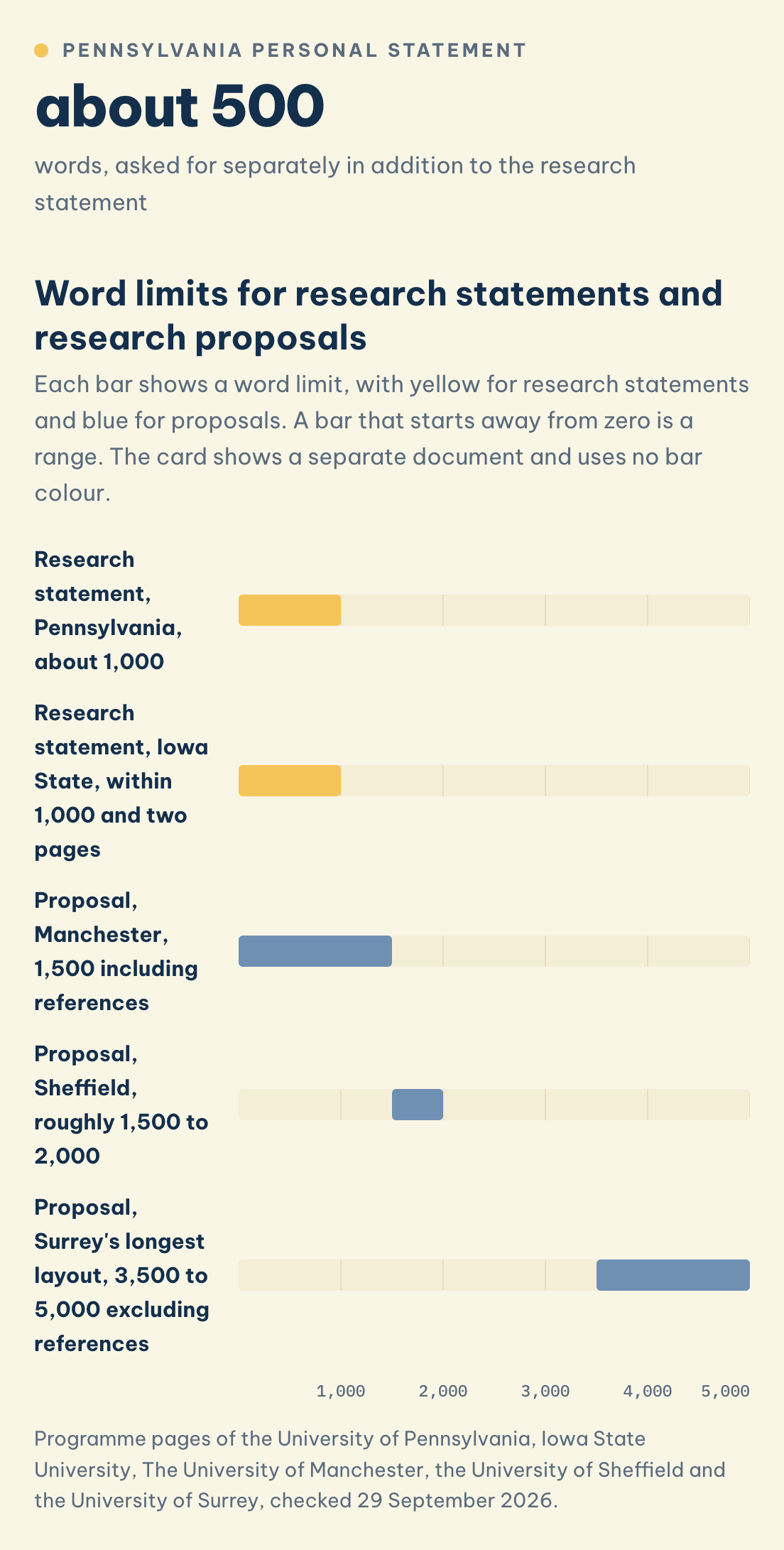
The University of Pennsylvania, Perelman School of Medicine, Biomedical Graduate Studies (n.d.) asks for a research statement of about 1,000 words plus a separate personal statement of about 500. On the proposal side the range is wide. The University of Sheffield, Sociological Studies, Politics and International Relations (n.d.) asks for roughly 1,500 to 2,000 words. The University of Warwick, Institute for Employment Research (n.d.) suggests about 2,000, split as 200 to 400 for the introduction, about 750 for the literature, 300 to 400 for the question and aims, about 750 for the research design including the timetable, and about 200 for the conclusion. The University of Surrey (n.d.) sets out several layouts on one guidance page, and the longest asks for a minimum of 3,500 and a maximum of 5,000 words, excluding references.
On method, the University of Surrey (n.d.) expects the type of data, how it will be collected and analysed, the ethics and the reason for the choices, plus a plan and timetable. Sheffield spreads its timetable over three years, or three and a half for some scholarship routes, and warns that "It is relatively easy to ask a new question; it is more challenging to set out how you might come up with a convincing answer!" Manchester counts references inside its 1,500 words and returns proposals that exceed them, so check the counting rule before you trim.
◆ Section 4 / 8 · Naming professors
Should I name the professors I want to work with?
Direct answer: In a statement, usually yes, and some programmes ask for it. In a proposal the naming is mostly done for you, because the department matches you to a supervisor. Manchester says a proposal helps when assigning a supervisor but does not guarantee that you are assigned the person you contacted.
Oregon Health & Science University, Neuroscience Graduate Program (n.d.) asks for two or three faculty members named at the end of the statement, and Iowa State University, Department of Computer Science (n.d.) asks that your direction fit the current research of its faculty. The logic is the same in both places: the statement is how a panel checks that the group can use you. The University of Pennsylvania, Perelman School of Medicine, Biomedical Graduate Studies (n.d.) goes further by allowing an applicant to apply to only one group within the programme, so the choice of group is itself part of the application.
For the University of Oxford (n.d.), some scientific research courses need no full proposal at all, only a list of the groups or supervisors you want to work with. For proposal-based routes, The University of Manchester, School of Social Sciences (n.d.) says the proposal is helpful when assigning a supervisor and gives no assurance that you will be placed with the academic you approached. Naming a person is therefore a fit argument you can make, and it is a request, not an arrangement.
◆ Section 5 / 8 · Can the topic change
Can my research topic change after I start the PhD?
Direct answer: Yes, and the universities say so themselves. Surrey describes a proposal as likely to evolve and change after registration, Manchester does not bind students to their proposal after enrolment, and Warwick states that it does not expect you to adhere closely to it. The proposal is a starting point that shows you can conceive a doctoral project.
The University of Warwick, Institute for Employment Research (n.d.) puts the purpose plainly: "we do not expect you to adhere to this proposal closely. However, through this proposal we want to see that you are able to conceive of a doctoral research project". The University of Sheffield, Sociological Studies, Politics and International Relations (n.d.) treats the proposal as the point of departure that is reworked with the supervisor in the first months. This does not make the proposal a formality. It changes what the reader is judging, which is your ability to frame a question, choose a method that could answer it and see how long it takes. What a proposal contains at each stage is covered in PhD proposal template.
A statement carries even less risk of lock-in, because it makes no promise about the future beyond a direction. An applicant who worries that a specific proposal will trap them can read these three university pages as evidence that it will not.
◆ Section 6 / 8 · Statement of purpose
How is a research statement different from a statement of purpose?
Direct answer: Sometimes they are the same document with different names. The University of Washington Information School lists a "Statement of Purpose" but describes it as "Your research statement", asks for 1,000 to 2,000 words, a specific research question and a description of one or two potential research projects. Read the list of required components, not the title.
The University of Washington Information School (n.d.) is a hybrid case that the rule of thumb cannot handle. It sits in the United States and asks for a statement, yet the statement must contain a research question and one or two potential projects, which is proposal material. The label does not tell you the content, and how to read the prompt printed beside the upload box is covered in statement of purpose vs motivation letter.
In the Council of Graduate Schools survey, at the final admissions decision "Doctoral admissions favored letters of recommendation (67%) and personal/research statements (64%) above academic transcripts (55%) and interviews (48%)" (Kent & McCarthy, 2016, p. 17). The Council of Graduate Schools counted personal and research statements as one item, so the 64% cannot be assigned to research statements alone, but it shows that panels weigh the document heavily. Posselt (2016) studied admissions committees in ten highly selective United States doctoral programmes, which is a reminder that in those programmes the readers are faculty committees reading whole files.
◆ Section 7 / 8 · Which one you need
Which one does my application need?
Direct answer: Ask what you are admitted into. A project you propose needs a proposal, and a group or programme with existing directions needs a research statement. If you are unsure, ask who is supervising the project on your first day. Your own project means a proposal, and the group's project means a statement.
Oxford shows that both can sit inside one university. The University of Oxford (n.d.) says that for some scientific research courses you join an existing research group, so you do not write a full proposal, and you may be asked for a personal statement or statement of purpose with your research interests and experience. It also states that "If you submit an unnecessary research proposal, it will be removed from your application." Where a course wants both documents, Oxford asks for one file with a separate sub-heading for each.
The Pennsylvania rule sits at the other end. The University of Pennsylvania, Perelman School of Medicine, Biomedical Graduate Studies (n.d.) is accepting applications for Fall 2027 from 1 October to 1 December 2026, and asks for a statement of about 1,000 words. So the working rule is a check, not a country map. Read the programme page, list the components it names, and match them to the day-one question.
◆ Section 8 / 8 · Getting both right
Getting the two documents right before you apply
If you are choosing between routes, the PhD application guide sets out how the documents fit into the whole sequence, from the shortlist to the interview. MAAS supports this step through PhD application strategy. Your expert drafts the statement and the proposal from your own account of your research and challenges the research question, the design and the fit with each programme on your list. You review, edit and approve every document and submit the application yourself. MAAS experts do not submit anything for you, and approach letters go out only after you have read and approved each one, sent by MAAS from an academic mailbox opened in your name and handed over to you when the engagement ends. Where the MAAS network already includes a suitable expert, MAAS introduces them within 48 hours, and where it does not we open a dedicated recruitment round, which usually takes about two weeks.
For what a sample statement can and cannot teach you about either document, see Should you use a PhD personal statement example?.
References
Iowa State University, Department of Computer Science. (n.d.). Research statement. Retrieved September 29, 2026, from https://www.cs.iastate.edu/research-statement
Kent, J. D., & McCarthy, M. T. (2016). Holistic review in graduate admissions: A report from the Council of Graduate Schools. Council of Graduate Schools. https://cgsnet.org/wp-content/uploads/2022/01/CGS_HolisticReview_final_web.pdf
Oregon Health & Science University, Neuroscience Graduate Program. (n.d.). Instructions for domestic applicants. Retrieved September 29, 2026, from https://www.ohsu.edu/school-of-medicine/neuroscience-graduate-program/instructions-domestic-applicants
Posselt, J. R. (2016). Inside graduate admissions: Merit, diversity, and faculty gatekeeping. Harvard University Press.
Punch, K. F. (2016). Developing effective research proposals (3rd ed.). SAGE.
The University of Manchester, School of Social Sciences. (n.d.). Writing your proposal. Retrieved September 29, 2026, from https://www.socialsciences.manchester.ac.uk/study/postgraduate-research/how-to-apply/writing-your-proposal/
University of Oxford. (n.d.). Research proposal. Graduate application guide. Retrieved September 29, 2026, from https://www.ox.ac.uk/admissions/graduate/application-guide/supporting-documents/research-proposal
University of Pennsylvania, Perelman School of Medicine, Biomedical Graduate Studies. (n.d.). PhD application information. Retrieved September 29, 2026, from https://www.med.upenn.edu/bgs/phd-application-information.html
University of Sheffield, Sociological Studies, Politics and International Relations. (n.d.). Writing a research proposal. Retrieved September 29, 2026, from https://sheffield.ac.uk/spir/phd/proposal
University of Surrey. (n.d.). PhD proposal guidance. Doctoral College. Retrieved September 29, 2026, from https://www.surrey.ac.uk/doctoral-college/prospective-postgraduate-researchers/phd-proposal-guidance
University of Warwick, Institute for Employment Research. (n.d.). Research proposal guidelines [PDF]. Retrieved September 29, 2026, from https://warwick.ac.uk/fac/soc/ier/study_with_us/phd/interest/research_proposal_guidelines.pdf
University of Washington Information School. (n.d.). Ph.D. application materials. Retrieved September 29, 2026, from https://ischool.uw.edu/programs/phd/admissions/application-materials
A free 20-minute consultation is a conversation about your situation and which of the two documents each programme on your list asks for.
Book a free consultation ▸