
◆ PhD Admissions
Which stage is your PhD proposal template written for?
Category: admissions
Last updated: 2026-09-04

Search for a PhD proposal template and the results arrive as files: a Word form from one graduate school, a downloadable structure from a tutoring site, a sample from a thesis repository. They look interchangeable because they carry the same headings. They are not interchangeable, because the word "proposal" names at least two different documents written at two different points in a doctoral career, assessed by two different bodies, against two different questions. The first thing to establish about a template is which of those documents it belongs to.
Direct answer: There is no national or universal PhD proposal template. Vietnam's doctoral regulation, Circular 53/2026/TT-BGDDT, delegates entry requirements to each training institution, so every template in circulation is one institution's internal form. Most of them are also stage-specific: the outline submitted at admission and the detailed proposal defended after enrolment are separate documents.
That distinction decides whether a downloaded form helps you or sends you to the wrong reader with the wrong argument.
◆ Section 1 / 6 · A standard format
Is there a standard PhD research proposal format?
Direct answer: No standard format exists at national level in Vietnam. Circular 53/2026/TT-BGDDT, published in Cong Bao issue 447 on 28 July 2026, mentions a research proposal exactly once across its 32 pages, and that mention sits in the chapter on organising training, not the chapter on admissions.
One date matters before any of this. Circular 53/2026 took effect on 30 June 2026 and applies to intakes announced from 1 January 2027, replacing Circular 18/2021/TT-BGDDT of 28 August 2021 and Circular 23/2021/TT-BGDDT of 30 August 2021. Article 34 clause 1 keeps candidates admitted under announcements issued before that date under the older regulation. So two regulations are live at once, and a template written for the older one is not automatically wrong; it is simply addressed to a different cohort.
Article 6 of the circular sets only three entry requirements: a completed bachelor's degree or above, the entry requirements set by the training institution, and language competence for foreign applicants. Clause 2 then hands the detail back to the institution, which must specify subject-matter fit, learning capacity and language competence for each programme, at a level not below the corresponding programme standard. Clause 3 permits institutions to set requirements higher than the circular does. Article 7 requires only that admissions be public and that the announcement appear at least 30 working days before the deadline; verified against the Cong Bao signed PDF on 4 September 2026.
Across all 32 pages of the signed text, the single appearance of the phrase "bao ve de cuong nghien cuu", defending the research proposal, comes in the article on organising training, where it is listed among the activities an institution must specify when teaching runs online. In other words, the national regulation treats proposal defence as something a candidate does after admission. Nothing in the admissions articles prescribes a proposal format, so a template claiming to be the standard form is describing a school, not a country.
◆ Section 2 / 6 · Which sections
What sections should a PhD research proposal include?
Direct answer: Sections depend on the stage. Can Tho University's form catalogue for doctoral candidates, updated for 2026, lists a general research outline inside the admission dossier and a separate detailed proposal with its own defence record, review form and registration slip, used after the candidate has enrolled.
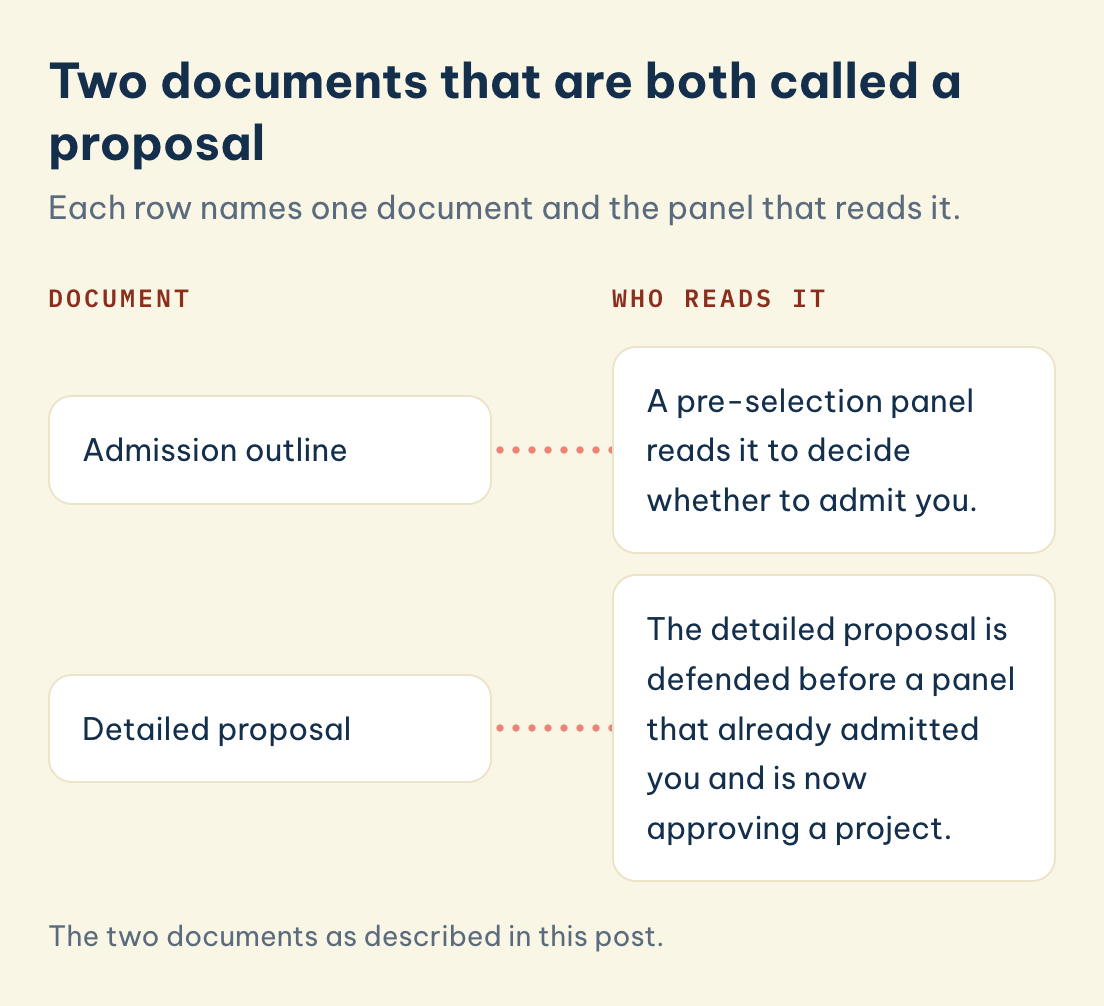
Two documents that are both called a proposal
Each row names one document and the panel that reads it.
Document
Who reads it
Admission outline
A pre-selection panel reads it to decide whether to admit you.
Detailed proposal
The detailed proposal is defended before a panel that already admitted you and is now approving a project.
Save this figure
Reading a university's own form catalogue is more informative than reading a template, because the catalogue shows the sequence. In the Can Tho list, checked on 4 September 2026, the admission dossier contains the doctoral application file, a publication list, a supervisor's academic record form, a reference letter template and a general research outline. A separate group of forms exists for scoring research proposals at admission, including the minutes of the specialist pre-selection panel. A third group, labelled detailed proposal, contains a request form for changing the thesis title after the proposal defence, an explanatory statement filed afterwards, plus the review sheet and minutes for that defence.
Three facts follow from that structure. The admission outline is read by a pre-selection panel deciding whether to admit you. The detailed proposal is defended before a panel that already admitted you and is now approving a project. The title can change between the two, and there is a form for it, which tells you the first document is not expected to be final.
The same catalogue lists a mid-term evaluation set, a publication list and co-author consent form tied to the 2021 intake onwards, and separate dossiers for thesis defence at unit level and at university level, in Vietnamese and English versions. Nine or more distinct panels and moments are named across the list. A single file called "de cuong" belongs to exactly one of them.
A template that mixes those two purposes produces a predictable failure. Fill an admission outline to the depth of a detailed proposal and you commit publicly to methods you have not yet had a supervisor argue with. Fill a detailed proposal to the depth of an admission outline and the panel has nothing to approve.
◆ Section 3 / 6 · One template, many universities
Can I use the same proposal template across different universities?
Direct answer: Not without checking what each destination is assessing. An analysis of 13,562 doctoral advertisements posted on Euraxess between 2016 and 2019 found that the attributes requested at admission differ significantly by country, by discipline and by year of posting (Mantai & Marrone, 2022).
Mantai and Marrone (2022) built a data-driven taxonomy from those 13,562 advertisements, posted between 2016 and 2019, and ran logistic regressions across the five countries and five disciplines that posted most: the Netherlands, Germany, France, Spain and the United Kingdom, and Biological Sciences, Physics, Chemistry, Engineering and Medical Sciences. Their results show medical science advertisements 40% more likely to request interpersonal skills than the reference group, while biological science advertisements were less likely to request every category except degree and achievement (Mantai & Marrone, 2022). A form built around what one field wants to see will underweight what another field looks for first.
The mismatch runs deeper than wording, because it reaches the purpose of the document. Where a project has been advertised with a defined topic, the proposal argues that you can execute a plan someone else has set. Where you propose your own topic, the same document has to establish that the question is worth three years of a supervisor's attention. Those are different arguments, and no template distinguishes them for you.
◆ Section 4 / 6 · Template as a checklist
What goes wrong when a template is treated as a checklist?
Direct answer: The proposal stops being an argument and becomes a compliance exercise. Interviews with 19 supervisors and doctoral students at three South African universities found participants understood proposal quality mainly as planning, disciplinary confinement and compliance with administrative requirements (Nubia & Simmonds, 2021).
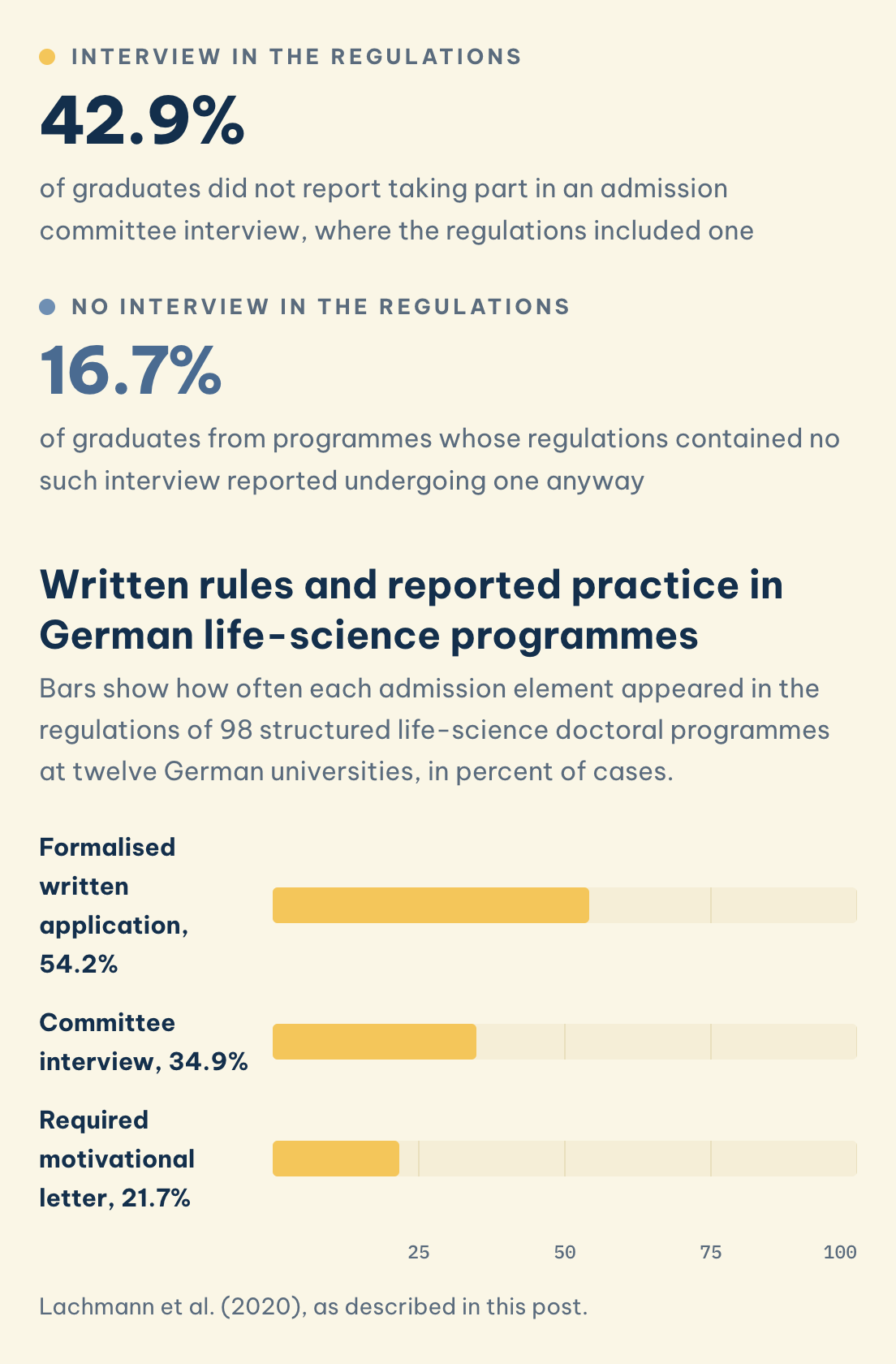
Interview in the regulations
42.9%
of graduates did not report taking part in an admission committee interview, where the regulations included one
No interview in the regulations
16.7%
of graduates from programmes whose regulations contained no such interview reported undergoing one anyway
Written rules and reported practice in German life-science programmes
Bars show how often each admission element appeared in the regulations of 98 structured life-science doctoral programmes at twelve German universities, in percent of cases.
Save this figure
Nubia and Simmonds (2021) interviewed 11 supervisors and 8 doctoral students, using semi-structured interviews to reconstruct how each group defined a quality proposal. Their conclusion is that a narrow understanding of the phase "supported the view that writing of research proposals is a matter of technical compliance", which in their reading deprives the proposal stage of its function as research learning. On the mechanism, they write that "these prescriptive guidelines can encourage conformity as opposed to conceptualizing coherently justified proposed research" (Nubia & Simmonds, 2021, p. 741).
Their South African context explains why compliance thinking spreads rather than being anyone's preference. To reach the national target of 100 doctoral graduates per million people each year, the country would need more than 5,000 doctorates annually, a volume that pushes institutions towards procedures that scale (Nubia & Simmonds, 2021). Forms scale; argument does not. That pressure exists in any system expanding doctoral numbers, which is the condition under which templates multiply.
There is a second, quieter problem: the written form and the actual practice can diverge. Lachmann et al. (2020) compared the institutional regulations of 98 structured doctoral programmes in the life sciences at twelve German universities against the reported experience of 1,796 doctoral graduates. In the document analysis, a formalised written application appeared in 54.2% of cases, a committee interview in 34.9% and a required motivational letter in 21.7%. The comparison with graduates then produced the finding that matters here: where regulations included an admission committee interview, 42.9% of graduates did not report taking part in one, while 16.7% of graduates from programmes whose regulations contained no such interview reported undergoing one anyway, and a formal application went unreported by 50.0% of graduates whose regulations required it (Lachmann et al., 2020).
The same study gives a sense of how much variation sits behind any single form. Of the 1,796 graduates surveyed, 22.8% had been through structured doctoral education and 77.2% through the individual model, and the split by discipline was wide: 38.3% of bio-science respondents against 7.9% of medical respondents (Lachmann et al., 2020). One national system, two dominant routes, and templates circulating from both.
Their recommendation is stated plainly: efficacy "should be examined based on reported practice rather than on the respective written regulations" (Lachmann et al., 2020). A template is a written regulation. It is evidence about a process, not the process.
◆ Section 5 / 6 · Fitting a programme
How do I fit a proposal to one specific programme or supervisor?
Direct answer: Work from three sources a template cannot contain: the stage the document is written for, the questions the receiving panel is empowered to ask, and the two or three most recent publications of the supervisor you are writing towards. Circular 53/2026 requires the admission announcement to carry the first two.
The sequence is short, each step is checkable, and none of it requires guessing. First, identify the stage by finding the form's home on the university's own graduate school site rather than on an aggregator, since the catalogue around it names the panel. Second, read the admission announcement, which Article 7 of Circular 53/2026 requires to be published at least 30 working days before the deadline and to state the admission method and the number of places. Third, read the recent work of the intended supervisor, because the proposal is being read by someone with a live research agenda rather than by the form's author. Our guide to narrowing a research direction covers how far to narrow before that reading, and our guide to reading a PhD admissions page covers where the binding requirements are actually published.
Article 7 clause 5 adds a fourth source that applicants routinely miss: every institution must issue its own internal admissions regulation and retain the admissions records. That internal regulation, not the downloadable form, is the document that states how the proposal will be scored. Where it is published, it is worth more than any sample.
Only then does the template become useful, in the role ChatGPT itself named when asked about this on 4 September 2026: a compliance checklist rather than the architecture of your thinking. Headings confirm you have not omitted anything the institution requires. They cannot tell you what the argument is.
◆ Section 6 / 6 · How MAAS works
How MAAS works on this document
Your expert drafts the proposal from your own account of your research, and you review, edit and approve it. The expert argues against the draft, checks whether each claim survives the objection a panel would raise, and works with you on the division between the admission outline and the detailed proposal defended later. You submit the application yourself, and MAAS cannot promise admission or funding, because those decisions rest with the pre-selection panel and the supervisor. The boundary is set out on the PhD Application Strategy and Execution service page, and the wider sequence this document sits inside is described in our PhD application guide.
Matching to a mentor runs on two tracks. Where the network already holds someone in your field, matching is usually complete within 48 hours. Where it does not, MAAS opens a dedicated recruitment round for your case, which normally takes around two weeks.
Frequently asked questions
Where can I find examples of successful PhD proposals?
Approved detailed proposals are rarely published, and admission outlines almost never are. What is public is the university's own form catalogue and the panel minutes template. Can Tho University, for instance, publishes both the review sheet and the minutes used at proposal defence, and those two documents state the assessment criteria more directly than any sample would.
Is the outline I submit at admission binding?
Not in the way applicants fear. Can Tho University publishes a form for requesting a change of thesis title after the proposal defence, which indicates the institution expects the topic to develop between admission and approval.
How long should a PhD research proposal be?
Whatever length the institution states in its own announcement. Circular 53/2026 sets no length, so any word count quoted as a national rule is being reported from one school's form.
Does a template from a foreign university work for a Vietnamese application?
Only as a prompt for what to think about. Requirements at admission vary significantly by country and discipline (Mantai & Marrone, 2022), and the Vietnamese admission dossier is assembled from institution-specific forms.
Should I write the proposal before contacting a supervisor?
Write enough to make the first conversation specific, then let the conversation shape the rest. Committing to a full method before a supervisor has questioned the question is the most expensive form of early work.
References
Lachmann, D., Martius, T., Eberle, J., Landmann, M., von Kotzebue, L., Neuhaus, B., & Fischer, F. (2020). Regulations and practices of structured doctoral education in the life sciences in Germany. PLOS ONE, 15(7), Article e0233415. https://doi.org/10.1371/journal.pone.0233415
Mantai, L., & Marrone, M. (2022). Identifying skills, qualifications, and attributes expected to do a PhD. Studies in Higher Education, 47(11), 2273-2286. https://doi.org/10.1080/03075079.2022.2061444
Nubia, W. D., & Simmonds, S. (2021). Dismantling common perceptions of research proposals through South African doctoral students' and supervisors' experiences. International Journal of Doctoral Studies, 16, 737-756. https://ijds.org/Volume16/IJDSv16p737-756Nubia7600.pdf
Tools and resources
- Circular 53/2026/TT-BGDDT, Cong Bao issue 447, 28 July 2026: https://congbao.chinhphu.vn/van-ban/thong-tu-so-53-2026-tt-bgddt-470098/67203.htm
- Can Tho University graduate school, form catalogue for doctoral candidates: https://gs.ctu.edu.vn/bieu-mau/bieu-mau-cua-nghien-cuu-sinh.html
A free 20-minute consultation is a conversation about your situation and the stage your proposal is written for.
Book a free consultation ▸