
◆ PhD application
What is a PhD admissions page telling you without numbers?
Here is a quick test of how well you have read a programme page. You can probably quote its grade and language requirements from memory, the kind that reads like IELTS 6.5 overall with no band below 6.0, or a GPA of 3.2. Now try to say, in one sentence, what kind of researcher the department hopes will apply. For most applicants the page goes quiet, and the silence is not because it failed to say so.
An admissions page carries two documents laid over one another. One states thresholds and is written in numbers, the kind you can check in under a minute. The other describes a person and is written in prose. Applicants read the first and skip the second, and the reason is ordinary: only the first one looks like a requirement.

◆ Question 1 / 4 · Why it goes unread
Why does the second document not register as a requirement?
Direct answer: Because it has no figures and no obligation verbs like minimum or must, so it reads as description rather than as a condition you could fail. Threshold text announces itself with a checkable number, such as a GPA of 3.0 on a 4.0 scale; portrait text describes a tradition, a background, or a method instead.
Threshold text announces itself. It uses "minimum", "must", "no less than", and it attaches a number you can check yourself in seconds, the kind of language behind a GPA of 3.0 on a 4.0 scale or a proposal capped at 2,000 words. Portrait text does none of this. It says a stream welcomes applicants with a background in a particular tradition, or that the group's work is experimental, or that candidates are expected to be comfortable with a certain family of methods, sometimes something as specific as Braun and Clarke's (2006) six-phase approach to thematic analysis, or structural equation modelling run in AMOS or Mplus. Nothing there can be failed in the way a grade can be failed, so the eye slides over it.
The habit is worth examining rather than simply correcting, because there is evidence that applicants and admitting departments do not weight criteria the same way. Work surveying prospective graduate students on how important they believe various admissions criteria to be, published in 2019, found their perceptions diverging from how those criteria actually function in selection (Chari & Potvin, 2019). In that survey's own abstract, “students rated several criteria, including personal statements, prior research experiences, publications, and familiarity with department as significantly more important than did faculty” (Chari & Potvin, 2019, p. 023101-1). Separately, research on rubric-based holistic review, published in 2022, documents committees scoring applicants against explicit criteria that extend well beyond the quantitative measures applicants tend to fixate on (Young et al., 2022). Both studies come from physics graduate admissions in the United States, so treat them as evidence that the gap exists rather than as a measurement of its size in your field or system. Once you know what a programme weighs, personal statement review helps you address it.
What follows for you is narrow but firm. The prose is doing selection work. It is simply doing it in a register that does not announce itself as selection.
◆ Question 2 / 4 · Where it is written
Where is the portrait actually written?
Direct answer: In three places, none of which is the entry requirements box.
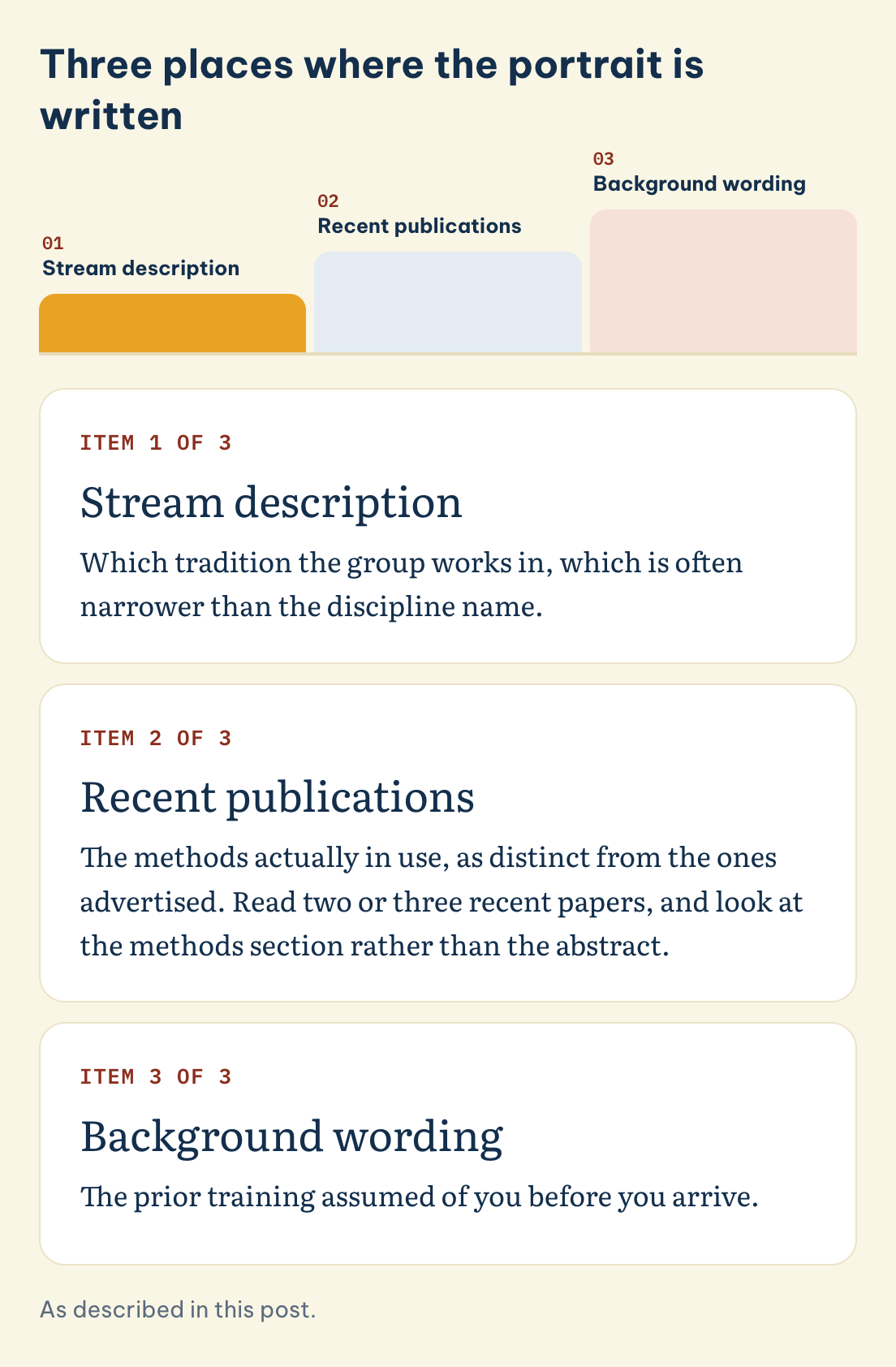
Three places where the portrait is written
Tap a place to read what it reveals, as the post puts it. None of the three is the entry requirements box.
Item 1 of 3
Stream description
Which tradition the group works in, which is often narrower than the discipline name.
Item 2 of 3
Recent publications
The methods actually in use, as distinct from the ones advertised. Read two or three recent papers, and look at the methods section rather than the abstract.
Item 3 of 3
Background wording
The prior training assumed of you before you arrive.
Save this figure
| Where to look | What it reveals | Wording to search for |
|---|---|---|
| The stream, branch or specialisation description | Which tradition the group works in, which is often narrower than the discipline name | approach, tradition, we focus on, our work is |
| Recent publications of the professors listed | The methods actually in use, as distinct from the ones advertised | Read two or three recent papers, and look at the methods section rather than the abstract |
| Any background, preparation or desirable-experience wording | The prior training assumed of you before you arrive | background in, expected to, familiarity with, desirable, preferably |
The middle row is the one most worth your time, and it is the one applicants skip because it takes longer than reading a page, usually 30 to 45 minutes per person. A departmental description can stay stable for years after the group's actual work has moved on. What the people are publishing this year is a more current statement of what they will supervise than anything written on the website. Searching a name on Google Scholar or Web of Science, filtering to the past 2 to 3 years, and reading the methods section rather than the abstract, is usually enough.
Note also that a single department frequently contains branches that want incompatible things. Within one discipline, one stream may be built on experimental design and statistical inference run in R or Stata, while another is built on econometric modelling and large datasets. A mid-sized UK department can easily hold 25 to 40 permanent faculty split across 3 to 5 research groups, and 2 of those groups may not have cited each other in 5 years. Reading the department as a single entity, rather than as a set of branches, is what produces a shortlist that looks reasonable and fits nothing.
◆ Question 3 / 4 · Setting it beside your record
What do you do once you have found it?
Direct answer: Set it beside your own record line by line, and let the mismatches be visible rather than argued away.
Write the portrait as a short list of 6 to 8 lines covering what the branch appears to want: this methodological tradition, this prior background, this kind of prior output. Then, against each line, in 40 to 60 words, write the specific evidence you hold, naming the course, the project or the mark rather than asserting a general capability. Where you have nothing to write, leave the line empty and look at it. One line on that list needs separate handling, which is any mention of prior publication, because it behaves differently depending on which block of the page it sits in: see what to do when a programme requires published papers you do not have.
That exercise routinely produces an uncomfortable and useful sentence. A programme can be the most open of your targets on published requirements and the most demanding on fit, because a low stated threshold often reflects a department confident it will select on other grounds. Where that is true, the effort you were about to spend proving you clear the threshold is effort spent on the part of the decision that was never in doubt.
A sensible shortlist usually runs 6 to 10 programmes, grouped into 3 tiers by fit rather than by ranking tables such as the QS World University Rankings or Times Higher Education (THE). The tempting response to a mismatch is to drop the school, and that is usually premature. More often the correct move is lateral rather than downward, because the branch is the unit that wants a particular profile, not the institution. Changing which stream you apply to within the same department can close a gap that changing institutions would not.
◆ Question 4 / 4 · What a mismatch is not
What does a mismatch not mean?
Direct answer: A mismatch is not a verdict on your capability, and it is not something to conceal.
An empty line on your comparison means the branch assumes preparation you have not had, which is a statement about sequence rather than about ability. Some gaps are genuinely closable in 3 to 6 months, through a course, a supervised project, or a method you take the time to learn properly. Others take 1 to 2 years and are not closable on your timeline, and knowing which is which is the entire value of doing the exercise early rather than after a rejection.
Where a gap remains, the honest approach reads better than the concealed one. In a 250 to 350 word approach letter, 2 sentences on the gap are enough, naming the course or software you are learning rather than your determination. A professor who reads that you know your background is in one tradition, that you have identified what the shift would require, and that you have already begun on it, is reading something more convincing than a letter that quietly hopes the difference will not come up. What you should not do is manufacture a fit you do not have, which tends to become apparent in the first substantive exchange about method, usually a 30 to 45 minute conversation.
MAAS works with applicants on exactly this reading and on the shortlist that follows from it. MAAS experts draft the proposal and the letters from the applicant's own account of their research. The applicant reads, edits and approves every document, then submits the application and attends the interviews themselves. No adviser can commit a department to an outcome.
Frequently asked questions
How many programme pages should I read this way?
Fewer than you expect, and more slowly than you expect. Reading 5 pages properly, roughly 45 minutes each including 3 to 5 recent publications, will shape a shortlist better than skimming 30. The skim tends to produce a list ordered by published requirements, which is the ordering least connected to the decision.
The page says nothing about background or approach. What then?
Then the professors' recent work on Google Scholar is your only source, and it is a sufficient one. Two further places worth checking are the department's own repository or research portal, and a thesis database such as ProQuest Dissertations and Theses or the British Library's EThOS. A sparse page is common and is not a signal that fit does not matter there, only that it has not been written down for you.
My background is in a different tradition from the branch I want. Should I apply anyway?
It depends on whether your 1,500 to 2,000 word proposal sits in the tradition you are trained in or the one you are applying to. A proposal that uses the branch's methods, submitted by someone trained elsewhere, invites the question of who will be doing the work. Deciding this before the proposal is drafted is far cheaper than discovering it in an interview, and the earlier decision it depends on, choosing which side of a methodological split you actually stand on, is the subject of a separate guide on how narrow a PhD research direction needs to be.
Does any of this apply where admission goes through a central committee rather than a professor?
Yes, though it moves. Where a committee admits, common in US and Canadian programmes, the portrait tends to be written into the programme description and the required background wording rather than carried by an individual's research interests, so the reading shifts toward those sections. Standardised testing has shifted too: the Graduate Record Examinations (GRE), once required by nearly every US programme, has been dropped or made optional by many departments in recent years, and funding is now often tied to a National Science Foundation (NSF) fellowship rather than to the department alone. A useful sign is a first year of required coursework followed by a qualifying exam before a topic is formally assigned.
How long before someone can look at my case with me?
Within 48 hours when our network already covers that field. If it does not, MAAS opens a dedicated recruitment round for your case, which usually takes about 2 weeks.
Related MAAS guides
- Is there a PhD programme with lower entry requirements? for why a low published threshold is not the same as an easy admission
- Does a taught master's qualify you to apply for a PhD? for what a reader extracts from your existing record
- Why does a PhD offer hinge on your lowest IELTS band? for the requirement that is read per component
- Can you just email the professor yourself? for how this reading turns into an approach
- PhD application guide for admissions systems and contact order
- PhD Application Strategy and Execution for what an engagement covers
References
Braun, V., & Clarke, V. (2006). Using thematic analysis in psychology. Qualitative Research in Psychology, 3(2), 77–101. https://doi.org/10.1191/1478088706qp063oa
Chari, D., & Potvin, G. (2019). Understanding the importance of graduate admissions criteria according to prospective graduate students. Physical Review Physics Education Research, 15(2), Article 023101. https://doi.org/10.1103/PhysRevPhysEducRes.15.023101
Young, N. T., Tollefson, K., Zegers, R. G. T., & Caballero, M. D. (2022). Rubric-based holistic review: A promising route to equitable graduate admissions in physics. Physical Review Physics Education Research, 18(2), Article 020140. https://doi.org/10.1103/PhysRevPhysEducRes.18.020140
A free 20-minute consultation with a MAAS adviser, to read a programme page together and test how your record fits it.
Book Free Discovery ▸