
◆ PhD Admissions
What if a PhD programme requires published papers and you have none?
Category: admissions
Last updated: 2026-08-30

Direct answer: Read the sentence again before you act on it. A publication line sits in one of two places: in the eligibility block, where an administrator checks a field and no argument reaches a reader, or in the selection criteria, where an academic panel weighs it against other evidence. The first blocks the file. The second can be answered.
Most applicants who read "applicants should have published research" do the same thing next. They start hunting for a substitute: a conference paper, a preprint, a thesis chapter, anything that might be swapped in. That is the second question, and taking it first is what wastes the season. The first question is who is holding the gate, because the two gates behave in ways that have nothing in common.
◆ Question 1 / 5 · Do PhD applications actually
Do PhD applications actually require published papers?
Direct answer: A minority do. The rule clusters by country and by department rather than by prestige, and it appears most often where the doctorate is a research post from the first day. Schmidt and Boczar (2025) found only 10 of 77 departments at one university required publication before graduation.
Some do, most do not, and the requirement clusters by country and by department rather than by prestige. In the files MAAS has advised on, it appears more often where the doctorate is structured as a research post from day one than where the first 1 or 2 years are coursework, though MAAS has found no study that measures this split across countries, so treat it as a pattern worth checking rather than a rule. What the published evidence does support is narrower and more useful: the requirement varies department by department inside a single institution, so read the department page rather than the ranking.
The habit of demanding publications is more visible at the exit than at the entrance. Schmidt and Boczar (2025), writing in College & Research Libraries volume 86, went through 598 electronic theses and dissertations submitted between 2014 and 2021 at one United States university and found that 45% contained wording indicating previously published material. When they looked at the rules rather than the documents, only 10 of 77 departments required publication before graduation, which is fewer than 15%. Put the other way, 67 of those 77 departments imposed no such rule at all, across an eight year window from 2014 to 2021. That gap matters for applicants, because a department where nearly half of candidates publish before submitting is not the same as a department that demands it, and applicants tend to read the culture as the rule.
A second point follows from the same evidence. If a department expects publication at graduation, its admissions page is more likely to mention publication at entry, and its wording is more likely to be the strict kind. Reading the graduation regulations, which are usually a separate document from the admissions page, tells you in advance what kind of programme you are dealing with.
◆ Question 2 / 5 · How do I tell whether
How do I tell whether a publication rule is an eligibility bar or a selection criterion?
Direct answer: Look at the block the sentence sits in and the verb it uses. A must held in the eligibility block is checked by an administrator against a field in a form. A weighed or considered in the selection criteria is scored by an academic panel. Only the second is arguable.
Three ways a publication rule can be worded, and who reads it
Each row sets a wording on the admissions page beside the reader and what you can do.
Wording on the page
Who reads it, and what you can do
Applicants must have published
Admissions administration. Ask the office in writing whether an accepted or under review manuscript is counted. If not, change programme or change cycle.
Publications are preferred or desirable
Academic panel. Present other research evidence and let the panel weigh it.
Research experience will be assessed
Academic panel. Publication is one input among several, and often not the heaviest.
Save this figure
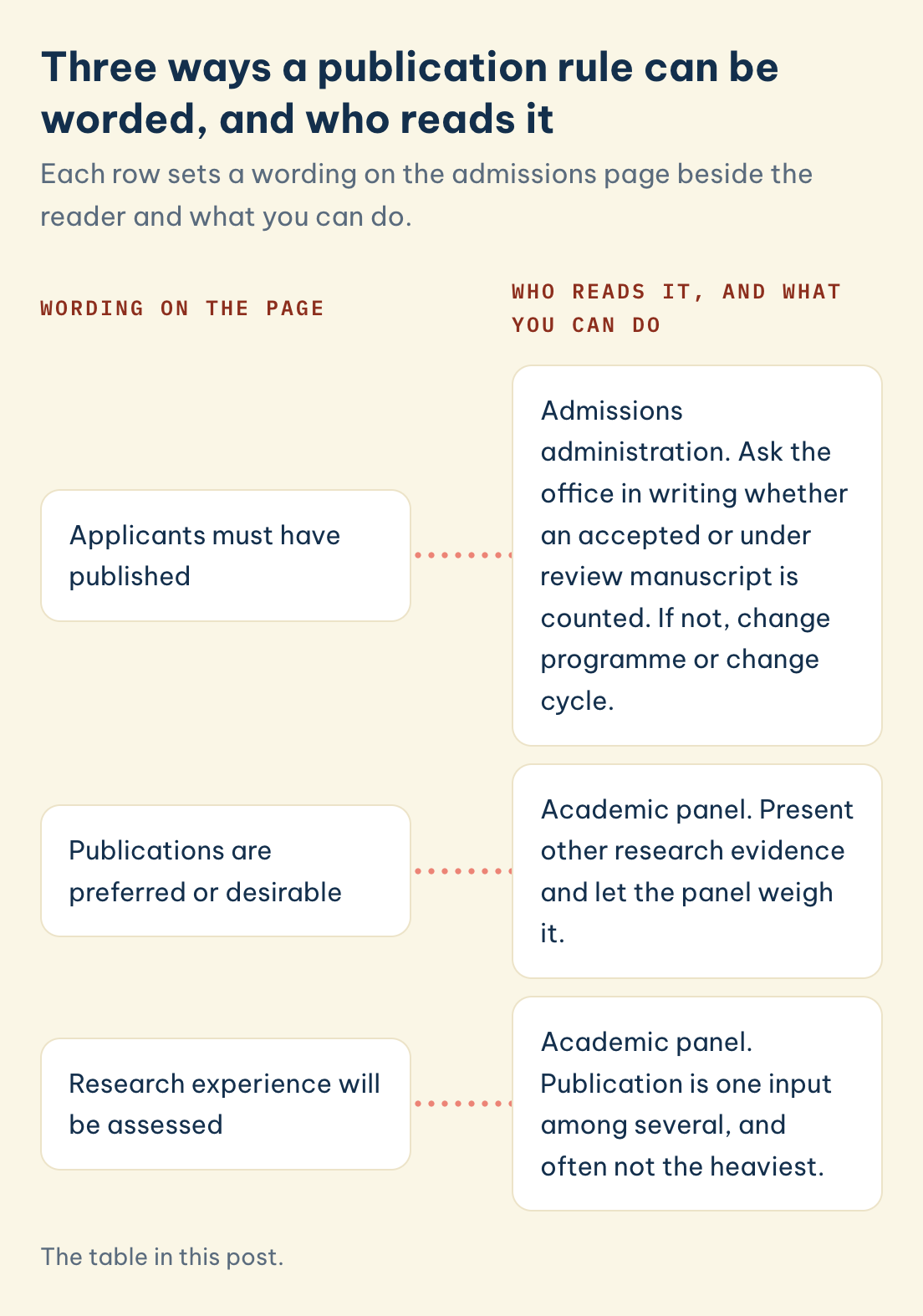
Look at which block the sentence sits in and which verb it uses. "Applicants must hold at least one peer reviewed publication" is an eligibility bar, checked by an administrator against a field in a form. "Evidence of research output is taken into account" is a selection criterion, weighed by an academic panel. Only the second is arguable.
The difference between the two blocks is not tone, it is who reads your file. An eligibility bar is processed before any academic sees the application, so there is nobody in that room to persuade. Your covering letter explaining that your master's thesis was of publishable quality does not reach anyone with the authority to agree with you. A selection criterion is different, because it is scored by people who already know that access to a publishable project depends heavily on where you studied and who supervised you.
Inouye et al. (2025), published in Higher Education volume 91 across pages 701 to 721, studied doctoral admissions at elite institutions in the United Kingdom and found that panels differ in something more fundamental than their checklists. Depending on disciplinary assumptions, some are assessing the person and some are assessing the project, and the same file reads differently in the two rooms. A publication signals different things in each: in a person-assessing room it reads as evidence about the applicant's capability, and in a project-assessing room it reads as evidence about whether the proposed work can be carried out.
Three wordings and what each one means in practice:
| Wording on the page | Who reads it | What you can do |
|---|---|---|
| Applicants must have published | Admissions administration | Ask the office in writing whether an accepted or under review manuscript is counted. If not, change programme or change cycle |
| Publications are preferred or desirable | Academic panel | Present other research evidence and let the panel weigh it |
| Research experience will be assessed | Academic panel | Publication is one input among several, and often not the heaviest |
Write to the admissions office and ask which of the three you are facing. That single email costs nothing and it decides whether the rest of your effort is aimed at a person or at a database field.
◆ Question 3 / 5 · What counts as research
What counts as research evidence if I have no publications?
Direct answer: Anything finished whose methodological choices were yours and are defensible. That covers a technical report, a conference paper, a manuscript still under review, a funded research assistantship, an undergraduate honours thesis, a master's dissertation, or a dataset you built and documented. Description of those choices is what makes any of it evidence, not the label.
Any completed piece of work where you made the methodological decisions and can defend them. A master's dissertation, an undergraduate honours thesis, a funded research assistantship, a conference paper, a technical report, a manuscript under review, or a dataset you built and documented. What converts these into evidence is description, not the label.
Describing the work is where most applications lose the value they already hold. "Completed a master's thesis on consumer behaviour" tells a panel nothing, because it names a topic and a container. What a panel can score is the chain of decisions: the question you asked, the design you chose over the alternatives you rejected, the sampling frame and why it excluded what it excluded, the analysis, the point at which the design failed and what you changed. That is the same material a viva examines, and it is the material a reference letter can corroborate.
A reference letter carries weight here that your own statement cannot. A supervisor writing "this candidate has not yet published, and I have watched her design and run a study without direction from me" makes a claim about observed behaviour rather than about a record. That is why the letter should go to whoever supervised the research, not to whoever taught you the most classes.
◆ Question 4 / 5 · How long does peer review
How long does peer review take, and can a submission arrive before the deadline?
Direct answer: Usually not. Phillips and Horn (2025) report a median of 60.5 days from submission to a first peer reviewed decision and 198 days to a final one, with desk rejections returning at a median of 10.0 days. Publishing is a poor instrument for meeting an admissions deadline.
Usually not, if you start now. Phillips and Horn (2025), writing in JAMA Network Open volume 8, tracked review and publication times across health policy journals and reported a median of 60.5 days from submission to a first peer reviewed decision, with a range of 21 to 263 days, and a median of 198 days to a final peer reviewed decision, ranging from 38 to 314 days. A median of 198 days is roughly 6.5 months, and the upper end of 314 days is over 10 months.
The review times reported above are worth sitting with, because they explain why the plan "I will publish something quickly and apply this cycle" almost never survives contact with a calendar. A first decision at the median arrives 2 months after you submit, and a first decision is rarely an acceptance. The median route to a final decision is over six months, and that is before any typesetting. Phillips and Horn also recorded a median of 10.0 days for decisions made without peer review, with a range of 2 to 67 days, which is the desk rejection path. A desk rejection returns you to the start with a different journal's formatting requirements, so two desk rejections at the median still cost 20 days before a single reviewer has read a word.
The same paper found open access journals reached a final peer reviewed decision faster than hybrid or subscription journals, at a median of 184.5 days against 228 days, a difference that was statistically significant at P = .03. That gap of 43.5 days, roughly 6 weeks, is real, and it is still nowhere near a rescue for an application deadline 3 months away.
There is a counterweight worth stating, because it cuts against the tone of everything above. Churchill et al. (2021), in the International Journal of Doctoral Studies volume 16 at pages 689 to 713, analysed 1,143 doctoral graduates from an Australian university over the 20 years from 2000 to 2020. Publication data were available for 707 graduates and time to degree data for 664, drawn from 8 fields of research grouped into 4 disciplines, and the graduates who published most, 4 or more articles, finished fastest rather than slowest. Their conclusion is stated plainly: "Publishing peer-reviewed articles during doctoral candidature is shown not to adversely affect candidates' completion time" (Churchill et al., 2021, p. 690). Publishing is not the enemy of speed once you are enrolled. It is simply a poor instrument for meeting an admissions deadline, because the queue is not yours to schedule.
Two limits on that evidence should be said out loud. Churchill et al. (2021) studied publishing during candidature, not before admission, and Schmidt and Boczar (2025) studied graduation rules at 1 university rather than entry rules across many. Neither measures what an admissions panel does with a missing publication. They tell you about the pipeline and about how common the requirement is, and that is a different claim.
◆ Question 5 / 5 · Is a research master's
Is a research master's or a research assistant post worth doing first?
Direct answer: A further research post earns its cost when the gap is research experience rather than a missing line on a form. A research master's, a predoctoral appointment or a funded assistantship of 12 to 24 months gives you a supervisor who watched you work and can say so. A paper is a by-product.
A supervised research post buys something a publication cannot buy. Twelve to 24 months in a research master's, a predoctoral appointment or a funded assistantship gives you a referee who watched you choose a design, hit a problem and change course, which is testimony about behaviour rather than a line on a record. A paper that comes out of it is a by-product rather than the objective.
The decision turns on a question you can answer honestly in an afternoon. If you have already run a study end to end and simply never wrote it up for a journal, another year of the same is expensive repetition, and your effort belongs in describing what you did. If you have never chosen a sampling frame or defended a method to anyone, a year of supervised research changes what a panel is reading rather than adding a line to it.
Where MAAS fits is narrow and worth stating plainly. We map which of your target programmes treat publication as an eligibility bar and which treat it as a criterion, we help you turn the research you have already done into evidence a panel can score, and we pair you with an expert in your field who drafts the proposal from your own account of your research and argues with it. You review, edit and approve every document, submit the application yourself and are the person in every interview. When our network already includes an advisor who fits your direction, matching is completed within 48 hours; when it does not, MAAS opens a dedicated recruitment round, which usually takes around two weeks. We do not promise admission or funding, because neither is ours to give.
If you want the full sequence rather than this one decision, the PhD application pillar sets out how the pieces fit together, and PhD Application Strategy and Execution describes what the work looks like week by week. If publication is a genuine long term goal rather than an admissions obstacle, Publishing Advisory is the relevant service.
Frequently asked questions
Does a preprint count as a publication?
It depends entirely on the wording. A preprint is not peer reviewed, so it almost never satisfies an eligibility bar that specifies peer review. It can still be strong evidence under a selection criterion, because it is a complete piece of work a panel can read. Ask the office rather than assuming.
Can I list a manuscript that is under review?
Yes, and you should, with the journal name, the submission date, and the current stage. Present it as a status rather than as a result. Given that Phillips and Horn (2025) report a median of 60.5 days to a first decision and 198 days to a final one, a panel reading your file in 2026 understands that under review means exactly that.
Is a conference paper a reasonable substitute?
Under a selection criterion it often is, particularly if the conference was peer reviewed and the paper appears in published proceedings. Under an eligibility bar that specifies a journal article, it usually is not. The same two gate test applies.
Should I pay to publish quickly somewhere that will accept anything?
No. A publication in a journal a panel does not recognise damages the file it was meant to strengthen, and it signals that you cannot yet tell venues apart, which is itself a research skill the panel is assessing.
References
Churchill, M. P., Lindsay, D., Mendez, D. H., Crowe, M., Emtage, N., & Jones, R. (2021). Does publishing during the doctorate influence completion time? A quantitative study of doctoral candidates in Australia. International Journal of Doctoral Studies, 16, 689-713. https://doi.org/10.28945/4875
Inouye, K., Robson, J., Rodriguez Anaiz, P., Baker, S., & Ilie, S. (2025). Assessing the person or the project? How disciplinary ontological and epistemological assumptions shape doctoral admissions in elite UK institutions. Higher Education, 91(2), 701-721. https://doi.org/10.1007/s10734-025-01438-8
Phillips, K. A., & Horn, D. M. (2025). Review and publication times and reporting across journals on health policy. JAMA Network Open, 8(5), e2512545. https://pmc.ncbi.nlm.nih.gov/articles/PMC12117454/
Schmidt, L., & Boczar, J. (2025). "At least one peer reviewed paper by graduation": An analysis of pre-graduation publication by post-baccalaureate graduate students. College & Research Libraries, 86(4). https://crl.acrl.org/index.php/crl/article/view/26862
A free 20-minute consultation is a conversation about your situation and the programmes you are considering.
Book a free consultation ▸