
◆ PhD application
Is there a PhD programme with lower entry requirements?
Whether a PhD programme with lower entry requirements exists is the most common question MAAS mentors hear once an applicant has read a few admissions pages and found themselves short on one line of them. It also assumes something untrue: that programmes sit on a single ladder, and that stepping down a rung makes admission easier. Applicants who search for that lower rung often land somewhere they are more likely to be rejected, not less.
The reason is that every research programme has two floors. One is printed on the page and screens applications out. The other is never listed under entry requirements at all, and it is the one that decides. This guide explains how the two differ, why they tend to move in opposite directions, and what to ask instead.

◆ Question 1 / 6 · Printed floor and real floor
What is the difference between the printed floor and the real one?
Direct answer: The printed floor is the published minimum, meaning a degree classification, a grade average or Grade Point Average (GPA), a language score such as IELTS, TOEFL or PTE Academic, and sometimes an admissions test such as the GRE. It is a filter, and passing it earns you a reading rather than a place. The real floor is fit.
Fit means whether anyone in that department researches closely enough to your question to supervise it, and wants to. It is rarely written as a requirement, because it cannot be expressed as a number.
Some departments publish the rubric their admissions panel scores against, and reading one is instructive. The doctoral admissions rubric published by the Department of Theatre Arts at the University of Pittsburgh scores an applicant on their desire and potential for rigorous research at doctoral level, on whether the personal statement, or Statement of Purpose (SOP), can say why they are pursuing a PhD and why Pitt, on the strength of argument in the writing sample, on what recommenders say about their potential as a scholar, and on capacity for creative and critical risk-taking (University of Pittsburgh, Department of Theatre Arts, n.d.). The top band of that rubric states plainly that the strongest applicant "can clearly express why they are pursuing a PhD, potential areas for research, and why Pitt in their personal statement" (University of Pittsburgh, Department of Theatre Arts, n.d.). Grades appear inside those criteria rather than as a threshold of their own, in the form of relevant experience evidenced on a CV, or Curriculum Vitae, and transcripts, and no criterion is a grade average or a test score in isolation.
One rubric from one department in one discipline does not describe the whole sector, and a quantitative field would weigh different evidence. What it does show is the shape of the assessment: an admissions panel scoring qualities, with the numbers serving those judgements rather than standing in for them.
That single observation reframes the whole question. If you are searching for a programme with a lower published minimum, you are searching along an axis that the people making the decision are not scoring.
◆ Question 2 / 6 · The most open school
Why does the school that looks most open often turn out to be the hardest?
Direct answer: Because a department that keeps its formal requirements broad is usually doing so in order to select hard on fit instead. Loosening one gate does not remove the selection, it moves it. Panels who cannot filter on a test score filter more sharply on whether your research direction belongs in their group.
The school that looks most open turning out to be the hardest is the pattern MAAS mentors run into most often when building a school shortlist, and it can be stated plainly from casework. A department may be the most open of a shortlist on formal eligibility, having dropped an admissions test requirement such as the GRE altogether, while its published description of the research group asks for a background the applicant does not have anywhere in their transcript, and a methodological tradition their proposal does not use. On paper it was the easiest door on the list. On fit it was the narrowest. An applicant sorting schools by published minimum would have placed it first and been rejected first.
One caution about how far to carry this. The pattern above is drawn from MAAS advisory casework rather than from a published study, so treat it as a working rule rather than a measured fact, and check it against the specific departments on your own list.
◆ Question 3 / 6 · Why fit is unwritten
Why is fit not written down as a requirement?
Direct answer: Because it is a relationship, not a threshold. A doctorate is supervised work, so the department is asking whether the specific capability sitting in their building matches the specific project sitting in your proposal.
That match cannot be published in advance, because it depends on who currently has capacity and what they are working on this year.
Fit is, however, published indirectly, and this is the part applicants miss. Departments describe their research groups, their themes, and often the kind of background a given strand expects. Institutional guidance for research applicants tells you to review the literature around your intended project and, where you have identified academics working in your area, to contact them to discuss their work before applying (University of Leeds, n.d.). That instruction is not networking advice. It is the department telling you that the unwritten floor is checkable, and that checking it is your job.
Doctoral qualifications are defined by the creation and interpretation of new knowledge, through original research of a quality to satisfy peer review and extend the forefront of the discipline (Quality Assurance Agency for Higher Education, 2024), sitting at Level 8 of the Regulated Qualifications Framework (RQF) in England, Wales and Northern Ireland, and at the equivalent level of the Framework for Higher Education Qualifications (FHEQ) that the same QAA document sets out. A panel assessing that has to assess it in a field, not in the abstract, which is precisely why the assessment cannot be reduced to the numbers on your transcript.
◆ Question 4 / 6 · What to ask instead
What should you ask instead of "who wants less"?
Direct answer: Ask which of the two floors you are actually failing, because the two failures have completely different remedies and one of them is not solved by changing schools at all.
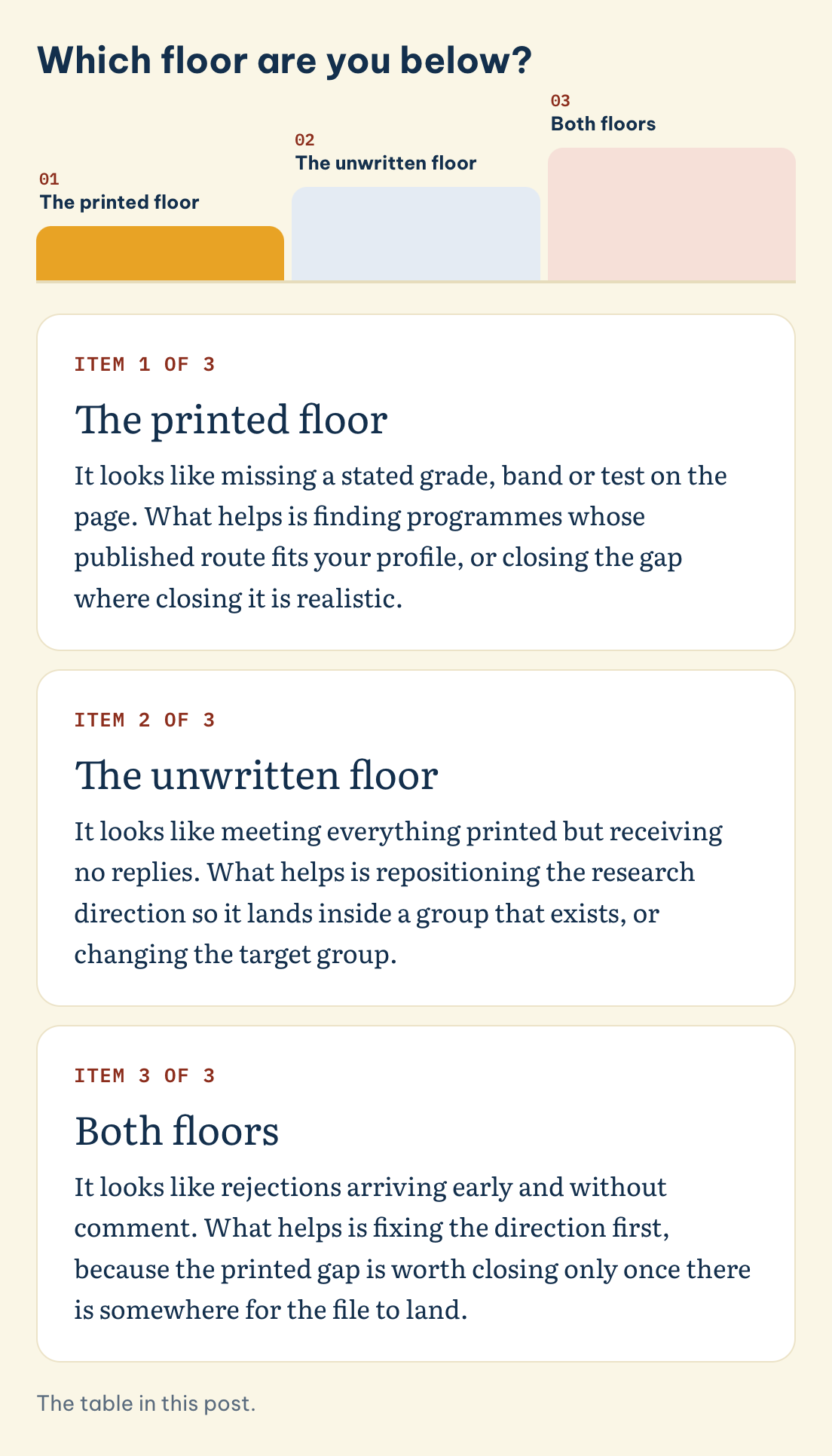
Which floor are you below?
Tap a case to see what it looks like and what actually helps, as the post's table gives them.
Item 1 of 3
The printed floor
It looks like missing a stated grade, band or test on the page. What helps is finding programmes whose published route fits your profile, or closing the gap where closing it is realistic.
Item 2 of 3
The unwritten floor
It looks like meeting everything printed but receiving no replies. What helps is repositioning the research direction so it lands inside a group that exists, or changing the target group.
Item 3 of 3
Both floors
It looks like rejections arriving early and without comment. What helps is fixing the direction first, because the printed gap is worth closing only once there is somewhere for the file to land.
Save this figure
| If you are below | What it looks like | What actually helps |
|---|---|---|
| The printed floor | You miss a stated grade, band or test on the page | Find programmes whose published route fits your profile, or close the gap where closing it is realistic |
| The unwritten floor | You meet everything printed but receive no replies | Reposition the research direction so it lands inside a group that exists, or change the target group |
| Both | Rejections arrive early and without comment | Fix the direction first, because the printed gap is worth closing only once there is somewhere for the file to land |
The printed floor almost always reduces to GPA, IELTS or TOEFL bands, or GRE thresholds, all filterable by a computer before any human reads the file. Most applicants who ask the lower-requirements question have already diagnosed themselves as the first row when they are in the second. The tell is simple. If you meet every published requirement of the programmes you are approaching and are still getting silence, no amount of searching for an easier list will change anything, because the thing failing was never on the list.
◆ Question 5 / 6 · Checking the unwritten floor
How do you check the unwritten floor before you apply?
Direct answer: Read the last 2 to 3 publications of the people you would be supervised by, not their biography page, and check whether your question could be the next thing that group works on.
A biography describes a career, and by the time it is written the person may have moved on twice. Recent output describes what is being worked on now, which is what determines whether a project is supervisable this cycle. Three things are worth establishing before you invest in an application, as UK institutional guidance frames it (University of Leeds, n.d.): whether anyone there works close enough to your direction to supervise it, whether that person currently has the Supervisory Capacity to take a doctoral researcher at all, and what funding realistically exists for the position, whether through UK Research and Innovation (UKRI) studentships, such as those run by the Arts and Humanities Research Council (AHRC), or departmental funds. None of the three appears in an entry requirements table, and all three decide the outcome.
Reading a department this way also changes what your proposal looks like. The rubric quoted above rewards an applicant who can say why they are pursuing a doctorate and why this university (University of Pittsburgh, Department of Theatre Arts, n.d.), and neither sentence is writeable until you have read the group. Applicants who skip the reading write the same letter to twelve departments, and the flatness of it is visible from the first paragraph.
◆ Question 6 / 6 · What MAAS does here
What does MAAS do at this point in an application?
Direct answer: Check your profile item by item against a shortlist of 20 to 30 departments, record where you meet the published requirement and where you do not, then build a separate positioning table for individual academics based on their recent work. Two tables, because the two floors are two different problems.
Where a department's published requirements are genuinely ambiguous, MAAS writes to the department to confirm, and the answer goes into the table with the reply attached. Where the gap turns out to be fit rather than eligibility, the work moves back to the proposal, because that is the only place a fit problem can be fixed. Your expert argues against your research direction point by point and drafts the revised proposal from your own account of your research for you to review, edit and approve. You remain the applicant, and no approach letter goes out until you have read and approved it, after which MAAS sends it from a campaign mailbox opened in your name and hands the mailbox over to you when the engagement ends. The PhD Application Strategy and Execution page sets out the full scope, and the PhD application guide covers how the shortlist and the outreach sequence are built.
Frequently asked questions
Does a lower-ranked university have lower requirements?
Not reliably. Published minimums and reputation, whether from QS World University Rankings, Times Higher Education or the Academic Ranking of World Universities (ARWU), are only loosely related, and a smaller department can be stricter on fit because it has fewer supervisors and therefore fewer directions it can support. Rank tells you very little about your own odds at a specific programme.
I miss the language requirement by half a band. Is that fatal?
It is a printed-floor problem, which means it is the more tractable of the two, but check the requirement per skill rather than the overall figure. Some programmes set a separate minimum for individual components, and an overall score that clears the bar can still fail on one of them.
Should I apply anyway and see what happens?
Applying with a fit problem you already know about, one no GPA or GRE score fixes, mostly buys a slow rejection. Applying with a small printed-floor gap and strong fit is sometimes worth it, because that is the situation where a department has a reason to look for a route. Know which of the two you are in before you spend the fee.
Is it easier to get in without an admissions test?
Not necessarily. A programme that does not require a test such as the GRE still has to distinguish between applicants, and it does so on the material that remains, which is your proposal, your writing sample and your referees, weighed much the way the Pittsburgh admissions rubric weighs them (University of Pittsburgh, Department of Theatre Arts, n.d.). Removing a gate concentrates the weight on the others.
Can MAAS guarantee admission or a scholarship?
No, and any provider who does is telling you something about themselves rather than about your chances. Admission decisions are made by panels and supervisors on evidence, and no external party controls them. What a serious provider can commit to, and the questions worth asking to tell the difference, are set out in a separate guide on what a guaranteed PhD admission actually promises.
If I start now, when would I be talking to someone who knows my field?
Within 48 hours when our network already covers that field. If it does not, MAAS opens a dedicated recruitment round for your case, which usually takes about 2 weeks.
Related MAAS guides
- What does a reader notice in your PhD proposal first? for the self-check before you send anything
- How do you write a PhD research proposal? for the structure of each section
- PhD application guide for admissions systems, contact order and the shortlist
- PhD Application Strategy and Execution for what an engagement covers
References
Quality Assurance Agency for Higher Education. (2024). The frameworks for higher education qualifications of UK degree-awarding bodies (2nd ed.). https://www.qaa.ac.uk/docs/qaa/quality-code/the-frameworks-for-higher-education-qualifications-of-uk-degree-awarding-bodies-2024.pdf
University of Leeds. (n.d.). Research proposals. Retrieved August 17, 2026, from https://www.leeds.ac.uk/research-applying/doc/research-proposals
University of Pittsburgh, Department of Theatre Arts. (n.d.). PhD admissions rubric. Retrieved August 17, 2026, from https://www.play.pitt.edu/sites/default/files/PhD%20Admissions%20Rubric.pdf
A free 20-minute consultation with a MAAS adviser, to work out which floor you are below, the printed one or the unwritten one.
Book Free Discovery ▸