
◆ PhD application
What does a PhD admission consultant's guarantee actually promise?
When a PhD admission consultant says admission is guaranteed, three different promises arrive wearing the same words. One is a promise about an outcome, one is a promise about work, and one is a promise about money. Only the first is impossible, and it is the one most often meant when an applicant is told their admission is guaranteed.
Separating them is worth doing calmly rather than indignantly, because the applicant hearing the promise is usually not being naive. They are trying to buy certainty in a process where almost nothing is observable from the outside, and a guarantee is the only thing on offer that sounds like certainty.

◆ Question 1 / 4 · The impossible promise
Which of the three promises is the impossible one?
Direct answer: The promise about the outcome, because the authority to admit you sits with a body that has no contract with the person selling it: a supervisor, a panel, or a funding body. A promise about work performed, or a refund conditional on that outcome, can genuinely be kept and checked; only the outcome itself cannot.
| The promise | What it is really about | Can it be kept |
|---|---|---|
| "You will be admitted" or "you will get the scholarship" | An outcome decided by a supervisor, a panel or a funding body | No, because the decision rests with people who are not party to the arrangement |
| "Your proposal will be reviewed three times, within five working days each" | Work performed by the provider | Yes, and it can be checked while it happens |
| "We refund you if you are not admitted" | Money, conditional on an outcome | Yes as a contract, but it is insurance rather than a claim about admission |
The third row is where the confusion concentrates, and it deserves precision rather than suspicion. In Australia, a headline claim that cannot be substantiated can also fall under the Australian Consumer Law, enforced by the Australian Competition and Consumer Commission, which treats a guarantee of a third party's decision as a candidate for a misleading-conduct complaint regardless of how the contract's fine print reads. In the United Kingdom, the same kind of claim can engage the Consumer Rights Act 2015, and in the United States the Federal Trade Commission treats an unsubstantiated outcome claim the same way, regardless of which country a provider happens to be registered in. A refund clause is a legitimate commercial instrument, and offering one is not in itself a warning sign. What it is not is evidence that anybody can influence the decision. It transfers a portion of your financial risk and leaves the academic risk exactly where it was, and its value depends entirely on how the contract defines the triggering event and what it excludes.
Who actually holds the decision differs by system, and knowing which system you are in tells you immediately how empty an outcome promise is. In the United Kingdom and Australia, a named supervisor usually decides first and the school confirms, so admission turns on one academic's judgement about fit. In the United States, an admissions committee selects a cohort, often meeting once in January or February. In Germany and the Netherlands, most doctoral places attach to a funded project and are advertised as jobs, sometimes through bodies such as the German Academic Exchange Service (DAAD). Funding sits somewhere else again, with bodies such as UK Research and Innovation, the Chevening scheme run by the Foreign, Commonwealth and Development Office, or the Australian Government Research Training Program. No provider is a party to any of those decisions.
◆ Question 2 / 4 · Why it persuades
Why is a guarantee so persuasive when it cannot be true?
Direct answer: Because you cannot watch the work being done, so an outcome promise substitutes for the quality signal you have no way to read.
This information gap between payer and provider is a well-described structural problem rather than a moral one. Writing in the Journal of Studies in International Education, Nikula and Kivistö (2020) analyse the education-agent relationship through agency theory, where the party paying cannot readily observe what the party acting actually does, and where the interests of student, agent and institution do not automatically align. Their own framing states it directly: "This article investigates the monitoring mechanisms proposed for education providers to mitigate information asymmetry in their education agent relationships" (Nikula & Kivistö, 2020, p. 212). Comparative work on how Australia and New Zealand have regulated agent conduct shows governments treating this as a systemic issue requiring standards, rather than as a matter of individual bad actors (Nikula, 2022). In Australia, that oversight sits with the Education Services for Overseas Students Act 2000 and the National Code 2018, while New Zealand's equivalent runs through the New Zealand Qualifications Authority, and in the UK a similarly misleading claim can fall within the remit of the Advertising Standards Authority and the Competition and Markets Authority. None of these frameworks grants any third party a vote in an individual admission decision. Nikula (2022) adds a limit on how far such rules travel: the paper, in Studies in Higher Education, concerns agent standards in Australia and New Zealand, so the rules it describes belong to those two systems and should not be assumed to apply to a UK or US application.
That literature concerns recruitment agents rather than doctoral advisory work specifically, so it describes the shape of the problem rather than your particular case. The shape is what matters here. When effort is invisible to the buyer, promises drift toward the one thing the buyer can verify later, which is the outcome, even though the outcome is the single element the seller controls least.
The practical consequence runs opposite to intuition. A provider willing to describe its work in checkable detail is offering you more information than one promising a result, because the first set of statements can be tested against reality within 2 to 3 weeks while the second can only be tested once, at the end, when nothing can be changed.
◆ Question 3 / 4 · What to ask instead
What should you ask instead of "do you guarantee it"?
Direct answer: Four questions that each force a description of mechanism, because a promise nobody can explain the mechanism for is a promise about something the promiser does not control.
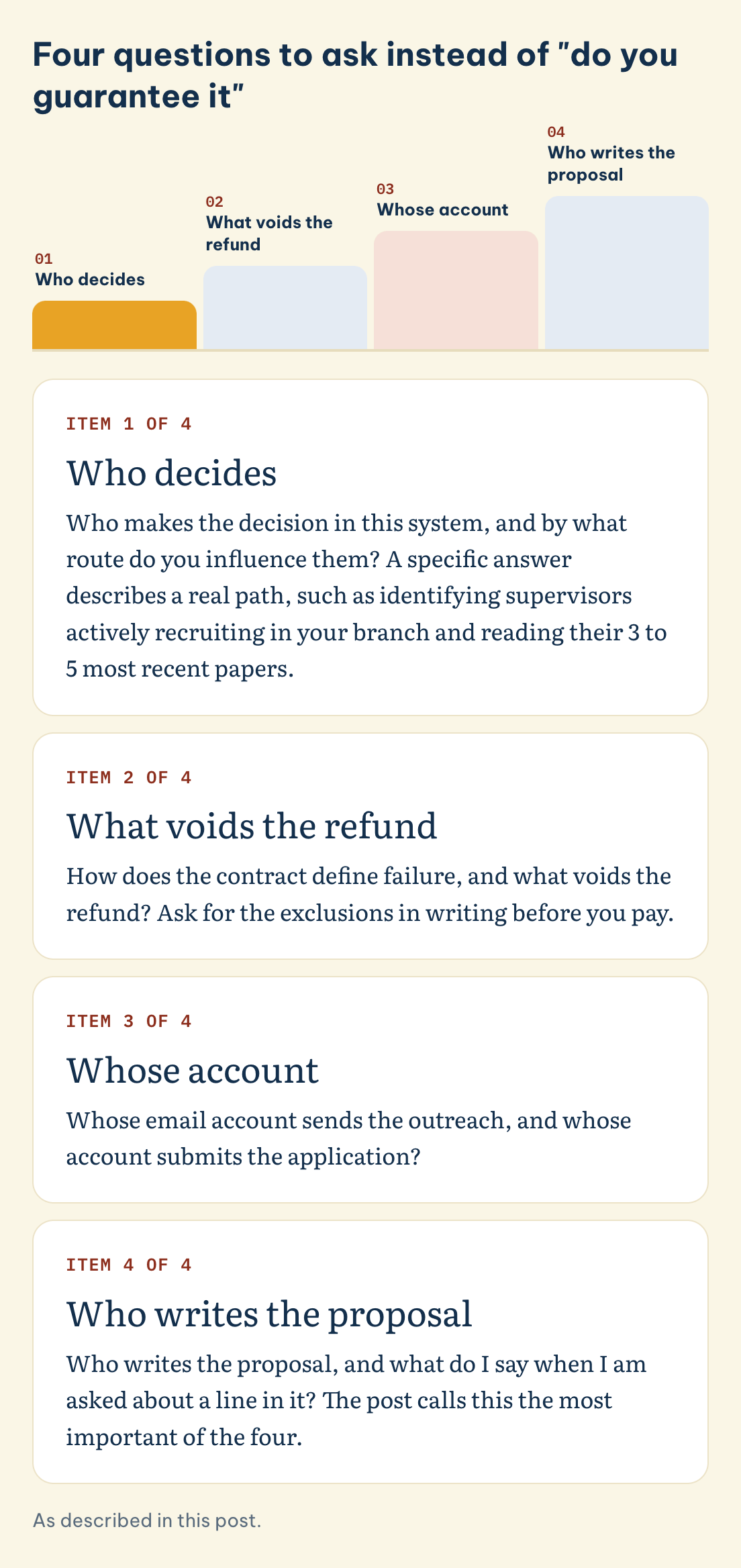
Four questions to ask instead of "do you guarantee it"
Tap a question to read it as the post puts it, in the order the post gives them.
Item 1 of 4
Who decides
Who makes the decision in this system, and by what route do you influence them? A specific answer describes a real path, such as identifying supervisors actively recruiting in your branch and reading their 3 to 5 most recent papers.
Item 2 of 4
What voids the refund
How does the contract define failure, and what voids the refund? Ask for the exclusions in writing before you pay.
Item 3 of 4
Whose account
Whose email account sends the outreach, and whose account submits the application?
Item 4 of 4
Who writes the proposal
Who writes the proposal, and what do I say when I am asked about a line in it? The post calls this the most important of the four.
Save this figure
"Who makes the decision in this system, and by what route do you influence them?" A specific answer describes a real path, such as identifying supervisors actively recruiting in your branch, reading their 3 to 5 most recent papers on Google Scholar, Scopus or Web of Science, and helping you make contact. A vague answer describes relationships instead, and a claim of personal acquaintance with professors is a claim you cannot verify and they cannot substantiate. A checkable version names the department, the research group and the ORCID record you can open yourself.
"How does the contract define failure, and what voids the refund?" Ask for the exclusions in writing before you pay, and read them against your own application calendar, which for an autumn intake normally runs from September to a December or January deadline. Common conditions turn on how many programmes you applied to, whether you met deadlines, and what counts as an unsuccessful outcome, and these determine whether the clause is worth anything to you.
"Whose email account sends the outreach, and whose account submits the application?" This is not administrative detail. Some institutions state in their admissions terms that they do not authorise external parties to act for applicants, and that applications arriving through intermediaries may be refused. In the United Kingdom the terms sit in the postgraduate research admissions policy, in Australia they sit alongside the National Code 2018 obligations that Nikula (2022) traces back to agent-conduct regulation, and in the United States they usually sit in the graduate school's own statement on application integrity. Check the wording on your own target programmes rather than taking anyone's word for it, because if such a clause applies, an arrangement designed to reassure you can be the thing that ends your application.
"Who writes the proposal, and what do I say when I am asked about a line in it?" This question tends to end the conversation quickly, and it is the most important of the four. A proposal written for you, typically 1,500 to 2,000 words, is a document you will be examined on by someone who reads for a living, usually in an interview lasting 30 to 45 minutes. The interview is where authorship becomes visible, and no guarantee covers that moment.
◆ Question 4 / 4 · Are all promises warnings
Does this mean every promise is a warning sign?
Direct answer: No, and treating it that way would leave you unable to distinguish a serious provider from a cautious one.
Promises about work are exactly what you should be asking for, and their absence is its own problem. How many rounds of feedback on the proposal, typically 2 to 3, within what turnaround, usually 5 to 7 business days, from someone with what background in your field, and what happens if the match is wrong. Those commitments are specific, testable inside the first 30 days, and they are what you are actually paying for.
The line worth holding is between a commitment to effort and a commitment to a decision that belongs to someone else, the same asymmetry Nikula and Kivistö (2020) describe between the party paying and the party who can actually observe the work. Applied to ourselves, MAAS states it this way: nobody can guarantee a PhD place or a scholarship, because the decision belongs to the panel and the supervisor, and what can be committed to is that you go to the right doors, on time, with a file strong enough to compete, and with someone negotiating on your behalf where negotiation is possible.
Read that as a template rather than as a pitch. Any provider, including this one, should be answerable to the four questions above, and you should ask them of everyone you speak to, in the same words, and compare what comes back.
Frequently asked questions
A company showed me a long list of successful cases. Does that prove anything?
It shows outcomes without showing the base, which is the number of applicants who did not succeed and the strength of the files that did. A list of 40 admissions means one thing against 60 applicants and something quite different against 600. Neither figure is usually available, and without them a list of admissions is compatible with almost any level of actual contribution.
They offered a full refund if I am not admitted anywhere. Is that reassuring?
It is a contract term, and its worth is in the exclusions rather than the headline. Ask what counts as an application, whether the minimum runs 5 to 8 programmes, what happens if you decline an offer, and what evidence you must supply, then decide whether the cover is real.
Is it wrong to pay for help with a doctoral application at all?
No. What matters is what the money buys. Paying someone to shortlist accurately across 5 to 8 programmes using Google Scholar or Web of Science, to critique your proposal hard over 2 to 3 rounds, or to handle correspondence you find difficult is ordinary professional support. Paying someone to be the author of your research is a different transaction, and it fails at the point where you have to defend the work. A draft built from your own account of your research, which you rework and approve until you can defend every line, is not that transaction.
What if the arrangement seems fine but I still cannot tell?
Ask the fourth question, allow about 2 minutes, and listen to how it is answered rather than what is answered. A provider who welcomes it and starts talking about how they would prepare you to defend your own argument is describing a different service from one who reassures you that it will not come up.
How long before someone can look at my case with me?
Within 48 hours when our network already covers that field. If it does not, MAAS opens a dedicated recruitment round for your case, which usually takes about 2 weeks.
What should a proposal review commitment actually look like on paper?
Specific enough to hold someone to. A workable version names 2 to 3 rounds of feedback, a turnaround of 5 to 7 business days per round, and a named point of contact, rather than an open-ended promise to "support you until you get in." If a provider cannot put a number on rounds or turnaround, that absence is itself information.
Related MAAS guides
- What is a PhD admissions page telling you without numbers? for reading a programme yourself rather than being told about it
- Is there a PhD programme with lower entry requirements? for why a low threshold is not an easy admission
- Does a taught master's qualify you to apply for a PhD? for what your existing record already proves
- Can you just email the professor yourself? for what outreach genuinely involves
- PhD application guide for admissions systems and contact order, usually reachable within 48 hours
- PhD Application Strategy and Execution for what an engagement covers and where it stops
References
Nikula, P.-T. (2022). Education agent standards in Australia and New Zealand: Government's role in agent-based international student recruitment. Studies in Higher Education, 47(4), 831-846. https://doi.org/10.1080/03075079.2020.1811219
Nikula, P.-T., & Kivistö, J. (2020). Monitoring of education agents engaged in international student recruitment: Perspectives from agency theory. Journal of Studies in International Education, 24(2), 212-231. https://doi.org/10.1177/1028315318825338
A free 20-minute consultation with a MAAS adviser, to talk through a promise an admissions provider has made to you and the four questions to ask about it. You make every decision.
Book Free Discovery ▸