
◆ PhD application
Can you cold email a professor yourself?
Yes, you can cold email a professor yourself. Nothing stops you, no permission is required, and the email itself takes about 20 minutes to write. Applicants who ask this question are usually asking something sharper underneath it, which is whether the writing was ever the hard part. It was not.
The hard part is that a first email is spent, not sent. There is a finite list of academics in the world whose current work sits close enough to your question to supervise it, that list is shorter than most applicants expect, and each name on it can only receive a first impression once. This guide is about what that constraint actually costs, and where the work sits if the typing is the cheap part.

Whether the professor has room at all is a separate question, and it is no longer answerable from their title: our guide to how many PhD students one supervisor can take sets out where that limit now lives.
◆ Section 1 / 7 · A non-renewable resource
Why is a first email a non-renewable resource?
Direct answer: Because a professor who has already read a vague email from you does not become neutral again. They become a name you have used. If the genuinely relevant supervisors in your subfield number only 10 to 15, every approach sent before you were ready permanently shortens a list you cannot restock.
That figure is an estimate from MAAS shortlisting work in narrow subfields rather than a measured average, and it will be larger in a broad field. For context, most funded UK doctoral places carry a stipend for 3 to 3.5 years through a body such as UK Research and Innovation (UKRI), often via a Doctoral Training Partnership (DTP) or a Centre for Doctoral Training (CDT) backed by a specific research council such as the Engineering and Physical Sciences Research Council (EPSRC), the Economic and Social Research Council (ESRC), or the Arts and Humanities Research Council (AHRC), or through a university studentship. In Australia the equivalent funding usually runs through the Research Training Program (RTP), sometimes supplemented by an Australian Research Council (ARC) grant tied to a specific project. Enrolment and completion figures for these routes are published by bodies such as the Higher Education Statistics Agency (HESA). Departments on both funding routes typically open one funded place per supervisor per intake, which is part of why a shortlist of 10 to 15 names in a narrow subfield does not stretch far.
This narrow, non-renewable shortlist is what makes the question misleading when it is framed as "can I do it myself". Of course you can. The real question is how many of those names you can afford to spend while you work out how to write the email, because the learning curve is paid for in names rather than in time.
Applicants tend to model outreach the way they model job applications, where volume compensates for hit rate and a rejection costs nothing. Doctoral outreach inverts both assumptions. The pool is small, it does not refresh, and a poor approach does not merely fail to land, it removes a possibility. That is why MAAS sends in waves of 4 to 6 rather than in a single batch of 20. The wave size is an operating choice rather than a published standard, and the reasoning is simple: if the first wave produces silence, the framing can be corrected while there are still names left to use.
◆ Section 2 / 7 · Where the work sits
If the email is easy, what is the work?
Direct answer: Three things, none of which happen in the email client. Deciding which names belong on the list, working out what each specific target requires, and handling the conversation that starts if someone replies.
The middle one is the most underestimated, and it is easy to demonstrate. Requirements are not uniform even inside a single institution. One business school states that the research proposal must be between 1,000 and 1,500 words for its integrated-study and MSc by Research routes, and between 3,000 and 5,000 words for its business economics, financial technology and management science routes, and tells applicants to check carefully because the limits differ by programme (University of Edinburgh Business School, n.d.). Same school, same faculty, one specification roughly triple the other.
The same page is blunt about two other things. Applications arriving without a research proposal will not be considered, and a personal statement does not satisfy the proposal requirement (University of Edinburgh Business School, n.d.). Those are not obscure details. They are the kind of thing that turns a strong candidate into a file nobody reads, and they are invisible to anyone who assumes one set of rules covers the whole sector.
Multiply that by twenty targets and the shape of the work becomes clear. It is not writing twenty emails. It is establishing twenty specifications, then writing to the ones still worth writing to.
◆ Section 3 / 7 · Who belongs on the list
What decides whether a name belongs on the list at all?
Direct answer: Whether that person's recent work could plausibly extend into your question, whether they can take a doctoral researcher this cycle, and whether funding exists for the position. A name that fails any of the three is not a lead, and writing to it is spending a shot on a target that was never open.
Where those names come from in the first place is a separate piece of work. Among 1,796 doctoral students surveyed in 2022, 11% ended up with a supervisor chosen because no other faculty member worked on their topic, and that group reported more difficulty afterwards (Pavliuk & Zhuchkova, 2025). Our guide to finding a PhD supervisor from the literature sets out how the list is built before any of these three filters is applied.
In many UK departments, shortlisting to interview commonly takes 4 to 8 weeks from a first reply, and in Australia the equivalent step often takes 2 to 4 weeks, so the timing of a reply is itself a signal worth reading.
Guidance for research applicants tells you to review the literature around your intended project and, having identified academics working in that area, to contact them to discuss their work (University of Leeds, n.d.). The guidance puts it directly: "If you have identified academics involved in your research area you should contact them to discuss their work" (University of Leeds, n.d.). The order in that sentence is the whole method. Reading comes first, and the email is a consequence of the reading rather than a substitute for it. An approach written without it produces a recognisable artefact: a letter that could have been addressed to anyone in the department, which is exactly how it reads to the person opening it.
◆ Section 4 / 7 · What goes in the email
What goes into a first email to a professor?
Direct answer: Guidance from the University of Oxford (n.d.), The University of Queensland (2025), UCL (n.d.) and Queen's University (n.d.) points to six parts: a subject line stating intent, a titled greeting, a short introduction, why this person, funding and start date, and one small request. Queen's University (n.d.) caps the body at 250 words.
The six parts of a first email
Tap a part to read what the guidance behind the post says to write, in the order the post gives them.
Item 1 of 6
Subject
State your level and field, for example "Prospective PhD student interested in [field]", and avoid vague lines such as "Hello" or "Enquiry".
Item 2 of 6
Greeting
The right title and surname, with the spelling of the name checked.
Item 3 of 6
Intro
Your level, university, subject and purpose for writing, in one or two sentences.
Item 4 of 6
Why them
One specific publication or open question of theirs that connects to what you plan to do.
Item 5 of 6
Details
Funding, international or home status, full-time or part-time, and when you want to start.
Item 6 of 6
Request
Ask whether they would like to talk further, and attach a CV and proposal rather than telling everything in the email.
Save this figure
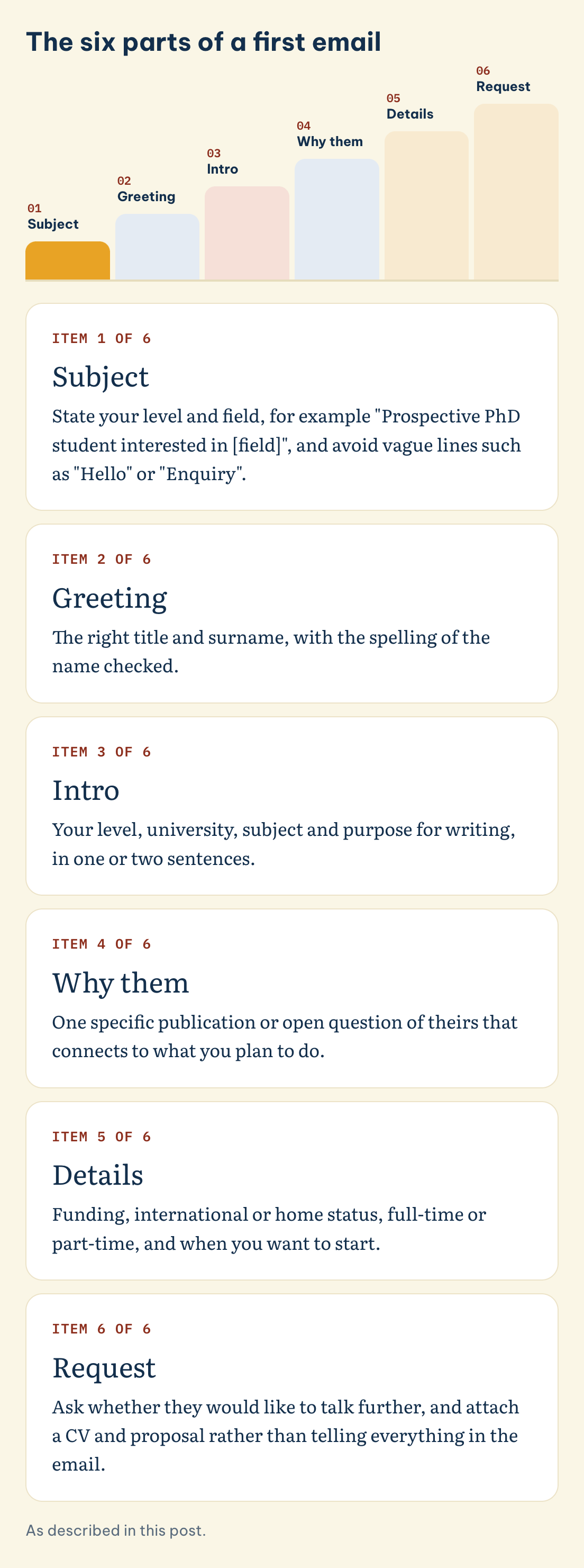
The six parts are easier to scan in the table below, each with the guidance it comes from.
| PART OF THE EMAIL | WHAT TO WRITE | SOURCE |
|---|---|---|
| Subject line | State your level and field, for example "Prospective PhD student interested in [field]", and avoid vague lines such as "Hello" or "Enquiry" | The University of Queensland (2025), Queen's University (n.d.) |
| Greeting | The right title and surname, with the spelling of the name checked | University of Oxford (n.d.) |
| Introduction | Your level, university, subject and purpose for writing, in one or two sentences | Queen's University (n.d.) |
| Why this person | One specific publication or open question of theirs that connects to what you plan to do | University of Oxford (n.d.), Queen's University (n.d.) |
| Required information | Funding, international or home status, full-time or part-time, and when you want to start | UCL (n.d.), The University of Queensland (2025) |
| Request and attachments | Ask whether they would like to talk further, and attach a CV and proposal rather than telling everything in the email | University of Oxford (n.d.), Queen's University (n.d.) |
One group of details worth getting right is information the recipient can check for themselves. The University of Queensland (2025) advises that the CV attached to the email give the grade as the mark achieved out of the maximum, so that a school using a different scale does not misread it, and that it list only publications the recipient can look up online. For applicants used to a 10-point or 4-point scale, MAAS infers that the scale should be written beside the number, and that inference is MAAS's own rather than the university's. UCL (n.d.) adds that in most cases the email should say whether funding is secured or still to be sought, whether you are an international or home applicant, and whether you study full-time or part-time.
What the email should stress also changes with the kind of department. UCL (n.d.) describes team-based settings such as science, engineering and medicine, where the recipient wants a CV showing you fit the group and a few lines on why you want to join it. In individual-scholarship settings such as the humanities and social sciences, UCL (n.d.) says recipients usually want a well-considered proposal that engages closely with their recent work, with a first version of about 500 words and no more than 3,000 words. If you are unsure whether the department you are targeting needs a proposal, UCL (n.d.) advises asking the department's graduate tutor.
The recipient is also reading more than the words. Henderson et al. (2025), in a qualitative study at one UK university, found that supervisors read whether an email came with a full CV and proposal, whether it mentioned their own publications, and that a personal email address may be read as unprofessional. That is a finding from one institution, so treat it as one way a recipient may read an email rather than a general rule.
On length, Queen's University (n.d.) recommends no more than 250 words, and Bealby (2025) suggests about 200 to 250 words unless the recipient asks for something different. Both are advice rather than a rule or a measured figure, so 250 is best used as a rough guide.
◆ Section 5 / 7 · After the reply
What happens after a reply, and why is that the harder half?
Direct answer: A reply is not an offer. It opens a short exchange in which four things have to be established quickly and diplomatically: whether funding exists, what the department expects the proposal to look like, whether a place is genuinely available this cycle, and what the local requirements are.
Applicants often prepare intensively for the first email and then improvise everything after it. What that exchange should establish is set out in what to ask after a professor says "send me more".
That post-reply exchange is where a promising thread most often dies, and it rarely dies from rudeness. It dies from vagueness. A professor who asks what your method would be, or how you would get access to your data, is testing whether there is a project underneath the enthusiasm. Answering that well requires the proposal to already exist in defensible form, which is why the sequence runs from the document outward rather than from the email inward.
One detail worth knowing before you start. Some universities state in their admissions rules that they do not accept applications submitted through agents, and reserve the right to reject an agent-routed file. Read those rules closely, though, because what they govern is representation and submission rather than correspondence. What they forbid is an agency filing your application, or standing as your named representative to the university. They do not forbid someone helping you run the correspondence, provided the application itself goes in under your own name, by you. The questions worth asking an adviser are therefore these: does every letter go out only after you have read and approved it, is the mailbox opened in your name and handed to you at the end of the engagement, and does the adviser stay out of the application itself. Getting that boundary wrong is expensive, because a file rejected as agent-routed is usually rejected without a stated reason and without appeal.
◆ Section 6 / 7 · What an adviser adds
So what does an adviser actually add?
Direct answer: Judgement about a field you are still entering, the research behind the shortlist, and a personalised draft for each professor. What stays yours is the decision on every letter and the interview, and the mailbox the letters leave from is opened in your name and handed to you when the engagement ends.
The division is easier to see if you separate the two costs. The cost you can pay yourself is time: reading, checking, following up. The cost that is harder to pay alone is judgement about a field you are still entering, which is what determines whether a name belongs on the list and whether your question reads as a real contribution to someone who has spent 20 years in that debate. That is the part where an experienced reader changes the outcome, and it happens before a single email is drafted.
In practice this means MAAS builds the shortlist by reading, checks your profile item by item against each department's published requirements such as those set out by the University of Edinburgh Business School or the University of Leeds, and writes to departments directly where their published rules are genuinely ambiguous. Where funding is administered through UK Research and Innovation (UKRI) or the Research Training Program (RTP), MAAS also flags the relevant application window so the timing lines up with the shortlist. Your expert argues against your research direction point by point and drafts the revised proposal from your own account of your research for you to review, edit and approve. Letters go out in waves, you review every one before it is sent, and progress is reported weekly. The PhD Application Strategy and Execution page sets out the full scope, and the PhD application guide explains how the shortlist and the outreach sequence are built.
When the vacancy is advertised, the letter you send is a different document with a different reader, because the advert itself lists what to send and to whom. That case is read line by line in What should a cover letter for a PhD position say?.
◆ Section 7 / 7 · A short test
A short test before you send anything
Direct answer: If you cannot answer these four questions about a specific target, the email is premature and the name is better saved.
- What has this person published in the last 2 to 3 years, and how does my question extend it rather than repeat it?
- What does this specific programme require, in its own words, and how long is its proposal meant to be?
- Can they take a doctoral researcher this cycle, and is there funding attached?
- If they reply asking about my method and my data access, can I answer in a paragraph without inventing anything?
Failing question four is common and is not a reason to give up on the target. It is a reason to finish the proposal before you write, which is the opposite of the order most applicants use.
Frequently asked questions
How long should a first email be?
Short enough to read on a phone, with a summary of 1 page attached rather than pasted. The email's job is to earn the attachment a reading, not to contain the whole project.
Is it rude to email a professor who has never heard of me?
No. It is standard practice, and institutional guidance from bodies such as the University of Leeds and the University of Edinburgh Business School actively recommends it. What causes irritation is not the contact but the evident absence of preparation behind it.
What if I get no reply at all?
Silence is the normal outcome for a large share of first approaches and is not usually a verdict on you personally. One follow-up after about 2 weeks is reasonable. What matters more is whether silence is coming from every wave, because that points at the framing or the target list rather than at any individual professor.
Should I write to several professors in the same department?
Be careful, especially within the same 5 to 10 person research group. Colleagues talk, and near-identical letters arriving at two desks in the same corridor read badly. If two people there are genuinely relevant, say so openly rather than pretending each is your only choice.
Who writes the approach letters, and who sends them?
MAAS drafts a personalised letter for each professor, built from a comparison between your research direction and their own work. Nothing goes out until you have read it and approved it. MAAS then sends it, and runs the schedule, the tracking and the follow-ups, from a dedicated academic mailbox opened in your name for the search, which is handed over to you at the end of the engagement with its correspondence history intact. That division exists because the failure mode is rarely the letter itself. Emily Henderson and her co-authors kept a diary study of 19 supervisors at one UK research-intensive university across 6 weeks, and logged 63 prospective applicants making 65 initial approaches in that window alone, published in Research Papers in Education in 2025 (Henderson et al., 2025). Against a queue that size, a dozen or more targets chased on their own schedules is a scheduling problem before it is a writing problem. Your application is a separate matter and stays entirely yours: MAAS never submits an application on your behalf and is never named as your representative.
Is a mentor with my own subfield background actually available?
Matching usually takes up to 48 hours when our network already covers that field. If it does not, MAAS opens a dedicated recruitment round for your case, which usually takes about 2 weeks.
Should the first email mention funding?
Yes, because UCL (n.d.) lists funding among the information a first email usually needs. Bealby (2025) advises only touching on it briefly unless it bears directly on the opportunity, so one short sentence is enough.
Should I use AI to write the email?
Queen's University (n.d.) and Bealby (2025) both advise against using AI to write the email without personalising it for each recipient. Both are advice rather than research findings, and Bealby (2025) allows AI for proofreading and clarifying wording.
Should the email to a UK or Australian professor be in English or Vietnamese?
In English, because Henderson et al. (2025) found supervisors use the email itself to gauge the writer's level of English. It is also the first sample of your writing they read, so in MAAS's view consistent, clear wording is enough and elaborate wording is not needed.
Related MAAS guides
- What does a reader notice in your PhD proposal first? for the self-check before anything is attached
- Is there a PhD programme with lower entry requirements? for how published minimums differ from fit
- How do you write a PhD research proposal? for the structure of each section
- What should a CV for a PhD application include and omit? for the CV you attach to the email
- PhD application guide for admissions systems and contact order
- PhD Application Strategy and Execution for what an engagement covers
References
Bealby, M. (2025, July 7). Your PhD application email. jobs.ac.uk. https://career-advice.jobs.ac.uk/phd-studentship/your-phd-application-email/
Henderson, E. F., Akkad, A., Kier-Byfield, S., Burford, J., & Dangeni. (2025). Seeking supervisability: The inclusivity implications of doctoral supervisors' engagement with prospective applicants prior to formal admissions. Research Papers in Education, 40(2), 167–187. https://doi.org/10.1080/02671522.2024.2349989
Pavliuk, D., & Zhuchkova, S. (2025). Choosing to succeed? Insights into doctoral students' supervisor selection and its outcomes. PLOS ONE, 20(7), e0328471. https://doi.org/10.1371/journal.pone.0328471
Queen's University. (n.d.). Contacting supervisors. School of Graduate Studies and Postdoctoral Affairs. Retrieved September 30, 2026, from https://www.queensu.ca/grad-postdoc/graduate-studies/supervision/contacting-supervisors
UCL. (n.d.). Guidance on how to contact potential supervisors [PDF]. Retrieved September 30, 2026, from https://www.ucl.ac.uk/prospective-students/graduate/sites/prospective-students_graduate/files/potential-supervisor.pdf
University of Edinburgh Business School. (n.d.). PhD research proposal guidelines. Retrieved August 17, 2026, from https://www.business-school.ed.ac.uk/phd/research-proposal-guidelines
University of Leeds. (n.d.). Research proposals. Retrieved August 17, 2026, from https://www.leeds.ac.uk/research-applying/doc/research-proposals
University of Oxford. (n.d.). How to find a research supervisor. Retrieved September 30, 2026, from https://www.ox.ac.uk/admissions/graduate/applying-to-oxford/how-to-guides/finding-a-supervisor
The University of Queensland. (2025, June 23). How to approach a PhD supervisor. https://study.uq.edu.au/stories/how-approach-phd-supervisor
A free 20-minute consultation with a MAAS adviser, to talk through your shortlist and your first email before anyone is written to. You read and approve every letter before it is sent, and you submit the application yourself.
Book Free Discovery ▸