
◆ PhD application advisory
What should you ask after a professor says "send me more"?
A reply arrives after 11 days of silence: 3 lines, friendly, ending with something like interesting, send me more. Applicants treat it as progress, attach the proposal, write a paragraph of thanks and press send. Then the thread goes quiet again, and nobody can say what went wrong, because on the surface nothing did.
A polite reply had handed them a job they never noticed they were given.
Three studies anchor the advice below. Huang, Yeomans, Brooks, Minson and Gino (2017) ran 3 live-conversation studies and found follow-up questions consistently predicted liking. Milkman, Akinola and Chugh (2015) tracked 6,548 tenure-track professors at 259 US universities and found 67% replied, with 95% of those replies landing inside 48 hours. Inouye, Robson, Rodriguez Anaiz, Baker and Ilie (2025) interviewed 65 admissions staff at the University of Oxford and the University of Cambridge and identified two distinct doctoral admissions cultures. None of the three studied academic follow-up email directly, so the numbers below inform the advice rather than prove it works.

◆ Question 1 / 7 · A friendly reply
Why does a friendly reply so often lead nowhere?
Direct answer: Because "send me more" states no condition, sets no test, and commits the professor to nothing across any of the 5 facts that matter. It leaves the exchange in an undefined state, and unless your next message contains a question that can be answered in one line, there is nothing for the professor to reply to.
Look at what that sentence contains. It does not say a place exists in the 2027 intake. It does not say funding exists. It does not say who decides. Of the 5 facts that determine whether a lead is real, it settles 0. It transfers the initiative back to you while appearing to move things forward, which is why a pause feels like an outcome.
A reply that is an attachment plus thanks gives a busy person nothing to answer, and the silence that follows is the resting state of a thread with no open question in it. Reading that silence as rejection is how applicants abandon leads that were still alive.
◆ Question 2 / 7 · Is it pushy
Is it pushy to ask a professor direct questions this early?
Direct answer: No, and the evidence points the other way. 4 of the 5 things you need are facts the professor already holds rather than decisions they must make, and asking follow-up questions is associated with being liked more, not less.
Huang, Yeomans, Brooks, Minson and Gino (2017), writing in the Journal of Personality and Social Psychology, ran three studies of live dyadic conversation and found a consistent relationship between question-asking and liking, driven specifically by follow-up questions. The authors define the term precisely: "questions that encourage the partner to elaborate on the content of their prior conversational turn" (Huang et al., 2017, p. 432). Participants told to ask at least 9 questions were better liked than those told to ask at most 4, and across the pooled transcripts of those two studies the share of questions that were follow-ups rose from about 28% to about 42%. In their speed-dating study, a trained follow-up-question detector showed that people asking more follow-up questions were more likely to secure a second meeting. The authors report that people fail to anticipate this effect in every role they tested across those 3 studies, as asker, as receiver and as third-party observer.
Two limits matter: the research covers conversation between strangers rather than academic email, and the paper carries an erratum published in March 2025 correcting several minor reporting errors, with the independent audit confirming that the substantive results of every hypothesis test were unchanged. What survives is useful enough: the instinct that questions cost you goodwill is not reliable.
◆ Question 3 / 7 · Five things
What are the five things to establish?
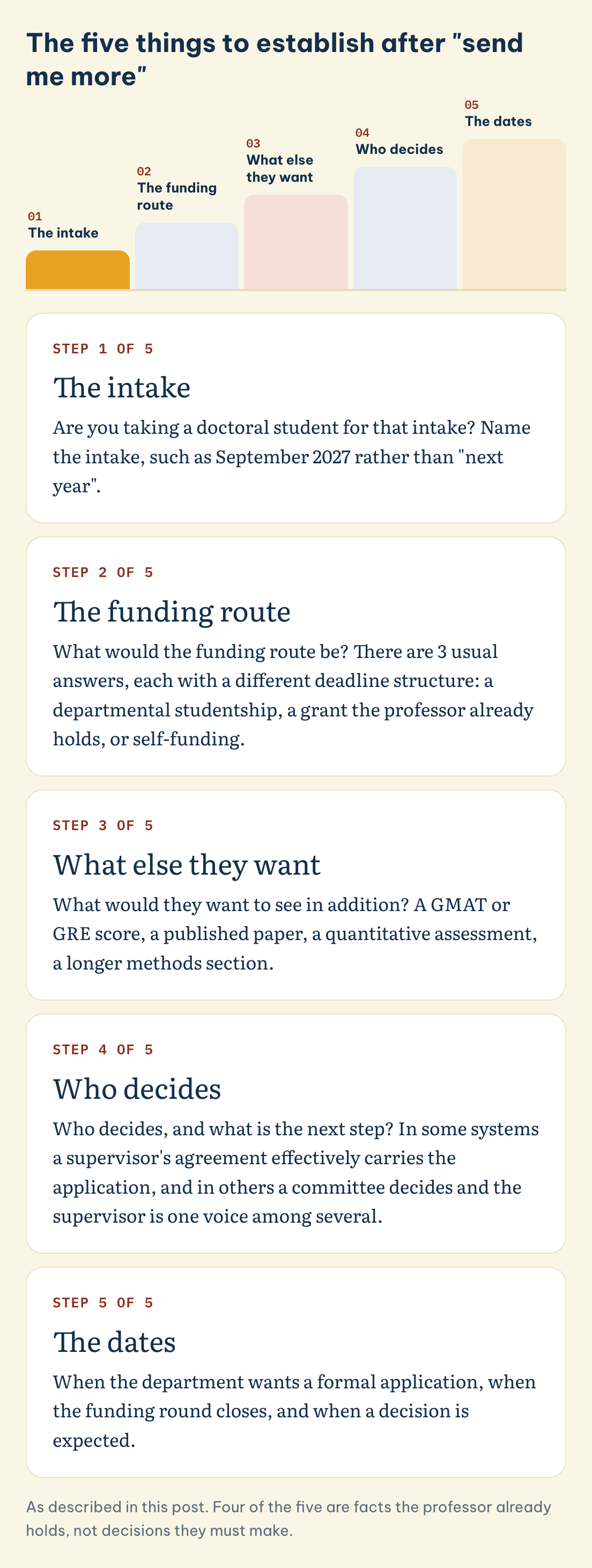
Direct answer: Whether they are taking a student in a given intake, where the money comes from, what they require in addition, who decides and what the next step is, and the dates binding all of it. 5 questions, 4 of them answerable in a line.
The five things to establish after "send me more"
Tap a question to see what it asks.
Step 1 of 5
The intake
Are you taking a doctoral student for that intake? Name the intake, such as September 2027 rather than "next year".
Step 2 of 5
The funding route
What would the funding route be? There are 3 usual answers, each with a different deadline structure: a departmental studentship, a grant the professor already holds, or self-funding.
Step 3 of 5
What else they want
What would they want to see in addition? A GMAT or GRE score, a published paper, a quantitative assessment, a longer methods section.
Step 4 of 5
Who decides
Who decides, and what is the next step? In some systems a supervisor's agreement effectively carries the application, and in others a committee decides and the supervisor is one voice among several.
Step 5 of 5
The dates
When the department wants a formal application, when the funding round closes, and when a decision is expected.
Save this figure
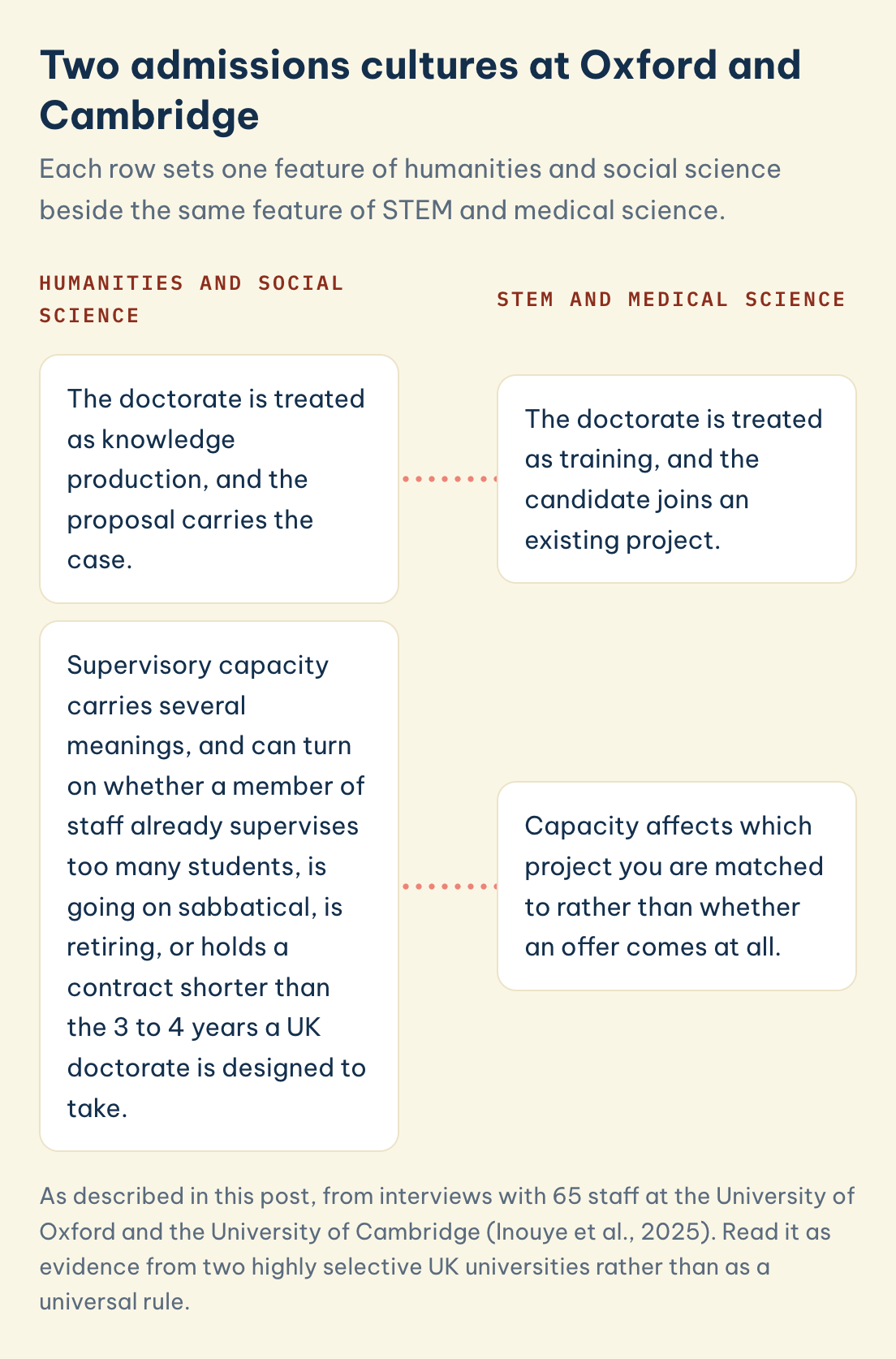
Two admissions cultures at Oxford and Cambridge
Each row sets one feature of humanities and social science beside the same feature of STEM and medical science.
Humanities and social science
STEM and medical science
The doctorate is treated as knowledge production, and the proposal carries the case.
The doctorate is treated as training, and the candidate joins an existing project.
Supervisory capacity carries several meanings, and can turn on whether a member of staff already supervises too many students, is going on sabbatical, is retiring, or holds a contract shorter than the 3 to 4 years a UK doctorate is designed to take.
Capacity affects which project you are matched to rather than whether an offer comes at all.
Save this figure
One: are you taking a doctoral student for that intake. Name the intake, such as September 2027 rather than "next year". A professor who cannot take anyone in 2027 may be able to in 2028, and that fact alone decides whether the name stays on your shortlist or moves to a second list you revisit in 12 months.
Two: what the funding route would be. There are 3 usual answers, each with a different deadline structure: a departmental studentship, a grant the professor already holds, or self-funding. For anyone who needs a scholarship this decides everything downstream, because a studentship normally carries its own application and its own closing date, often well before the programme's own deadline, while a grant-funded place usually has neither and is offered directly by the group. That mismatch between the two calendars is exactly what our guide to scholarship deadlines closing before the programme itself walks through. It is also the question most often left unasked.
Three: what they would want to see in addition. A GMAT or GRE score, a published paper, a quantitative assessment, a longer methods section. Each takes between 4 weeks and 6 months to produce, so guessing wrong costs a cycle rather than an afternoon. Ask, and prepare the one thing that counts.
If that conversation ends in an invitation to interview, the questions change again, and the methodology block of a PhD admission interview is where most candidates lose ground.
Four: who decides, and what the next step is. In some systems a supervisor's agreement effectively carries the application; in others a committee decides and the supervisor is one voice among several. Inouye, Robson, Rodriguez Anaiz, Baker and Ilie (2025), writing in Higher Education, interviewed 65 academic staff involved in doctoral admissions at the University of Oxford and the University of Cambridge, and describe two broad clusters: humanities and social science, where the doctorate is treated as knowledge production and the proposal carries the case, and STEM and medical science, where it is treated as training and the candidate joins an existing project. Fit with the research of supervisors and the department, the authors write, "was one of the most important criteria for selection in doctoral admissions and, importantly, was cited as the key reason why applicants, even objectively excellent applicants, might be rejected" (Inouye et al., 2025, p. 711). In the humanities and social science cluster they also record that supervisory capacity carries several meanings, and can turn on whether a member of staff already supervises too many students, is going on sabbatical, is retiring, or holds a contract shorter than the 3 to 4 years a UK doctorate is designed to take. In the STEM cluster the same study reports the opposite weighting, with capacity affecting which project you are matched to rather than whether an offer comes at all. Read it as evidence from two highly selective UK universities rather than as a universal rule. Their analysis separates the two clusters on three points: the role of the project itself, the role of the potential supervisor, and the weight given to existing skills. None of the three appears on a webpage, and a single email covering all 5 questions can settle them in under 200 words.
Five: the dates. When the department wants a formal application, when the funding round closes, when a decision is expected. 3 dates turn an encouraging exchange into a schedule you can plan backwards from, which is the subject of our guide on building a PhD application timeline from the deadline backwards.
◆ Question 4 / 7 · One email
How do you put five questions into one email without interrogating anyone?
Direct answer: Send what they asked for, then attach the questions as a numbered block framed around what you need in order to prepare properly. Keep the message under roughly 200 words and ask for the facts, never for the outcome.
Send the material first, because they asked for it, then add 3 or 4 lines saying you want to prepare the right things and would be grateful to know whether they are taking a student in the intake you are aiming at, how funding usually works in their group, what they would want beyond the proposal, and what the next step is from their side.
Note what is absent: you have not asked whether they will accept you. Nobody answers that in an email, and asking converts a professional exchange into a request for a favour. Everything else on the list is a fact they already hold, which is why 5 minutes between meetings is enough to answer it.
◆ Question 5 / 7 · Skipped questions
What if they answer some questions and skip others?
Direct answer: Record which ones they skipped rather than repeating them. A skipped question is information, most often about funding, and the working rule is that any professor with a positive reply should have answered all five or have been noted as declining to answer specific ones.
Selective answers follow a pattern across the 5. Availability and next steps come back easily. Funding is the one that goes quiet, and silence there frequently means there is no departmental money attached to that group in that cycle, which nobody has an incentive to write down. Treat it as a soft no on funding rather than an oversight, and read the department's own funding pages before asking a second time.
Keep the tracking on paper, 1 row per professor: what was sent, what came back, which of the 5 questions is still open, what you owe them next and by when. A campaign of 8 to 10 names becomes unmanageable inside a mailbox within about 3 weeks, and threads die from being forgotten far more often than from being refused. MAAS sends approach letters in waves of 4 to 6 a week for the same reason.
◆ Question 6 / 7 · Reminders
How long should you wait before a reminder?
Direct answer: Longer than instinct suggests, and with new information rather than a repeat. Replies cluster heavily in the first 48 hours (Milkman et al., 2015), so a thread still silent after a week is silent for a reason that another copy of the same message will not change.
Milkman, Akinola and Chugh (2015), publishing in the Journal of Applied Psychology, ran a field experiment in which 6,548 tenure-track professors at 259 US universities, drawn from the 2010 U.S. News rankings and spanning 109 doctoral disciplines, received an identical email from a fictional prospective doctoral student requesting a meeting. 67% of those emails produced a reply, 95% of replies arrived within 48 hours, and 0.4% arrived on the seventh and final day. The paper's actual subject is bias in who gets answered: faculty were significantly more responsive to Caucasian male senders than to all other groups collectively, an effect larger in higher-paying disciplines and at private institutions.
Read the timing as an aside rather than as the finding, and note that those were cold first-contact emails rather than follow-ups inside a live thread. The modest inference it supports is that waiting 3 weeks in silent hope is not warranted by how academic email behaves, and neither is a reminder sent on day two. MAAS works to a first reminder after 7 to 10 working days and a second after about 3 weeks, each carrying one new piece of information rather than repeating the last message, with silence across both rounds treated as an answer. What that new piece of information has to be, and why a letter with nothing new in it rarely earns a reply, is set out in the guide to follow-up emails after silence. Those two numbers are a MAAS operating rule built from running these campaigns, not a published standard.
◆ Question 7 / 7 · What stays yours
Where does an adviser change this, and where does it stay yours?
Direct answer: The judgement about what a given reply means and what to ask next is where experience shows; the words and the decisions stay with you, and the academic mailbox the letters go from is opened in your name and handed over to you when the engagement ends.
Reading a reply is a skill built from having read many. Whether I have limited capacity but do get in touch nearer the deadline is a courteous decline or a real instruction is not obvious the first time, and an applicant reading their own thread has a comparison set of 1. A mentor who argues the interpretation with you, drafts the follow-up you then rewrite, and keeps the tracking sheet honest is doing the part that is hard alone.
Authorship does not move. Letters leave an academic mailbox opened in your name, you approve each one before MAAS sends it, the mailbox is handed over to you when the engagement ends, and every letter says what you mean about your own research. The PhD Application Strategy and Execution service sets out where that line sits, and the PhD application guide shows how the shortlist and the outreach sequence are built before any of this begins.
Frequently asked questions
How soon after their reply should I send the follow-up?
Within 2 working days. The exchange is warm and you are answering a request they made, so speed here reads as organisation rather than eagerness.
Should I ask about funding in the first email instead?
No. A first approach is judged on whether your question is worth a specialist's time, and money in the opening line displaces that. Once they have replied the exchange has moved on, and funding becomes 1 of 5 practical questions rather than an opening demand. Our guide to the first email to a professor covers that stage.
They said to apply through the formal system. Is that a rejection?
A referral to the formal system is neither an acceptance nor a rejection, and it usually means the decision is not theirs alone. The Oxford and Cambridge admissions study describes exactly this split, so treat it as a prompt to ask who assesses the file and whether they will be among the reviewers.
How long does it take to be paired with a mentor?
You are paired within 48 hours when our network already covers that field. If it does not, MAAS opens a dedicated recruitment round for your case, which usually takes about 2 weeks.
An encouraging reply and a real opening look identical from outside. One has 5 answered questions behind it and the other has 0, and the only way to learn which you hold is to ask. The applicants who lose these threads are rarely the ones who were refused; they are the ones who read a pause as a promise and waited for a message that had no reason to arrive. Sources in this article were checked on 21 August 2026.
References
Huang, K., Yeomans, M., Brooks, A. W., Minson, J., & Gino, F. (2017). It doesn't hurt to ask: Question-asking increases liking. Journal of Personality and Social Psychology, 113(3), 430-452. https://www.hbs.edu/ris/Publication%20Files/Huang%20et%20al%202017_6945bc5e-3b3e-4c0a-addd-254c9e603c60.pdf
Inouye, K., Robson, J., Rodriguez Anaiz, P., Baker, S., & Ilie, S. (2025). Assessing the person or the project? How disciplinary ontological and epistemological assumptions shape doctoral admissions in elite UK institutions. Higher Education, 91(2), 701-721. https://doi.org/10.1007/s10734-025-01438-8
Milkman, K. L., Akinola, M., & Chugh, D. (2015). What happens before? A field experiment exploring how pay and representation differentially shape bias on the pathway into organizations. Journal of Applied Psychology, 100(6), 1678-1712. https://repository.upenn.edu/bitstreams/f972b7bf-4c1f-46d4-8e06-ca90493b7f0d/download
A free 20-minute consultation with a MAAS mentor, to talk through the reply you received and what to ask next.
Book Free Discovery ▸