

Study 01
Roghanizad and Bohns (2017)
Ran 2 studies in which 986 university students made real requests of strangers and found senders systematically overestimate how persuasive their emails are.
◆ PhD application
Twelve letters went out on a Monday. Three weeks later the sent folder is full and the inbox is empty, and the applicant sits down to write the one message everybody dreads: the reminder. Most drafts of it open with a variation of I am writing to follow up on my email of 3 August, and that opening sentence is already the problem, because it announces that the message contains nothing the professor has not already declined to answer once.
A reminder that only reminds asks a busy person to reconsider the same decision on the same evidence.
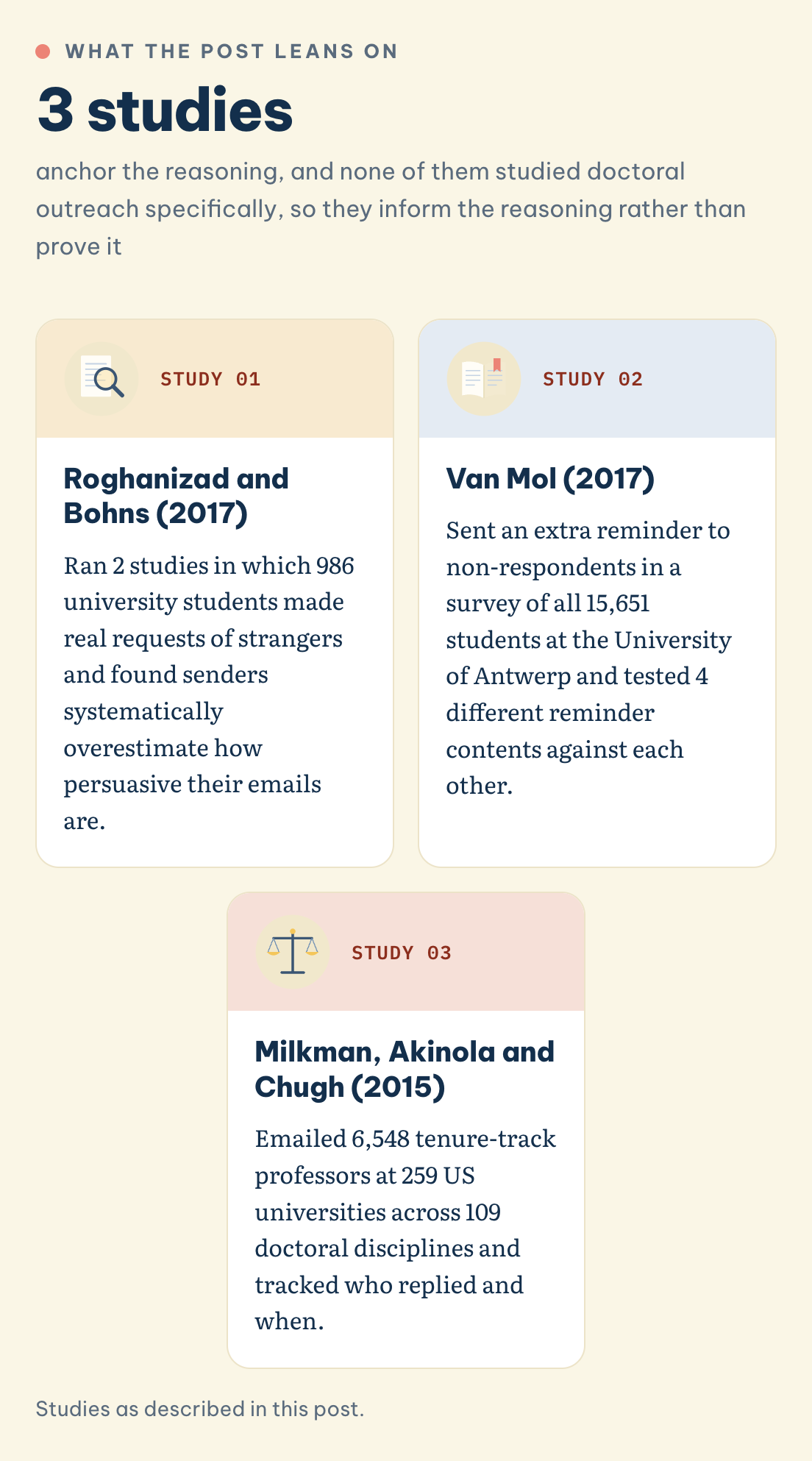
Three studies anchor what follows. Roghanizad and Bohns (2017) ran 2 studies in which 986 university students made real requests of strangers and found senders systematically overestimate how persuasive their emails are. Van Mol (2017) sent an extra reminder to non-respondents in a survey of all 15,651 students at the University of Antwerp and tested 4 different reminder contents against each other. Milkman, Akinola and Chugh (2015) emailed 6,548 tenure-track professors at 259 US universities across 109 doctoral disciplines and tracked who replied and when. None of the three studied doctoral outreach specifically, so they inform the reasoning below rather than prove it.
◆ Question 1 / 7 · Why it is ignored
Direct answer: Because the professor already has every fact your first email contained, and a second copy adds no reason to decide differently. Silence usually means the message was read, filed as low priority and never resurfaced, so the job of the follow-up is to make the thread new rather than to make it louder.
What the post leans on
3 studies
anchor the reasoning, and none of them studied doctoral outreach specifically, so they inform the reasoning rather than prove it
Ran 2 studies in which 986 university students made real requests of strangers and found senders systematically overestimate how persuasive their emails are.
Sent an extra reminder to non-respondents in a survey of all 15,651 students at the University of Antwerp and tested 4 different reminder contents against each other.
Emailed 6,548 tenure-track professors at 259 US universities across 109 doctoral disciplines and tracked who replied and when.
Roghanizad and Bohns (2017), publishing in the Journal of Experimental Social Psychology, put a number on how badly senders misjudge this. Across 2 studies with 506 and 480 participants, split into 49 and 60 requesters against 457 and 420 targets, requesters predicted how many strangers would agree to a request, then actually made it either in person or by email. Face-to-face requesters underestimated compliance at d = 1.00, replicating at least 12 earlier studies in which participants had collectively approached some 14,000 strangers. Email requesters did the opposite: they overestimated it, with effect sizes of d = 4.20 in Study 1 and d = 0.98 in Study 2, and in Study 1 the same request made in person secured compliance 34 times as often. The authors trace the error to a perspective-taking failure: anchored on their own perspective, senders do not picture the suspicion, and the resulting absence of empathy, with which a stranger reads an unsolicited email.
Read that as a correction to your instinct rather than as a verdict on your letter. The participants were students cold-emailing strangers about a questionnaire, not applicants writing to an academic in their own subfield, and the gap between those two situations is large. The modest inference it supports is that the silence you are reading as rejection is probably weaker than that, and that the confidence with which your first email felt persuasive was itself part of the miscalibration.
◆ Question 2 / 7 · New information
Direct answer: Something that changed the state of your application, not something that changed your feelings about it. A test result that arrived, a section of the proposal that now exists, a funding decision, a paper of theirs published since you last wrote. Enthusiasm restated is not new information, and neither is a longer explanation of material already sent.
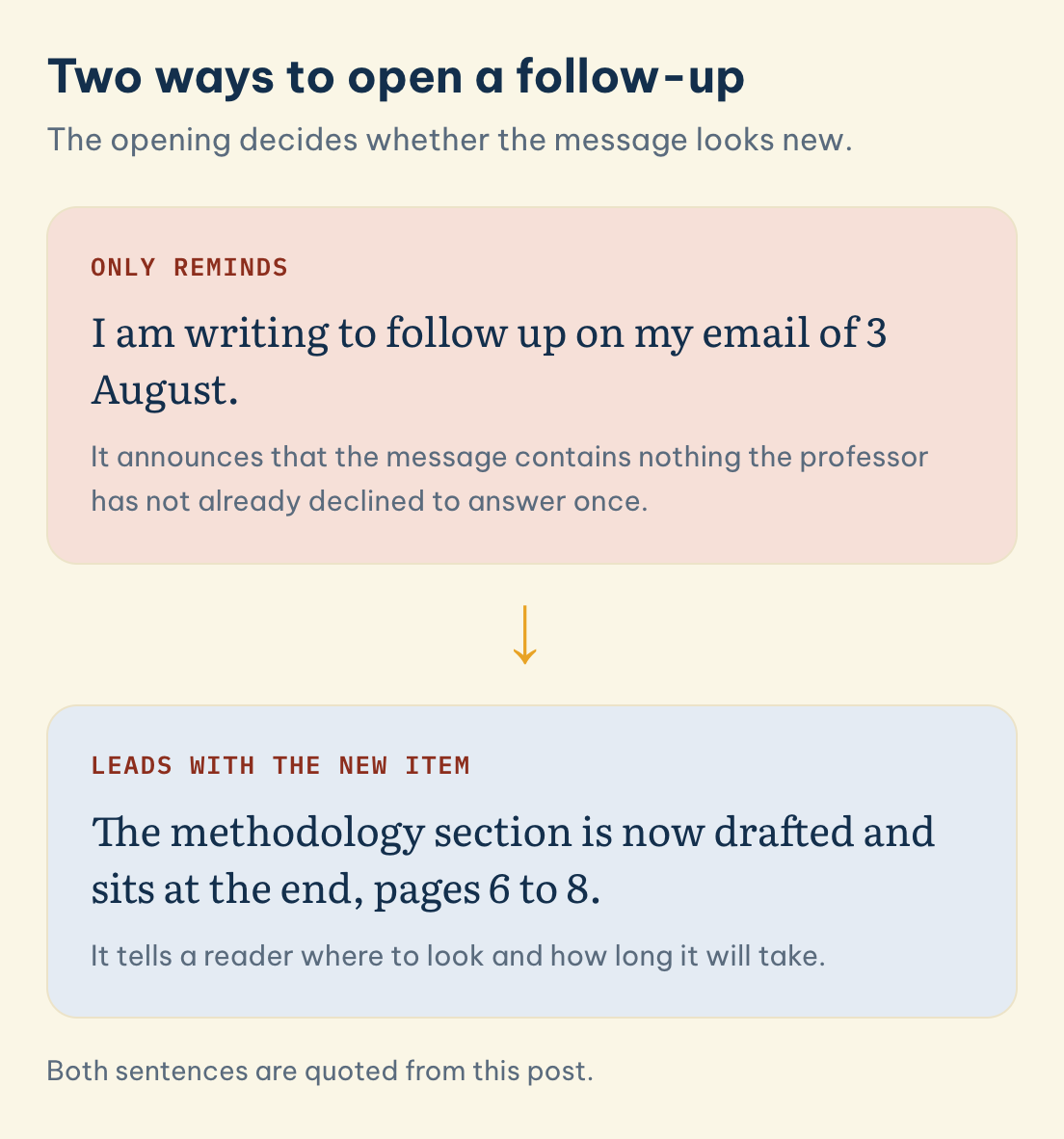
Two ways to open a follow-up
The opening decides whether the message looks new.
Only reminds
I am writing to follow up on my email of 3 August.
It announces that the message contains nothing the professor has not already declined to answer once.
Leads with the new item
The methodology section is now drafted and sits at the end, pages 6 to 8.
It tells a reader where to look and how long it will take.
MAAS works to a simple test on this. Before sending, ask what a reader would learn from the reminder that they could not have learned from the first letter. If the honest answer is nothing, the letter is not ready and the problem is not the wording. That test has an awkward consequence most guidance skips: whether you can write a good reminder in week three was largely decided in week one, because you need to have left something in motion that can visibly progress. An applicant who sent a finished proposal, a completed IELTS certificate and a closed set of questions has nothing left to report and has, without meaning to, written a letter with no sequel.
The practical fix runs backwards from that. When the first letter goes out, keep one deliverable deliberately in flight, most often the methodology section or a pending result, and say in the first message that it is coming. The follow-up then writes itself as an update, opens on the new item rather than on an apology, and never needs the sentence I am writing to follow up.
◆ Question 3 / 7 · Attachments
Direct answer: Attach a document only when it has changed, and say in one line what changed. Re-attaching an identical CV signals that the sender has run out of things to say and is padding the message, and it reproduces the exact problem the follow-up exists to solve.
An updated proposal is the strongest attachment available, and it is strongest when the update is specific and small. The methodology section is now drafted and sits at the end, pages 6 to 8 tells a reader where to look and how long it will take. A silently replaced file with no note asks them to diff two documents, which nobody will do. The MAAS supervisor-matching process treats the proposal as the object of the whole exchange for this reason: four universities give consistent advice on it, with UCL suggesting a first covering version of roughly 500 words and no more than 3,000 in total, and the University of Queensland noting that a proposal still in development shows seriousness without appearing inflexible. Oxford advises making contact while the proposal is still being written rather than after it is finished.
There is a limit worth stating plainly. Attachments do not create a reason to reply where none existed, and an applicant sending a third document to a thread that has produced 0 responses is answering the wrong question. At that point the constraint is the shortlist, not the letter.
◆ Question 4 / 7 · Wait and rounds
Direct answer: MAAS sends a first reminder after 7 to 10 working days and a second after about 3 weeks, then stops. Two rounds of silence is an answer. The earlier guide on reading a professor's reply covers the timing evidence in detail, so this section states the rule rather than re-arguing it.
The follow-up timeline
Tap a stage to see what happens and when.
Stage 1 of 4
Day 0
The first letter goes out, with one deliverable deliberately kept in flight.
Stage 2 of 4
Day 7 to 10
MAAS sends a first reminder after 7 to 10 working days.
Stage 3 of 4
About 3 weeks
MAAS sends a second reminder after about 3 weeks, if it carries something new.
Stage 4 of 4
Close the name
Two rounds of silence is an answer, so close the name and move the effort to a different name on the shortlist.
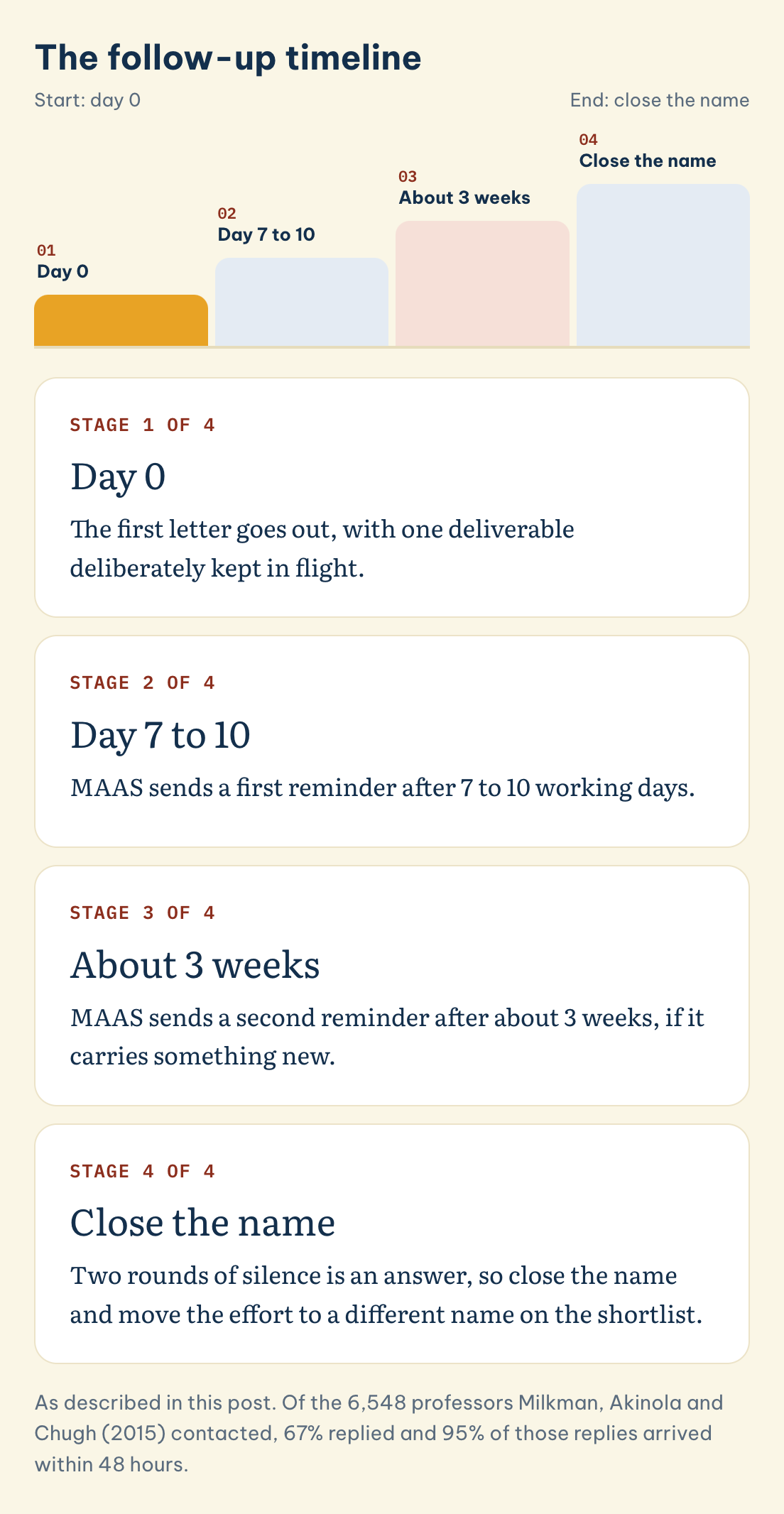
The reason for stopping at 2 is not politeness. Milkman, Akinola and Chugh (2015), writing in the Journal of Applied Psychology, found that of the 6,548 professors they contacted, 67% replied and 95% of those replies arrived within 48 hours, with 0.4% arriving on the seventh and final day. Replies to academic email cluster hard and early. A thread silent at day 21 is not a thread that needs a third nudge; it is a thread carrying information you should act on, and the action is to move the effort to a different name on the shortlist.
◆ Question 5 / 7 · Wording
Direct answer: Outside of doctoral outreach, the best available experiment says no. Van Mol (2017) tested 4 reminder contents against each other and found the differences were not statistically significant, concluding that it is the extra reminder itself, not its content, that lifts response.
Standard text
8.62%
response among the group that received the standard extra reminder
Median completion time
7.14%
response when the reminder gave the median completion time of 16 minutes 31 seconds, significantly worse than the standard text
Response to four wordings of the extra reminder
Response among non-respondents, in percent. The blue bar is the only variant the post reports as significantly worse than the standard text.
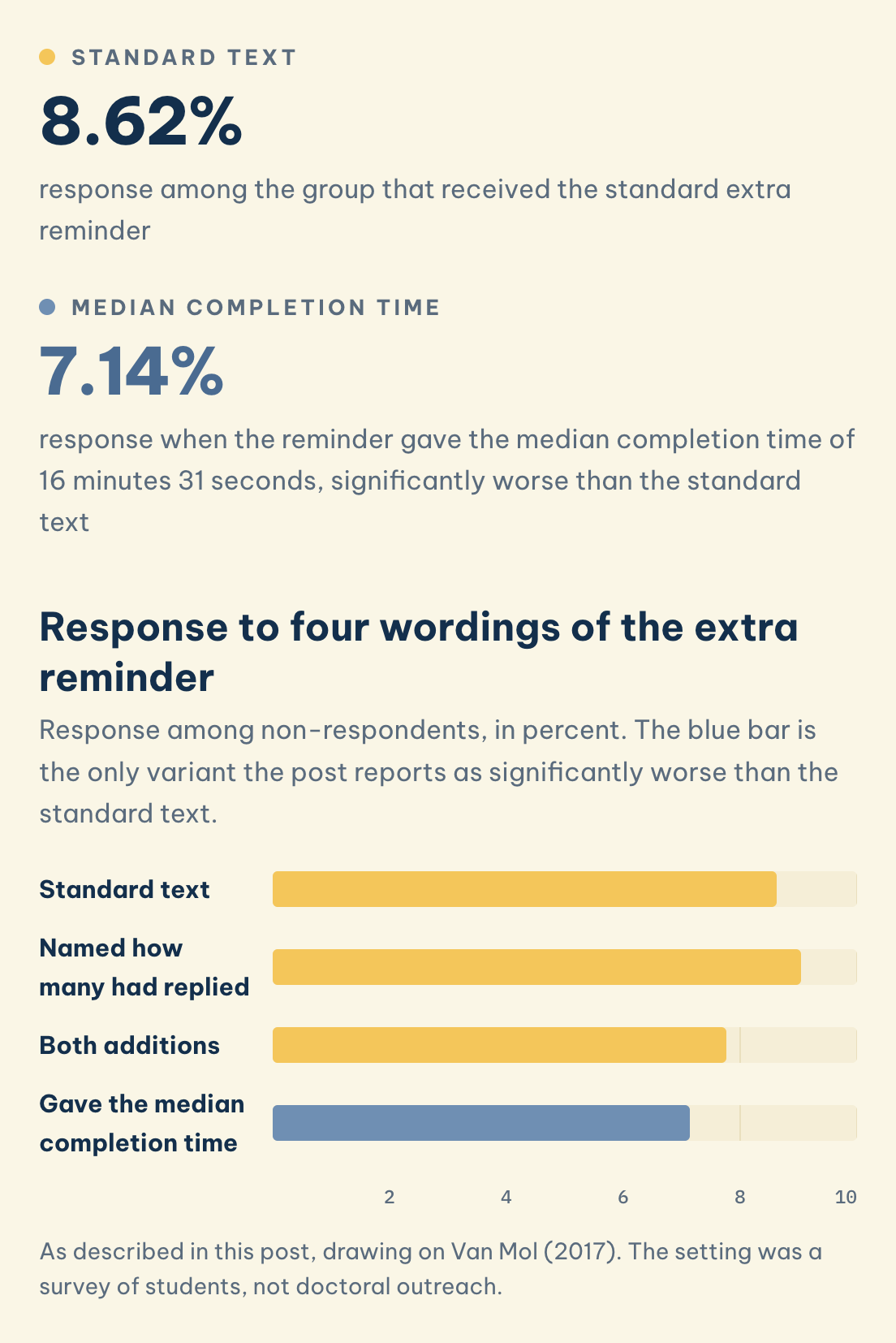
The Van Mol finding deserves airing because it cuts against the rule stated above. Van Mol, publishing in the International Journal of Social Research Methodology, emailed the full population of 15,651 University of Antwerp students between October and December 2013. The first wave returned 6.2%, the first reminder added 10.3% and the second added 8.6%, for 24.96% after the two standard rounds. A further reminder, sent 9 to 28 days after the second, brought in 955 more students and lifted the total to 31.2% (n = 4,880). Non-respondents were then split into 4 random groups of 2,946, 2,927, 2,940 and 2,913, each receiving a differently worded extra reminder. Response ran 8.62% for the standard text, 9.04% when it named how many students had already replied, 7.76% for both additions and 7.14% when it gave the median completion time of 16 minutes 31 seconds, the last of these significantly worse than standard (OR = 0.811, SE = 0.097, p < .05). Projected across the whole sample the 4 variants would have finished at 31.54%, 31.85%, 30.77% and 30.43%, a spread of 1.4 percentage points. Van Mol's conclusion is blunt: "the best strategy to follow is to use the same reminder throughout the survey process" (Van Mol, 2017, p. 324).
Two things separate that setting from yours, and both matter. The recipients were being asked to complete a form, an action with a fixed cost and no relationship attached, whereas a professor is being asked to open an ongoing commitment. And the winning variant there was still an appeal to social proof, a lever an applicant does not hold. What survives the transfer is a warning rather than a rule: rewriting the same content more elegantly is unlikely to earn a reply, which is precisely why the MAAS rule asks for a changed fact rather than changed phrasing. Treat this as an assumption still open to test, not as settled ground.
◆ Question 6 / 7 · Three weeks of silence
Direct answer: Send the second reminder if it carries something new, then close the name and redistribute the effort. A shortlist worked properly should have several threads at different stages, so one going quiet costs you a name rather than a season.
Sending pattern is where that reserve comes from. MAAS sends in batches of 4 to 6 letters a week rather than releasing a list of 12 in one day, because the first batch reveals whether the letter works while there are still names left to fix it for. An applicant who sent all 12 on the same Monday now has 12 simultaneous silences, no diagnostic information and nothing in reserve, having spent a shortlist that took weeks to build in a single morning. Every professor on the list should end in exactly one of 3 states: replied, silent through both rounds, or not yet due for a reminder.
Switching channel is the other common instinct, and it is usually a mistake. A message on a professional network arriving after 2 unanswered emails reads as pursuit across platforms, and it moves an academic conversation onto a surface where the recipient has no obligation to hold one. The exception is narrow: a public post inviting enquiries, answered in the terms that post sets.
◆ Question 7 / 7 · What stays yours
Direct answer: Judging whether a thread is genuinely dead, and what counts as new information rather than restated enthusiasm, is where experience shows, because both calls depend on having watched many campaigns. Every decision stays with you, and follow-ups go from a mailbox in your name that is handed over to you at the end.
An applicant reading their own silence has a comparison set of 1 and no way to tell an ordinary quiet fortnight from a closed door. A mentor who has watched many campaigns argues the reading with you, keeps the tracking sheet honest across 3 states rather than letting names drift, and pushes back when a proposed reminder is a restatement wearing new clothes. Where the network already holds a suitable mentor, MAAS matches within 48 hours; where it does not, MAAS opens a dedicated search that usually takes around two weeks.
The decisions stay yours. Letters leave an academic mailbox opened in your name, you approve each one before MAAS sends it, the mailbox is handed over to you when the engagement ends, and every letter says what you mean about your own research. The PhD Application Strategy and Execution service sets out where that line sits, and the PhD application guide shows how the shortlist and the outreach sequence are built before any letter is written.
Most who reply do so quickly. In the Milkman, Akinola and Chugh (2015) sample of 6,548 professors, drawn from institutions in the 2010 U.S. News rankings, 67% replied at all and 95% of those replies landed inside 48 hours, with 0.4% arriving as late as day 7. Those were cold first-contact emails rather than messages inside a live thread, so read the figure as a rough shape rather than a schedule.
Reply in the same thread. It gives the reader the original message without asking them to search for it, and it keeps the exchange as one conversation rather than two separate approaches.
Not as a substitute for email. After 2 unanswered letters, a message on another platform reads as pursuit rather than persistence. The one reasonable case is a public post that explicitly invites enquiries.
No. Send one message that leads with what has changed since August rather than with an apology for the delay, and treat it as your first reminder rather than as a late one.
Length is not the variable. A follow-up needs one new fact and one answerable question; whether that takes 4 sentences or 8 matters far less than whether the new fact is there at all.
Milkman, K. L., Akinola, M., & Chugh, D. (2015). What happens before? A field experiment exploring how pay and representation differentially shape bias on the pathway into organizations. Journal of Applied Psychology, 100(6), 1678–1712. https://doi.org/10.1037/apl0000022
Roghanizad, M. M., & Bohns, V. K. (2017). Ask in person: You're less persuasive than you think over email. Journal of Experimental Social Psychology, 69, 223–226. https://doi.org/10.1016/j.jesp.2016.10.002
Van Mol, C. (2017). Improving web survey efficiency: The impact of an extra reminder and reminder content on web survey response. International Journal of Social Research Methodology, 20(4), 317–327. https://doi.org/10.1080/13645579.2016.1185255
A free 20-minute consultation with a MAAS adviser, to talk through your shortlist and your follow-up plan.
Book Free Discovery ▸