
◆ PhD Admissions
How do you build a shortlist of PhD supervisors from published papers?
Category: admissions
Last updated: 2026-09-05

A PhD supervisor shortlist is built from papers, databases and search terms, not from a staff directory. Most applicants treat finding a supervisor as a lookup problem. Open the department's staff directory, scan the profiles, pick the one whose interests read closest to yours, write to that person. The step feels like the cheap part of the application, so it gets an afternoon.
Direct answer: What predicts trouble later is not which name you pick but how many names you had to pick from. Among 1,796 doctoral students surveyed, 11% chose their supervisor because no other faculty member worked on their topic, and that group reported more difficulty and less confidence about the defence (Pavliuk & Zhuchkova, 2025).
Finding a supervisor is therefore the work of building a plural list, and that list is built out of the literature rather than out of a directory.
Two consequences follow from that finding. The names come from papers, not from staff pages. And a list of one is a result you should treat as a warning, not as a decision.
◆ Question 1 / 6 · Databases and tools
Which databases and tools actually surface researchers by topic?
Direct answer: The literature databases do, because they index what people wrote. University directories do not, because they index where people are employed. Start with Google Scholar, Scopus, Web of Science, PubMed or arXiv, search your question rather than your discipline, and let the author lines of the closest 15 to 20 papers become the raw list.
Compare that route with the institutional one. The University of Glasgow, checked on 5 September 2026, publishes its postgraduate research opportunities as an A to Z of subject headings running from Accounting and Finance to Veterinary Medicine, and it offers a separate "Staff research interests search" as a second, distinct route. The structure is honest about its own resolution. A heading like Psychology and Neuroscience contains hundreds of possible questions, and the directory cannot tell you which of them anyone is working on this year.
The bibliography of your own reading is a better index than any directory because it is already filtered by relevance. If a paper is close enough to your question that you cited it, its authors are candidates by construction. This is the reverse of the usual order: institution first, then person, then topic. Run it as topic, then person, then institution, and the geography sorts itself out afterwards.
◆ Question 2 / 6 · Search terms
How do you turn your research interest into search terms?
Direct answer: Write the question at the level of a variable, a population and a method, not at the level of a field. "Machine learning in healthcare" retrieves tens of thousands of authors and separates nobody. "Interpretable models for early detection of cardiovascular disease in longitudinal clinical records" retrieves a group small enough to read.
The test of a good search string is that it returns a set you can finish reading in a week. If your query returns 40,000 results, the query is describing a discipline, and disciplines do not supervise anyone. Our guide to narrowing a PhD research direction covers how that sharpening happens before the search begins, because a supervisor search inherits whatever precision the research question already has.
Keep the vocabulary of the papers themselves. Fields name the same object differently, and the term used by the group you want to join is the term that will retrieve them.
◆ Question 3 / 6 · How many supervisors
How many supervisors should be on the list?
Direct answer: Enough that no single reply decides the outcome. The evidence does not fix a number, but it does identify the failure mode at the bottom end: the "only option" scenario, where a student had no alternatives, was associated with both more interaction difficulties and lower confidence about the defence (Pavliuk & Zhuchkova, 2025).
Tuition-free place
71%
of the 1,796 respondents held a tuition-free place
The only option
11%
chose their supervisor because no other faculty member worked on their topic, and that group reported more difficulty and less confidence about the defence
How 1,796 doctoral students in Russia chose a supervisor
Share of respondents who named each criterion, in percent. Respondents could name several, so the eight bars add up to well past 100%.
Save this figure
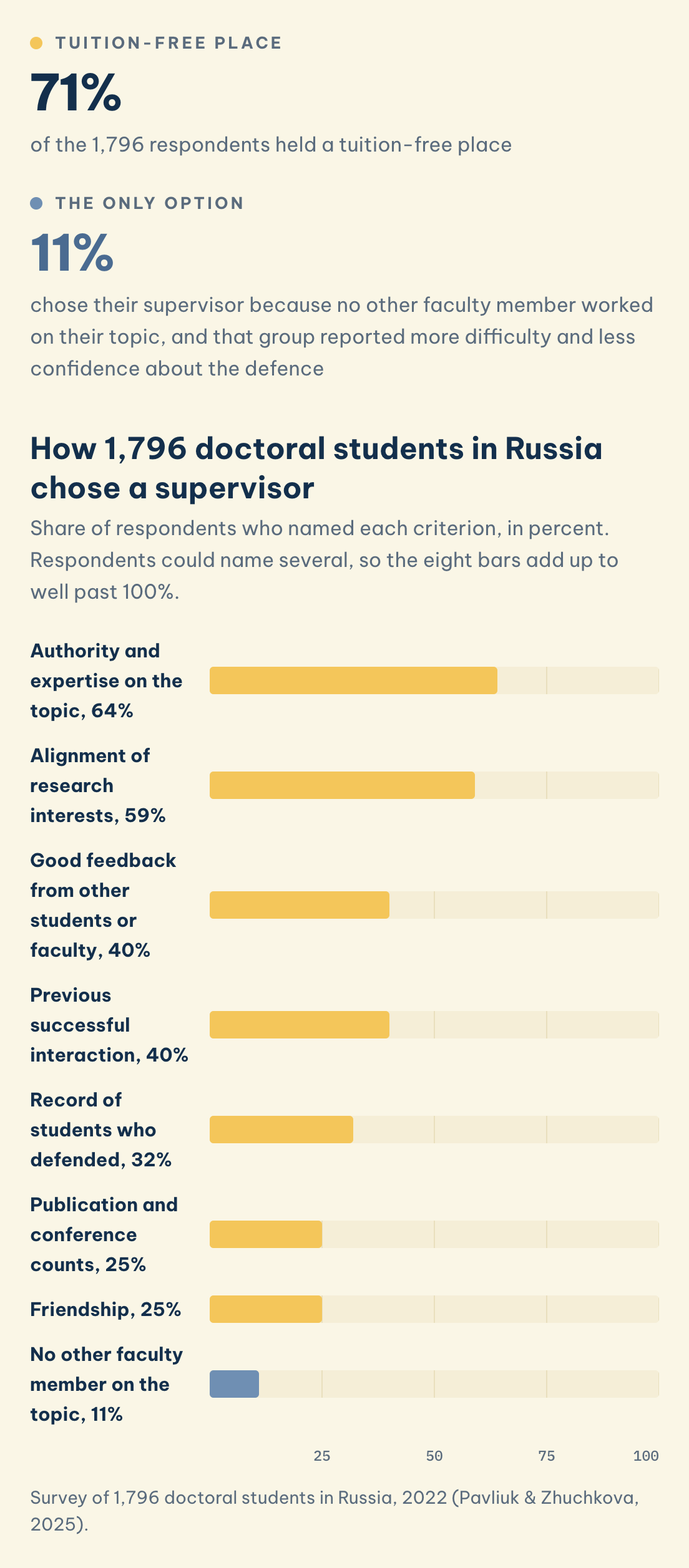
Pavliuk and Zhuchkova (2025) surveyed 1,796 doctoral students across Russia in 2022, spanning the social sciences at 25% of the sample, technology at 23%, natural sciences and mathematics at 23%, the humanities at 17% and educational sciences at 12%. Respondents could name several criteria. Authority and expertise on the dissertation topic was named by 64%, alignment of research interests by 59%, good feedback from other doctoral students or faculty by 40%, previous successful interaction with the supervisor by 40%, a record of doctoral students who successfully defended by 32%, publication and conference counts by 25%, friendship by 25%, and the absence of any other faculty member working on the topic by 11%.
Note what those figures do not add up to. Because Pavliuk and Zhuchkova (2025) allowed multiple answers, the 8 options above total well past 100%, which means most respondents were already combining criteria rather than applying one. A principal component analysis reduced those answers to four strategies, explaining 74% of the variance: subject-matter expertise, successful supervision history, positive personal relationships, and the "only option" (Pavliuk & Zhuchkova, 2025). The first two behaved best. Choosing on subject-matter expertise reduced the reported lack of confidence by 0.18 per standardised unit and choosing on supervision history reduced it by 0.06, while the "only option" moved both outcomes the wrong way.
One further detail of that 2022 sample is worth carrying: 71% of the 1,796 respondents held a tuition-free place, so most of them were choosing inside a funded system rather than buying their way past a shortage of supervisors.
Two limits are worth stating plainly. The sample is one national system with its own allocation rules, and the outcomes measured are self-reported difficulty and confidence rather than completion or examination results. What transfers is the shape of the finding, which is that the number of live options a student holds is itself a variable, not a background condition.
◆ Question 4 / 6 · The staff profile page
Why is the staff profile page the weakest evidence you have?
Direct answer: Because it is written to be persuasive. Marder et al. (2021) interviewed 19 people about supervisor selection in United Kingdom business schools and found that profiles work as impression management, with judgements resolving into a hierarchy that runs, in ascending order of importance, from gatekeeping attributes to competence to warmth.
Marder et al. (2021) appeared in The International Journal of Management Education in 2021, volume 19, issue 1, and is one of the few to examine the assessment itself rather than the relationship that follows it. The same study produced a typology of four stereotypes read off those profiles, named The Guru, The Friend, The Machine and The Dud, and noted the trade-off that produces them: applicants read high-competence academics as colder and high-warmth academics as less competent. Marder et al. (2021) also record why student judgement carries so much weight here, observing that in business schools "the most dominant allocation method is student-led selection." The page you are reading was authored by the person you are assessing, for the purpose of attracting you.
Where selection runs that way, the whole weight of the first filter falls on a document the candidate wrote about themselves. Recent publications are weaker as self-presentation and stronger as evidence, because they were reviewed by people with no interest in recruiting you. That is the reason our own PhD application guidance filters candidates on their last two or three papers rather than their biography.
Two mechanical checks belong here as well. In many fields the senior author of a paper supervises and the first author is the doctoral researcher, but authorship conventions differ enough between disciplines that the group page should be checked rather than assumed. And a paper from six years ago tells you where a group used to be, so weight the most recent output first.
◆ Question 5 / 6 · Before a name is a target
What do you check before a name becomes a target?
Direct answer: Three things that have nothing to do with fit: whether the person can take a doctoral researcher this cycle, whether funding exists for the position, and whether their current work still touches your question. A name that fails any of the three is not a lead.
The selection literature keeps reaching past topic overlap. Shafiq et al. (2020) surveyed 315 research students in Malaysia between August and October 2018, 194 women and 121 men, and their validated model resolved into three constructs, being the supervisor's demographic characteristics, their expertise, and their physical appearance, with confirmatory factor analysis run on a holdout sample of 158 respondents. Their review of the earlier literature states the underlying reason for weighting an active research record: "if a supervisor is not an active researcher then the burden of meeting research targets falls on supervisees alone" (Shafiq et al., 2020, p. 290). The expertise construct returned an average variance extracted of 0.41, which the authors themselves flag, so the model is better read as a map of what applicants weigh than as a scoring rubric.
Their paper runs from page 285 to page 304 of volume 15 of the International Journal of Doctoral Studies, published in 2020. Availability and capacity sit outside that model entirely, and they are the checks that fail most often. Our guide to how many doctoral students one supervisor can take sets out where that ceiling now lives, and our guide to who decides studentship funding covers the second check.
◆ Question 6 / 6 · Where MAAS fits
Where does MAAS fit, and where does it stop?
Direct answer: MAAS builds and defends the shortlist with you, working from 20 to 30 candidate departments down to 12 to 15 professors. An adviser carries the reading behind the list and a drafted letter for each professor. Every decision stays yours, and letters go from a mailbox in your name, handed over to you at the end.
The PhD Application Strategy and Execution service works from your research direction outwards, and you read, edit and approve every document and submit the application yourself, under your own name; MAAS does not submit it for you and is never named as your representative. On matching you with a MAAS mentor, there are two branches. Where your deadline is urgent, MAAS can prioritise matching right away, and where the network already has a suitable person, the match is made within 48 hours, and where it does not, MAAS opens a dedicated recruitment round, which usually takes about two weeks. No outcome is promised, because the decision belongs to the department.
Frequently asked questions
Should I contact the first author or the last author of a paper I like?
Check the group page rather than assume. In many laboratory fields the last author leads the group and supervises, while the first author is often the doctoral researcher who did the work. In fields that order authors alphabetically, position carries no information at all.
What if a professor's recent work has moved away from the paper I liked?
Then they are a weaker candidate than the paper suggested. Weight the most recent two or three outputs, since supervision is offered on what someone is working on now, not on what they published six years ago.
Is it a problem if only one person in the world works on my exact topic?
It is a signal to widen the question rather than a reason to proceed. Students who chose a supervisor because no alternative existed reported more difficulty and less confidence than those who chose on academic criteria (Pavliuk & Zhuchkova, 2025).
Does a supervisor's publication count matter?
Less than applicants expect. In the Russian survey, publication and conference counts were named by 25% of respondents, against 64% for authority and expertise on the dissertation topic itself (Pavliuk & Zhuchkova, 2025).
How recent does a publication have to be to count?
Treat the last 2 or 3 outputs as the evidence and anything older than about 5 years as background. Groups move, funding ends, and a 2019 paper describes a project that may have closed in 2021.
Can I approach several professors at the same university?
Approach one at a time within a department, and keep parallel candidates across different institutions. Departments are small, and simultaneous approaches to colleagues become visible.
Related MAAS guides
References
Marder, B., Oliver, S., Yau, A., Lavertu, L., Perier, C., Frank, M., & Cowan, K. (2021). Impression formation of PhD supervisors during student-led selection: An examination of UK business schools with a focus on staff profiles. The International Journal of Management Education, 19(1), 100453. https://doi.org/10.1016/j.ijme.2021.100453
Pavliuk, D., & Zhuchkova, S. (2025). Choosing to succeed? Insights into doctoral students' supervisor selection and its outcomes. PLOS ONE, 20(7), e0328471. https://doi.org/10.1371/journal.pone.0328471
Shafiq, A., Pahlevan Sharif, S., & Jan, A. (2020). Psychometric analysis of a proposed model to determine factors influencing selection of a research supervisor. International Journal of Doctoral Studies, 15, 285–304. https://doi.org/10.28945/4567
Tools & resources
- University of Glasgow postgraduate research opportunities A to Z and staff research interests search: https://www.gla.ac.uk/research/opportunities/howtoapplyforaresearchdegree/
A free 20-minute consultation is a conversation about your situation and the research direction you are building a list from.
Book a free consultation ▸