
◆ PhD Admissions
PhD in Psychology: how do you find research fit and a supervisor?
To find research fit for a PhD in psychology, read the last few papers of the academics you are considering, check that your question matches what their group studies now, and contact them before you apply. The University of Sydney (n.d.) states: "Before submitting your application, you must secure a supervisor."
◆ Question 1 / 7 · Supervisor first
Why does a PhD in psychology start with a supervisor and not a general application?
Direct answer: Because the departments we checked want a named academic behind your project before they assess it. Sydney makes securing a supervisor a condition of applying (University of Sydney, n.d.), so the first decision about you is made by one researcher, not by an admissions office. A strong transcript alone does not open that door.
In many other fields you can submit an application first and be matched later. In psychology, the people reading your application usually want to see that an academic has already looked at your idea and thinks it can be supervised. UNSW Sydney (n.d.) puts the reason plainly: finding a supervisor with compatible research interests and working styles is critical to your success. The same page says most faculties require you to contact potential supervisors before you apply.
The supervisor-first rule matters for Vietnamese students and other international applicants in particular. Many of us were taught to treat admission as a score-based process, where marks and an English test decide the result. A psychology PhD abroad behaves more like a job application for a research role. The first conversation is with a researcher, not with an admissions office, and that researcher is asking one question: can I supervise this person on this topic for several years?
◆ Question 2 / 7 · What research fit means
What does research fit actually mean in psychology?
Direct answer: Research fit means your question, your method and your training overlap with what a particular group is doing now, and that the academic has room to supervise you. It is a match of topic, methods and capacity, not a match of general interest in "the mind".
Think of fit as three separate tests. The first is topic: does the group study the phenomenon you care about, in a population or setting close to yours? The second is method: do you have, or can you realistically learn, the designs and analysis the group uses, whether experiments, neuroimaging, longitudinal surveys or qualitative interviews? The third is capacity: is the person accepting students this cycle?
On capacity, the University of Edinburgh (2026) notes that some supervisors are already at their maximum number of PhD students, and it advises checking the staff profile to see whether a person accepts enquiries. That one check saves you from writing to someone who cannot say yes.
Fit also has a limit that applicants often miss. The UNSW School of Psychology (2025) writes: "An academic's willingness and ability to supervise is not a guarantee of admission" (p. 1). A friendly reply is a start, not an offer. The department still decides, and so does the funding route.
◆ Question 3 / 7 · Testing fit
How do you test fit before you write to anyone?
Direct answer: Read each academic's two or three most recent papers, then try to state in two sentences how your question extends or differs from them. If you cannot do that, the fit is not yet there, and an email will not create it.
Here is a short routine that works for most psychology applicants.
- State your question at the level of a variable, a population and a method, for example "how sleep loss affects emotion regulation in first-year university students", not "mental health".
- Search your question in a literature database and list the authors of the closest 15 to 20 papers.
- For each name, open the staff page and the latest papers. Mark whether the group is still working on the topic or has moved on.
- Check capacity and whether the person accepts enquiries (University of Edinburgh, 2026).
- Keep only the names where you can explain the overlap in two sentences.
If you want a fuller method for turning papers into a list of names, our guide on how to build a PhD supervisor shortlist from published papers covers it, and this post stays on what is specific to psychology. A realistic shortlist for one country is a handful of names, not one. If your whole plan depends on a single reply, widen the question.
◆ Question 4 / 7 · Approaching a supervisor
How do you approach a psychology supervisor, and what should you send?
Direct answer: Send a short email that names a specific recent paper, states your question in two sentences, and attaches your CV, transcripts and a draft research proposal. The University of Sydney (n.d.) says an enquiry should include a resume, transcripts and an initial research proposal.
The University of Edinburgh (n.d.) strongly encourages you to get in touch with a potential supervisor and to include their name in your application. It also explains how the proposal is used: staff judge whether the research "is feasible and can be supervised by our staff". Its advice on process is worth copying: "draft the research proposal independently and then discuss it with your planned supervisor(s)" (University of Edinburgh, n.d.).
The draft-first order is important. The proposal begins as your own thinking, and the supervisor then reacts to it. Some programmes go further and build the proposal with the supervisor. The University of Sydney School of Psychology (2026) procedure for its clinical Master of Clinical Psychology/PhD, which is open to domestic applicants only, asks for a proposal of at least 1,000 words developed with the supervisor, evidence of that contact, and more than one month for the process. The same document shows how selective a supervised psychology place can be: the previous cycle drew over 500 applications, 70 interviews and 20 places, applications closed on 27 October 2025, and all non-Australian qualifications must first be assessed by the Australian Psychological Society (APS) (University of Sydney School of Psychology, 2026).
Most proposals, whatever the length, answer the same five questions: what is the research question, what does the literature already show, which design and measures will you use, who are the participants and how will you reach them, and what is the timeline. A reader should finish it knowing why this question needs this supervisor.
A good first email has four parts:
- One sentence on why you are writing to this person, naming a recent paper of theirs.
- Two sentences on your question and method.
- One sentence on your background that matters for the project, such as a methods course or research assistant role.
- A clear ask: whether they are accepting students and whether a short call is possible.
Do not send the same message to every name on your list. Academics can tell, and generic emails are the easiest to ignore.
A short example, to adapt rather than copy:
Subject: Prospective PhD student: sleep loss and emotion regulation
Dear Dr Nguyen,
I read your 2025 paper on sleep restriction and reappraisal, and your finding on first-year students is close to the question I want to study. I would like to test whether two nights of restricted sleep change emotion regulation in first-year students, using an experimental design with daily diary follow-up.
I hold a BSc in Psychology and worked for a year as a research assistant on a diary study. I have attached my CV, transcripts and a two-page draft proposal.
Are you accepting PhD students for the next intake, and would a short call be possible?
Kind regards,
Linh Tran
The paper, names and details above are placeholders. Replace each with a real paper you have read and your own background.
◆ Question 5 / 7 · Australia and the UK
How do the Australian and UK routes differ for psychology?
Direct answer: In Australia you usually secure a supervisor before you lodge an application, while in the UK some funded routes, such as ESRC doctoral training partnerships, ask you to name a supervisor and to have discussed the proposal. International eligibility and funding differ in each, so check both before you invest time.
Australia and the UK: the supervisor step side by side
Each row sets the Australian route beside the UK route, from the pages cited in this post.
Australia (Sydney, UNSW)
UK (Edinburgh, ESRC route via UBEL)
Contact a supervisor before you apply
Contact a potential supervisor and name them in the application
Send a resume, transcripts and an initial proposal
Send a proposal staff can judge as feasible and supervisable
Funded study needs a rationale for the project and supervisory team
Funded study needs one named supervisor at first, two at full stage
The Sydney MCP/PhD is for domestic applicants only
International applicants can apply, but places are capped by the ESRC
Save this figure
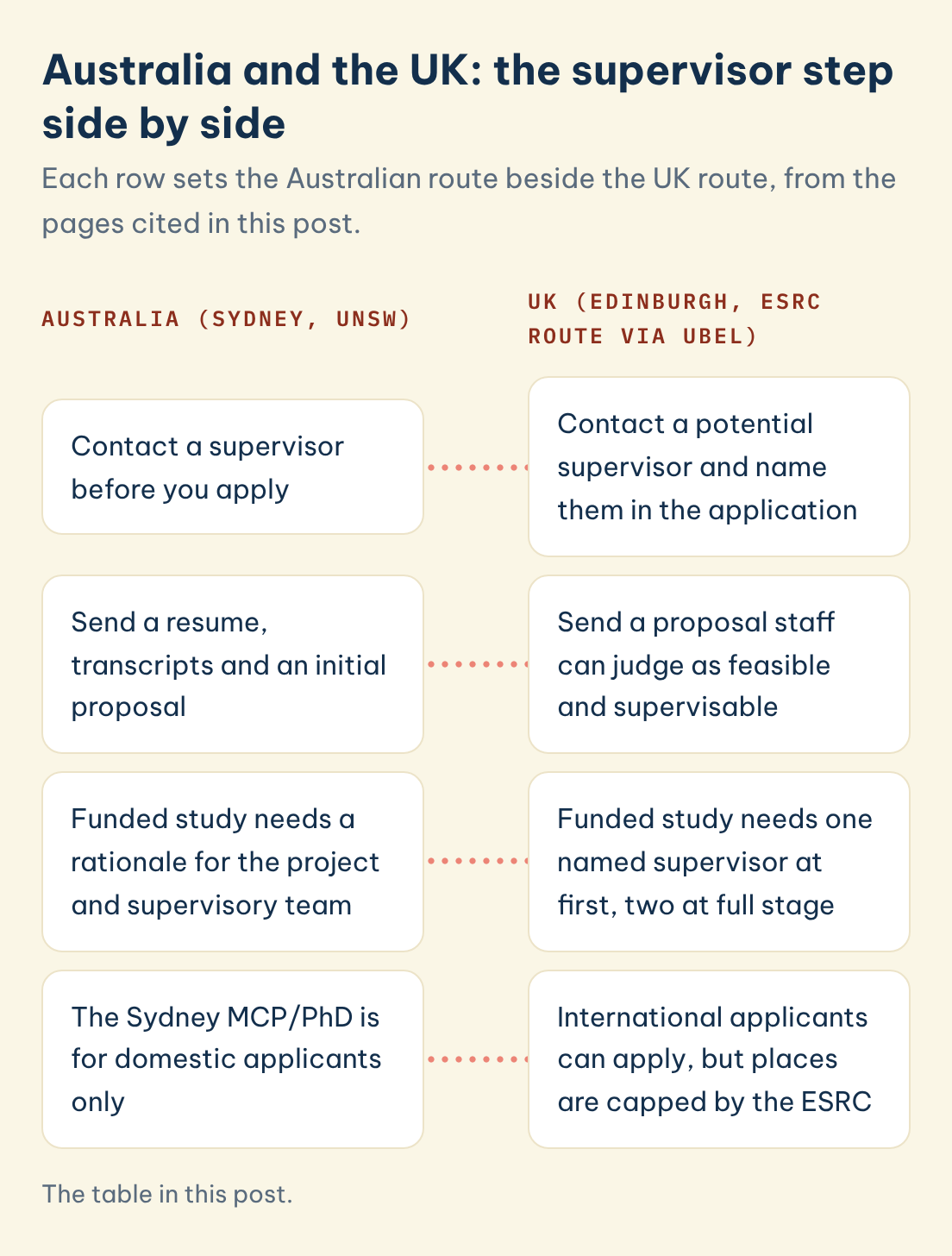
The table below compares what the sources we checked say. It is a summary of the pages cited, not a full guide to every university, so confirm the details for your own department.
| Question | Australia (Sydney, UNSW) | UK (Edinburgh, ESRC route via UBEL) |
|---|---|---|
| Who do you contact first? | A supervisor, before applying (University of Sydney, n.d.; UNSW Sydney, n.d.) | A potential supervisor, whose name you include in the application (University of Edinburgh, n.d.) |
| What do you submit? | Resume, transcripts and an initial proposal at enquiry stage (University of Sydney, n.d.) | A research proposal that staff can judge as feasible and supervisable (University of Edinburgh, n.d.) |
| What about funding? | A scholarship is required for the combined PhD/Master of Psychology (UNSW School of Psychology, 2025) | Name at least one potential supervisor, having discussed the proposal and gained approval to submit; two supervisors at full stage (UBEL Doctoral Training Partnership, 2025) |
| International students | Check each programme: the Sydney MCP/PhD is for domestic applicants only (University of Sydney School of Psychology, 2026) | Can apply, but international studentships are capped by the ESRC (UBEL Doctoral Training Partnership, 2025) |
| Separate university application? | No: you apply to the university once a supervisor is secured (University of Sydney, n.d.) | Yes, you must also apply separately to the university (UBEL Doctoral Training Partnership, 2025) |
Two points deserve a plain statement. The first is that the combined clinical programme at Sydney is open to domestic applicants only (University of Sydney School of Psychology, 2026), so a Vietnamese applicant should look at the research PhD route instead and read the eligibility line before writing to anyone. The second is that UK funding through a doctoral training partnership is capped for international students (UBEL Doctoral Training Partnership, 2025), so a UK plan needs a funding question answered early, not after you have found a supervisor. To find out, read the scholarship page of each university and doctoral training partnership on your list, and ask the supervisor in your first email whether a funded place is available for the project.
◆ Question 6 / 7 · Common mistakes
What goes wrong most often, and how do you avoid it?
Direct answer: The most common mistakes are contacting a supervisor who is not taking students, sending a proposal that is a topic and not a question, and treating a polite reply as an offer. Each can be caught with a short check before you send anything.
- Writing to someone at capacity. Check the staff profile first (University of Edinburgh, 2026).
- A topic instead of a question. "Anxiety in students" is a topic. "Whether a brief cognitive intervention lowers exam anxiety in first-year students" is a question a supervisor can assess.
- Reading willingness as admission. The UNSW School of Psychology (2025) is clear that willingness to supervise is not a guarantee of admission (p. 1).
- Ignoring eligibility. Read whether the programme accepts international applicants before investing time (University of Sydney School of Psychology, 2026).
- Leaving no time. Even the domestic clinical MCP/PhD at Sydney asks applicants to allow more than one month (University of Sydney School of Psychology, 2026). Start months before the deadline.
◆ Question 7 / 7 · Where MAAS fits
How can MAAS help with your supervisor search?
Direct answer: MAAS advisors work with you on your research direction, shortlist and proposal preparation. You do the thinking, write the documents and submit the application yourself. The advisors give feedback on each draft, explain what psychology departments look for, and help you test fit before you contact anyone.
If you are a Vietnamese student unsure how to turn a broad interest in psychology into a question a supervisor can assess, our PhD application strategy service is built for that stage. An advisor reviews your reading, helps you test fit against the criteria above and comments on drafts of your proposal and emails. The decisions, the writing and the submission stay with you, and the department makes the admission decision.
Frequently asked questions
Do I need a supervisor before I apply for a PhD in psychology?
At the universities we checked, yes or very nearly. The University of Sydney (n.d.) says you must secure a supervisor before submitting your application, and UNSW Sydney (n.d.) says most faculties require you to contact supervisors before you apply.
Can international students apply for a psychology PhD in the UK?
Yes. Self-funded applicants apply to the university with a named supervisor (University of Edinburgh, n.d.). For ESRC funding, UBEL Doctoral Training Partnership (2025) says international studentships are capped, and you must also apply separately to the university.
Should I write the research proposal before or after contacting a supervisor?
Start with your own draft. The University of Edinburgh (n.d.) advises drafting the proposal independently and then discussing it with your planned supervisor. Some programmes, such as the clinical MCP/PhD at Sydney, then expect a version developed with the supervisor (University of Sydney School of Psychology, 2026).
What if a supervisor replies but says they cannot take students?
Thank them and ask whether a colleague works on a similar question. Capacity limits are real (University of Edinburgh, 2026), and a refusal on capacity does not reflect on your idea.
How long should I allow for finding a supervisor?
The clinical MCP/PhD procedure at Sydney asks for more than a month (University of Sydney School of Psychology, 2026). In practice, MAAS advisors suggest starting several months before your target deadline, because reading, replies and proposal revisions all take time.
Does a reply from a supervisor mean I will be admitted?
No. The UNSW School of Psychology (2025) states that willingness to supervise is not a guarantee of admission (p. 1). Treat a reply as permission to continue, not as an offer.
References
UBEL Doctoral Training Partnership. (2025). 2026 entry applicant frequently asked questions [PDF]. https://ubel-dtp.ac.uk/wp-content/uploads/2025/10/2026-Entry-Applicant-Frequently-Asked-Questions-FAQs.pdf
University of Edinburgh. (n.d.). Help with your application: Psychology PhD programme. https://ppls.ed.ac.uk/psychology/prospective/postgraduate/psychology-phd-programme/help-with-your-application
University of Edinburgh. (2026). Finding a research supervisor. https://study.ed.ac.uk/postgraduate/applying/research-degrees/proposing-own-research/finding-supervisor
University of Sydney. (n.d.). How to apply for postgraduate research. https://www.sydney.edu.au/study/applying/how-to-apply/postgraduate-research.html
University of Sydney School of Psychology. (2026). 2026 application procedure: Master of Clinical Psychology/Doctor of Philosophy [PDF]. https://www.sydney.edu.au/content/dam/corporate/documents/faculty-of-science/schools/school-of-psychology/2026-application-procedure-mcp-phd.pdf
UNSW School of Psychology. (2025). School of Psychology application guide: Combined PhD/Master of Psychology [PDF]. https://www.unsw.edu.au/content/dam/pdfs/future-students/2025-08-school-of-psychology-application-guide/2025-08-school-of-psychology-application-guide-combined-phd-mpsych.pdf
UNSW Sydney. (n.d.). Higher degree research application. https://www.unsw.edu.au/research/hdr/application
Not sure how this guide applies to your own case? Talk it through with MAAS in a free 20-minute consultation.
Book a free consultation ▸