
◆ PhD application
How narrow does a PhD research interest or direction need to be?
Applicants usually narrow a PhD research interest by counting words. They start with "marketing", decide that is too broad, and arrive at "the effect of AI-generated content on consumer trust in online retail". The phrase is longer, so it feels narrower, and the proposal goes out.
It usually comes back with the same comment it would have received before the trimming. That is worth sitting with, because it tells you the trimming was not the operation being asked for. A direction is not broad because it covers too much ground. It is broad because it has not yet taken a side.

◆ Question 1 / 5 · What a committee reads
What does a committee actually read a direction for?
Direct answer: A committee checks whether you have staked out a position inside a debate the field is already having, not whether the subject happens to interest you. Because every established discipline splits into traditions that answer the same questions in incompatible ways, your direction signals which one you belong to, more than how tightly the topic has been trimmed.
Every mature discipline is organised into traditions that answer the same questions in incompatible ways. Marketing is a clean example, and the split described here is the working distinction MAAS uses when scoping a direction rather than a classification drawn from a published taxonomy. Consumer behaviour treats buying as a psychological event, works mainly through lab and field experiments run under IRB-reviewed protocols and analysed with ANOVA or mixed models, and argues about mechanisms and mediators; work in that tradition tends to land in outlets such as the Journal of Consumer Research or the Journal of Consumer Psychology. Quantitative marketing treats buying as an outcome in observed data, works through econometric modelling such as OLS or panel regressions, and argues about identification and endogeneity; that tradition tends to land in the Journal of Marketing Research or Marketing Science. Both study the same shoppers. They do not share a notion of what counts as an answer, and a department that hires for one will read a proposal written in the other as unfocused rather than as an alternative.
This split between research traditions is not merely a matter of taste between colleagues. A 2014 study of interdisciplinary doctoral supervision, published in the Canadian Journal of Higher Education, states that it set out to "investigate the epistemological, structural, and relational factors that shape ID doctoral research supervision, explore how differing knowledge cultures and values are negotiated in supervisory practices" (Hibbert et al., 2014, p. 85). That study describes what happens after admission, when the student and the supervisor are already bound together for what is typically 3 to 4 years of full-time doctoral study in the UK or Australia, or 5 to 6 years in the United States once coursework is included. Read it as an indication of what a committee is trying to avoid at the point of selection: pairing a candidate with a group whose idea of good work is not the candidate's own.
So the question a reader is holding while reading your direction is not "is this topic small enough". It is closer to "do I know which conversation this person is entering, and is it ours".
◆ Question 2 / 5 · Why detail fails
Why does adding detail fail to make a direction narrower?
Direct answer: Because detail restricts what you will look at, while a position restricts how you will answer, and only the second one tells a reader where you stand.
Compare the two moves on the same starting point.
| Move | What the sentence looks like | What the reader learns |
|---|---|---|
| Adding detail | AI-generated content, consumer trust, online retail, Southeast Asia, post-2023 | The boundaries of your subject matter, and nothing about your method or your commitments |
| Taking a position | Trust here is a psychological state that shifts under specific disclosure conditions, so the study is experimental and the contribution is a mechanism | Which tradition you write in, what evidence you will accept, and therefore who could supervise you |
The first move can be repeated forever without ever reaching the point. You can keep adding qualifiers until the sentence is a paragraph and still leave a reader unable to say whether you will run a study in the tradition of the Journal of Consumer Research or build a model in the tradition of the Journal of Marketing Research.
There is a cheap test for which move you have made. Name the researchers in your field who would disagree with your approach, and say what they would object to. If nobody would object, you have described a subject rather than staked a claim, and the proposal has not yet begun. Ravitch and Riggan (2017) describe this same shift, from listing topics to committing to a conceptual framework, as the point where a proposal starts making an argument instead of surveying one.
◆ Question 3 / 5 · Which choice first
Which choice do you make first?
Direct answer: The tradition, because everything downstream inherits from it.
A workable sequence for choosing a tradition
Tap a step to read it as the post puts it. The post numbers them in this order.
Step 1 of 5
A plain sentence
Write your interest as a plain sentence, without qualifiers.
Step 2 of 5
The traditions
Identify the 2 to 3 traditions in your field that would each treat that sentence as their own, and describe what each would count as an answer.
Step 3 of 5
Choose one
Choose one, and write down what you are giving up by choosing it. The discomfort here is the signal that a real choice was made.
Step 4 of 5
Your training
Check the choice against your own training. A tradition that runs on econometrics is a poor choice if your quantitative background stops at introductory statistics, and the honest response is either to change the choice or to plan the gap.
Step 5 of 5
Search by tradition
Only now go looking for people on Google Scholar or Web of Science, and search on the tradition rather than on the topic.
Save this figure
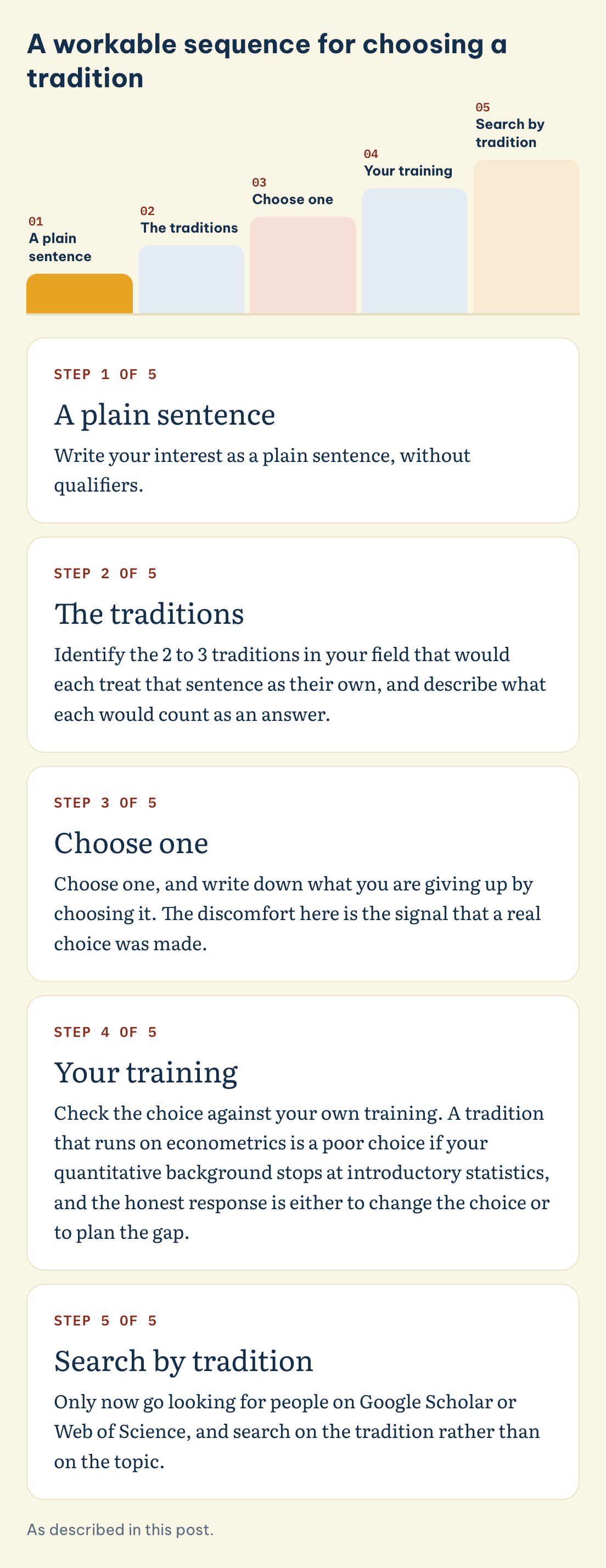
The order matters more than it appears to. Creswell and Creswell (2018) place this same decision, choosing a research paradigm before a method, at the start of their guidance for exactly this reason. A tradition carries a method with it, the method decides what data you need, the data decides which projects are feasible within the 3 to 4 years a UK or Australian PhD is typically funded for, and only then does a list of names become meaningful. Work backwards from the names instead and the list is assembled on the wrong criterion, which is the most expensive error available at this stage: it produces a shortlist that looks busy and matches nothing.
A workable sequence looks like this.
- Write your interest as a plain sentence, without qualifiers.
- Identify the 2 to 3 traditions in your field that would each treat that sentence as their own, and describe what each would count as an answer.
- Choose one, and write down what you are giving up by choosing it. The discomfort here is the signal that a real choice was made.
- Check the choice against your own training. A tradition that runs on econometrics is a poor choice if your quantitative background stops at introductory statistics rather than a course covering OLS and panel-data methods, and the honest response is either to change the choice or to plan the gap.
- Only now go looking for people on Google Scholar or Web of Science, and search on the tradition rather than on the topic.
Step four is the one applicants skip. Choosing a tradition you cannot actually execute is not ambition; it produces a proposal that a specialist reads as inconsistent, because the method promised in one paragraph is not supported by the background stated in another.
◆ Question 4 / 5 · Between two traditions
What if your interest genuinely sits between two traditions?
Direct answer: Then say so explicitly and name your primary base, rather than letting the ambiguity sit unremarked, the same negotiation Hibbert et al. (2014) describe as required whenever two knowledge cultures meet on one project.
Interdisciplinary work is real and is funded. What sinks a proposal is not crossing a border but crossing it silently, so the reader cannot tell whether you have made a considered move or simply have not noticed the border exists. The same 2014 study on interdisciplinary supervision found these arrangements demand explicit negotiation of differing knowledge cultures, which is only possible once someone has named them (Hibbert et al., 2014).
Practically, in 1 to 2 sentences: nominate the tradition that will govern your method, state which second tradition supplies your questions or your data, and say in one sentence how you will handle the point where their standards conflict. That paragraph converts a weakness a reader would have detected into a design decision you have already made.
There is a related reason to be explicit early. A 2021 study comparing what doctoral students and supervisors expect of each other, published in the International Journal of Doctoral Studies, found that the areas a university regulates explicitly are where both sides clarified their expectations and largely agreed, while the areas left unregulated were where expectations stayed implicit and diverged most (Baydarova et al., 2021). That study was conducted with 27 participants at 2 Malaysian research universities, so treat it as a description of the mechanism rather than as a figure that transfers to your system. The mechanism is enough on its own: unstated assumptions about what good work looks like do not quietly resolve themselves.
◆ Question 5 / 5 · Writing the proposal
How does this change the way you write the proposal?
Direct answer: The narrowing shows up in the literature section as exclusions, not as coverage.
A proposal written from a position does not survey everything published near its subject. It establishes the conversation it is entering, states where that conversation has stalled, and explains what its own study would settle. Guidance published for prospective doctoral applicants by the University of Leeds asks applicants to focus a proposal on 1 to 2 key research aims, to show how the research questions serve those aims, and to plan a realistic timescale (University of Leeds, n.d.), and a position is what makes that specificity possible.
A concrete symptom, easy to check on your own draft: if your literature review is organised by topic, with a paragraph on each nearby study, the position has not been made. If it is organised by disagreement, with studies grouped by what they claim and your own work placed among them, it has. Creswell and Creswell (2018) describe this same organising choice, themes and arguments rather than a list of individual studies, as the difference between a literature review and an annotated bibliography.
Frequently asked questions
Does choosing a tradition mean I can never change direction later?
No. Doctoral projects shift regularly in their first year, and Ravitch and Riggan (2017) treat a conceptual framework as something expected to evolve once data starts coming in. What the choice does is make you legible at the point of selection, which is when you have the least room to be ambiguous. Changing later happens in conversation with a supervisor who has already agreed to work with you.
My department at home did not teach me these divisions. How do I find them?
Read the methods sections of 5-6 recent articles that sit close to your interest, using Google Scholar or Web of Science, and group them by what they treat as evidence. The divisions become visible quickly because they are the reason those methods sections look nothing alike, and Baydarova et al. (2021) found that expectations made explicit this early are the ones both sides tend to agree on fastest.
Is a narrower direction always better?
No. A direction can be narrowed to a point where no supervisor works on it and no data exists to study it. The target is not minimum breadth but a claim that a specific group of researchers would recognise as belonging to their argument.
How does MAAS work on this?
Your MAAS expert challenges the direction before drafting it: pressing on which tradition it belongs to, what it excludes (Ravitch & Riggan, 2017), and whether your background supports the method it implies. The expert then drafts the proposal from your own account of your research, and you review, edit and approve it before you submit the application yourself. Details of the engagement are on the PhD application strategy service page.
How long does it take to be paired with a mentor?
You are paired within 48 hours when our network already covers that field. If it does not, MAAS opens a dedicated recruitment round for your case, which usually takes about 2 weeks.
Narrowing is not compression. It is the act of committing to one way of answering a question and accepting that the commitment closes doors. That is the part applicants resist, and it is also the part a reader is looking for.
For the full sequence of a PhD application, from proposal to outreach, see the PhD application guide.
References
Baydarova, I., Collins, H. E., & Ait Saadi, I. (2021). Alignment of doctoral student and supervisor expectations in Malaysia. International Journal of Doctoral Studies, 16, 1-29. https://ijds.org/Volume16/IJDSv16p001-029Baydarova6680.pdf
Creswell, J. W., & Creswell, J. D. (2018). Research design: Qualitative, quantitative, and mixed methods approaches (5th ed.). SAGE Publications.
Ravitch, S. M., & Riggan, M. (2017). Reason & rigor: How conceptual frameworks guide research (2nd ed.). SAGE Publications.
Hibbert, K., Lingard, L., Vanstone, M., Kinsella, E. A., McKenzie, P., Pitman, A., & Wilson, T. D. (2014). The quest for effective interdisciplinary graduate supervision: A critical narrative analysis. Canadian Journal of Higher Education, 44(2), 85-104. https://files.eric.ed.gov/fulltext/EJ1038378.pdf
University of Leeds. (n.d.). Research proposals. Retrieved August 19, 2026, from https://www.leeds.ac.uk/research-applying/doc/research-proposals
A free 20-minute consultation with a MAAS adviser, to press on which tradition your research direction belongs to and what it excludes.
Book Free Discovery ▸