
Category: admissions
Last updated: 2026-09-03

The familiar answer is seven for a professor, five for an associate professor, three for a doctorate holder. Those figures were real, they are no longer in the doctoral training regulation, and the numbers that replaced them are not quite the same kind of number.
Direct answer: Circular 53/2026/TT-BGDĐT no longer states a personal supervision cap. Article 17 refers instead to the Ministry's rules on determining doctoral intake. Circular 34/2026/TT-BGDĐT sets those ratios at 8 doctoral candidates per professor, 6 per associate professor or doctor of science, and 3 per doctorate holder.
The shift is easy to miss and changes what you should ask. The old figure was a limit on a person. The new figure is an input to a department's capacity calculation.
◆ Part 1 / 5 · Where the numbers went
Where the numbers went
Direct answer: Article 6 of Circular 18/2021/TT-BGDĐT capped independent supervision at 7, 5 and 3 by academic title. Article 17 of Circular 53/2026/TT-BGDĐT replaces that with a cross-reference to the Ministry of Education and Training rules on determining doctoral intake at the same time (Bộ Giáo dục và Đào tạo, 2026b).
The old supervision cap and the new ratios
Each row sets the old rule beside the new one. The first row gives the numbers and the second row says what kind of number each is. The 2026 intake still follows Circulars 03/2022 and 10/2023.
Before: Circular 18/2021, Article 6
Now: Circular 34/2026, Article 5
A cap on independent supervision: 7, 5 and 3 by academic title.
Ratios of doctoral candidates per lecturer: 8 for a professor, 6 for an associate professor or doctor of science, 3 for a doctorate holder.
A limit on a person.
An input to a department's capacity calculation.
Save this figure
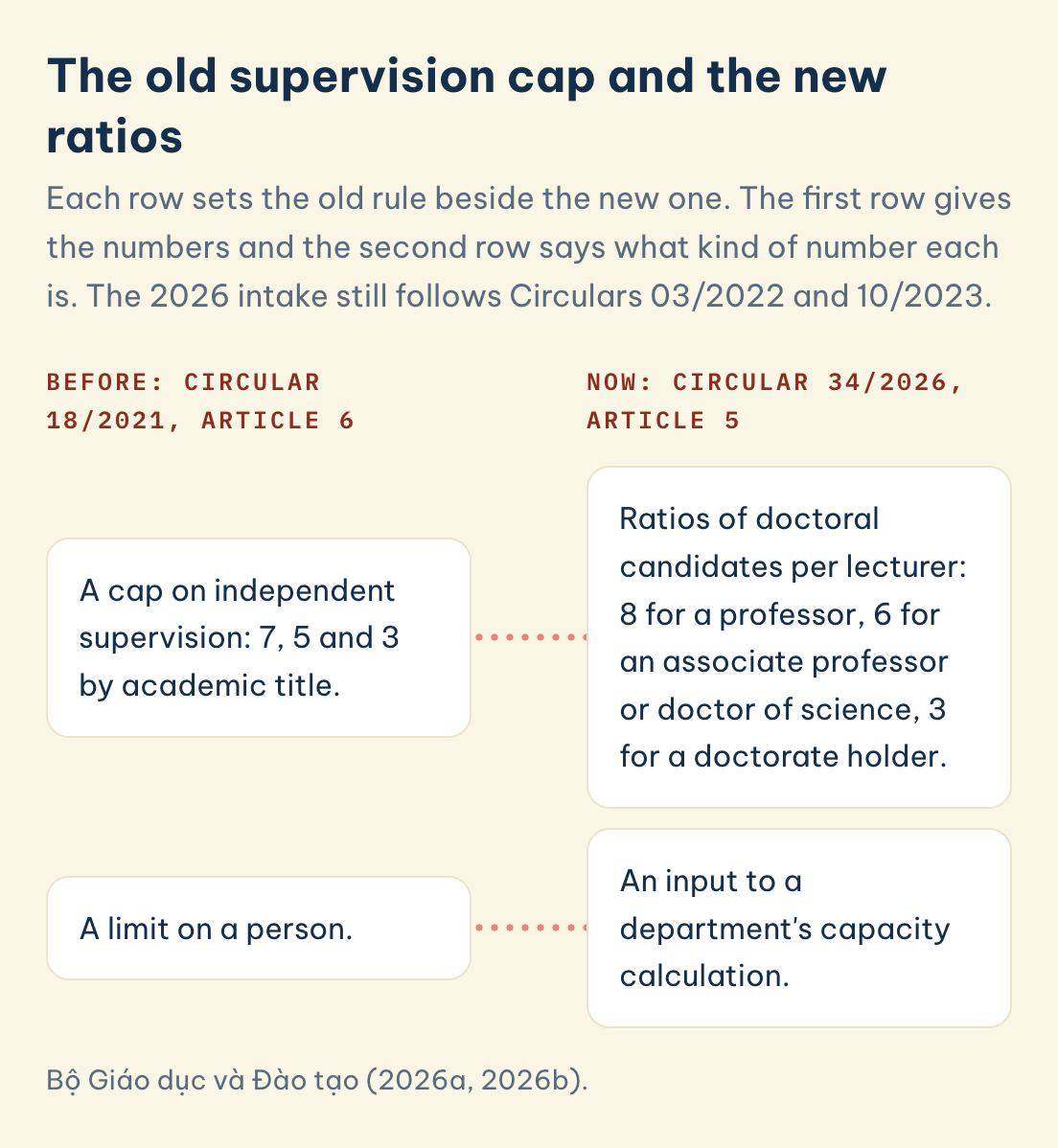
Those rules are Circular 34/2026/TT-BGDĐT, issued by the Ministry of Education and Training on 19 April 2026 and published in Official Gazette No. 266 on 10 May 2026 (Bộ Giáo dục và Đào tạo, 2026a). Article 5 sets the ratio of doctoral candidates per lecturer, by qualification and title, at 8 for a professor, 6 for an associate professor or doctor of science, and 3 for a doctorate holder. The ratio for master's students is 6 per lecturer.
Both circulars keep one rule unchanged: co-supervising one candidate counts as 0.5 of an independent supervision (Bộ Giáo dục và Đào tạo, 2026b). Article 17 of Circular 53/2026/TT-BGDĐT also fixes the structure around the count, requiring each candidate to have one or two supervisors, at least one of whom is on the institution's own staff, and requiring supervisors to hold a Web of Science or Scopus publication, a book, a patent or a utility solution from the past 5 years.
◆ Part 2 / 5 · Why a ratio is not a cap
Why a ratio is not a cap
Direct answer: A cap tells you what one person may not exceed. A ratio in Circular 34/2026 is used to compute how many candidates a field may admit, given its qualified staff. The same number therefore answers a departmental question, not a personal one.
Read Article 5 of Circular 34/2026/TT-BGDĐT in context and the difference becomes practical. The institution counts its qualified lecturers in a field, applies the ratio to derive training capacity, subtracts current enrolment, and adds the candidates expected to graduate that year. The intake figure falls out of that arithmetic (Bộ Giáo dục và Đào tạo, 2026a). An individual professor's headroom is a by-product of it rather than a quantity defined on its own.
A timing detail matters here too. Circular 34/2026/TT-BGDĐT requires institutions to update their data on the higher education database by 30 January each year, to determine and report intake by 28 February, and to publish any adjustment by 31 May (Bộ Giáo dục và Đào tạo, 2026a). Whether a supervisor has room is therefore a question with a season, not a permanent property.
One transitional wrinkle applies to the current cycle. Article 8 of Circular 34/2026/TT-BGDĐT states that the 2026 intake is determined under the criteria of Circular 03/2022/TT-BGDĐT and Circular 10/2023/TT-BGDĐT (Bộ Giáo dục và Đào tạo, 2026a), so a candidate asking about this year and a candidate asking about next year are asking about different rulebooks.
◆ Part 3 / 5 · What this changes
What this changes for an applicant
Direct answer: You can no longer infer a supervisor's availability from their title. Under the old rule, a professor with six students was visibly one short of the limit. Under the current rules, availability depends on the field's capacity arithmetic that season, which only the department can see.
That reframes the approach email. Asking whether a professor is accepting students is a question they may not be able to answer in the abstract, because the answer belongs to the departmental intake plan. Asking whether the field expects to announce doctoral places in the coming cycle, and whether they intend to take a candidate in it, is answerable. Our guide to the first approach email covers what belongs in that message.
The co-supervision rule creates a second opening. Because co-supervising counts as half, a supervisor near the ratio can still take a candidate jointly with a colleague. That arrangement also has to satisfy the requirement that at least one supervisor is on the institution's staff.
◆ Part 4 / 5 · Supervision load
Does supervision load affect your outcome?
Direct answer: The regulation counts supervisors, while the research literature measures support. Zhuchkova and Bekova (2023), studying 985 doctoral graduates, found that the apparent effect of pre-doctorate research experience on a successful defence disappeared once support from supervisors and departments was entered into the model.
The reading offered by Zhuchkova and Bekova (2023) is that support may account for much of what prior experience appeared to be doing. If that holds, the question of how many other candidates your prospective supervisor is carrying is not idle curiosity about their diary; it is a question about the input that the evidence associates most strongly with finishing.
There is also evidence that having two supervisors rather than one helps. Mosanya et al. (2022), in a mixed-methods study of doctoral candidates in clinical pharmacy in Nigeria with 47 survey respondents and 8 interviewees, report that having more than one supervisor, supervisor commitment to the research, and departmental support were identified as facilitators of timely completion. Participants with more than one supervisor also reported higher research output, and the authors write that "students who had more than one supervisor experienced a reduced risk of experiencing burnout" (Mosanya et al., 2022, p. 9).
Both studies are small, one drawn from 985 graduates in Russia and one from 55 participants in Nigeria, and neither is Vietnamese. What they support is modest and still worth acting on: ask about the supervision arrangement, not only about the person.
◆ Part 5 / 5 · Where MAAS fits
Where MAAS fits
Whether a supervisor has capacity is outside anyone's control, including ours. What is inside your control is arriving with work that makes a department want to find room, and in this system that means accepted publications, which is what MAAS Publishing Advisory works on, with you as sole author and sole submitter. For the approach strategy and the proposal, phased coaching sits under academic mentoring. MAAS commits to process quality, never to an admission outcome. The wider sequence is in our PhD application guide. The supervisor approach itself is the part a PhD application consultant at MAAS works on with you.
Frequently asked questions
Is the 7, 5 and 3 rule still in force?
Not in the doctoral training regulation. Those figures were in Article 6 of Circular 18/2021, which Circular 53/2026 replaced. The comparable figures now sit in Circular 34/2026 at 8, 6 and 3.
Does co-supervision count as a full place?
No. Both circulars count co-supervising one candidate as equivalent to 0.5 of an independent supervision.
Can I have two supervisors?
Article 17 of Circular 53/2026 provides for one or two supervisors per candidate, and requires at least one to be a full-time or jointly appointed member of the institution's staff.
How do I find out whether a professor has room?
Ask the department rather than inferring it from the professor's title, and ask about the intake cycle, since intake is determined and reported annually under Circular 34/2026.
Do these ratios apply to my 2026 intake?
Article 8 of Circular 34/2026 states that the 2026 intake is determined under the criteria in Circular 03/2022 and Circular 10/2023, so confirm which cycle your application belongs to.
References
Mosanya, A. U., Ukoha-kalu, B. O., Isah, A., Umeh, I., Amorha, K. C., Ayogu, E. E., & Ubaka, C. (2022). Factors associated with the timely completion of doctoral research studies in clinical pharmacy: A mixed-methods study. PLOS ONE, 17(9), Article e0274638. https://doi.org/10.1371/journal.pone.0274638
Zhuchkova, S., & Bekova, S. (2023). Building a strong foundation: How pre-doctorate experience shapes doctoral student outcomes. PLOS ONE, 18(9), Article e0291448. https://doi.org/10.1371/journal.pone.0291448
Bộ Giáo dục và Đào tạo. (2026a). Thông tư số 34/2026/TT-BGDĐT quy định về việc xác định số lượng tuyển sinh đại học, thạc sĩ, tiến sĩ và số lượng tuyển sinh cao đẳng ngành Giáo dục Mầm non (Công báo số 266). Công báo Chính phủ. https://congbao.chinhphu.vn/van-ban/thong-tu-so-34-2026-tt-bgddt-469435.htm
Bộ Giáo dục và Đào tạo. (2026b). Thông tư số 53/2026/TT-BGDĐT ban hành Quy chế tuyển sinh và đào tạo sau đại học (Công báo số 447). Công báo Chính phủ. https://congbao.chinhphu.vn/van-ban/thong-tu-so-53-2026-tt-bgddt-470098/67203.htm
A free 20-minute consultation is a conversation about your situation and the supervisor approach you are planning.
Book a free consultation ▸