
◆ PhD Admissions
PhD in France: does cotutelle or codirection award two degrees?
Category: admissions
Last updated: 2026-09-22

Vietnamese applicants looking at a PhD in France usually meet the French system through a single phrase, đồng hướng dẫn, and that phrase covers two arrangements that French regulation keeps apart. The two look identical from the outside, because both give you a supervisor in Vietnam and a supervisor in France, and they differ in something no promotional page mentions: how many administrative enrolments the paperwork creates.
Direct answer: Codirection gives you two supervisors and one enrolment, so one university awards the degree. Cotutelle internationale is an agreement between two institutions, so you enrol at both every year and each awards a qualification. Campus France Vietnam (n.d.) states that under codirection "sinh viên chỉ được nhận bằng của trường này", meaning the main supervisor's institution.
That one sentence reverses what most Vietnamese-language sources promise. On the first screen of Google for cotutelle là gì, several study-abroad pages describe đồng hướng dẫn as the programme where "nghiên cứu sinh có thể nhận cả 2 bằng từ 2 trường", and Perplexity, asked the question in Vietnamese on 22 September 2026, opened its answer by treating đồng hướng dẫn and cotutelle as one thing that "thường được cấp bằng tiến sĩ của cả hai trường". The official Vietnamese-language page from Campus France Vietnam draws the line the other way, and it is the line the French institutions act on.
◆ Section 1 / 9 · Who supervises
Who supervises a Vietnam-France co-supervised doctorate?
Direct answer: Both arrangements give you two thesis supervisors, one at the institution where your main laboratory sits and one elsewhere in France or abroad. Under cotutelle, Campus France (n.d.) specifies that the two supervisors "agree to act as full tutors to the doctoral student", so their responsibility is joint rather than divided into a senior and a courtesy role.
The supervisory picture is therefore the worst possible thing to use as a diagnostic. Campus France Vietnam (n.d.) describes codirection as having "2 giáo viên hướng dẫn", one in the main laboratory of the institution where you have enrolled and one from another institution in France or in another country, and describes cotutelle as running across a French institution and a foreign one (Campus France Vietnam, n.d.). If you ask a prospective supervisor how many people will supervise you, both answers come back as two, and you learn nothing about which regime you are entering.
France also allows the co-supervisor role to be held by someone outside the ministry's own staff. Campus France (n.d.) lists professors and teachers of equivalent rank of French or foreign nationality who do not report to the Ministry of Higher Education and Research, staff of public research organisations and research foundations qualified to direct research, and individuals holding a doctorate chosen for their scientific competence, approved by the head of the école doctorale after the institution's scientific council has given its view. The last category "is not required to be affiliated with a research unit".
◆ Section 2 / 9 · One degree or two
Do you receive one degree or two?
Direct answer: Under codirection there is one administrative enrolment and one degree, from the institution where you enrolled, although the diploma carries the names and titles of both supervisors. Under cotutelle the two institutions award either one joint degree or two parchments of equal value, and the international cotutelle is mentioned on both.
Codirection and cotutelle internationale compared
Each row sets codirection beside cotutelle internationale on enrolment, the degree awarded, the defence and the agreement that is signed.
Codirection
Cotutelle internationale
One administrative enrolment
Enrolment at both institutions every year
One degree from the institution where you enrolled, with the names and titles of both supervisors on the diploma
One joint degree or two parchments of equal value, with the international cotutelle mentioned on both
A single defence, usually at the institution where you are enrolled
A single defence before a jury designated by joint agreement of the two partner universities
A co-supervision agreement signed by the two supervisors concerned
An agreement drawn up by the two supervisors and approved by the école doctorale. The supervisor submits the application to the head of the école doctorale.
Save this figure
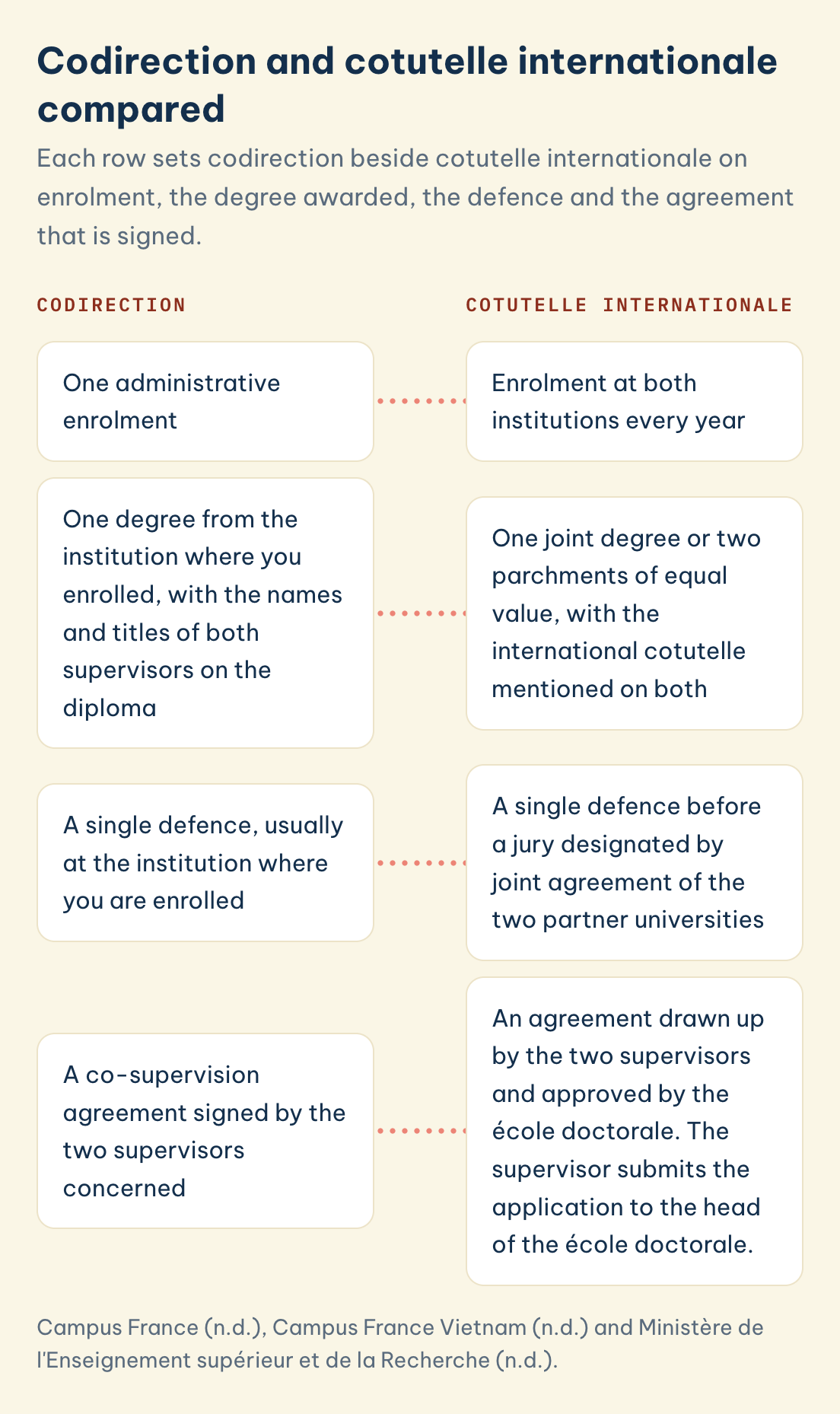
Campus France (n.d.) puts the codirection case in one clause: "A co-supervision agreement signed by the two supervisors concerned, but only one administrative enrolment." The defence is single and usually takes place at the institution where you are enrolled, and the recognition you gain is a diploma bearing the names and titles of both supervisors (Campus France, n.d.). Nothing in that arrangement produces a second qualification, which is why a page promising two degrees under the heading đồng hướng dẫn is describing a different instrument from the one it has named.
Cotutelle produces the second qualification because the two institutions have both admitted and both enrolled you. Campus France (n.d.) describes the result as "a PhD degree awarded jointly by the partner institutions (joint degree)" or "two PhD degrees from each institution (double degree)", with the choice written into the agreement. The defence stays single in both regimes, and in the French procedure 2 rapporteurs verify the thesis of at least 200 pages before the candidate earns the right to defend it in a normally public session (Campus France Vietnam, n.d.); for a cotutelle the jury is designated by joint agreement of the two partner universities, composed in a balanced proportion of members from each institution together with the two supervisors and researchers external to both (Campus France, n.d.). The national doctoral platform adds a durable form of proof: the international cotutelle is recorded on the national theses portal theses.fr and mentioned on both doctoral degrees awarded (Ministère de l'Enseignement supérieur et de la Recherche, n.d.).
◆ Section 3 / 9 · Time split between countries
How is the research time split between the two countries?
Direct answer: Cotutelle requires you to work alternately in both countries, and the split is written into the agreement rather than left to preference. The two official sources state the floor differently: Campus France (n.d.) sets a minimum of one year in France, while the national doctoral platform describes alternating stays of at least one year in each country.
Read that discrepancy as a warning about where the real number lives. The normal duration of a French doctorate is 3 years (Campus France, n.d.), which Campus France Vietnam (n.d.) extends to a maximum of 6 years in the humanities and social sciences, so a floor of 1 year in each country consumes two thirds of a 3-year science timetable. Because the split is one of the clauses the convention fixes, the figure that binds you is the one in your own agreement, not the one on a national page.
Codirection carries no equivalent mobility floor. The national platform positions international joint supervision without a cotutelle agreement as the option for projects that do not require extended stays abroad, and Campus France Vietnam (n.d.) calls codirection "một hình thức thú vị và khá dễ dàng thực hiện". The language matters for planning: if you cannot commit a full year abroad, the lighter instrument is not a consolation prize but the correctly matched one.
◆ Section 4 / 9 · Where fees are paid
Where do you pay enrolment fees when you are registered at two universities?
Direct answer: At one of them. The cotutelle convention exempts you from enrolment fees at one institution each year on proof that you paid at the partner institution for that year, so double enrolment does not mean double fees. You still complete both institutions' annual administrative registration.
Campus France (n.d.) describes the mechanism as an annual waiver: "a fee waiver is granted each year by one university upon proof of payment at the partner university for the year in question". Campus France Vietnam (n.d.) states the same rule for a Vietnamese reader, that each year the candidate must register at both institutions but pays the enrolment fee at only one, and that the arrangement has to be written into the commitment. Which institution collects is a clause, not a default, so it is a term to read rather than assume.
Registration is annual on both sides, and the file repeats. Campus France (n.d.) lists the documents an école doctorale usually asks for each year: a résumé, copies of the relevant diplomas with a certified translation, a thesis proposal, proof of a funding commitment stating its nature and amount for the entire duration of the thesis, and, for the first year, the cotutelle agreement signed by both supervisors and both universities or by the école doctorale. The convention also allocates research expenses between the two laboratories (Ministère de l'Enseignement supérieur et de la Recherche, n.d.), which is a separate question from who collects the enrolment fee, and the two are easy to conflate when only one of them has a number attached in the first conversation.
The fee clause is also the one the French system flags as most likely to break. The national doctoral platform warns of possible regulatory incompatibilities "particularly regarding enrolment fees and the requirement for a single thesis defence" (Ministère de l'Enseignement supérieur et de la Recherche, n.d.). Two institutions whose own rules cannot both be satisfied on fees will discover that while drafting, which is an argument for starting the drafting inside the first year, as the platform requires (Ministère de l'Enseignement supérieur et de la Recherche, n.d.), rather than treating it as a formality after admission.
◆ Section 5 / 9 · Legal framework and timing
What is the legal framework, and when must the agreement be in place?
Direct answer: A cotutelle rests on a formal agreement between two institutions, each accredited to award doctorates, with one necessarily French. The national doctoral platform states that the arrangement needs 3 to 6 months of administrative preparation, less where a framework agreement already exists, and must be put in place from the first year of the thesis.
The application does not travel the route an applicant would expect. Campus France (n.d.) states that the agreement is "drawn up by the two supervisors, and approved by the graduate school (école doctorale), in duplicate form", and that "in France, applications for an international joint PhD supervision ('cotutelle') are submitted by the PhD supervisor to the Head of the graduate school (école doctorale)". You are the subject of the file, not its sender, which is why searching for a cotutelle application portal returns nothing: the prerequisite is a master's degree worth 300 ECTS or an equivalent, a thesis proposal agreed with both supervisors, and an admission decision from the French école doctorale and its counterpart abroad, and only then does a convention become possible (Campus France, n.d.).
The convention itself is unusually wide in scope. Campus France (n.d.) lists the administrative arrangements it settles, including registration fees, length of stay in the partner institution, training requirements, funding, the projected date, place, language and jury composition of the defence, and the type of diploma awarded, and notes that it guarantees the research falls under protected works in the French Intellectual Property Code. It may be a pre-existing framework agreement between the two institutions or one concluded for a single candidate (Campus France, n.d.). Where a framework already exists, the 3 to 6 month preparation window shrinks, so asking whether your two institutions have signed anything before is a cheaper question than asking whether cotutelle is possible in principle.
◆ Section 6 / 9 · Thesis language
Which language will the thesis be written in, and who decides?
Direct answer: The cotutelle agreement names the language. Campus France (n.d.) states that for any language other than French "a lengthy summary must be written in French", so an English-language thesis remains possible while the French-language obligation moves to the summary rather than disappearing.
The discipline decides how much room there is to negotiate. Campus France Vietnam (n.d.) reports that in the exact sciences, engineering and biology a candidate is not required to hold French proficiency and may write the thesis in English with only the research summary translated, while the humanities and social sciences usually expect good French, commonly at B1 or B2, and business, marketing, political science, communication and law leave the decision to the institution. Under codirection the thesis is written in French except at those écoles doctorales that accept English with a French summary (Campus France, n.d.), so the permission is institutional in both regimes rather than personal.
Scale explains why the answer varies so much. France trains doctoral candidates through 270 écoles doctorales attached to 2,500 public research laboratories, and awards close to 15,000 doctorates a year, split 46% in science and technology, 20% in biology and medicine, 20% in the humanities and 14% in the social sciences (Campus France Vietnam, n.d.). The écoles doctorales also run about 150 hours of complementary training across the doctorate and organise admission themselves, so a rule that holds at one of them is not a national rule.
◆ Section 7 / 9 · Do both sides share decisions
Does a signed agreement mean the two sides really share decisions?
Direct answer: Not by itself. Salimi, Bekkers and Frenken (2015) examined 191 university-industry doctoral projects at one Dutch university and found more than two thirds adopted centralised governance rather than shared, and that geographical and cognitive distance both made shared decision-making less likely, even though earlier work found shared governance more successful.
A convention distributes obligations; it does not distribute working authority. The finding that matters for a Vietnam-France pairing is the distance effect, since the two institutions sit about 9,000 km apart, and across the 191 projects examined Salimi et al. (2015) report that geographical distance had a significantly negative effect on both shared project management and shared decision-making. Their recommendation to institutions entering distant collaborations is to accept that shared governance "might require additional investments in time and resources from both collaborators" rather than to expect it to arise on its own.
The instrument's limits are documented at the European level too. Coy et al. (2020) argue that cotutelle agreements, though widely used for international joint supervision, "are merely bilateral and individual case-based agreements" that remain far from a joint degree established under a legal framework. Leite, Peneoasu and Hasgall (2022), reporting for the European University Association's thematic peer group on co-tutelles and joint doctorates with findings from 23 universities in 15 European countries, treat the negotiation itself as the site of both the opportunity and the recurring difficulty. What follows for you is practical: agree in writing who arbitrates when the two supervisors disagree on the direction of a chapter, because the convention will have settled the defence and the fees long before it settles that.
◆ Section 8 / 9 · Other instruments
Are there other instruments besides these two?
Direct answer: Yes, and the national platform and Campus France list them as alternatives rather than upgrades. Beyond cotutelle and codirection, France recognises the "European Doctorate" or Doctor Europaeus label, an international thesis jury, the European Joint Doctorate under Marie Skłodowska-Curie Actions, and the CIFRE doctorate carried out inside a company.
The Doctor Europaeus label is awarded in addition to the national degree, was introduced in 1992 by the Confederation of European Union Rectors' Conferences, and rests on four conditions: part of the doctorate prepared during a stay of at least 3 months in another European state, authorisation to defend granted on reports from at least two external examiners with the label itself awarded on reports from three professors belonging to two institutions in two European states other than the one hosting the defence, at least one jury member from an institution in another European state, and part of the defence conducted in a European national language other than that of the host country (Ministère de l'Enseignement supérieur et de la Recherche, n.d.). The platform states that the label "is distinct from international joint doctoral supervision (cotutelle), with which it may be combined", and that although the label does not appear on the national degree or on theses.fr, the international composition of the jury does.
The two remaining instruments sit further from a Vietnam-France pairing. A European Joint Doctorate runs 3 years across 3 institutions in 3 different countries (Campus France Vietnam, n.d.), so it is a consortium programme rather than a bilateral arrangement. A CIFRE doctorate places the candidate in a company partnered with a university, with one academic and one company supervisor, the company paying the candidate and receiving a state subsidy, and the university awarding the degree. Naming the instrument you actually want is therefore the first piece of work, because four of these five produce different paperwork from the one most Vietnamese-language pages describe.
◆ Section 9 / 9 · What this changes
What this changes about how you approach the two systems
The question to carry into a first email is not whether a professor will co-supervise you. It is whether your project will produce one enrolment or two, because that single fact determines the qualification, the mobility floor, the fee clause and the length of the administrative runway. A candidate who wants a French qualification and can commit a year abroad is describing a cotutelle and needs the convention started in the first year. A candidate who wants French expertise inside a Vietnamese doctorate is describing codirection, and will be better served by naming it correctly than by chasing a second diploma that the instrument was never built to award.
If you are still deciding between systems, the PhD application resource hub sets out how the admission routes differ before money and paperwork enter the picture. Where the decision is already made and the next step is a proposal two supervisors can both sign off, MAAS works with you through PhD application strategy: your expert drafts the proposal from your own account of your research, you review, edit and approve it and sit the interviews, and the expert challenges the argument and the fit before it reaches an école doctorale. Where MAAS's network already includes a suitable expert, MAAS introduces them within 48 hours, and where it does not, MAAS opens a dedicated search, which usually takes about two weeks.
References
Campus France. (n.d.). International joint PhD supervision and double/dual PhD degrees. Retrieved September 22, 2026, from https://ressources.campusfrance.org/esr/diplomes/en/cotutelle_en.pdf
Campus France Vietnam. (n.d.). Bậc tiến sĩ tại Pháp. Retrieved September 22, 2026, from https://www.vietnam.campusfrance.org/vi/bac-tien-si-tai-phap
Coy, P., Cánovas, S., Van Soom, A., Bernabò, N., Lonergan, P., & Schellander, K. (2020). European Joint Doctorates: Myth or reality? In Sixth International Conference on Higher Education Advances (HEAd'20) (p. 1109). Editorial Universitat Politècnica de València. https://doi.org/10.4995/head20.2020.11209
Leite, L., Peneoasu, A.-M., & Hasgall, A. (2022). Co-tutelles in European universities: Concept, aims and implementation. European University Association. https://www.eua.eu/publications/reports/co-tutelles-in-european-universities-concept-aims-and-implementation.html
Ministère de l'Enseignement supérieur et de la Recherche. (n.d.). International joint doctoral supervision (cotutelle). La plateforme nationale du doctorat. Retrieved September 22, 2026, from https://doctorat.gouv.fr/en/before/international-cotutelle/
Salimi, N., Bekkers, R., & Frenken, K. (2015). Governance mode choice in collaborative Ph.D. projects. The Journal of Technology Transfer, 40(5), 840-858. https://doi.org/10.1007/s10961-014-9368-5
Tools & resources
- La plateforme nationale du doctorat, the French national doctoral platform, including the model international cotutelle agreement and checklist: https://doctorat.gouv.fr/en/before/international-cotutelle/
- Campus France directory of écoles doctorales, laboratories and research centres: https://doctorat.campusfrance.org
A free 20-minute consultation is a conversation about your situation and whether your project means one enrolment or two.
Book a free consultation ▸