
◆ PhD application
Why do PhD application timelines collapse in the final month?
Ask an applicant in October whether they have enough time and the answer is almost always yes. Ask the same person in January, roughly 3 months later, and the answer has changed completely, though nothing dramatic happened in between. No single week went badly. The calendar simply ran out in a place nobody was looking at.
What failed was not the effort. It was the direction the schedule was built in.

◆ Question 1 / 5 · Why forward feels easy
Why does planning forward from today always feel comfortable?
Direct answer: Because a forward schedule counts only the work you will do, and almost every task in a PhD application also contains time when you are doing nothing but waiting for somebody else. Forward planning starts from the present, lists what needs doing, and totals working weeks, usually fewer than the weeks remaining, which is why the exercise reassures you.
When you plan forward, you start from the present, list what needs doing, estimate each piece, and add it up. The result is a number of working weeks, and that number is usually smaller than the number of weeks remaining, which is why the exercise reassures you.
That reassuring underestimate is a well documented pattern rather than personal carelessness. Buehler, Griffin and Ross (1994), published in the Journal of Personality and Social Psychology, a flagship American Psychological Association journal, put the mechanism directly: "the planning fallacy implies that people typically adopt an internal perspective when predicting their own completion times" (Buehler, Griffin, & Ross, 1994, p. 367). They found that people predicting their own completion times focused on plan-based scenarios for the specific task in front of them and gave little weight to their own history of running late, and that the bias eased when predictions were made from an observer's position rather than the actor's. The applied literature that followed, published in Advances in Experimental Social Psychology, describes the same mechanism, with attention to the singular case crowding out the base rates that would have corrected it (Buehler et al., 2010). Two limits are worth naming: this research covers task prediction in general rather than graduate admissions specifically, and it explains why the forward estimate is optimistic, not what any particular application will require. The 1994 study in the Journal of Personality and Social Psychology and the 2010 follow-up in Advances in Experimental Social Psychology reach the same conclusion sixteen years apart, which is the kind of replication that separates a durable finding from a one-off result. The personal statement is one document on that backward calendar, and personal statement review is the matching MAAS service.
A PhD file is unusually exposed to that bias, because it is not one long task. It is a chain of short tasks separated by queues that belong to other institutions.
◆ Question 2 / 5 · What you cannot compress
Which parts of the timeline are not yours to compress?
Direct answer: Score release, referee turnaround, and document issuance, and each behaves like a fixed cost rather than something effort can shorten.
Three waits that effort cannot shorten
Tap a wait to see why it behaves like a fixed cost.
Test results
Official GRE General Test scores become available in your ETS account 8 to 10 days after the test date (ETS, n.d.). IELTS results are issued in 1 to 5 days for the computer-delivered test, 6 to 8 days for IELTS Online, and up to 13 days for the paper test (IELTS, n.d.). Both sets of figures were checked on 20 August 2026, so confirm the timings for the test and format you have booked.
Reference letters
The interval between asking and receiving is not under your control. MAAS works to a minimum of 3 weeks, sometimes extending to 4 to 5 weeks when the referee is in a different time zone, and that is an operating rule drawn from case experience rather than a published standard.
Transcripts, translation, notarisation
These involve at least one office that has no interest in your admissions cycle, and often two in sequence, since a document frequently has to be issued before it can be translated and translated before it can be certified. Sequential queues do not overlap.
Save this figure
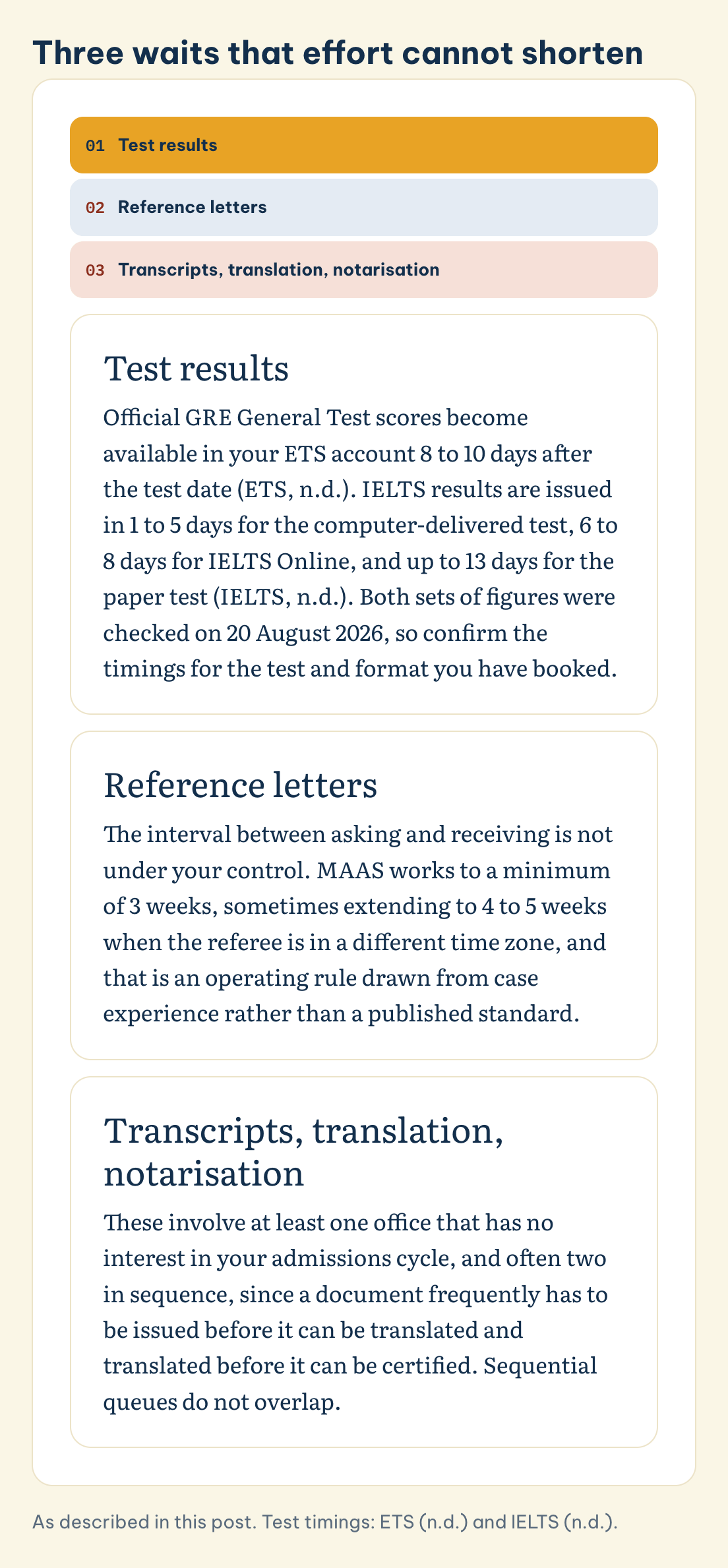
GRE (Graduate Record Examinations) General Test and IELTS both sit inside the same submission deadline. Working late into the night compresses your writing. It has no effect whatsoever on the three items below.
Test results. Sitting the test is not the milestone. The milestone is the score existing in a form an admissions office can read. Official GRE (Graduate Record Examinations) General Test scores become available in your ETS (Educational Testing Service) account 8 to 10 days after the test date (ETS, n.d.). IELTS is offered up to 4 times a month at most test centres, and IELTS Online runs on a similar cycle, so the sitting itself is rarely the bottleneck. IELTS, administered jointly by the British Council, IDP IELTS Australia and Cambridge Assessment English, has timing that varies by format, and the differences are large enough to change a plan: results are issued in 1 to 5 days for the computer-delivered test, 6 to 8 days for IELTS Online, and up to 13 days for the paper test (IELTS, n.d.). That schedule applies whether you sit IELTS Academic or IELTS General Training, since it is the delivery format, not the test version, that sets the wait. Both sets of figures were checked on 20 August 2026, and both bodies publish current timings on their own pages, so confirm the numbers for the test and format you have actually booked.
Reference letters. A referee is a busy academic with their own deadlines who is doing you a favour, and the interval between asking and receiving is not under your control at all. MAAS works to a minimum of 3 weeks here, sometimes extending to 4 to 5 weeks when the referee is in a different time zone, and that is an operating rule drawn from case experience rather than a published standard. It is deliberately generous, because a reference chased at short notice is usually a thinner reference. Time is only half of that problem, and what the referee needs from you to write a specific letter is covered in what a PhD referee needs from you.
Transcripts, translation and notarisation. These involve at least one office that has no interest in your admissions cycle, and often two in sequence, since a document frequently has to be issued before it can be translated and translated before it can be certified. Sequential queues do not overlap.
Notice what these three have in common. In each case the clock starts when you hand something over and stops when somebody else hands it back. Your capacity for hard work is not an input.
◆ Question 3 / 5 · Building it backwards
How do you build the schedule in the other direction?
Direct answer: Start at the submission date, subtract each prerequisite in the order it must exist, and stop when you reach a date, because that date is your real starting point.
Building the schedule backwards from the deadline
Tap a step to see what you subtract. The post lists them in this order.
Step 1 of 5
Deadline
The submission deadline. The real one for the specific programme, not the one you remember from a similar school.
Step 2 of 5
Proposal
Proposal finished, 3 to 4 weeks earlier. This gap exists so a final revision round can happen.
Step 3 of 5
Test
The test date, plus the release interval. Subtract the sitting and the wait separately. This is the step most often collapsed into one.
Step 4 of 5
Reference
The reference request, at least 3 weeks before it is needed, the same floor the Find a PhD Supervisor team works to. A referee usually wants to see the proposal, which quietly makes this dependent on step 2 rather than independent of it.
Step 5 of 5
Documents
Transcripts, translation, notarisation. Place these earliest, because they involve the queues you have the least visibility into.
Save this figure
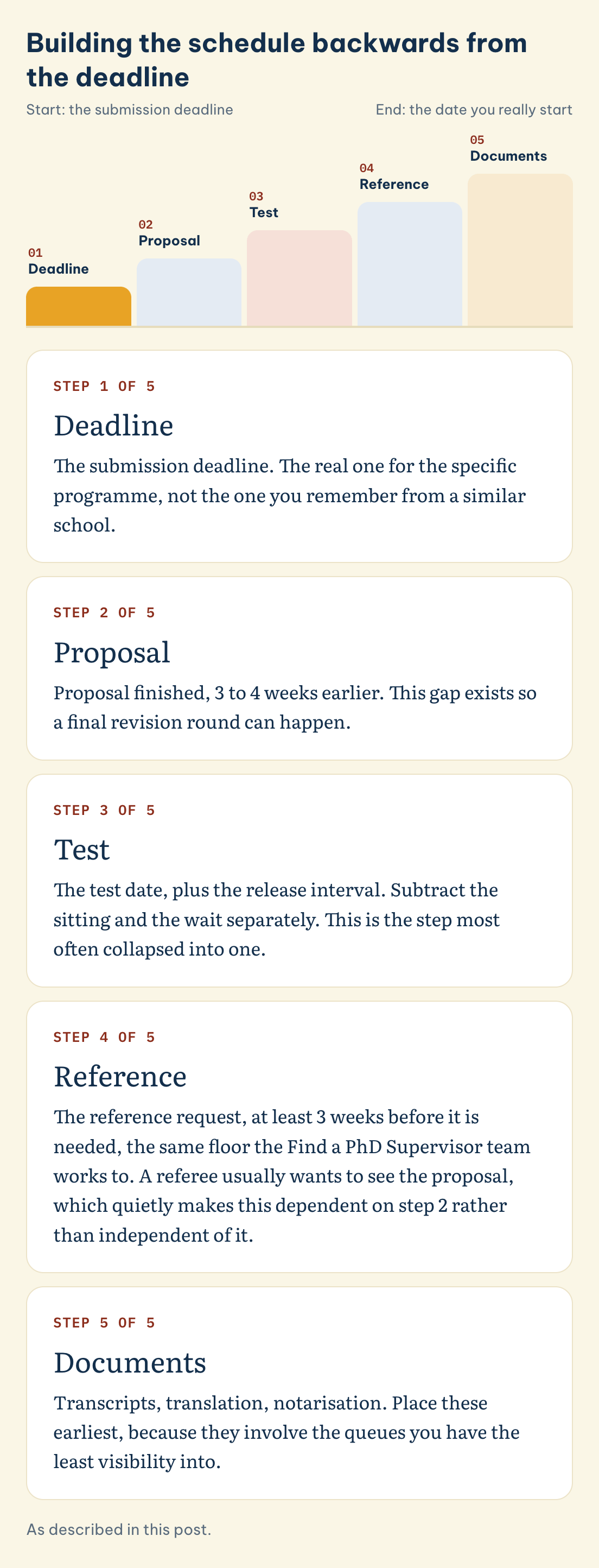
The sequence, working backwards:
- The submission deadline. The real one for the specific programme, not the one you remember from a similar school.
- Proposal finished, 3 to 4 weeks earlier. This gap exists so a final revision round can happen. A proposal completed the night before submission has never been read by anyone who could improve it.
- The test date, plus the release interval. Subtract the sitting and the wait separately. This is the step most often collapsed into one, and it is where the paper and computer formats stop being interchangeable.
- The reference request, at least 3 weeks before it is needed, the same floor the Find a PhD Supervisor team works to. Note that a referee usually wants to see the proposal, which quietly makes this dependent on step two rather than independent of it.
- Transcripts, translation, notarisation. Place these earliest, because they involve the queues you have the least visibility into.
Run that chain and one of three answers appears. The start date is in the future, and you have room. The start date is roughly today, and the plan is viable but has no slack, which means one delay costs you the cycle. Or the start date has already passed.
◆ Question 4 / 5 · When the date has passed
What do you do when the calculation says the date has passed?
Direct answer: Change something structural, and do it as a decision rather than by drifting.
An impossible schedule does not become possible through determination, and this is the moment when a timeline stops being an administrative document and starts being a strategic one. Both Buehler et al. (1994) and Buehler et al. (2010) describe the same mechanism, seen again here at the point of decision rather than only at the point of estimation. Three responses are real, and all three are legitimate.
Drop the school with the earliest deadline and keep the others. This costs the least when that school was not your strongest match anyway.
Move to the next intake. This feels like a loss of a year and often is not, because a strong application in the next cycle competes better than a rushed one now, and the proposal you write with time is the same document you would otherwise be apologising for.
Change the test format, where the format itself is what is squeezing you. If a paper sitting and a computer sitting are both available and the release intervals differ by more than 1 week, that difference alone can move a decision.
What all three have in common is that they preserve the quality of what you submit. The response that does not work is keeping the plan intact and absorbing the shortfall in the final month, because the last thing built is always the proposal, and the proposal is the only part the reader actually assesses.
◆ Question 5 / 5 · The one-page version
What does a one page version look like?
Direct answer: One row per week, and each row names a deliverable rather than an activity.
The distinction matters more than it sounds. "Work on proposal" cannot be checked off, so a week of drift looks identical to a week of progress until the shortfall surfaces. "Methods section drafted" can be checked, and it either happened or it did not.
The finished sheet should let you answer one question at a glance: if I look at this week's row and it is not done, do I still have room, and where does that room come from. A timeline that cannot answer that is a list of hopes with dates attached.
MAAS builds this sheet alongside the school shortlist within the Find a PhD Supervisor engagement. Your expert drafts the proposal from your own account of your research, you review, edit and approve it, and you submit your own applications; the expert maps the gates, works the chain backwards, and pressure-tests whether the plan can physically run. The scope is set out on the PhD application strategy service page.
Frequently asked questions
How far ahead should I start a PhD application?
Work it out rather than adopting a number. The chain above tends to produce a start date 6 to 9 months before submission for an applicant who still needs a test result and reference letters, and less for someone who already holds valid scores. Anyone who quotes a fixed figure without asking what you already have is guessing.
Does an earlier submission improve my chances?
Not by itself, and treating it as an advantage is how weak applications get sent. Where rolling admission or funding rounds apply, timing genuinely matters, which is a reason to start earlier rather than to submit before the proposal can carry your case.
My test scores are already valid. Does that change the schedule?
Substantially, because it removes both the sitting and the release wait from the chain. Check the validity window against the submission date rather than against today, since scores that are valid now may not be at the point of assessment: GRE scores are reportable by ETS for 5 years from the test date, while IELTS results are commonly treated as valid for 2 years.
What if a referee misses the date I gave them?
Assume it will happen to one of them, and build the schedule so that it costs you slack rather than the cycle. Asking three people when you need two is the cheapest form of insurance available in this process.
How long does it take to be paired with a mentor?
You are paired within 48 hours when our network already covers that field. If it does not, MAAS opens a dedicated recruitment round for your case, which usually takes about 2 weeks.
A forward schedule answers the question "what can I get done with the time I have", and that question has a comfortable answer almost every time. A backward schedule answers a harder one: what has to be true, and by when, for this to be submittable at all. The applicants who run out of time in the final month are rarely the ones who worked least. They are the ones who never asked the second question until the answer stopped being useful.
For the full sequence of a PhD application, from proposal to outreach, see the PhD application guide.
References
Buehler, R., Griffin, D., & Peetz, J. (2010). The planning fallacy: Cognitive, motivational, and social origins. Advances in Experimental Social Psychology, 43, 1-62. https://doi.org/10.1016/S0065-2601(10)43001-4
Buehler, R., Griffin, D., & Ross, M. (1994). Exploring the "planning fallacy": Why people underestimate their task completion times. Journal of Personality and Social Psychology, 67(3), 366-381. https://doi.org/10.1037/0022-3514.67.3.366
ETS. (n.d.). Get your GRE General Test scores. Retrieved August 20, 2026, from https://www.ets.org/gre/test-takers/general-test/scores/get-scores.html
IELTS. (n.d.). Getting and sharing your results. Retrieved August 20, 2026, from https://ielts.org/take-a-test/your-results/getting-and-sharing-your-results
A free 20-minute consultation with a MAAS adviser, to talk through how to work your own application timeline backwards from the deadlines on your shortlist.
Book Free Discovery ▸