
◆ PhD application
What does a PhD referee need from you to write a strong letter?
Category: admissions
Last updated: 2026-09-11

Most applicants treat the recommendation letter as a favour they request and then wait for. They choose someone who likes them, send a CV and a deadline, and assume the goodwill will turn into a strong letter. The letter that arrives is often polite, warm and almost empty, and the applicant never sees it. The gap is rarely about goodwill. A doctoral reference is closer to a witness statement answering a form the university has already written, and a witness can only testify to what they saw.
Direct answer: A referee needs episodes they personally witnessed, not a longer CV. Doctoral reference forms ask them to rate you against a group of stated size and to cite specific projects with results. Give each referee a short record of shared work mapped to those questions, then let them write and submit alone.
◆ Section 1 / 7 · What a referee answers
What is a PhD referee actually asked to answer?
Direct answer: Most doctoral referees complete a structured form before writing any letter. The University of Cambridge asks three rated questions covering performance relative to others, potential for originality and independence, and suitability for the course, then requests a letter of 500 to 1,000 words.
The three rated questions on the Cambridge referee form
Tap a question to see what the University of Cambridge asks, as the post describes it.
Item 1 of 3
Performance relative to others
A rated question on your performance relative to others. Cambridge also asks about the size of the group you are compared with, and the capacity in which the referee oversaw your work.
Item 2 of 3
Originality and independence
A rated question on your potential for originality and independence. The form ends by asking whether the referee would want to supervise you themselves or offer you a place in their own research group.
Item 3 of 3
Suitability for the course
A rated question on your suitability for the course. Cambridge then asks for a letter of 500 to 1,000 words.
Save this figure
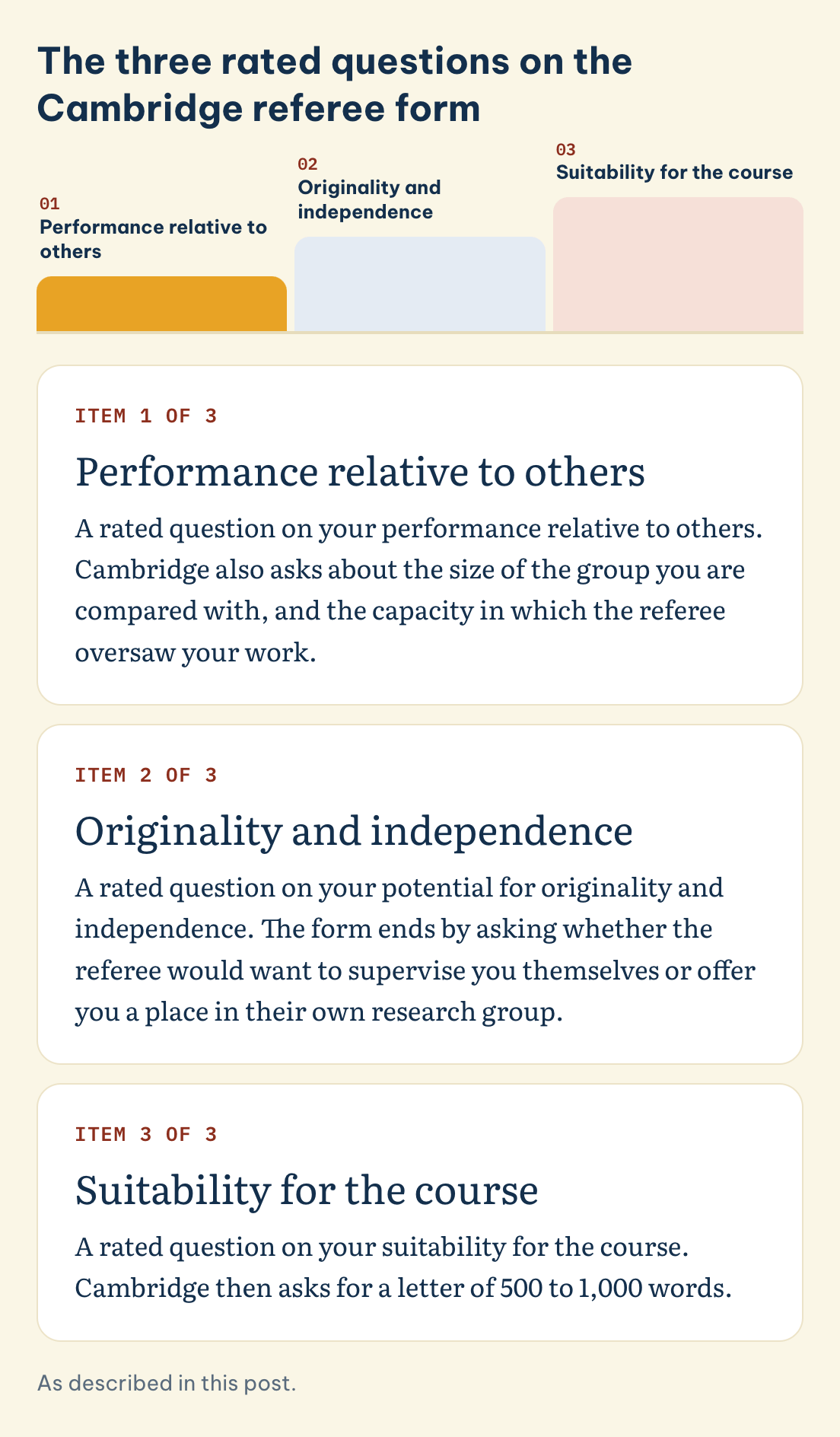
The Cambridge form goes further than a rating. When a referee rates your performance relative to others, the University of Cambridge also asks about the size of the group against which you are being compared, and asks the referee to describe the capacity in which they oversaw your work. The guidance states that a reference is most useful when the referee gives specific examples of projects or tasks you conducted and the results you achieved, and it closes by asking whether the referee would want to supervise you themselves or offer you a place in their own research group. Cambridge treats 500 to 1,000 words as the most effective length and warns that a very short reference may disadvantage the student.
Other universities ask for the same kind of evidence in different words. The University of Leeds asks referees to provide examples where possible, including marks and ranking where known and the quality of written work, notes that scholarship applicants normally have a similar level of academic achievement, and asks for the reference within 2 working weeks from an institutional or professional email account. The University of Waterloo asks academic referees to explain how they know you and to rank your skills across a series of attributes such as research potential and communication, and states that Hotmail, Gmail and Yahoo addresses are not encouraged and will be verified. Every one of these prompts asks for observation rather than opinion, and a referee who likes you but cannot recall a single task you completed has no way to answer them.
◆ Section 2 / 7 · Why letters come out thin
Why do letters come out thin when the referee likes you?
Direct answer: Thin letters usually reflect missing evidence, not missing goodwill. Heilman et al. (2015) analysed 19,046 recommendation forms for 7,035 graduate applicants and found that about 70% of evaluative sentences in their annotated training set were generic, while only 9% contained a specific example.
Evaluative sentences in the annotated training set of a study of 19,046 recommendation forms
The annotated training set, by how specific each sentence is.
Generic
70
% of evaluative sentences
Specific, no example
21
% of evaluative sentences
Specific, with an example
9
% of evaluative sentences
Save this figure
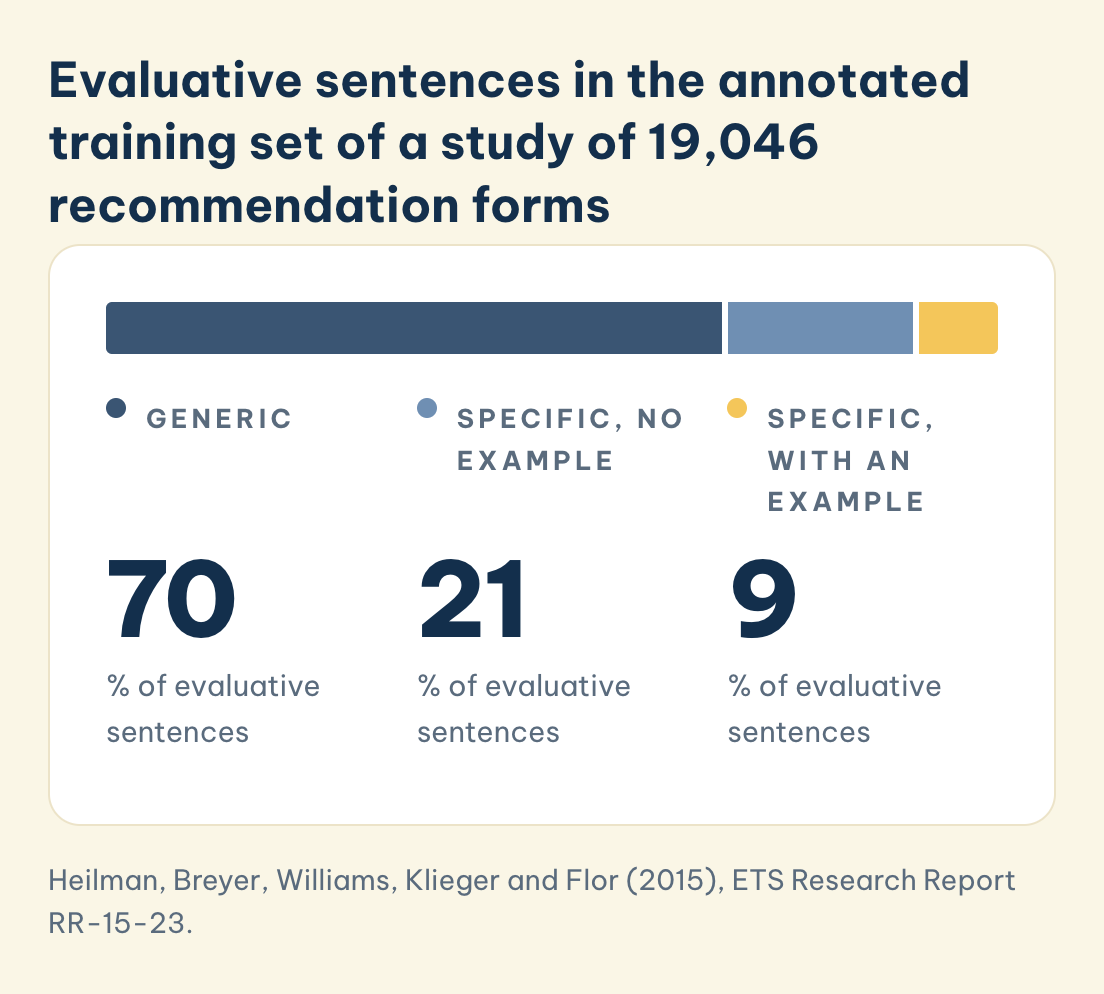
The Educational Testing Service team behind ETS Research Report RR-15-23 built the training set from 3,516 sentences in 1,020 text boxes, kept 1,883 sentences from 570 text boxes for development and 1,385 sentences from 461 text boxes for testing, and 70% of the evaluative sentences carried no specific information, 21% were specific without an example, and only 9% were specific with an example (Heilman et al., 2015). The same report observed that recommenders are reluctant to write negatively, so they either decline or use "lukewarm, vague, and generic language that avoids commitment" (Heilman et al., 2015, p. 1). The 19,046 forms covered 7,035 applicants and rated each one on six dimensions, namely knowledge and creativity, communication, teamwork, resilience, planning and organization, and ethics and integrity, on a scale running up to outstanding, top 5%, and truly exceptional, top 1% (Heilman et al., 2015). Even trained annotators found specificity hard to judge consistently, reaching a quadratic-weighted kappa of only 0.628 on the doubly annotated sample, which shows how easily a sentence that sounds concrete still says little about the applicant (Heilman et al., 2015). Praise was also close to universal, since about 98% of the evaluative sentences in the training set were positive, 1% neutral and 1% negative, so warmth on its own tells a committee almost nothing (Heilman et al., 2015). The annotated sentences were a small slice of the material, because the ETS team also held 122,627 unannotated sentences from 39,882 text boxes.
Generic text is therefore the default outcome, not a sign that a referee thinks poorly of you. Botham et al. (2021), three authors at Stanford University writing ten rules for letter writers in PLOS Computational Biology, tell referees to decline if they can only provide a weak, generic or unenthusiastic letter, and to ask themselves whether they have observed specific traits or accomplishments that match the opportunity (Botham et al., 2021). A lecturer who taught you in a large module may think well of you and still have nothing to write except your grade, because they never watched you work.
◆ Section 3 / 7 · What to give a referee
What should you give a referee instead of another copy of your CV?
Direct answer: Give an episode record, meaning three to five pieces of work the referee actually saw, each with the task, what you did, the result, and when it happened. Map each episode to a question the programme's form asks, and add marks or ranking where you know them, as Leeds explicitly invites.
An episode is useful only when the referee can recognise it. A line such as a strong research methods student gives them nothing to confirm. A line naming the module, the term, the dataset you cleaned, the decision you defended in the seminar and the mark the report received gives them a memory to check and a sentence they can write in their own words. Keep each episode to a short paragraph of 80 to 120 words, and put the work the referee supervised first, because the University of Cambridge asks explicitly for the capacity in which the referee oversaw your work.
Three further items help, and none of them is a draft letter. Include the name of the programme and a short summary of your proposed research, so the referee can speak to suitability for the course, which is the third rated question on the Cambridge form. Include anything that happened after the referee stopped seeing your work, such as the final mark on a thesis they supervised in its early stages. If there is a discrepancy in your record, such as an interim mark below your expected final result, say so plainly, because Cambridge asks referees to explain that kind of discrepancy, and referees are advised not to mention personal circumstances without the applicant's agreement (Botham et al., 2021).
◆ Section 4 / 7 · Who writes it
Can you draft the letter yourself if the referee asks you to?
Direct answer: No. A reference is valuable because it is an independent statement, and universities check that independence. Waterloo verifies every reference form for authenticity and reserves the right to revoke an offer and financial support where misrepresentation is found, while Cambridge receives references in confidence and does not disclose them to students.
The University of Waterloo adds that it may disclose evidence of misrepresentation to other Canadian universities, and the University of Cambridge states that references are exempt from the right of access provisions of UK GDPR. The useful line therefore runs between facts and judgement. You can hand over the facts, including dates, tasks, results, the cohort size of a module and the title of your proposal. The words, the comparison with other students and the level of enthusiasm must stay with the referee, because those are exactly the parts the form is paying them to supply. A referee short of time who asks you to write the letter is asking you to provide the part of the file that is supposed to come from someone else.
The line between facts and judgement is also where the scope of advisory help ends. MAAS works with applicants on the episode record and on checking it against the questions each programme's form asks. Our experts do not write, edit or submit reference letters, and they do not contact referees on your behalf.
◆ Section 5 / 7 · How much weight
How much weight does a letter carry against the rest of the file?
Direct answer: Less than applicants fear, and more than nothing. Zhao et al. (2023) built models to predict admissions decisions for two STEM graduate programmes and found that letters alone provided modest but useful signals, while the best model combining letters with other application data reached 89% accuracy.
The Fordham University study behind that finding used 717 applications to a Master's in Computer Science and a Master's in Data Science in the Computer and Information Sciences department, converting letter text into features with a commercial language tool and a manual rating process, and its best combined model reached 89% accuracy (Zhao et al., 2023). The more practical finding for applicants concerns inflation. Liu et al. (2007), in ETS Research Report RR-07-38, tested a standardized letter with seven scales on candidates from 2004 to 2006, collecting 414 professor ratings during selection and 51 mentor ratings after the internship programme ended in 2006, with 20 of the 51 interns rated twice, and found that professor ratings were systematically higher than mentor ratings, with the two cognitive scales, knowledge and analytical skills, predicting selection best (Liu et al., 2007). On that five-point form, 414 professors rated clear and critical thinking, at a mean of 4.05, while the two items with the fewest ratings, knowledge of program evaluation with 354 and qualitative research skills with 360, also received the two lowest means, 3.25 and 3.27 (Liu et al., 2007). That pattern is consistent with referees leaving out or marking down what they had less chance to observe, although the report does not test that explanation.
Read together, the findings suggest that general praise is the expected baseline, and that the information which separates candidates is a comparison with peers and a concrete account of analytical work. Botham et al. (2021) make the comparison point directly, advising referees to quantify by comparing an applicant with peers, for example as among the top 1% of students trained in the past 10 years (Botham et al., 2021). A referee can only make that kind of statement honestly when they remember the group, which is why including cohort size or the number of students supervised in your episode record helps. Do not ask a referee to state a percentile they cannot support, because a comparison the referee cannot defend weakens the whole letter.
◆ Section 6 / 7 · Which referee
Which referee should you choose when two people know you differently?
Direct answer: Choose the person who watched you do research-like work over the person with the more senior title. Cambridge asks each referee to state the role in which they knew you and for how long, and Waterloo does not accept references from classmates, colleagues or teaching assistants.
The University of Waterloo states that admission to a PhD programme generally requires 3 references and a master's programme 2, so most applicants need more than one strong witness. The University of Leeds adds two boundaries: the referee must not be related to you, and a professional reference must come from a manager or supervisor rather than a colleague, and Leeds notes that such references may become necessary when your study ended more than 6 years before you apply. A combination that often works is a thesis or project supervisor, a lecturer who marked substantial written work, and, where relevant, a manager who saw you handle research tasks at work.
Seniority helps only when it comes with observation. A department head who met you twice can confirm your enrolment but cannot answer a question about originality, while a lecturer who marked your dissertation chapter can. The University of Cambridge reflects this in its own guidance, noting that referees may consult colleagues such as a PhD candidate who taught you, even though applicants should not nominate PhD candidates as referees directly.
◆ Section 7 / 7 · Building the record
Building the record before you send the request
Start from the programme's reference form, not from your CV. Read each question the referee will face, write one or two episodes that answer it, and check that every episode names something the referee personally saw. Send the record with the programme details and your research summary, and leave the judgement and the wording to the referee. The scheduling side of requests, including when to ask, is covered in our guide to building a PhD application timeline backwards, and the difference between the letter you write and the letters written about you is set out in statement of purpose versus motivation letter.
If you want a second reader on whether your episode record actually answers the questions a specific programme asks, MAAS works with applicants as academic advisors: you submit your own file, and our experts challenge the evidence in it. You can see the full pathway in our PhD application guide, and the scope of the advisory work in PhD supervisor search and application strategy.
Frequently asked questions
How many referees does a PhD application need?
The number depends on the programme, but three is common. Waterloo states that PhD admission generally requires 3 references and master's admission 2, so plan for at least three people who have each seen a different part of your work.
Can I read the letter my referee writes?
Often not. Cambridge receives references in confidence and states that they will not be disclosed to the student or to third parties, so the only part you control is the quality of the evidence you give the referee beforehand.
Is a letter from my employer acceptable?
Sometimes, and usually as a professional reference rather than an academic one. Leeds accepts professional references from a manager or supervisor, not a colleague, and notes they may become necessary when your studies ended more than 6 years before the application.
Should I tell my referee what to write?
Tell them what happened, not what to say. Give dates, tasks, results and the form's questions, and leave the wording and the comparison to them, because Waterloo verifies references for authenticity and misrepresentation can cost an offer.
Does a long letter help?
Only up to a point. Cambridge considers 500 to 1,000 words most effective and states that longer references give no additional help, while a very short reference may disadvantage the student.
Related MAAS guides
References
Botham, C. M., Kong, J. H., & Steele, L. J. (2021). Ten simple rules for writing compelling recommendation letters. PLOS Computational Biology, 17(2), e1008656. https://doi.org/10.1371/journal.pcbi.1008656
Heilman, M., Breyer, F. J., Williams, F., Klieger, D., & Flor, M. (2015). Automated analysis of text in graduate school recommendations (Research Report No. RR-15-23). Educational Testing Service. https://files.eric.ed.gov/fulltext/EJ1109317.pdf
Liu, O. L., Minsky, J., Ling, G., & Kyllonen, P. (2007). The standardized letter of recommendation: Implications for selection (Research Report No. RR-07-38). Educational Testing Service. https://files.eric.ed.gov/fulltext/EJ1111595.pdf
Zhao, Y., Chen, X., Xue, H., & Weiss, G. M. (2023). A machine learning approach to graduate admissions and the role of letters of recommendation. PLOS ONE, 18(10), e0291107. https://doi.org/10.1371/journal.pone.0291107
Tools & resources
- University of Cambridge, guidance for academic referees: https://www.postgraduate.study.cam.ac.uk/apply/how/academic-referees
- University of Leeds, references for postgraduate research applications: https://www.leeds.ac.uk/research-applying/doc/references-postgraduate-research-applications
- University of Waterloo, graduate admission references: https://uwaterloo.ca/future-graduate-students/admissions/how-to-apply/application-documents-and-materials/references
A free 20-minute consultation with a MAAS adviser, to check your episode record against the questions on each programme's reference form. The referee writes the letter, and you remain the applicant.
Book a free consultation ▸