

Same step, other fields 01
1 of 12
Linguistics statements discussed their own research in the background move.
◆ PhD Admissions
Category: admissions
Last updated: 2026-09-03
An applicant spends a week hunting for the difference between the two labels, finds a dozen articles that each define them differently, and writes nothing. The search fails because it assumes the two names mark two document types with settled rules. In the genre research since Samraj and Monk (2008) they behave instead as regional labels for one genre, and the specification that binds you is published somewhere else.
Direct answer: Statement of purpose, personal statement and motivation letter are largely interchangeable names for one admissions genre, and the name says little about what to write. What changes the content is the prompt printed beside the upload box, the discipline you apply into, and, at doctoral level, how much argument your research proposal already carries.
So the first move is not to look up a definition. It is to find the programme's own instruction, because that instruction is the only specification that is binding, and it varies between departments inside a single university.
◆ Section 1 / 7 · What is the basic structure
Direct answer: Genre research on 35 successful statements finds a five-move shape: introduction, background, reasons for applying, extra-curricular activities, conclusion. Only two of the five appear in every text. Background establishes suitability; reasons for applying establishes why the degree is worth pursuing (Samraj & Monk, 2008).
Electrical Engineering statements
8 of 9
discussed their own research in the background move (Samraj & Monk, 2008)
Linguistics statements discussed their own research in the background move.
Business Administration statements did so.
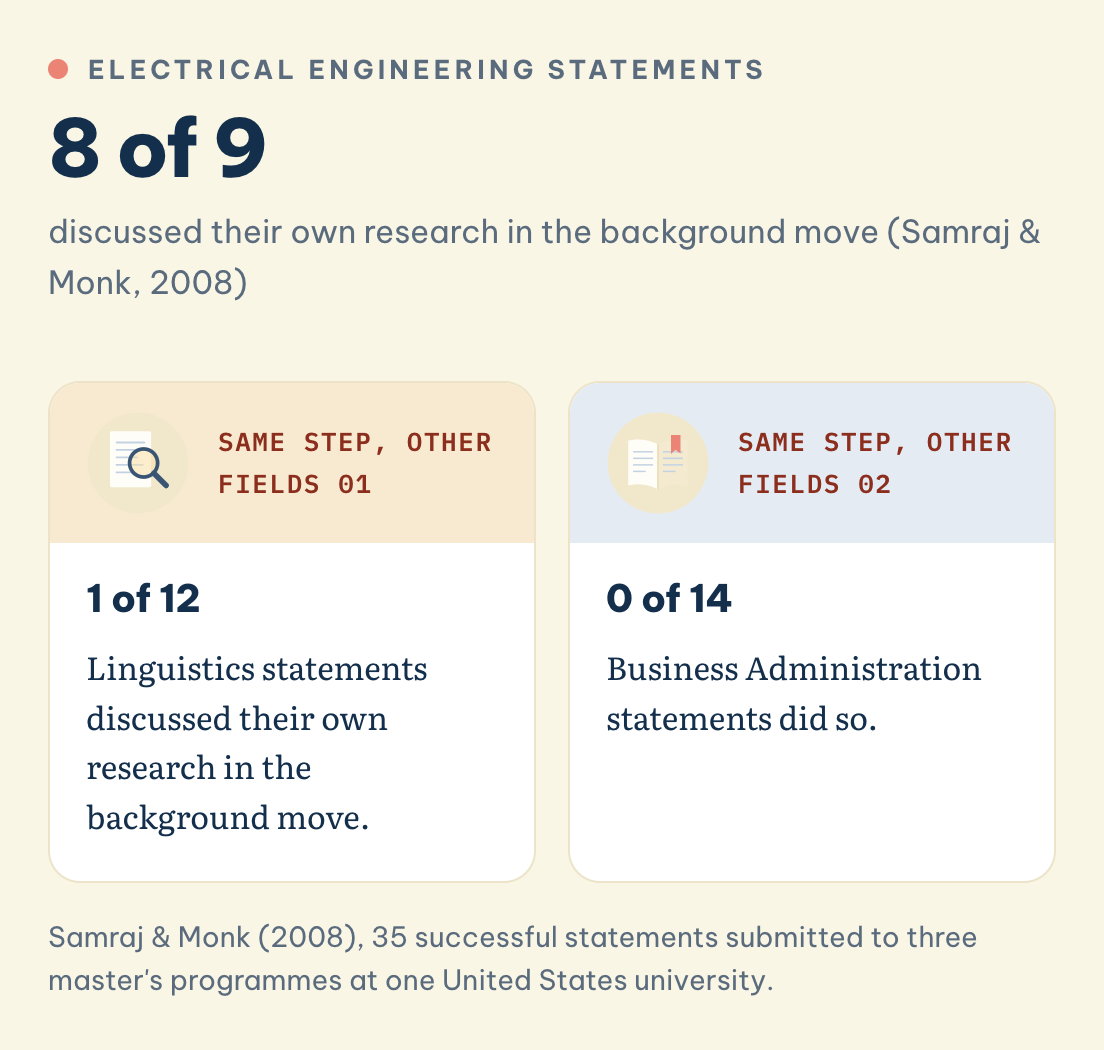
Samraj and Monk (2008) analysed 35 successful statements submitted to three master's programmes at one United States university, 12 in Linguistics, 9 in Electrical Engineering and 14 in Business Administration, alongside interviews with a specialist informant in each department. Across those 35 texts, Samraj and Monk (2008) found the same five moves in all three disciplines, with three of the five optional, and only background and reasons for applying present in every statement. The disciplines diverged not in the moves but in the steps used to realise them, which is why advice copied from another field reads as slightly off rather than plainly wrong.
One row of their results shows how far apart the steps can sit. Within the background move, the step in which an applicant discusses their own research appeared in 8 of the 9 Electrical Engineering statements, in 1 of the 12 Linguistics statements, and in 0 of the 14 Business Administration statements. Work experience ran the other way, appearing in 10 of 12 Linguistics statements and 11 of 14 Business Administration statements. A single template applied across those three files would misallocate most of its space.
The reasons-for-applying move splits the same way. The step naming a gap in one's own background appeared in 10 of 14 Business Administration statements but only 2 of 9 Electrical Engineering ones, while the step giving disciplinary and research reasons reversed that, at 7 of 9 in Electrical Engineering against 2 of 14 in Business Administration (Samraj & Monk, 2008).
Two rhetorical goals sit underneath that structure. In the background move the applicant argues why the programme should want them; in the reasons move they argue why the programme is worth wanting. A draft that does only the first reads as a curriculum vitae in prose; a draft that does only the second reads as enthusiasm without evidence.
◆ Section 2 / 7 · What does an effective
Direct answer: One large study of 2,701 master's applicants measured this. Content specific to the programme performed well, and generic praise of the city and the university performed badly, at least as a predictor of the grades those students later earned on the course (de Boer et al., 2024).
De Boer et al. (2024) applied Latent Dirichlet Allocation to the application essays of 2,701 master's students across the 2014 to 2017 intakes at a Dutch faculty, of whom 2,051 graduated and 650 dropped out. They distinguished seven moves, five of which had a significant relationship with grades in the master's programme. The moves labelled "master specific" and "interest to learn" had a positive effect (de Boer et al., 2024); the moves labelled "research skills", "societal impact" and "city and university" had a negative one.
That result measures the association between essay content and later academic performance, not between essay content and an offer, and it comes from one faculty in one country. Read at that width it still says something useful: paragraphs praising the university are paragraphs any applicant could have written, and they occupy space that programme-specific reasoning would otherwise fill. Our guide to reading a PhD admissions page covers where the raw material for that specific reasoning is found.
Worth noting from the same study: for those essays "no specific requirements (including word count) were formulated" (de Boer et al., 2024). Absence of a prompt is itself information, and it is the condition under which applicants most often default to the generic.
◆ Section 3 / 7 · Which universities ask
Direct answer: The motivation letter label is common in continental Europe, while statement of purpose and personal statement dominate in the United Kingdom and North America. Two universities checked on 3 September 2026, the University of Manchester and Utrecht University, both treat the labels as one slot and push the specification down to the department.
The University of Manchester, in the United Kingdom, lists the supporting documents for postgraduate research in a single sequence, and the wording is unusually candid about where authority sits: "Prepare a personal statement/statement of purpose, if required. This will be specified on the relevant academic School website"; verified on 3 September 2026. Two names, one slash, one slot, and the content requirement delegated to a School page the central admissions page does not reproduce.
Utrecht University, in the Netherlands, handles it the same way from the other side of the naming convention, telling applicants that the specific application procedure, admission requirements and required documents are found on the page of the individual master's programme under Admission and Application; verified on 3 September 2026. Neither institution is being unhelpful. Both are saying the central page is not the specification.
◆ Section 4 / 7 · When should you write
Direct answer: You do not choose between them. You write whichever the programme names, in whatever length it states, answering whatever question it prints. Where no prompt is given, the safer default is the research-forward statement, because an unprompted document is read against disciplinary expectations rather than against a rubric.
The variation in prompts is wider than most applicants expect, and Samraj and Monk (2008) documented it inside one university. Their Electrical Engineering applicants received nothing beyond the phrase "Personal statement of graduate program goals". Their Business Administration applicants were told this: "This is your opportunity to describe your special characteristics or skills and to articulate how your goals are compatible with the program to which you are applying. This should be 1-2 pages in length" (Samraj & Monk, 2008). Their Linguistics applicants were asked for a statement of 250 to 500 words demonstrating an understanding of the programme and indicating an area of research within the department's scope of expertise. Same institution, same admissions cycle, two instructions that call for genuinely different documents. The Linguistics prompt requires evidence of reading the department; the Electrical Engineering prompt requires the applicant to infer that requirement unaided.
Their survey of the advice available at the time is worth knowing about, because the same pattern holds today. Samraj and Monk (2008) examined 10 websites offering guidance on writing the statement and sorted them into three groups: commercial sites selling help and publishing samples whose authenticity cannot be verified, general guides equivalent to commercial handbooks, and pages produced by university writing or careers centres. Only three sites in that survey were written by academics for a specific discipline, two of them in computer science; the most detailed instruction they found anywhere was a seven-paragraph format published by one psychology professor. They also record that guidance for professional master's programmes such as the MBA is far easier to find than guidance for other master's programmes, and that discipline-specific advice, where it exists, tends to suit doctoral applications even when it does not say so (Samraj & Monk, 2008).
Samraj and Monk describe the genre as "semi-occluded", their term for a text type whose successful examples are rarely available to the people who must write it, and whose evaluative standards are held privately by the departments that apply them (Samraj & Monk, 2008). That is the honest description of the situation, and it explains why the search for a universal definition returns nothing usable.
For a fuller comparison of the two documents, see research statement vs research proposal. At doctoral level a further division applies. Where a research proposal is required, the proposal carries the research argument, and the statement carries what the proposal cannot: the trajectory that brought you to this question, and the reasons for this department rather than another. That division is visible in the data: the research step filled 8 of 9 Electrical Engineering statements, where no separate proposal was in play, and Samraj and Monk (2008) note the genre reaches doctoral applicants with the least specific guidance of all. Duplicating the proposal inside the statement wastes the one document in the file you fully control.
◆ Section 5 / 7 · What is most often confused
Direct answer: The most frequent error is not choosing the wrong genre. It is filling the document with material already carried by the transcript, the curriculum vitae or the reference letters, and omitting what appears nowhere else in the file. Admissions readers name that missing material as what they value (Hinkle et al., 2020).
In a survey of pulmonary and critical care fellowship programme directors in the United States, Hinkle et al. (2020) received 114 responses from 344 possible respondents, a 33 percent response rate. More than half of the respondents regarded the personal statement as at least moderately important when deciding whether to offer an interview, and 40 percent regarded it as at least moderately important when deciding rank order. Among the four consistent themes that Hinkle et al. (2020) identified in what those directors valued was the "provision of information not found elsewhere".
That study describes clinical fellowship selection rather than doctoral admissions, and the transfer is limited. What generalises is the test it implies, which works whatever the document is called: for each paragraph, ask which other document in your file already says this. If another document says it, the paragraph is spending the one space in the application that no other document can occupy.
Three consequences follow. Restating grades in prose adds nothing the transcript has not established. Listing roles adds nothing the curriculum vitae has not listed. Asserting that you are hard-working and passionate adds nothing a reader can check, and character claims carry weight in the reference letters, where someone else is making them.
◆ Section 6 / 7 · What else does a scholarship
Direct answer: The essay is one item in a package. Chevening requires 2 referees, 3 UK course choices and 2 years of work experience. Australia Awards in Vietnam asks for 1 referee report for coursework masters and 2 for research. Fulbright Vietnam requires 3 letters of reference. Read the programme's own checklist first.
Applicants who spend every available hour on the statement often discover the avoidable failures sit elsewhere. Referee counts, English test validity windows, file size limits and offer deadlines are each published, each checkable, and each capable of ending an application on a technicality no essay can rescue. The figures below come from the programmes Vietnamese applicants most often enter, and every one of them republishes its dates annually, so treat the deadlines as illustrations of shape rather than as this year's calendar.
Chevening asks for the widest package. Applicants must "apply to three different and eligible UK university courses" and "have at least two years' work experience, acquired after completing your undergraduate degree, equivalent to 2,800 hours" (Chevening, n.d.-b). References are capped rather than open: you "must provide the names of two referees in your application", and a referee "should be someone who knows you in a professional or personal capacity, but not a friend or relative" (Chevening, n.d.-d). The form asks for "the names, job details, and contact details of two referees" rather than the letters themselves at that stage (Chevening, n.d.-c). Timing is the trap, because the letters themselves are not due with the form; you "must upload your reference letters to the online application system no later than seven working days before your interview" (Chevening, n.d.-d). A reference written in Vietnamese has to be uploaded "with a notarised English translation in one file". Two further rules are worth reading before anyone offers to help you: Chevening states plainly that "the use of AI software to generate answers in Chevening applications is strictly prohibited", and that applying "is free: You do not need to pay anyone to apply, and Chevening does not endorse or work with third parties who charge for application support or advice" (Chevening, n.d.-a).
Australia Awards in Vietnam runs the tightest document rules of the group. The referee requirement is exact rather than a minimum: "01 academic or professional referee report for all Masters by coursework applicants" and "02 academic or professional referee reports for Masters by research", with the warning that applicants "must submit no more than the required number of referee reports" because extras "may not be considered" (Australia Awards in Vietnam, n.d.-c). English test reports must carry a "valid test date on or after 1 January 2025" for the current round, uploads have a "recommended maximum size" of 2MB, and eligibility requires "at least 24 months' relevant full-time work experience in Vietnam" as at the stated date (Australia Awards in Vietnam, n.d.-b). One rule catches career changers in particular: you must "not be applying for a scholarship for a course of study at an academic level lesser than you have already achieved". The long-answer fields are measured in characters, not words, with "a limit of 500 to 2000 characters" that "includes blank spaces and all punctuation" (Australia Awards in Vietnam, n.d.-a).
Fulbright Vietnam publishes its package as a single sentence worth memorising. A complete application "includes an application form, three letters of reference, diplomas, and transcripts (including notarized English translations), TOEFL/IELTS/Duolingo/TOEFL Essentials score reports, and a curriculum vitae" (U.S. Mission Vietnam, 2026). Note that 3 letters is more than Chevening's 2 and more than the 1 Australia Awards requires for coursework masters, so a referee list assembled for one application does not transfer to another without checking.
European and New Zealand routes shift the emphasis again. For Erasmus Mundus Joint Masters, applicants need "a bachelor's degree (first degree), or be in your last year of bachelor studies", the programmes run "1 to 2 academic years (60, 90 or 120 ECTS credits)" and "involve at least 3 institutions from at least 3 different countries", and "in most cases, you should submit your application between October and January for courses starting the following academic year" (European Commission, n.d.-b). The programme guide adds a nationality quota that shapes your odds: no more than 10% of the scholarships awarded during a project should go to candidates of the same nationality (European Commission, n.d.-a). Manaaki New Zealand Scholarships take a different measure of readiness, requiring either "one year of full-time work experience (i.e. 30 hours or more per week)" or "two years of part-time work experience", and noting that English scores are requested of shortlisted candidates rather than at first submission (Education New Zealand, n.d.).
The transferable rule is simple enough to apply in an afternoon. Open the programme's own checklist page, list every document with its own deadline, and mark the 2 or 3 items that depend on somebody else, which are usually the referee letters, the notarised translation and the unconditional university offer. Those are the items that fail an application, and none of them can be fixed the night before, unlike the sentences in the statement itself.
◆ Section 7 / 7 · How MAAS works on this
Your expert drafts the statement and the proposal from your own account of your research, and you review, edit and approve both. The expert argues against the draft point by point, checks each claim against what your file can support, and works with you on the division of labour between the statement and the research proposal. You submit the application yourself, and MAAS cannot promise an outcome, because admission and funding decisions rest with the admissions panel and the supervisor. The full boundary is set out on the PhD Application Strategy and Execution service page, and the wider sequence this document sits inside is described in our PhD application guide. For coursework master's and undergraduate applications, the equivalent coaching sits under admissions consulting.
Matching to a mentor works on two tracks. Where the network already holds someone in your field, matching is usually complete within 48 hours. Where it does not, MAAS opens a dedicated recruitment round for your case, which normally takes around two weeks.
If you are weighing whether to read a sample statement before you write, see Should you use a PhD personal statement example?.
In most graduate admissions contexts the two names refer to the same document, and universities print them together in one line; the University of Manchester writes "personal statement/statement of purpose". Where an institution asks for both separately, it defines what it wants in each, and that definition overrides any general advice.
Whatever length the programme states. Where it states nothing, the lengths documented in genre research run from 250 to 500 words up to 1-2 pages, varying by discipline (Samraj & Monk, 2008).
The evidence argues against reusing it unedited (de Boer et al., 2024). The content that performs well is programme specific, and the content that is portable between applications is precisely the generic material that adds least.
Follow the programme's instruction. Where the application asks for a letter and gives no format, an addressed opening and a signature line are conventional in European applications; neither is expected in a United States statement of purpose, which is normally uploaded as plain prose.
Yes, and the answer is usually more precise than any published guide. A short enquiry to the postgraduate admissions contact asking what the statement should cover is a routine question that departments answer.
Australia Awards in Vietnam. (n.d.-a). Apply online. Retrieved September 4, 2026, from https://australiaawardsvietnam.org/applicants/apply-online/
Australia Awards in Vietnam. (n.d.-b). Eligibility criteria. Retrieved September 4, 2026, from https://australiaawardsvietnam.org/applicants/eligibility-criteria/
Australia Awards in Vietnam. (n.d.-c). Supporting documents. Retrieved September 4, 2026, from https://australiaawardsvietnam.org/applicants/supporting-documents/
Chevening. (n.d.-a). Chevening application criteria. Retrieved September 4, 2026, from https://www.chevening.org/resource-hub/guidance/application-criteria/
Chevening. (n.d.-b). Chevening eligibility criteria. Retrieved September 4, 2026, from https://www.chevening.org/scholarships/who-can-apply/eligibility/
Chevening. (n.d.-c). How to apply to Chevening. Retrieved September 4, 2026, from https://www.chevening.org/resource-hub/guidance/online-application-system/
Chevening. (n.d.-d). References. Retrieved September 4, 2026, from https://www.chevening.org/resource-hub/guidance/references/
De Boer, T., van Rijnsoever, F. J., & de Bresser, H. (2024). Dear admission committee: Which moves in application essays predict student master grades? PLOS ONE, 19(6), Article e0304394. https://doi.org/10.1371/journal.pone.0304394
Education New Zealand. (n.d.). Check eligibility criteria. Manaaki New Zealand Scholarships. Retrieved September 4, 2026, from https://www.nzscholarships.govt.nz/check-eligibility-criteria/
European Commission. (n.d.-a). Erasmus Mundus action. Erasmus+ Programme Guide. Retrieved September 4, 2026, from https://erasmus-plus.ec.europa.eu/programme-guide/part-b/key-action-2/erasmus-mundus-action
European Commission. (n.d.-b). Erasmus Mundus Joint Masters (students). Erasmus+. Retrieved September 4, 2026, from https://erasmus-plus.ec.europa.eu/opportunities/individuals/students/erasmus-mundus-joint-masters
Hinkle, L., Carlos, W. G., Burkart, K. M., McCallister, J. W., & Bosslet, G. T. (2020). What do program directors value in personal statements? A qualitative analysis. ATS Scholar, 1(1), 44-54. https://pmc.ncbi.nlm.nih.gov/articles/PMC8043283/
Samraj, B., & Monk, L. (2008). The statement of purpose in graduate program applications: Genre structure and disciplinary variation. English for Specific Purposes, 27(2), 193-211. https://doi.org/10.1016/j.esp.2007.07.001
U.S. Mission Vietnam. (2026, January 14). Fulbright Vietnamese Student Program academic year 2027-2028. U.S. Embassy & Consulate in Vietnam. https://vn.usembassy.gov/fulbright-vietnamese-student-program-academic-year-2027-2028/
A free 20-minute consultation is a conversation about your situation.
Book a free consultation ▸