
◆ PhD Admissions
PhD in Germany: find a supervisor or join a structured programme?
Category: admissions
Last updated: 2026-09-17

Ask an AI assistant how to do a PhD in Germany and it will describe two routes: find a professor who agrees to supervise you, or apply to a structured programme. Bing Copilot Search and Perplexity both give that answer, and both are right about the routes. Perplexity then adds that the structured route also needs an invitation letter from a supervisor, which is not what the German Academic Exchange Service asks for. The route you choose does not change who finally accepts you. It changes which document the scholarship application must contain on the day you submit it.
Direct answer: Most candidates take the individual route, where one professor agrees to supervise you: 168,141 of 216,243 doctoral candidates in 2025 were outside structured programmes (Statistisches Bundesamt, 2026a). For a DAAD scholarship, that route needs a supervision letter at application, while the structured route needs proof of contact with the coordinator (Deutscher Akademischer Austauschdienst, 2026).
◆ Question 1 / 6 · The two routes
What are the two routes to a doctorate in Germany?
Direct answer: The individual doctorate rests on an agreement between you and one supervisor. The structured doctorate places you in a programme, graduate school or research training group that offers a common qualification programme, shares supervision across several professors and admits through a published call (Statistisches Bundesamt, 2026a).
Lachmann et al. (2020) describe the individual model as the "master-apprentice-model", in which an individual agreement between candidate and supervisor governs the research, and they note that in the structured form much of that responsibility moves to the academic organisation. The Federal Statistical Office uses a tighter definition for its counts. In the 2025 report, Statistisches Bundesamt (2026a) counts a programme as structured only if it meets three conditions at the same time: a structured qualification programme for every participant, shared responsibility for supervision among the supervisors involved, and a transparent, competitive admission procedure with a published call. Germany introduced the first structured formats through the Volkswagen Foundation in the 1980s and the German Research Foundation in the 1990s, yet Lachmann et al. (2020) conclude that after three decades the individual model is still dominant.
◆ Question 2 / 6 · The route most take
Which route do most doctoral candidates in Germany take?
Direct answer: The individual route, by a wide margin. In the 2025 reporting year, 48,099 of the 216,243 registered doctoral candidates, about 22 per cent, were in a structured programme, and 168,141, about 78 per cent, were not (Statistisches Bundesamt, 2026a, Table 21352-12).
Vietnamese citizens
425
doctoral candidates in Germany in 2025, 99 in a structured programme and 326 outside one
Doctoral candidates in Germany by route, 2025
Each bar shows a route's share, in percent, of the 216,243 registered doctoral candidates.
Save this figure
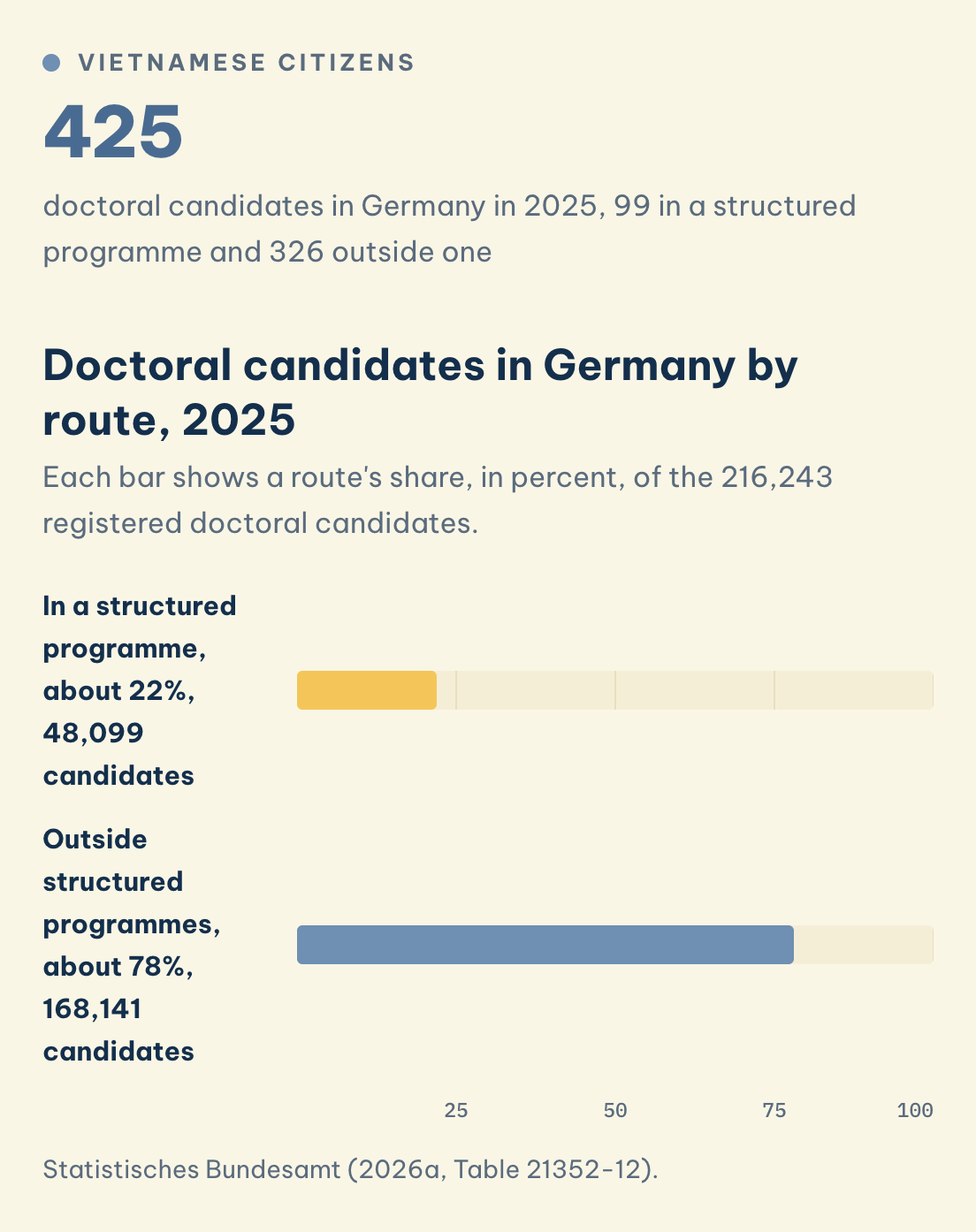
Table 21352-12 of the report counts 48,099 candidates inside a structured programme and 168,141 outside one, which works out at about 22 and 78 per cent of the total. The same table breaks the figure down by nationality. Of the 425 doctoral candidates holding Vietnamese citizenship in 2025, 99 were in a structured programme and 326 were not, a split of roughly 23 to 77 that almost mirrors the national one (Statistisches Bundesamt, 2026a). The Federal Statistical Office reported 35,800 first-time doctoral candidates that year, 9,800 of them, or 27 per cent, with a foreign nationality (Statistisches Bundesamt, 2026b). Put together, these figures mean that a Vietnamese applicant who only searches for advertised programmes is looking at the door through which fewer than one in four doctoral candidates are enrolled.
The share does vary by field. Lachmann et al. (2020) cite federal reports showing structured enrolment rising from 8 per cent to 23 per cent between the 2013 and 2017 editions, with about 33 per cent in the natural sciences and only 14 per cent in medicine.
◆ Question 3 / 6 · Who accepts you
Who actually accepts you as a doctoral candidate?
Direct answer: The institution, not the professor alone. The Federal Statistical Office counts you as a doctoral candidate only once a university entitled to award doctorates has confirmed your acceptance in writing, and that date counts as the start of your doctorate (Statistisches Bundesamt, 2026c).
A professor's agreement therefore opens the individual route but does not complete it. The written acceptance comes from the university under its own doctoral regulations, which is why the statistical office reports every candidate through the university where the degree is sought, even when the supervision is shared with other institutions (Statistisches Bundesamt, 2026c). On the structured route the programme's selection round comes first, but the university's acceptance still follows it. Epstein et al. (2023), reporting on 1,796 graduates in medicine and the life sciences, found that formalised recruitment occurs more often in structured programmes "although informal admission processes apparently still exist in practice", so a published call does not guarantee that a professor's early interest counts for nothing.
The two routes also differ less in daily practice than their labels suggest. Summarising the E-Prom projects, the authors conclude that "the disparities between these doctoral approaches are less pronounced than anticipated" (Epstein et al., 2023, p. 1). Epstein et al. (2023) report written supervision agreements for almost 64 per cent of structured candidates against 53 per cent of individual ones, and note that only 30 per cent of those agreements include concrete milestones and a work plan. Meuleners et al. (2023), who analysed 82 life science doctoral programmes, found supervision agreements and regular meetings rarely built into programme rules, and supervisors still heavily involved in examining the theses they had supervised.
◆ Question 4 / 6 · DAAD documents by route
What does the DAAD doctoral scholarship ask for on each route?
Direct answer: Both routes need a self-written proposal plus a description of previous research, 10 pages in total, a short CV, a motivation letter, transcripts and one recommendation. The individual route adds a supervision letter and an agreed schedule, and the structured route adds a module plan and proof of contact with the coordinator (Deutscher Akademischer Austauschdienst, 2026).
The call caps the CV at 3 pages and the motivation letter at 1 to 2 pages. The difference between the routes is one of timing. On the individual route, the DAAD scholarship database asks for a "letter confirming supervision by the doctoral supervisor" as part of the application, so the professor's agreement must exist before you submit. On the structured route, the letter of admission to the programme "may be submitted at a later date if it is not available at the time of application", provided you upload a module plan and evidence of existing contact with the programme coordinator (Deutscher Akademischer Austauschdienst, 2026). The call also lists a declaration from the scientific supervisor in Germany on safety-relevant and ethical aspects of the project. The proposal requirement is the same on both routes, and the DAAD defines it as "an extensive and detailed description of the research project which has been discussed with the academic adviser". A proposal written without any contact in Germany does not meet that definition.
The scholarship itself pays 1,400 euros a month plus insurance contributions and an annual research allowance of 460 euros, for up to four years (Deutscher Akademischer Austauschdienst, 2026). Grants are first awarded for up to three years, with a yearly review of progress and a separate application for a possible fourth year. Eligibility rules cut in two further places: as a rule your latest degree should be no more than six years old at the deadline, and a doctorate already under way should have started no more than three years before you apply. The independent selection committee weighs qualification, the quality of the research project and the applicant's potential, and under project quality it explicitly scores the "choice of host institution and first contacts".
◆ Question 5 / 6 · The DAAD deadline
When is the DAAD deadline for applicants in Vietnam?
Direct answer: For funding that starts in October 2027, the Doctoral Programmes in Germany deadline for applicants in Vietnam is 21 October 2026, with selection around February 2027 (DAAD Vietnam, n.d.). Applications through the DAAD portal are possible from 1 June until that deadline.
Working backwards from 21 October changes the order of tasks, and a decision in February 2027 still leaves several months to complete university registration before an October 2027 start. On the individual route the supervision letter and the agreed schedule must be in hand before that date, which means the first contact with a professor usually needs to happen months earlier, while the structured route lets you submit before the programme has decided on you. The DAAD Vietnam listing also shows a separate Research Grants in Germany programme for candidates already enrolled in a doctorate elsewhere, funded for 2 to 12 months, with a deadline of 7 October (DAAD Vietnam, n.d.). That shorter grant is a different product and should not be confused with full doctoral funding.
◆ Question 6 / 6 · Combining DAAD with funding
Can a DAAD scholarship be combined with other funding?
Direct answer: Not with funding from another German source. The DAAD states that anyone already funded by the DAAD, another German funding organisation or another state agency in Germany cannot receive a DAAD scholarship at the same time, and that a full DAAD scholarship is not compatible with an Erasmus scholarship (Deutscher Akademischer Austauschdienst, n.d.).
Three further conditions from the same page shape the choice of route. DAAD scholarships only fund full-time study with compulsory attendance, so part-time or distance doctorates are excluded; the holder must live in Germany for the whole funding period; and an applicant who has already been resident in Germany for more than 15 months at the deadline cannot be considered (Deutscher Akademischer Austauschdienst, n.d.). On language, the DAAD notes that host universities often require level C1 in the language of instruction, and that its own preparatory German courses of up to six months cannot bring a beginner to that level. If a German university offers you a funded post or another German scholarship during the process, check with the DAAD before accepting, because the rule is written about funding from any German source.
If you want a second reader while you decide which route fits your project and prepare the proposal that DAAD expects you to have discussed in Germany, MAAS works with applicants as academic advisors. You choose the professors or programmes, sit any interviews and make every decision. Our experts draft the proposal and the motivation letter from your own account of your research and challenge the fit, the timeline and the evidence behind each choice, while you review, edit, approve and submit them yourself. No one can promise a DAAD award or a doctoral place, since those decisions belong to the DAAD selection committee and the German university. You can see the full pathway in our PhD application guide, and the scope of the advisory work in PhD supervisor search and application strategy. Systems differ on this point, and the contrast is worth reading before you assume a rule is universal: Canada's national doctoral award is closed to international applicants until they are registered, so the money that opens the door there is the university's guaranteed minimum funding package rather than a national one.
Frequently asked questions
Do I need a German professor's agreement before applying for the DAAD doctoral scholarship?
On the individual route, yes, because the application must include a letter confirming supervision. On the structured route you need proof of contact with the programme coordinator, and the admission letter can follow later.
Is a structured PhD in Germany better than an individual one?
The evidence is mixed. Epstein et al. (2023) found some benefits for structured programmes but describe the differences as "less pronounced than anticipated", partly because programme rules and actual practice often diverge.
How much does the DAAD doctoral scholarship pay?
The current call lists 1,400 euros a month, an annual research allowance of 460 euros and insurance contributions, with rent and family allowances available on application after funding starts.
Can I apply if I finished my master's degree seven years ago?
As a rule the latest degree should be no more than six years old at the deadline. The DAAD lets applicants explain delays caused by childcare, care of relatives, illness or disability, with supporting documents.
Does the DAAD pay for German language courses?
It pays for an online course after the award letter, may fund a preparatory course of 2, 4 or 6 months, and reimburses one TestDaF or DSH test fee.
Related MAAS guides
- PhD application: the full pathway
- Is there an Erasmus PhD scholarship, and how are PhDs in Europe paid?
- Who screens government PhD scholarships first?
- Who decides PhD studentship funding?
- Which money actually gets you into a PhD in Canada?
- Do PhD scholarship deadlines fall before programme deadlines?
References
DAAD Vietnam. (n.d.). Scholarship database. Retrieved September 17, 2026, from https://www.daad-vietnam.org/vi/hoc-bong/scholarship-database/
Deutscher Akademischer Austauschdienst. (n.d.). Important information for scholarship applicants. Retrieved September 17, 2026, from https://www.daad.de/en/study-and-research-in-germany/scholarships/important-information-for-scholarship-applicants/
Deutscher Akademischer Austauschdienst. (2026). Doctoral programmes in Germany [Scholarship announcement]. https://www2.daad.de/deutschland/stipendium/datenbank/en/21148-scholarship-database/?detail=57135739
Epstein, N., Eberle, J., Meuleners, J., Lachmann, D., Heuser, S., Herzig, S., Neuhaus, B., & Fischer, M. R. (2023). The role of research competence as an influencing factor for the careers of young academics: Findings and implications from studies on doctorates in medicine and life sciences in Germany. GMS Journal for Medical Education, 40(6), Doc70. https://doi.org/10.3205/zma001652
Lachmann, D., Martius, T., Eberle, J., Landmann, M., von Kotzebue, L., Neuhaus, B., & Herzig, S. (2020). Regulations and practices of structured doctoral education in the life sciences in Germany. PLOS ONE, 15(7), e0233415. https://doi.org/10.1371/journal.pone.0233415
Meuleners, J. S., Boone, W. J., Fischer, M. R., Neuhaus, B. J., & Eberle, J. (2023). Evaluation of structured doctoral training programs in German life sciences: How much do such programs address hurdles faced by doctoral candidates? Frontiers in Education, 8, 930283. https://doi.org/10.3389/feduc.2023.930283
Statistisches Bundesamt. (2026a). Statistik der Promovierenden 2025 [Statistical report]. https://www.destatis.de/DE/Themen/Gesellschaft-Umwelt/Bildung-Forschung-Kultur/Hochschulen/Publikationen/Downloads-Hochschulen/statistischer-bericht-promovierende-5213501257005.html
Statistisches Bundesamt. (2026b). 1,8 % mehr Promovierende im Jahr 2025 [Press release No. 307]. https://www.destatis.de/DE/Presse/Pressemitteilungen/2026/08/PD26_307_213.html
Statistisches Bundesamt. (2026c). Qualitätsbericht: Promovierende an Hochschulen. https://www.destatis.de/DE/Methoden/Qualitaet/Qualitaetsberichte/Bildung/promovierende.pdf
Tools & resources
A free 20-minute consultation is a conversation about your situation and the doctoral route that fits your project.
Book a free consultation ▸