

Other terms 01
EUR 710
mobility allowance per person-month.
◆ PhD Admissions
Category: admissions
Last updated: 2026-09-14
Search for an Erasmus PhD scholarship and the name leads you to a scheme that stopped selecting doctoral programmes more than a decade ago. In the 2009-2013 programme period Erasmus Mundus selected 43 joint doctorate projects (European Commission, 2024, p. 26), and in the following period doctoral-level funding moved to the Marie Skłodowska-Curie Actions (European Commission, 2024, p. 27). The money for a doctorate in Europe still exists, but EU-funded positions such as MSCA Doctoral Networks are recruited as jobs with a contract, which changes both what you search for and what can rule you out.
Direct answer: No full-PhD scholarship carries the Erasmus name today. Erasmus Mundus funds joint master's programmes, and Erasmus+ only pays doctoral candidates for exchanges of up to 12 months. The EU funds full doctorates through programmes such as MSCA Doctoral Networks, which recruit candidates under employment contracts, so you apply to advertised positions rather than to a scholarship.
◆ Question 1 / 6 · Erasmus Mundus today
Direct answer: No. Erasmus Mundus Joint Doctorates belonged to the 2009-2013 programme, when 43 doctorate projects were selected. In the 2014-2020 period the joint doctorates moved outside Erasmus Mundus, and the current Erasmus+ catalogue offers Erasmus Mundus Joint Masters lasting 1 to 2 academic years that require a bachelor's degree.
The European Commission's 20-year review of Erasmus Mundus sets out the history in two tables. In the 2009-2013 programme period, Action 1 selected 140 master's courses and 43 joint doctorates, and the doctorates accounted for 246 institutional instances of participation within an overall budget of about EUR 1.6 billion (European Commission, 2024, p. 26). The same report describes the next period plainly: in 2014-2020, "the move of Joint Doctorates and Action 3 projects outside the programme" left a budget that the report's text puts at EUR 748 million, which was fully targeted on master's programmes and funded 251 programme iterations (European Commission, 2024, p. 29).
The current Erasmus+ page describes Erasmus Mundus Joint Masters run by at least 3 institutions from at least 3 countries, lasting 1 to 2 academic years or 60, 90 or 120 ECTS credits, with applications usually submitted between October and January and a bachelor's degree as the entry condition (European Commission, 2025a). A website that advertises an Erasmus Mundus PhD scholarship today is therefore describing an intake from the programme period that ended in 2013, or using the brand loosely. Coy et al. (2020) add that even the old label did not guarantee a single shared degree: of 41 joint doctoral programmes listed by the European Consortium for Accreditation, only 13, or 32%, proposed to award a joint degree.
If you are looking for the master's route, how to get an Erasmus Mundus scholarship for a master's covers eligibility, the EUR 1,400 monthly amount, English requirements and 2027 deadlines.
◆ Question 2 / 6 · What Erasmus+ pays for
Direct answer: Erasmus+ pays for mobility during a doctorate, not for the doctorate itself. A doctoral candidate already registered at a participating university can spend 2 to 12 months abroad, or 5 to 30 days on short-term mobility, within a total cap of 12 months per study cycle, and the grant only contributes to travel and living costs.
The Erasmus+ studying abroad page lists doctoral candidates among eligible participants, on condition that they are registered in a higher education institution that participates in Erasmus+ and enrolled in studies leading to a recognised degree (European Commission, n.d.). Long-term mobility lasts from 2 to 12 months, short-term mobility lasts from 5 to 30 days, and the maximum total is 12 months within one study cycle, with doctoral candidates as the only group allowed short-term mobility without a virtual component. There is no central application form, because the sending institution selects applicants and the sending or receiving institution signs the grant agreement, and the amount depends on living-cost differences, distance and the number of applicants.
The practical consequence is a matter of order. Erasmus+ becomes relevant only after you hold a doctoral place and a home institution that takes part in the programme, so it cannot be the funding that gets you into a PhD in the first place. It is a way to add a research stay to a doctorate that someone else is already paying for, and the receiving institution waives tuition, registration and laboratory access fees for that stay (European Commission, n.d.).
◆ Question 3 / 6 · How MSCA is paid
Direct answer: MSCA Doctoral Network positions are paid as employment. The 2026-2027 MSCA work programme sets a living allowance of EUR 4,250 per person-month before a country coefficient, plus a EUR 710 mobility allowance and a EUR 660 family allowance where applicable, and it requires recruitment under an employment contract with full social security coverage.
MSCA living allowance per person-month, 2026-2027 work programme
EUR 4,250
before a country coefficient, and a gross amount that already includes social security contributions and direct taxes
mobility allowance per person-month.
family allowance per person-month, where applicable.
country coefficient for Denmark, against 101.5% for Germany, applied to the living allowance.
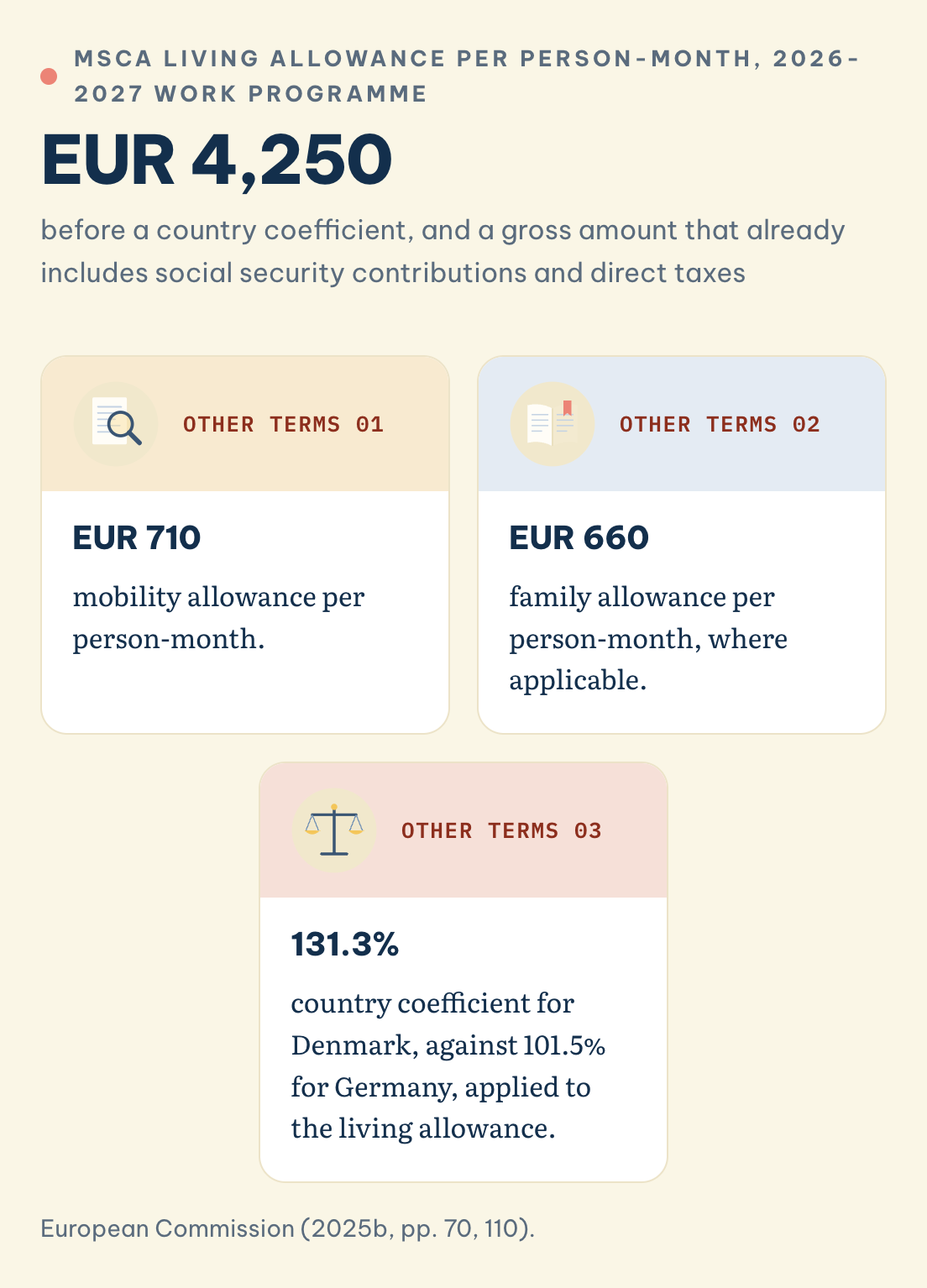
The Horizon Europe work programme 2026-2027 for the Marie Skłodowska-Curie Actions (MSCA), adopted by Commission Decision C(2025) 8493 of 11 December 2025, sets the unit contributions for each recruited doctoral candidate at a living allowance of EUR 4,250, a mobility allowance of EUR 710 and a family allowance of EUR 660 per person-month (European Commission, 2025b, p. 70). The living allowance is a gross amount that already includes employer and employee social security contributions and direct taxes, so the figure on a payslip will be lower. On status the text is explicit: "The beneficiary must recruit each eligible doctoral candidate under an employment contract or equivalent direct contract" (European Commission, 2025b, p. 70). Where national law prevents a contract, the host may exceptionally use a fixed-amount fellowship, and the living allowance is then halved.
The living allowance is then multiplied by a country correction coefficient that follows the recruiting organisation's country. Table 1 of the work programme sets 101.5% for Germany, 111.8% for the Netherlands, 116.6% for France and 131.3% for Denmark (European Commission, 2025b, p. 110), so the same position carries a gross living allowance of about EUR 4,314 in Germany and about EUR 4,956 in France. The Doctoral Networks page adds that each fellowship lasts between 3 and 36 months, or up to 48 months in a Joint Doctorate, and that a network can last up to 4 years, or 5 years for a Joint Doctorate project (European Commission, 2026). A position funded for 36 months does not automatically cover a national doctorate that takes longer, so the length of the contract is worth asking about before you accept an offer. National regulation also decides what a second institution can add to the same doctorate, and France draws that line sharply between two arrangements that share a Vietnamese name, as cotutelle and codirection shows.
◆ Question 4 / 6 · MSCA eligibility
Direct answer: Candidates of any nationality who do not yet hold a doctorate and who meet the mobility rule. You must not have lived or carried out your main activity, such as work or study, in the country of the recruiting organisation for more than 12 months in the 36 months before your recruitment date.
Section 1.3.2 of the MSCA work programme lists the conditions for recruited researchers (European Commission, 2025b, p. 73). A recruit must not already hold a doctoral degree on the recruitment date, and a candidate who has defended a thesis but has not yet been formally awarded the degree is also ineligible. The recruit must be enrolled in a doctoral programme in at least 1 EU Member State or Horizon Europe Associated Country, can be of any nationality, and must satisfy the mobility rule, which counts residence or main activity in the recruiting country over the 36 months before recruitment and ignores compulsory national service and short stays such as holidays.
For applicants based in Vietnam the mobility rule works in two directions. A graduate who has lived and worked in Vietnam for the past 3 years meets it for every European host country. A graduate who finished a 2-year master's degree in the Netherlands last year does not meet it for a Dutch position, although the same person may still meet it for a position in Belgium or Germany. The rule measures where you have been rather than how strong your record is, so it can close an application before anyone reads your research statement, and it is the first thing to check against each vacancy.
◆ Question 5 / 6 · Job or scholarship
Direct answer: Doctoral status depends on the institution, and many universities use more than one status at once. In the 2025 EUA survey of 217 universities, 50% said their doctoral candidates have employee status, 52% early-stage researcher status and 86% student status, with multiple answers allowed. University funds and national agencies were the leading funding sources.
Marti and Peneoasu (2025) report the first results of the 2025 survey by the Council for Doctoral Education of the European University Association, based on 217 participating universities. On status, 52% of institutions said their doctoral candidates have a status as early-stage researchers, 50% as employees and 86% as students, and the authors note that the percentages overlap because institutions could select several statuses (Marti & Peneoasu, 2025, p. 29). On money, universities' own funding was selected by 80% and national funding agencies by 71%, while 42% selected the EU framework programme for research and innovation (Marti & Peneoasu, 2025, p. 21). In an open question, 30% of 183 respondents named sufficient and reliable funding as the main challenge in doctoral education today (Marti & Peneoasu, 2025, p. 22).
The EUA figures explain why MSCA positions are only one part of the European picture, and why the same country can offer both contract routes and scholarship routes. Life inside an EU network also varies. Biswas et al. (2021) surveyed 82 early-stage researchers from 9 MSCA Innovative Training Networks funded under Horizon 2020, between May and June 2020. More than 80% rated the overall experience favourably and 98.3% would recommend it, yet the authors found that the lack of a common EU framework left the experience largely dependent on the host institution, country and supervisor, and that finishing a doctorate within 3 years was a common strain.
◆ Question 6 / 6 · Finding a funded position
Direct answer: Search for vacancies rather than scholarships. MSCA Doctoral Network positions are advertised internationally, including on the EURAXESS portal, and you apply directly to the recruiting institution or project. Check the mobility rule, the contract length and the usual doctoral duration in that country before you invest in a full application.
A workable search takes four steps. First, search EURAXESS with terms such as "Doctoral Network" or "MSCA" together with your field, since the Doctoral Networks page directs candidates to the vacancies published there (European Commission, 2026). Second, for each vacancy, count your months in the host country over the last 36 months against the 12-month limit. Third, compare the fellowship length, between 3 and 36 months, with how long doctorates normally take in that system, as set out in how long a PhD programme takes. Fourth, read the project description closely, because each position sits inside a defined research programme; in the 2 tinnitus networks studied by Biswas et al. (2021), each network ran 15 individual PhD projects grouped into work packages.
The other routes deserve the same discipline. University studentships and national agency funding follow different deadlines and different decision makers, which are covered in who decides PhD studentship funding and why scholarship deadlines come before programme deadlines. Germany is a case of its own, because most doctoral candidates there never join a programme at all, which is explained in the two routes to a PhD in Germany and what DAAD asks for.
If you want a second reader while you shortlist positions and prepare applications, MAAS works with applicants as academic advisors. You choose the positions and make every decision. Our experts draft the research statement from your own account of your research and challenge the fit, the eligibility checks and the timeline, while you review, edit, approve and submit it yourself. No one can promise a PhD position or funding, since that decision belongs to the recruiting institution and its selection panel. You can see the full pathway in our PhD application guide, and the scope of the advisory work in PhD supervisor search and application strategy.
Yes. The Erasmus+ page lists Erasmus Mundus Joint Masters worth 60, 90 or 120 ECTS credits with a bachelor's degree as the entry condition, and it lists no doctoral programme.
Erasmus+ can fund a research stay once you are enrolled as a doctoral candidate at a university that takes part in Erasmus+ and that university selects you. The grant contributes to travel and living costs for the stay, not to the whole doctorate.
No. The work programme defines it as a gross amount that includes social security contributions and direct taxes, so net pay depends on the tax rules of the host country.
Only if your time there falls within the limit: no more than 12 months of residence or main activity in that country during the 36 months before recruitment.
The MSCA conditions only exclude people who already hold a doctorate. The degree you need for entry is set by the university that enrols you in its doctoral programme.
Biswas, R., Schiller, A., Casolani, C., Daoud, E., Dode, A., Genitsaridi, E., Jacquemin, L., Liyanage, N., Lourenco, M., Makani, P., Parameshwarappa, V., Riha, C., Santacruz, J. L., Shabbir, M., Simoes, J., Trpchevska, N., & Schoisswohl, S. (2021). Doctoral studies as part of an Innovative Training Network (ITN): Early Stage Researcher (ESR) experiences. Open Research Europe, 1, 34. https://doi.org/10.12688/openreseurope.13094.2
Coy, P., Cánovas, S., Van Soom, A., Bernabò, N., Lonergan, P., & Schellander, K. (2020). European Joint Doctorates: Myth or reality? In 6th International Conference on Higher Education Advances (HEAd'20). Universitat Politècnica de València. https://doi.org/10.4995/head20.2020.11209
European Commission. (n.d.). Studying abroad. Erasmus+. https://erasmus-plus.ec.europa.eu/opportunities/opportunities-for-individuals/students/studying-abroad
European Commission. (2024). 20 years of Erasmus Mundus. Publications Office of the European Union. https://doi.org/10.2797/9051
European Commission. (2025a). Erasmus Mundus Joint Masters (students). Erasmus+. https://erasmus-plus.ec.europa.eu/opportunities/opportunities-for-individuals/students/erasmus-mundus-joint-masters
European Commission. (2025b). Horizon Europe work programme 2026-2027: 2. Marie Skłodowska-Curie Actions (Commission Decision C(2025) 8493). https://ec.europa.eu/info/funding-tenders/opportunities/docs/2021-2027/horizon/wp-call/2026-2027/wp-2-marie-sklodowska-curie-actions_horizon-2026-2027_en.pdf
European Commission. (2026). Doctoral Networks. Marie Skłodowska-Curie Actions. https://marie-sklodowska-curie-actions.ec.europa.eu/actions/doctoral-networks
Marti, S., & Peneoasu, A.-M. (2025). Doctoral education in Europe today: Enhanced structures and practices for the European knowledge society (2025 EUA-CDE survey, Report I). European University Association. https://www.eua.eu/images/publications/Publication_PDFs/CDE_Doctoral_Education_Survey_Part_1_web.pdf
A free 20-minute consultation is a conversation about your situation and the positions you are looking at.
Book a free consultation ▸