
Category: admissions
Last updated: 2026-09-21

Ask whether a Dutch doctorate is a job and almost every source will tell you yes. The answer holds for the largest group and quietly misdescribes the one a Vietnamese applicant is most likely to enter, because the Netherlands sorts doctoral candidates into categories that turn on who pays, and only some of those categories sit inside employment law.
Direct answer: No. In 2025 the Netherlands counted 37,886 doctoral candidates, and 63% of them were employed doctoral candidates (werknemer-promovendus), which leaves roughly a third outside the employment relationship altogether (Rathenau Instituut, 2026). Your status is set by the document that pays you, not by the country you move to.
Every Vietnamese-language page on the first screen of Google for this question says the same thing: in the Netherlands a doctoral candidate is staff, draws a salary, and is not really a student. That sentence is true of the largest group and misleading for the group a Vietnamese applicant is most likely to join. The Universities of the Netherlands (UNL) classification recognises four types of doctoral candidate, and only two of them carry employee status. If you arrive holding an award from a ministry or a foundation at home, you are normally placed in a category that sits outside Dutch labour law, at the same desk, under the same supervisor, doing the same work.
What are the four categories of doctoral candidate in the Netherlands?
Direct answer: Utrecht University lists employed doctoral candidate, employee in a PhD track, scholarship candidate, externally funded candidate and external candidate, grouped into four types "per the Universities of the Netherlands (UNL)" (Utrecht University, n.d.). Only the first two carry employee status; the rest hold an admission decision and a funding arrangement.
The distinction is administrative in form and consequential in substance. An employed doctoral candidate has "a labour contract as a PhD candidate for a period of, usually, 4 years", and Utrecht notes that most of its candidates fall into this group (Utrecht University, n.d.). A scholarship candidate "does not have an employment contract with the university but receives funding for doctoral research from an external scholarship provider", which is precisely the shape of a government award carried from Vietnam. An externally funded candidate works on the doctorate in an employer's time, so the salary comes from that employer rather than the university. An external candidate, the buitenpromovendus, "receive[s] no funding for their doctoral research in the form of a salary or scholarship", works in their own time, and has "no dedicated workspace at the university".
Promovendi Netwerk Nederland, the national doctoral candidates' body, draws the same line and states its consequence plainly: for scholarship and external candidates, "rights and benefits originating from labor law or the CLA do not extend to this kind of PhD candidate" (Promovendi Netwerk Nederland, n.d.). The CLA is the collective labour agreement for Dutch universities, and it is the instrument that carries holiday pay, pension accrual, the end-of-year payment and annual movement along the salary scale.
If you are also comparing how the word "candidate" is used elsewhere, Is a PhD candidate different from a PhD student? sets the Dutch usage beside the American and Australian ones.
How many doctoral candidates in the Netherlands are not employees?
Direct answer: Nearly a third of them. Of the 37,886 candidates recorded for 2025, 16% were external candidates, 13% were externally funded and 1% held a scholarship, against 63% employed candidates and 7% employees in a PhD track (Rathenau Instituut, 2026). The non-employed groups together cover several thousand people.
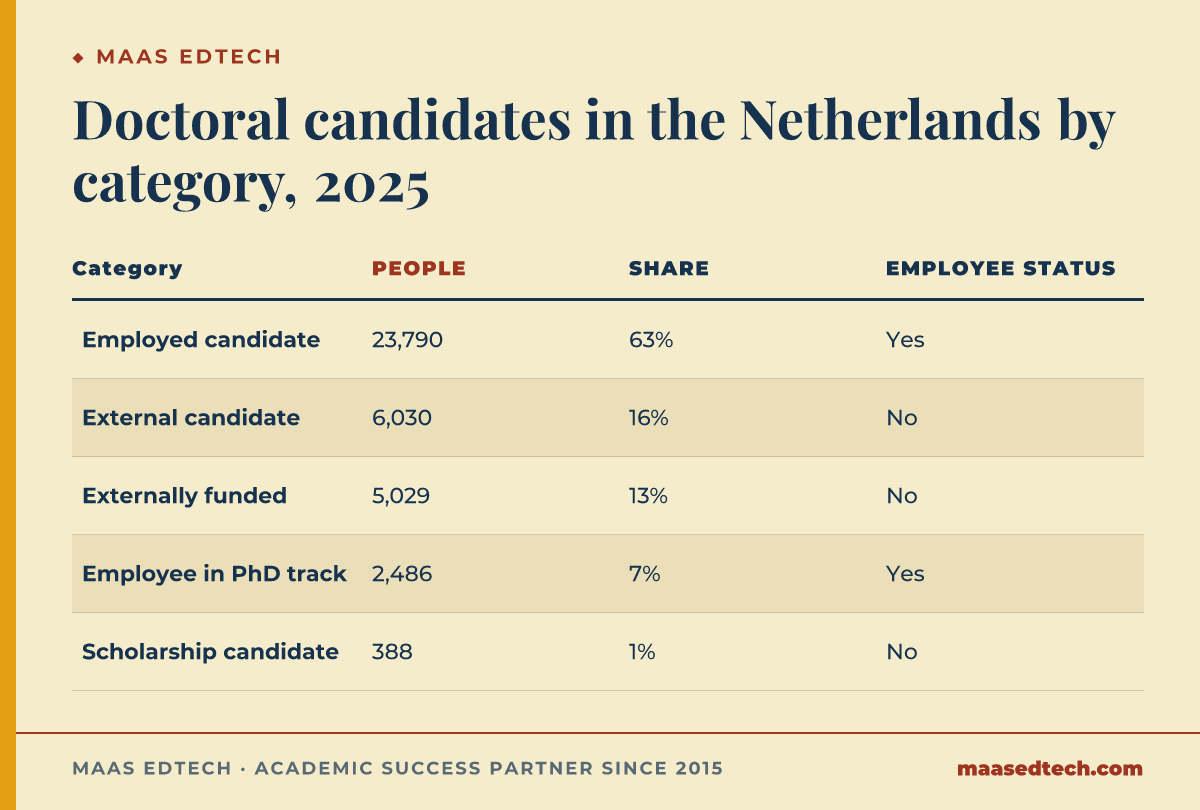
Those proportions are worth reading slowly, because they contradict the summary sentence that circulates in Vietnamese study-abroad material. The non-employed groups are not a rounding error; together they cover several thousand people. The Rathenau Instituut compiled the figures from data supplied by UNL and published them on 20 January 2026, and the same publication records the raw counts behind the percentages: 23,790 employed candidates, 6,030 external candidates, 5,029 externally funded candidates, 2,486 employees in a PhD track and 388 scholarship candidates (Rathenau Instituut, 2026).
The scholarship category is the smallest of the five and the one a foreign award most often leads to, which is why it is also the least visible in general advice. A category that holds 1% of the national population will not shape the sentence a search engine writes about the country, and it may still be the category that decides your four years.
Does the answer change depending on which university you choose?
Direct answer: Substantially. The employed share runs "from 38% at Maastricht University to 88% at TU Delft", and at the Open University only 25% of doctoral candidates hold an employment contract while 40% fall under the external category (Rathenau Instituut, 2026). A national average therefore tells you very little about the institution you are actually applying to.
The spread between universities is the practical hinge of the whole question, and it is why a national generalisation is a poor planning instrument. A candidate comparing two Dutch offers is not comparing two instances of one system. At TU Delft the employed share reaches 88%, while at Maastricht it falls to 38%, and at the Open University it drops to 25% against 40% in the external category. The University of Groningen is separately noted as having a relatively high proportion of scholarship candidates at 10% (Rathenau Instituut, 2026), a legacy of the policy experiment described below.
So the useful question is not whether a Dutch doctorate is a job. It is which category a specific faculty, at a specific university, will register you in, given the specific way your research is funded. That is a question with a documented answer, and it can be asked before you accept anything.
Why is the Dutch scholarship category itself contested?
Direct answer: Because the country ran an experiment with it and then stopped. From 2016 universities could offer scholarships instead of employment, the responsible minister ended the scheme with no new positions after 2024, and in 2025 the Supreme Court held that 44 scholarship candidates at Groningen's university medical centre had been employees in law throughout (Universiteitskrant, 2022; Algemene Onderwijsbond, 2025).
Jongbloed (2019) describes the design of the 2016 scheme from the inside, and the terms are worth setting beside the later judgment that reclassified 44 of its candidates. Scholarship candidates received "slightly more than EUR 1,800 net per month" from the university, an amount set equal to the starting salary of an employed candidate, and the university made notional payments covering tax and social security so that the candidates remained integrated into the Dutch social system. The trade-off was legal rather than financial at the outset: scholarship candidates "are not covered by the Collective Labour Agreement for Dutch Universities, meaning that they don't receive an end-of-year bonus or holiday pay, don't go up a grade on the salary scale each year", and, being outside employment, could not be required to teach (Jongbloed, 2019).
The University of Groningen, which took up the experiment on by far the largest scale, described the outcome as a success in its own terms and confirmed the mechanism in its own words: scholarship candidates "have student status" and "are allocated a notional employment contract to receive payment of their scholarship" (University of Groningen, 2022). The ministry read the evaluation differently and closed the scheme. For an applicant reading offers in 2026, the point is not who was right. It is that the difference between the two categories was large enough to be litigated to the highest court in the country, which is a reasonable signal that it is worth identifying in your own paperwork.
What should an applicant in Vietnam check before accepting a place?
Direct answer: Ask the graduate school which UNL category your admission will be registered under, and ask in writing before you sign, because the category follows the funding source rather than the quality of your file. Utrecht instructs its own candidates to "check your status with your supervisors if unsure" (Utrecht University, n.d.).
Three checks follow from that, and all three are things you can do yourself. Read the vacancy or the admission letter for the word that names the relationship, because a position advertised with a salary scale is a different instrument from an admission granted alongside an external award. Read the graduate school's own page on categories, which most Dutch universities publish, and locate yourself on it rather than inferring your place from a country-level summary. Then ask the department, in one message, which category your file will sit in and what that category does and does not include at that institution, since Utrecht is explicit that non-employee candidates "are not required to teach or have annual assessments" while employed candidates have duties under the collective agreement.
Rules here vary by university and by faculty, and they are revised, so read the regulations of the institution you are actually applying to rather than relying on a national rule of thumb. Where the answer decides whether you accept an offer, ask for it in writing.
MAAS works with applicants at exactly this point. Our advisers read the vacancy or admission documents with you, help you frame the question to the graduate school, and pressure-test the research proposal that sits underneath it. Your expert drafts the proposal from your own account of your research and you review, edit and approve it, and you remain the person who corresponds with the department. The expert's job is to make sure you know what you are agreeing to before you agree to it. Where the network already includes a suitable specialist, matching takes about 48 hours; where it does not, MAAS opens a dedicated search, which usually takes around two weeks.
Frequently asked questions
Is a doctoral candidate in the Netherlands a student or an employee?
Both arrangements exist. In 2025, 63% of the country's 37,886 doctoral candidates were employed candidates and 7% were employees in a PhD track, while 16% were external candidates, 13% externally funded and 1% scholarship candidates (Rathenau Instituut, 2026).
If I bring a scholarship from Vietnam, will I be an employee?
Normally no. A candidate funded by an external scholarship provider "does not have an employment contract with the university" and is admitted as a scholarship candidate, a category outside the collective labour agreement (Utrecht University, n.d.; Promovendi Netwerk Nederland, n.d.).
Do non-employed candidates face the same academic requirements?
Yes. Utrecht states that "the same requirements are placed on the quality of supervision and thesis, as in all types of doctoral programmes", and that its four-year track duration applies to all four types (Utrecht University, n.d.).
Can a university still create new scholarship positions?
No new positions were granted under the national experiment after 2024, when the minister ended it (Universiteitskrant, 2022).
Where do I find which category a university uses?
On the graduate school's own admissions or categories page, and in the admission letter itself. Ask the graduate school directly if the letter does not say.
Related MAAS guides
- What is a postdoc, and how is it different from a PhD?
- Is there an Erasmus PhD scholarship, and how are PhDs in Europe paid?
- Two routes into a German doctorate, and where DAAD sits
- PhD application resources
- PhD Application Strategy and Execution
References
Algemene Onderwijsbond. (2025, April 1). Supreme Court rules: PhD candidates on grants are employees. https://www.aob.nl/en/recent/articles/Supreme-Court-rules-that-PhD-candidates-are-employees/
Jongbloed, B. (2019). Scholarships for PhD students: An interim evaluation of a Dutch policy experiment. Center for Higher Education Policy Studies, University of Twente. https://research.utwente.nl/en/publications/e7f8e06f-fa2b-4169-b212-d8be4f6c3411
Promovendi Netwerk Nederland. (n.d.). Types of PhD contracts. Retrieved September 21, 2026, from https://www.hetpnn.nl/knowledge-base/types-of-phd-contracts
Rathenau Instituut. (2026, January 20). Nederlandse promovendi naar type promovendus naar universiteit. https://www.rathenau.nl/nl/wetenschap-cijfers/output/promoties-en-studenten-hoger-onderwijs/nederlandse-promovendi-naar-type-promovendus-naar-universiteit
Universiteitskrant. (2022, June 1). Minister puts definitive end to scholarship PhD experiment. https://ukrant.nl/minister-puts-definitive-end-to-scholarship-phd-experiment-the-ug-has-1500-of-those/?lang=en
University of Groningen. (2022, June 2). "The PhD scholarship experiment has helped us immensely". https://www.rug.nl/about-ug/latest-news/news/archief2022/nieuwsberichten/the-phd-scholarship-experiment-has-helped-us-immensely
Utrecht University. (n.d.). Categories of PhD candidates. Retrieved September 21, 2026, from https://www.uu.nl/en/education/phd-at-the-graduate-school-of-life-sciences/starting-your-phd/getting-started/categories-of-phd-candidates
Tools & resources
- Rathenau Instituut, doctoral candidates by type and university, downloadable CSV: https://www.rathenau.nl/nl/wetenschap-cijfers/output/promoties-en-studenten-hoger-onderwijs/nederlandse-promovendi-naar-type-promovendus-naar-universiteit
- Study in NL, the official Dutch study information portal: https://www.studyinnl.org/