
◆ PhD Admissions
What is a postdoc, and how is it different from a PhD?
Category: admissions
Last updated: 2026-10-06

Perplexity opens its answer to this question with a tidy sentence saying a postdoc is a temporary research job taken after earning a PhD. Google's People also ask box adds the follow-ups people actually type, such as whether a postdoc is better than a PhD and how many years after a PhD you can start one. Both answers are accurate and both skip the point that changes how you plan, which is that a postdoc is a stage defined by timing and funding, not a qualification you enrol in.
Direct answer: A postdoc is a temporary, mentored research position taken after a doctorate, and it is not a degree. The National Academies describe it as the only career stage "referred to only by the period of time, and not the position itself" (National Academy of Sciences et al., 2014). It ends with a contract, not a thesis defence.
Readers coming from Vietnam often meet the word through nghiên cứu sinh, which in Vietnamese means a doctoral student, and assume a postdoc is the next, higher student status. It is not. A doctoral student is admitted to a programme and examined on a thesis, and that earned qualification is a different thing from an honorary doctorate, as Is an honorary doctorate a real PhD, and can you use Dr? explains. A postdoc is hired, or awarded a fellowship, to do research on a defined project for a fixed term.
◆ Question 1 / 6 · Degree, training or job
Is a postdoc a degree, a training programme or a job?
Direct answer: A postdoc is training and employment at once, and no degree is awarded. The National Academies report that definitions from the NIH, NSF, Association of American Medical Colleges and National Postdoctoral Association agree on three features: a prior doctorate, advanced research training, and "a fixed term of appointment" (National Academy of Sciences et al., 2014).
The 2014 report, The Postdoctoral Experience Revisited, quotes the NIH and NSF definition from 2007: an individual who has received a doctoral degree and is "engaged in a temporary and defined period of mentored advanced training to enhance the professional skills and research independence needed to pursue his or her chosen career path". The wording matters because it explains the oddity people notice first. There is no curriculum, no examination and no award at the end, yet the person is a trainee on paper and a researcher in practice.
The 2014 report is blunt about the second half of that description. It notes that "the only qualification that is required for any position to be postdoctoral is that it occurs after the receipt of a doctoral degree", and it acknowledges that the work also functions as a job, with the lab receiving "highly skilled, low-cost research labor" (National Academy of Sciences et al., 2014). That is why two postdocs at neighbouring universities can have very different titles, pay scales and rights, even though both are counted as postdocs.
If you are comparing this with other doctoral labels, Is a PhD candidate different from a PhD student? covers the terms that apply before the thesis is finished.
◆ Question 2 / 6 · Without a PhD, and how soon
Can you do a postdoc without a PhD, and how many years after a PhD can you start?
Direct answer: You need a doctorate, or in some schemes a completed defence, and some fellowships also cap how long ago you earned it. The Marie Skłodowska-Curie Postdoctoral Fellowships require a PhD at the application deadline and "a maximum of eight years experience in research" counted from the award of the degree (European Commission, 2026).
The first condition is the one in the name. Applicants to the MSCA scheme "should have a PhD degree at the time of the deadline for applications", and the European Commission adds that people who have defended their thesis but have not yet been formally awarded the degree are also eligible (European Commission, 2026). Years outside research and career breaks do not count towards the eight-year cap, so the cap is a measure of research experience, not of calendar time since graduation.
The second condition is mobility. MSCA applicants must not have lived or carried out their main activity in the host country for more than 12 months in the 36 months immediately before the call deadline (European Commission, 2026). That rule is specific to this fellowship, and a project-based postdoc advertised by a single laboratory will set its own conditions. The practical reading is that "how many years after a PhD" has no universal answer; each scheme and each advertisement states its own window, and you should read it before you plan around it.
◆ Question 3 / 6 · How long a postdoc lasts
How long does a postdoc last?
Direct answer: A single appointment commonly runs about two years, and people stay in the stage for longer in total. The National Academies estimate a median of 3 to 4 years as a postdoctoral researcher, possibly too low, and call more than 5 years across several appointments "not unusual" among biomedical researchers (National Academy of Sciences et al., 2014).
The two-year figure comes from United States survey data collected in 2006. The 3 to 4 year median is a Survey of Doctorate Recipients estimate that the report takes from the NIH biomedical workforce material, and the report's own note says it "may be an underestimate" because foreign doctorates may do longer postdocs. Treat both as a description of a pattern rather than a 2026 statistic. They are nevertheless the figures the report itself uses, and they sit alongside a structural point. Because each appointment is short and tied to a funding stream, a postdoc stage that looks like one step from the outside is often a sequence of two or three contracts.
Fellowship schemes publish their own lengths. The European Postdoctoral Fellowship "can last between 1 and 2 years", while the Global Postdoctoral Fellowship "lasts between 2 to 3 years", and only nationals or long-term residents of EU Member States or Horizon Europe Associated Countries can apply for the Global one (European Commission, 2026). A reader planning a career should therefore ask two separate questions: how long is this appointment, and how many appointments does the field normally expect before a permanent post.
◆ Question 4 / 6 · Who pays a postdoc
Who pays a postdoc, and does that decide what you do all day?
Direct answer: Mostly principal investigators with research grants, and yes, it shapes your freedom. In the United States, the National Academies report, roughly 80 percent of postdoctoral researchers are employed by principal investigators and paid out of research grants, while holders of some independent fellowships can typically choose where to work (National Academy of Sciences et al., 2014).
The report sorts funding into three categories: fellowships, training grants and research grants. It calls the research-grant route the most common, in which principal investigators "recruit postdoctoral researchers directly to work on research grant awards they have been able to secure", and says postdocs in that model work in an area that interests the host laboratory and "have little mobility" (National Academy of Sciences et al., 2014). A fellowship works the other way round. The researcher proposes the project and usually has some direct control over the topic and the host.
The fellowship route is also an application with a partner. The MSCA states that interested researchers "submit an application together with a host organisation" (European Commission, 2026), so a Vietnamese applicant cannot treat it as a personal scholarship form. You need a host who agrees to hold the project, and the proposal is built with them.
The pay gap with the rest of the doctoral labour market is real. For the United States, the report cites survey data showing that the median for all postdoctoral researchers within five years of receiving their degree was "only around $43,000 in 2010" (National Academy of Sciences et al., 2014). The number is old and American, so use it only as a reminder that postdoc pay is set by the funder and the country, not by the prestige of the institution.
◆ Question 5 / 6 · Better than a PhD
Is a postdoc better than a PhD, and where does it lead?
Direct answer: A postdoc is not a higher qualification, and it is not a guaranteed route to a faculty post. In the figures the National Academies cite, about 23 percent of United States biomedical PhDs moved into tenure-track faculty positions, while more than 65 percent of the same group entered postdoctoral positions (National Academy of Sciences et al., 2014).
Tenure-track faculty positions
about 23%
of United States biomedical PhDs move into them, an NIH advisory committee estimate with caveats about data quality
Entering postdoctoral training, by field
Each bar shows the share of 2012 United States doctorate recipients with definite commitments who were entering postdoctoral training, drawn at the rounded figure the report gives. The card shows a different group, United States biomedical PhDs, from an NIH advisory committee estimate, and its dot colour carries no meaning.
Save this figure
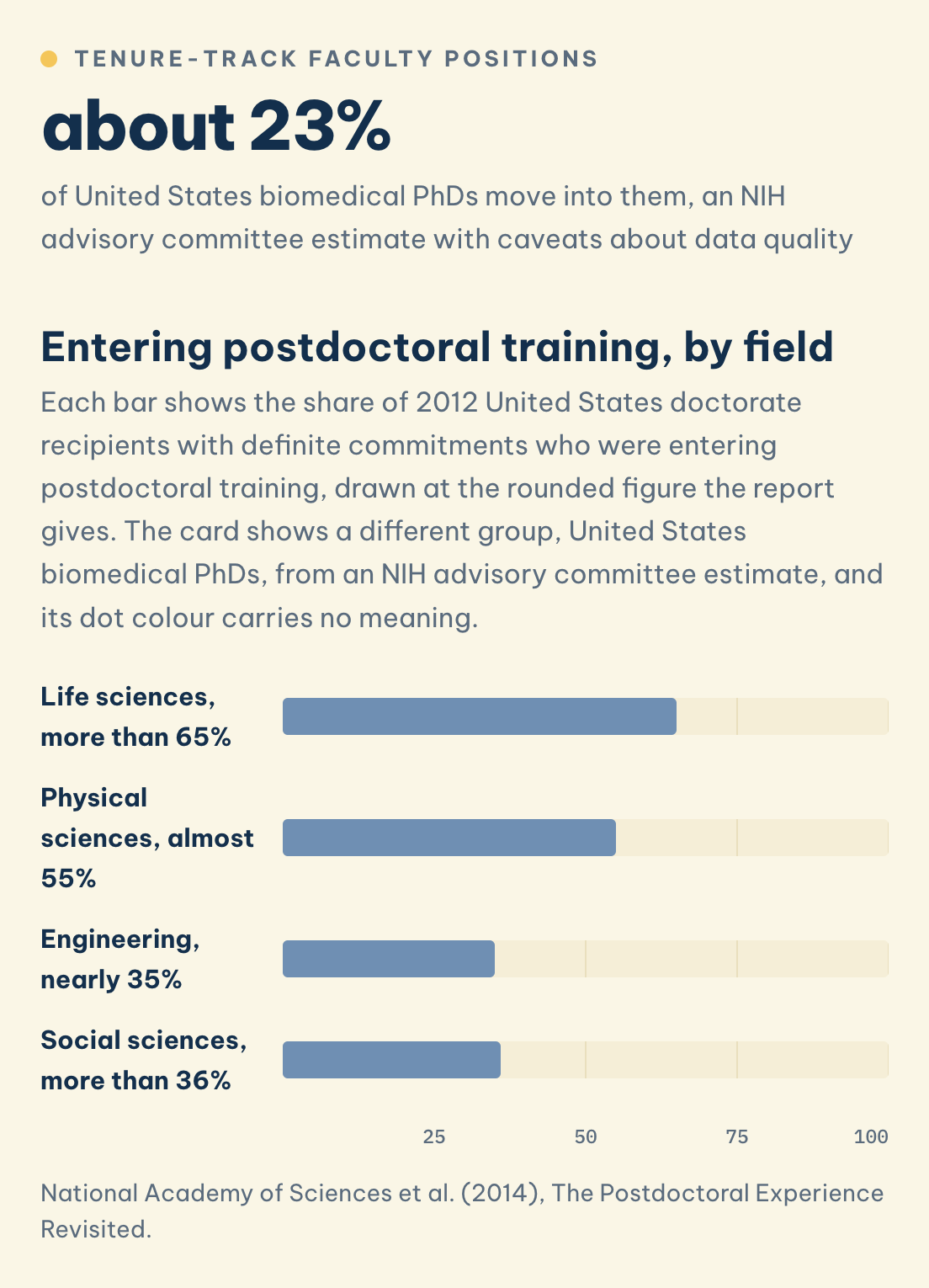
The word "better" hides a mismatch between two different things. The NIH advisory committee behind the figure estimated, with caveats about the quality of the data, that about 23 percent of biomedical PhDs move into tenure-track faculty positions, and its flow chart showed more than 65 percent of them entering postdoctoral positions. A PhD is the qualification that lets you work as an independent researcher at all. A postdoc is an optional, field-dependent apprenticeship that follows it. The report records how unevenly it is used: among 2012 United States doctorate recipients with definite commitments, more than 65 percent of life scientists, almost 55 percent of physical scientists, nearly 35 percent of engineers and more than 36 percent of social scientists were entering postdoctoral training (National Academy of Sciences et al., 2014).
The spread across fields is the useful fact for planning. In some fields a postdoc is close to the default after the degree, and in others it is one option among several and a hiring committee may not expect it. The report also notes that between 2000 and 2012 growth was fastest in disciplines where postdoctoral training had been rare, such as engineering and the social sciences. A field that expects a postdoc today may not have expected one when your supervisor was a graduate student.
The figures above do not tell you whether you should do a postdoc. They tell you the question has a field-specific answer you can look up, and that the people best placed to give it are the hiring staff and recent hires in the departments you are targeting.
◆ Question 6 / 6 · What to check from Vietnam
What should an applicant from Vietnam check before choosing a postdoc route?
Direct answer: Check three things in writing: whether the post is an employment contract or a fellowship, who the principal investigator or host is, and what the term is. The distinction decides your salary source, your contract length and how much of the research direction is yours (National Academy of Sciences et al., 2014).
First, read the advertisement for the relationship it names. A post advertised with a grade and a salary scale is an employment arrangement, while an award from a funder is a fellowship with its own conditions, and the two carry different rights. Second, identify the person whose grant pays for the post, since in the most common model their project defines your daily work. Third, ask what happens when the term ends, because both the median stay and the structure of the funding point to short renewable appointments rather than an open-ended post.
Rules vary by country, by funder and by employer, and they change, so read the call text or the contract itself rather than relying on a general summary. If you are still deciding whether to do a doctorate first, the order of the work is covered in PhD application resources. MAAS does not support postdoc applications. Its adviser support covers the PhD application stage, and the page for PhD Application Strategy and Execution sets out what that includes and what you approve at each step.
Frequently asked questions
Is a postdoc the same as a PhD?
No. A PhD is a doctoral degree earned by completing a programme and a thesis. A postdoc is a temporary, mentored research position taken after the doctorate, with a fixed term of appointment and no degree awarded at the end (National Academy of Sciences et al., 2014).
Can I do a postdoc without a PhD?
Generally no. Postdoctoral status requires a doctoral degree already received. The MSCA Postdoctoral Fellowships ask for a PhD at the call deadline, and also accept applicants who have defended but not yet been formally awarded the degree (European Commission, 2026).
How many years after a PhD can you be a postdoc?
There is no universal limit. Individual schemes set their own, for example a maximum of eight years of research experience from the award of the PhD for the MSCA fellowships (European Commission, 2026).
How long does a postdoc usually last?
A single appointment commonly lasts about two years, and the median total time in the stage was estimated at 3 to 4 years in United States data, which the report says may be an underestimate. MSCA fellowships last 1 to 2 years (European) or 2 to 3 years (Global, open only to EU and Associated Country nationals or long-term residents) (National Academy of Sciences et al., 2014; European Commission, 2026).
Is a postdoc a job or a student status?
The literature uses both descriptions. The National Academies treat a postdoctoral position as mentored training and also as a "job", and about 80 percent of United States postdocs are employed by principal investigators and paid from research grants (National Academy of Sciences et al., 2014).
Related MAAS guides
References
European Commission. (2026, September 30). MSCA Postdoctoral Fellowships. Marie Skłodowska-Curie Actions. https://marie-sklodowska-curie-actions.ec.europa.eu/actions/postdoctoral-fellowships
National Academy of Sciences, National Academy of Engineering, & Institute of Medicine. (2014). The postdoctoral experience revisited. National Academies Press. https://doi.org/10.17226/18982
Tools & resources
- The Postdoctoral Experience Revisited, full text, free to read online: https://www.nationalacademies.org/read/18982/chapter/4
- Marie Skłodowska-Curie Actions, Postdoctoral Fellowships call page: https://marie-sklodowska-curie-actions.ec.europa.eu/actions/postdoctoral-fellowships
A free 20-minute consultation is a conversation about your situation and the PhD application stage that comes before any postdoc.
Book a free consultation ▸