
◆ PhD Admissions
Is a PhD candidate different from a PhD student?
Category: admissions
Last updated: 2026-10-02

Vietnamese uses one word, nghiên cứu sinh, for everyone on a doctoral programme, so the English split between "student" and "candidate" is easy to read past. It should not be, because the same checkpoint is described with opposite grammar in different countries. At Michigan and UC Davis you become a candidate after you pass the checkpoint. At the University of Queensland and the University of Southern Queensland you are a candidate from enrolment and become a confirmed one after it. The noun alone does not tell you where you stand.
Direct answer: In many United States programmes, a PhD student becomes a PhD candidate after passing qualifying or preliminary exams and getting the proposal approved, and the status can change tuition and funding. In Australia, "candidate" is used from enrolment, and the checkpoint turns a provisional candidate into a confirmed one. Read the programme's own definition.
Asked on 2 October 2026, Perplexity and ChatGPT in guest mode both gave the American version: the student completes coursework and exams, then advances to candidacy and works mainly on the dissertation. Perplexity added that the terms are looser in the United Kingdom and Australia and that in the Netherlands a candidate may be an employee. Neither explained what actually changes on the day of advancement, or that Australian universities run the same logic in reverse. The official policies below do.
◆ Section 1 / 7 · Candidate or student
What is the difference between a PhD candidate and a PhD student?
Direct answer: The difference is a formal checkpoint, but which side of it the word "candidate" sits on depends on the country. In the United States it usually marks passing exams and an approved proposal. In Australia it describes anyone enrolled, with "confirmed" marking the checkpoint. Treat the word as a label for a programme's own rules, not as a universal rank.
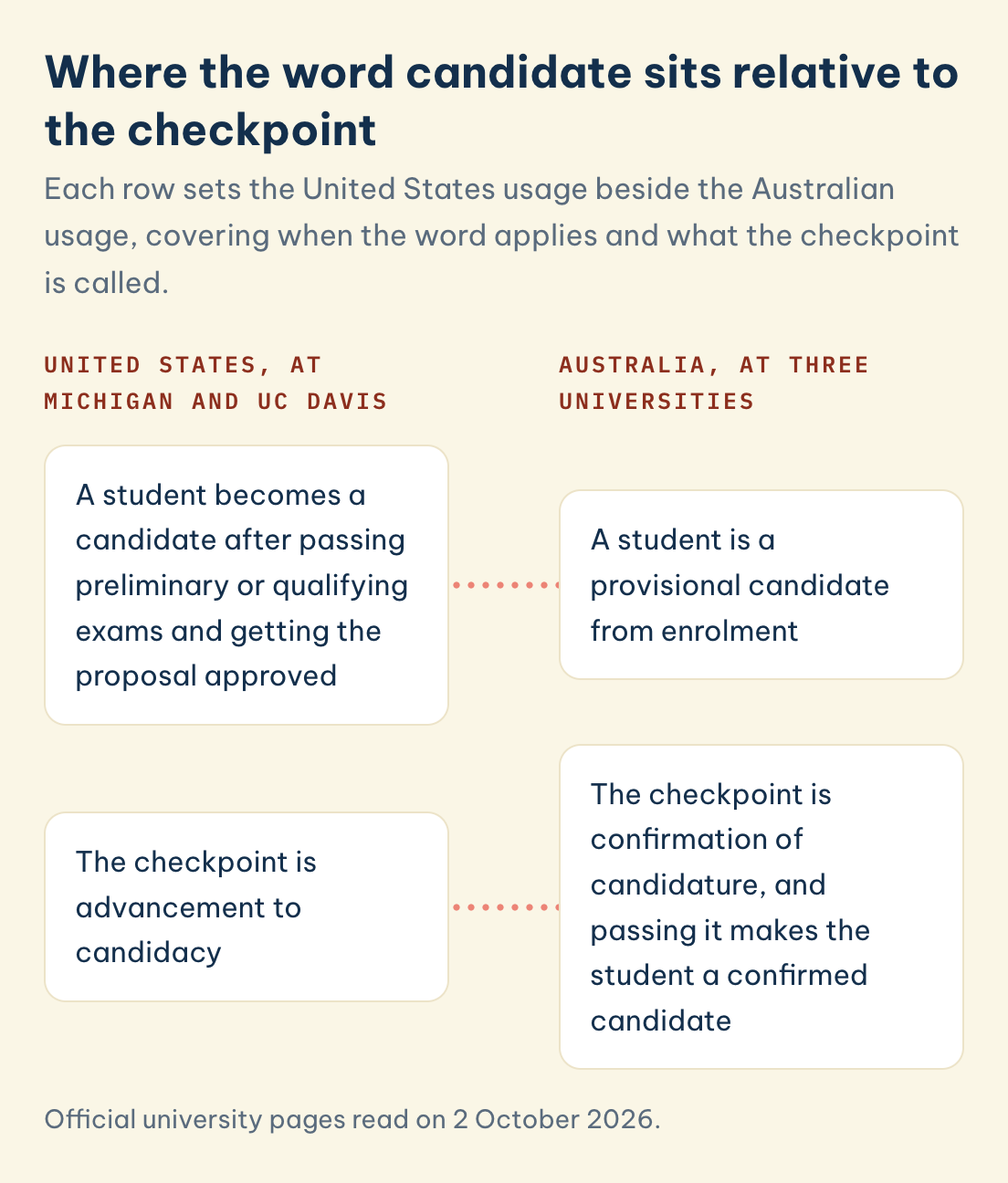
Where the word candidate sits relative to the checkpoint
Each row sets the United States usage beside the Australian usage, covering when the word applies and what the checkpoint is called.
United States, at Michigan and UC Davis
Australia, at three universities
A student becomes a candidate after passing preliminary or qualifying exams and getting the proposal approved
A student is a provisional candidate from enrolment
The checkpoint is advancement to candidacy
The checkpoint is confirmation of candidature, and passing it makes the student a confirmed candidate
Save this figure
The Ph.D. Completion Project (n.d.), run by the Council of Graduate Schools across 29 North American research universities, defines candidacy for its data as "the successful completion of coursework and qualifying examinations", and adds that institutions using a different definition can record their own. Even the body that collects completion statistics expects the definition to vary. The Council of Graduate Schools (2004, p. 6) says it more bluntly in an earlier report: "Graduate institutions differ in the ways they define when a student begins and who is, and who is not, a doctoral candidate."
The Rackham Graduate School at the University of Michigan (n.d.) says doctoral education has two stages, precandidacy and candidacy, and that students are "admitted to candidacy" after passing preliminary or qualifying exams and showing readiness for original research. UC Davis Graduate Studies puts the change in one sentence: "Candidacy is the transition from being a traditional student to becoming an academic researcher" (UC Davis Graduate Studies, n.d.).
◆ Section 2 / 7 · What ABD means
What is ABD status in a PhD programme?
Direct answer: ABD stands for "all but dissertation". It describes a doctoral student who has finished coursework and the required exams and has only the dissertation left. UC Davis says doctoral candidates in some fields are referred to as ABD for exactly that reason. It is an informal label for candidacy, not a separate credential.
UC Davis Graduate Studies (n.d.) explains that candidates are called ABD because their remaining academic responsibility is researching and writing the dissertation. The University of Maryland, Baltimore County (n.d.) uses similar wording for the period after coursework but before the defence of the dissertation, and notes that preliminary examinations or other substantial tests are frequently prerequisites for admission to candidacy. ABD is therefore a description of where you stand, and the formal name for the same position is candidacy.
◆ Section 3 / 7 · Reaching candidacy
How do I know when I reach candidacy?
Direct answer: You know because your programme or graduate school records it, usually after a request signed by your department. It is not automatic when you finish exams. Michigan expects advancement within three calendar years of first enrolment, UC Davis says most students advance by their tenth registered quarter, and Maryland Baltimore County sets five years from admission.
The policies share a pattern and differ in the clock. The Rackham Graduate School at the University of Michigan (n.d.) says students should advance no later than three calendar years after first enrolment, and that a student who has not may be placed on academic probation unless the programme petitions for more time. UC Davis Graduate Studies (n.d.) says most doctoral students advance by the 10th registered quarter, and that eligibility requires a cumulative grade point average of 3.0, a passed qualifying exam and a dissertation committee. The University of Maryland, Baltimore County (n.d.) requires admission to candidacy within five years of admission to the doctoral programme and at least two full semesters before the degree is conferred.
◆ Section 4 / 7 · What changes at candidacy
What changes at candidacy: tuition, funding and registration?
Direct answer: Often a good deal. At Michigan, tuition and fees are adjusted to a candidacy rate. At the University of Maryland, Baltimore County, candidates register for a nine-credit research course billed at the rate of two credits. At UC Davis, advancing to candidacy starts a nine-quarter non-resident tuition waiver for international doctoral students. These rules belong to each university.
The Rackham Graduate School at the University of Michigan (n.d.) states that the enrolment status of a student changes in the term they advance, with tuition and fees adjusted to the candidacy rate, and that registration moves into a dissertation course of eight credit hours for a full term. The University of Maryland, Baltimore County (n.d.) says candidates take a fixed nine-credit course, 899, but are billed at the rate of two credits, and that students must complete the degree within four years of admission to candidacy or reapply. UC Davis Graduate Studies (n.d.) adds that advancing may open dissertation fellowships, may qualify a student for a higher academic employment pay level and, for international students, starts the nine-quarter waiver.
For a Vietnamese applicant comparing offers, this is the practical reason to read the handbook: two programmes with the same advertised stipend can differ sharply in what you pay or lose at the moment you advance, and the date of that moment is set by the programme's clock above.
◆ Section 5 / 7 · Outside the United States
How does candidacy work outside the United States?
Direct answer: The same checkpoint exists, under different names. In Australia it is "confirmation of candidature", roughly 9 to 12 months after a PhD begins at the three universities read here, and you are a provisional candidate until it is passed. In the Netherlands most PhD positions are employment, so "candidate" often describes an employee.
The University of Queensland (n.d.) lists a confirmation review at 12 months full-time equivalent for a PhD, with later reviews at 24 and 36 months and examination at 42, and states that "the status of a candidate will change from provisional to confirmed" when confirmation is passed. The University of Southern Queensland (n.d.) admits students to a research programme "as a provisional candidate until successful completion of the confirmation of candidature process", expects it within one year of full-time study and requires a written proposal and an oral presentation normally of 30 to 40 minutes. The Australian National University (n.d.) places its confirmation milestone within 9 to 12 months of the start of a PhD and asks for a thesis proposal and an oral presentation of 40 to 60 minutes.
Compare the table: the checkpoint is the same kind of event, but the Australian "candidate" is already enrolled while the American one has just passed.
| University | When it applies | What the word marks |
|---|---|---|
| Michigan | within 3 calendar years of enrolment | advanced to candidacy after preliminary exams |
| UC Davis | by the 10th registered quarter | candidate after the qualifying exam |
| Maryland, Baltimore County | within 5 years of admission | admitted to candidacy after coursework and exams |
| Queensland | confirmation at 12 months full-time equivalent | provisional candidate becomes confirmed |
| Southern Queensland | confirmation within 1 year full-time | provisional candidate until confirmed |
| Australian National University | confirmation within 9 to 12 months | confirmation of candidature |
Official pages read on 2 October 2026. Rules change by admissions year, so check the current handbook.
The Dutch case is different again. Utrecht University (n.d.) says that in the Netherlands most PhD positions are considered employment, with rights and duties set by the type of contract. Whether a candidate there is an employee or a scholarship holder is its own question, covered in Are all PhD candidates in the Netherlands paid employees?. The United Kingdom has its own upgrade step and is not covered here.
◆ Section 6 / 7 · Using it on a CV
Can I use "PhD candidate" on my CV or LinkedIn?
Direct answer: No official source sets a rule, so follow your own university's status record. Perplexity reported a common American habit of writing "PhD student" before candidacy and "PhD candidate" after, but that is a convention, not a regulation. In Australia or the Netherlands the institution itself uses "candidate" from the start.
No policy read for this article tells an applicant how to title themselves on a CV, so the safest test is one a reader can check: use the word your university's own records and website use for your status on that date, and be ready to state the stage if asked. A programme that calls you a provisional candidate in its policy has already given you the wording, and one that reserves "candidate" for those past qualifying exams has too.
◆ Section 7 / 7 · Where MAAS fits
Where MAAS fits
You sit your own exams, and nothing here changes that. MAAS EdTech does not take assessments or write coursework or exam answers. For a PhD application, the expert drafts the research proposal from your own account of your research and you review, edit and approve it. What an adviser can also do is help you read a programme's handbook for the checkpoint that matters, compare how two programmes define candidacy and what it costs or funds, and challenge the logic of the proposal. The wider application process is laid out in the PhD application guide, and the one-to-one version of the planning work is the PhD application strategy service. The Hungarian version of a mid-course gate, with money attached, is in the Stipendium Hungaricum complex exam.
References
Australian National University. (n.d.). Higher degree by research: Candidature [Procedure]. ANU Policy Library. Retrieved October 2, 2026, from https://policies.anu.edu.au/ppl/document/ANUP_012809
Council of Graduate Schools. (2004). Ph.D. completion and attrition: Policy, numbers, leadership, and next steps. https://cgsnet.org/wp-content/uploads/2022/01/phd_completion_and_attrition-2.pdf
Ph.D. Completion Project. (n.d.). Frequently asked questions. Council of Graduate Schools. Retrieved October 2, 2026, from https://www.phdcompletion.org/frequently-asked-questions/
Rackham Graduate School, University of Michigan. (n.d.). 4. Doctoral degrees. Rackham Academic Policies. Retrieved October 2, 2026, from https://rackham.umich.edu/academic-policies/section4/
University of California, Davis, Graduate Studies. (n.d.). Master's & doctoral candidacy. Retrieved October 2, 2026, from https://gradstudies.ucdavis.edu/masters-doctoral-candidacy
University of Maryland, Baltimore County, The Graduate School. (n.d.). Doctoral candidacy. Retrieved October 2, 2026, from https://gradschool.umbc.edu/candidacy/
University of Queensland. (n.d.). Higher degree by research candidature progression procedure [Procedure]. Policy and Procedure Library. Retrieved October 2, 2026, from https://policies.uq.edu.au/document/view-current.php?id=247
University of Southern Queensland. (n.d.). Higher degree by research confirmation of candidature schedule. Retrieved October 2, 2026, from https://policy.unisq.edu.au/documents/151744PL
Utrecht University. (n.d.). Categories of PhD candidates. Retrieved October 2, 2026, from https://www.uu.nl/en/education/phd-at-the-graduate-school-of-life-sciences/starting-your-phd/getting-started/categories-of-phd-candidates
A free 20-minute consultation is a conversation about your situation and how the programmes you are comparing define candidacy.
Book a free consultation ▸