
◆ PhD Admissions
What happens at the complex exam on a Stipendium Hungaricum PhD?
Category: admissions
Last updated: 2026-09-28

The Stipendium Hungaricum doctoral award is usually described as four years of funding: no tuition fee, a monthly stipend, and housing support. Read against the Hungarian rules it sits on, it is two funded stages of two years each, joined by a pass-or-fail examination at the end of the fourth semester. Whether the second two years exist for you is decided at that examination, not at admission.
Direct answer: The complex exam (komplex vizsga) closes the first four semesters and decides entry to the research and dissertation phase. It is public, judged by a committee of at least three, and graded pass or fail. A failed exam can be retaken once in the same exam period; a second failure ends your student status, and the scholarship with it.
Asked on 28 September 2026 what happens at the complex exam and how long the stipend lasts, ChatGPT described the exam well and named the lack of doctoral extensions as the one important catch. It did not say what happens if the exam is failed. That missing step is the subject of this page.
◆ Section 1 / 7 · The complex exam
What is the complex exam in a Hungarian PhD and when is it taken?
Direct answer: The complex exam ends the training and research phase. The 2026/2027 call describes doctoral programmes as 8 semesters split into two phases of 4, with the complex exam at the end of the first 4 semesters. It has a theoretical part on the literature and methods of your field and a report on your research progress.
The structure dates from a reform that took effect in the 2016/2017 academic year. Before it, a Hungarian doctorate consisted of a three-year organised training period followed by an open-ended period for obtaining the degree; the 2015 amendment of the Act on National Higher Education lengthened training to 8 semesters and at least 240 credits, divided into a two-year training and research phase and a two-year research and dissertation phase of 4 semesters each (Pusztai et al., 2022). The current text of the Act no longer names a semester: section 53(1) leaves the timing of the exam to each doctoral school's rules (Hungarian Parliament, 2011), so the fourth-semester placement comes from the scholarship call rather than from the statute. The Stipendium Hungaricum call states the consequence for scholarship holders in one sentence: "Doctoral students can only continue with the second phase of their studies upon the successful completion of the complex exam" (Tempus Public Foundation, 2025, p. 5).
The form of the exam is fixed by section 12/A of Government Decree 387/2012 (Government of Hungary, 2012). Under subsection (2), it is taken in public before a committee of at least three members, all of whom hold a scientific degree; at least one third of them must not be employed by the institution running the doctoral school, and your own supervisor may not sit on the committee. Under subsections (3) and (5), the exam has two parts, a theoretical part covering the literature, theory and methods of the discipline and a report on your scientific progress, and the result is recorded as pass or fail with no grade in between. Subsection (1) leaves the content to each doctoral school, which publishes its requirements when it advertises the programme, so the reading list and the length of the progress report differ between schools (Government of Hungary, 2012).
The same kind of mid-course gate is called advancement to candidacy in the United States and confirmation of candidature in Australia, and Is a PhD candidate different from a PhD student? compares the three.
◆ Section 2 / 7 · If you fail it
What happens if you fail the complex exam on a Stipendium Hungaricum PhD?
Direct answer: You get one retake, in the same exam period. If the retake also fails, the Act on National Higher Education ends your student status on the day of the failure, and the Operational Regulations then end the scholarship automatically. Any challenge goes to the exam decision itself, under the university's own rules, not to the scholarship.
The chain runs through three documents, and each link is short. Section 12/A(4) of Decree 387/2012 allows a doctoral student who fails the complex exam to repeat it one more time within the same exam period (Government of Hungary, 2012). Section 59(1)(j) of Act CCIV of 2011 then provides that student status ends if the doctoral student does not complete the complex exam, on the day the obligation is missed or the exam is failed (Hungarian Parliament, 2011). Finally, the Stipendium Hungaricum Operational Regulations in force from 31 August 2026 list the termination of student status as one of the grounds on which the scholarship is terminated automatically (Tempus Public Foundation, 2026, p. 15).
The practical reading is that the two halves of the award carry different kinds of risk. The first two years depend on admission, which is competitive but happens once. The second two years depend on a committee that includes outsiders and excludes your supervisor, meeting at the end of your second year in Hungary. Michalkó et al. (2021) describe strengthening the filtering and excluding character of the complex exam (its szűrő, kizáró jelleg) as one of three explicit aims of the 2016 reform, alongside time pressure and a larger number of state-funded places, so the gate is designed to remove people rather than to certify everyone who reaches it.
How many candidates it removes is not published for scholarship holders. The best national evidence predates the reform: Szigeti (2019), using the Higher Education Information System for doctoral students who enrolled in autumn 2010 and autumn 2014, found that about 18% did not meet the training and degree requirements, and that between 43% and 60% of those who dropped out, depending on the cohort, left in their first or second semester. Those cohorts never sat a complex exam, so the figure describes attrition in general, not failure at this gate.
◆ Section 3 / 7 · The stipend by phase
What is the Stipendium Hungaricum PhD stipend in each phase?
Direct answer: HUF 140,000 a month in the first two years and HUF 180,000 a month in the second two, paid for 12 months a year. The higher rate belongs to the phase after the complex exam. Tuition is waived, and the award adds a dormitory place or HUF 40,000 a month towards housing, plus health cover.
Housing contribution
HUF 40,000
a month, as an alternative to a free dormitory place
Health contribution
HUF 65,000
per academic year
Stipendium Hungaricum PhD stipend per month, by phase
Each bar shows the monthly stipend in forints, yellow for the first two years and blue for the second two years, and both rates are paid for 12 months a year. The two cards show other payments and use no phase colour.
Save this figure
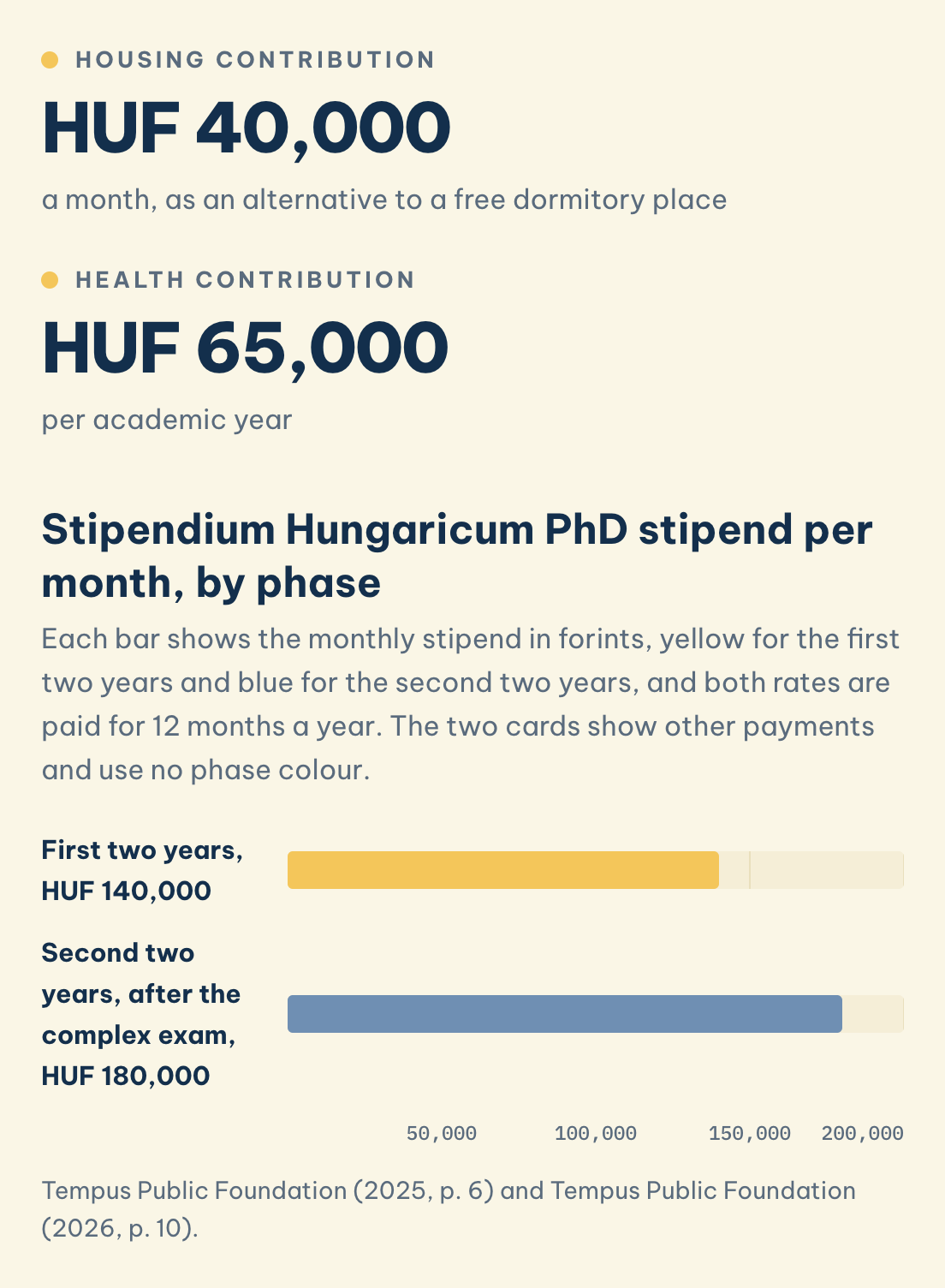
The call pays both rates for 12 months a year until completion of studies, alongside a free dormitory place or a housing contribution of HUF 40,000 a month (Tempus Public Foundation, 2025, p. 6). The two rates are the national doctoral scholarship amounts introduced with the 2016 reform, not a figure specific to Stipendium Hungaricum (Pusztai et al., 2022). The Operational Regulations word the second rate carefully: HUF 180,000 is paid "in the second two years following the complex examination" (Tempus Public Foundation, 2026, p. 10). The same regulations add a one-off grant of HUF 400,000 for doctoral scholarship holders who started in 2016/2017 or later, and a health contribution of HUF 65,000 per academic year (Tempus Public Foundation, 2026, p. 10). The call prints approximate euro equivalents next to each amount, and at least one of them is misprinted, so plan in forints and check the exchange rate when you need it.
The stipend step is also where the design shows. A 29% rise from HUF 140,000 to HUF 180,000 is attached to passing the exam rather than to time served, so the higher amount is paid only to candidates the committee has let through to the research and dissertation phase.
◆ Section 4 / 7 · Extension beyond four years
Can the Stipendium Hungaricum PhD scholarship be extended beyond four years?
Direct answer: No. The Operational Regulations state that scholarships may not be renewed for doctoral training, so the award covers 8 semesters. A holder who passes the final examination of doctoral training without a degree has status suspended from the next semester and terminated after one year. A separate dissertation scholarship exists through its own competitive call.
Here the legal calendar and the funding calendar part ways. Section 53(4) of the same Act gives a doctoral student three academic years after the complex exam to submit the dissertation, extendable by at most one year in cases deserving special consideration (Hungarian Parliament, 2011). Counted from an exam at the end of the fourth semester, the ordinary deadline falls at the end of the fifth year, one year after the eighth and last funded semester. The Operational Regulations close that year from the funding side: extensions "may not be renewed for doctoral" programmes (Tempus Public Foundation, 2026, p. 14), and a scholarship holder who has passed the final examination of doctoral training without obtaining the degree has scholarship and student status suspended from the following semester, terminating after 1 year if no degree follows (Tempus Public Foundation, 2026, pp. 10-11). The Act itself ends student status at the end of the eighth registered semester (Hungarian Parliament, 2011), so a fifth year spent finishing the dissertation is spent in the degree procedure, not as an enrolled and funded student.
Pusztai et al. (2022) record that the reform's authors had planned a harsher rule, under which a doctoral student who did not write the dissertation would repay the stipend for the last two years, and that it was dropped under pressure from professional bodies. They also report that, measured against the annual quota of state-funded places, about 70% of places led to a degree over the preceding ten years. The degree, in other words, is not guaranteed by finishing the funded period, and the funded period is shorter than the time the law allows.
◆ Section 5 / 7 · Application and next call
What does a Stipendium Hungaricum doctoral application need, and when is the next call?
Direct answer: The most recent call, for 2026/2027, required a research plan of at least 2 pages, a recommendation letter from a holder of a scientific degree, and a supervisor's statement where the doctoral school demands one. Applications closed on 15 January 2026. There is one deadline a year; the 2027/2028 call was unpublished on 28 September 2026.
The supervisor requirement is stricter than the document list suggests. The call says every doctoral applicant "must have a supervisor at their selected Host University" and asks applicants to contact the doctoral school in advance to agree a topic, while the signed statement of acceptance is mandatory only where the programme requires it; in that round the statement could follow by 15 March 2026 (Tempus Public Foundation, 2025, pp. 9, 12, 14). The research plan itself had to run to at least 2 pages and is checked by the universities for plagiarism (Tempus Public Foundation, 2025, p. 13). Host institutions then hold their own admission examinations between March and May, scored out of 100 points, and applicants in the STEM+ fields, which the call lists as natural sciences, technology, engineering, mathematics, agricultural and health sciences, receive priority when places are allocated (Tempus Public Foundation, 2025, pp. 20-21).
For the 2026/2027 round online applications closed at 2 p.m. Central European Time on 15 January 2026 (Tempus Public Foundation, 2025). On 28 September 2026 the programme's application page still carried that call and none for 2027/2028, and the programme's application page answers the obvious follow-up question directly: there is only one application deadline each year, and an applicant who misses it can apply one year later (Tempus Public Foundation, n.d.). Vietnam is a listed sending partner, so a Vietnamese application also goes to the national nominating authority, whose deadline and requirements may differ from those of Tempus (Tempus Public Foundation, 2025, p. 17).
◆ Section 6 / 7 · Time abroad
Can you spend time abroad during a Stipendium Hungaricum PhD?
Direct answer: Yes, within limits. Doctoral scholarship holders may spend at most one semester abroad for research in each of the two phases and keep the stipend and housing allowance meanwhile. Otherwise holders must live in Hungary, and habitually living elsewhere ends the scholarship.
The one-semester rule is written phase by phase (Tempus Public Foundation, 2026, p. 13), which matters for a thesis that needs data from Vietnam: fieldwork has to be planned so that each phase uses no more than its single semester, and the first semester abroad falls before the complex exam is sat. Another scholarship that pays for study outside Hungary for more than 30 days terminates the Stipendium Hungaricum agreement (Tempus Public Foundation, 2025, p. 25), so a mobility grant from a second source needs checking before you accept it. The residence rule behind all of this is blunt: scholarship holders are obliged to live and study in Hungary, and those who live habitually in another country have their status terminated (Tempus Public Foundation, 2025, p. 25).
◆ Section 7 / 7 · What this changes
What this changes about applying
A strong application wins the first two years. The second two are won in front of a committee at the end of the fourth semester, so the research plan you submit in January is also the starting point of the progress report that committee will read. Before you choose a doctoral school, find its published complex exam requirements and ask the prospective supervisor how the theoretical part is examined in that school, because that is the gate the scholarship depends on.
If you are still deciding between countries, the PhD application resource hub compares the admission routes before scholarships enter the picture. When Hungary is on the list and the next task is a research plan that will hold up at both admission and the complex exam, MAAS works with you through PhD application strategy: your expert drafts the research plan from your own account of your research, you review, edit and approve it and sit the exams, and the expert challenges the design, the timeline and the fit with the doctoral school. Where our network already includes a suitable expert we introduce them within 48 hours, and where it does not we open a dedicated search, which usually takes about two weeks.
References
Government of Hungary. (2012). 387/2012. (XII. 19.) Korm. rendelet a doktori iskolákról, a doktori eljárások rendjéről és a habilitációról [Government Decree 387/2012 on doctoral schools, doctoral procedures and habilitation]. Retrieved September 28, 2026, from https://net.jogtar.hu/jogszabaly?docid=a1200387.kor
Hungarian Parliament. (2011). 2011. évi CCIV. törvény a nemzeti felsőoktatásról [Act CCIV of 2011 on national higher education]. Retrieved September 28, 2026, from https://net.jogtar.hu/jogszabaly?docid=a1100204.tv
Michalkó, G., Havran, D., Galgóczi, E., & Petrovics, N. (2021). Doktori képzés 2.0: A hazai tudományos utánpótlás-nevelés verzióváltásának mezsgyéjén [Doctoral training 2.0: New directions in the education of future generations of scientists in Hungary]. Magyar Tudomány, 182(4), 449-461. https://doi.org/10.1556/2065.182.2021.4.2
Pusztai, G., Fináncz, J., & Tóth, D. A. (2022). A doktori képzés nemzetközi és hazai átalakulása [The international and domestic transformation of doctoral education]. Educatio, 31(1), 85-103. https://doi.org/10.1556/2063.31.2022.1.7
Szigeti, F. (2019). The patterns of the dropout of doctoral students. Hungarian Educational Research Journal, 9(2), 288-302. https://doi.org/10.1556/063.9.2019.1.25
Tempus Public Foundation. (2025). Call for applications for doctoral programmes 2026/2027. Stipendium Hungaricum. https://stipendiumhungaricum.hu/wp-content/uploads/2025/10/PhD_Call_for_Applications_2026_27.pdf
Tempus Public Foundation. (n.d.). Apply. Stipendium Hungaricum. Retrieved September 28, 2026, from https://stipendiumhungaricum.hu/apply/
Tempus Public Foundation. (2026). Stipendium Hungaricum Programme operational regulations (effective 31 August 2026). Retrieved September 28, 2026, from https://stipendiumhungaricum.hu/documents/stipendium_hungaricum/OR/SH_OR.pdf
A free 20-minute consultation is a conversation about your situation and the doctoral school and research plan you are considering in Hungary.
Book a free consultation ▸