
Category: admissions
Last updated: 2026-09-18

How hard is a PhD abroad? Asked that, Perplexity answers yes, then lists five difficulties in one breath: a competitive entry, research that can hit dead ends, high academic demands, isolation, and money. The list is reasonable, but it mixes two questions that have different answers. One is whether you will be admitted. The other is whether you will finish. The second has been measured across thousands of candidates in several countries, and the measurements say that several of the conditions linked to finishing, such as funding, field and supervisor, are largely set when you choose where to apply.
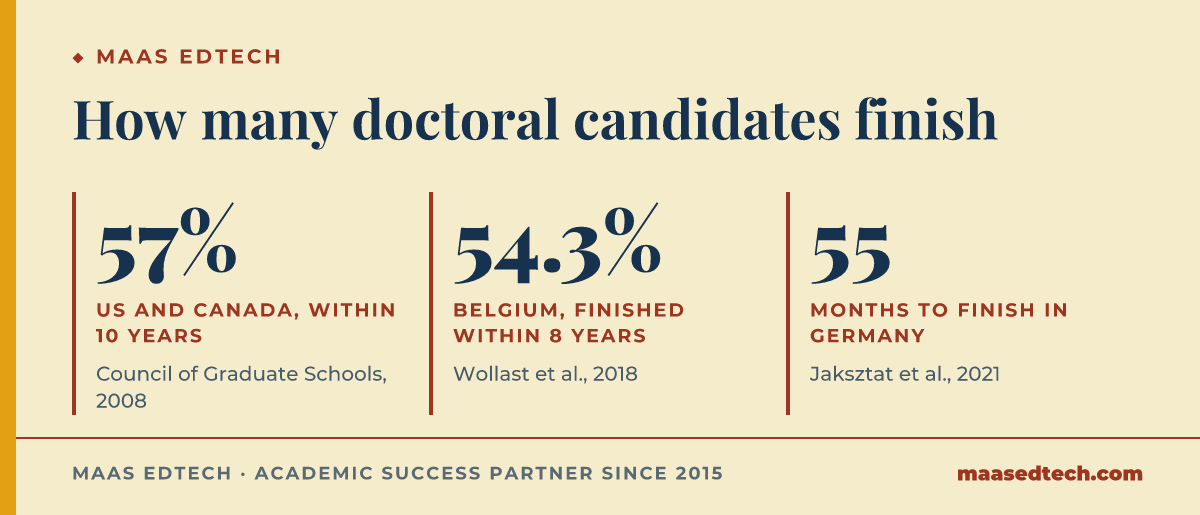
Direct answer: Two numbers describe the difficulty: admission reflects one application season, completion reflects four to eight years. Only 57% of candidates in a US and Canadian study finished within ten years (Council of Graduate Schools, 2008), and 54.3% finished within eight years at two Belgian universities (Wollast et al., 2018). Funding, field and supervisor contact are linked to who finishes.
Is doing a PhD hard, and hard in which sense?
Direct answer: A PhD is hard in two separate senses. Getting in is a competition decided by an admissions committee or one supervisor within a single cycle. Finishing is a question of conditions that last four to eight years. The Council of Graduate Schools (2004) found that "under highly favorable conditions, no more than three quarters" of entrants complete (p. 3).
The Council of Graduate Schools (2004) reviewed fifteen completion studies covering fifty years of US data and reported rates from a low of 33.4% for humanities and social sciences students to a high of 76% for biomedical students on National Institutes of Health training grants. The full sentence from that review is worth reading slowly: "it appears from the perspective of national studies that, under highly favorable conditions, no more than three quarters of students who enter doctoral programs complete their doctoral degrees" (Council of Graduate Schools, 2004, p. 3). An admission letter therefore settles the first difficulty and says almost nothing about the second. A Vietnamese applicant who asks a single question about hardness often has the first one in mind, because it is the one they can see. The second one is invisible from outside, even though it is the one with published numbers.
How many doctoral candidates actually finish?
Direct answer: Roughly half to three fifths, depending on the country and the time window. The Ph.D. Completion Project tracked programmes at 30 US and Canadian universities and found a ten-year completion rate of 57% (Council of Graduate Schools, 2008). Wollast et al. (2018) followed 1,509 candidates in French-speaking Belgium and found 54.3% finished within eight years.
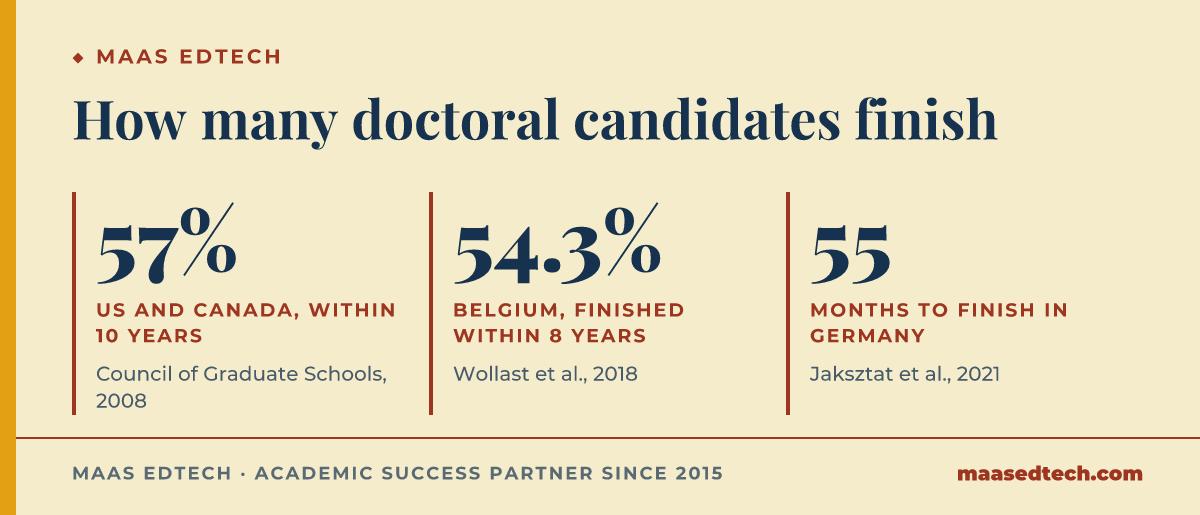
The 57% ten-year figure comes from program data supplied by 30 universities for students who started between 1992-93 and 1994-95, the only cohorts old enough to observe for ten years, and the Council of Graduate Schools (2008) reports it by field: 64% in engineering against 49% in the humanities. Inside a single broad field the spread is wider still, with civil engineering at about 78% and electrical engineering at about 56%. The Belgian figure uses a shorter eight-year window. Of the 1,509 candidates at the two largest universities of the French-speaking Community, 820 (54.3%) finished, 572 (37.9%) had probably dropped out and 117 (7.8%) were probably still active (Wollast et al., 2018). The authors describe the result as "a rate quite similar to the ones observed in English-speaking countries" (p. 152). The two systems differ in almost everything, from how candidates are admitted to how long funding lasts, yet they land within three percentage points of each other.
How long does a PhD take to finish, and when do people leave?
Direct answer: Finishing takes longer than the funded period, and leaving happens early. In Germany the envisaged length is three years, but completers took 55 months on average, while those who withdrew left after 32 months on average (Jaksztat et al., 2021). US and Belgian studies also place most departures in the first two or three years.
Jaksztat et al. (2021) followed 1,226 German doctoral candidates from a national panel of graduates who finished their first degree in 2005. They report an average of 55 months to completion, and the middle half of all completers needed between 41 and 66 months, against an envisaged length of 3 years that matches the usual funding period in Germany. Withdrawal came much earlier: non-completers left after 32 months on average, and the middle half of them left between month 16 and month 46. The Council of Graduate Schools (2004) summarised US research in the same direction, noting that "most students depart in their first two or three years" (p. 4). Wollast et al. (2018) found the same pattern in Belgium and added a detail that matters for anyone planning: candidates without funding left much sooner than funded ones. How long a PhD is meant to take is a separate question, covered in how long a PhD programme really lasts.
Which conditions predict who finishes?
Direct answer: The studies agree on three conditions: funding, field of study and contact with the supervisor. In Germany, receiving a scholarship and close contact with the supervisor were both linked to a lower chance of dropping out (Jaksztat et al., 2021). In Belgium, funding and field stayed significant when all factors were modelled together (Wollast et al., 2018).
Jaksztat et al. (2021) tested individual, institutional and external factors in one event history model. Women and candidates with children dropped out more often, candidates with better prior grades less often, and those in mathematics, natural sciences, medicine and engineering less often than those in the humanities. A scholarship and close supervisor contact were linked to lower dropout. Wollast et al. (2018) found four factors that remained significant together: marital status, master's grade, research field and funding. They also counted risk factors per candidate, and the result is stark: 92% of candidates with none of the risk factors finished, while 79% of candidates with six risk factors dropped out. Of the predictors in both studies, the prior grade is the one an admissions committee weighs directly from your file. Funding, field and the choice of supervisor are settled, or at least accepted, before you enrol, although how often you actually meet that supervisor only shows once the work starts.
What should you settle before you apply?
Direct answer: Settle the conditions the completion studies measured, because an application season rarely lets you revisit them. Check whether the offer includes funding for the whole expected length, not only three years, and whether the supervisor has time for regular contact. The German data show completers taking 55 months against a 3-year plan (Jaksztat et al., 2021).
In practice this changes what you ask before accepting an offer, not only how you write the application. Three questions follow directly from the findings above. First, how many months does the funding cover, and what happens between the end of a 3-year grant and a realistic finishing date of 55 months, the German average? Second, how often does the supervisor meet current candidates, which you can ask those candidates directly? Third, is your field one where completion is lower, such as the humanities, and if so, is the project scoped so that it can finish? None of these questions appear on an application form. They belong to the choice of where to apply, and the PhD application pathway sets out where each fits in the sequence. Who pays for a studentship, and who decides that, is covered in who decides PhD studentship funding.
How does a PhD abroad differ from one at home?
Direct answer: The published research does not isolate a single penalty for studying abroad. Belgian data showed foreign candidates finishing less often than Belgian ones (Wollast et al., 2018), while a US study found foreign nationals slightly more likely to finish, at 54.1% against 50.3% (Council of Graduate Schools, 2004). Nationality interacts with field and funding.
The Council of Graduate Schools (2004) cites Espenshade and Rodriguez, who compared US citizens and permanent residents with foreign nationals in six fields and found completion rates of 50.3% and 54.1%. Wollast et al. (2018) reported the opposite in Belgium and noted that the effect was heavily influenced by research field. The honest reading is that being international is not, on current evidence, a fixed handicap. In the Belgian data the gap between Belgian and non-EU candidates was significant on its own, but it was no longer significant once marital status, grades, field and funding entered the same model (Wollast et al., 2018). What travels with nationality, in other words, is mostly funding and field. If you are still weighing whether the degree itself fits your plans, what a PhD actually certifies takes that question separately.
If you want a second reader while you compare offers and prepare the proposal, MAAS works with applicants as academic advisors. You choose the programmes and supervisors, write the proposal and every email, sit the interviews and make each decision, while our experts challenge the fit, the funding timeline and the evidence behind each choice. No one can promise admission or completion, because those outcomes belong to the university and to you. The scope of that advisory work is described in PhD supervisor search and application strategy.
Frequently asked questions
What percentage of PhD students drop out?
It depends on the country and the window. In the US Ph.D. Completion Project, 57% finished within ten years, so a little over four in ten had not (Council of Graduate Schools, 2008). In the Belgian study, 37.9% had probably dropped out within eight years (Wollast et al., 2018).
When do most PhD students drop out?
Early. US reviews place most departures in the first two or three years (Council of Graduate Schools, 2004), and German non-completers left after 32 months on average (Jaksztat et al., 2021).
Is it harder to finish a PhD in the humanities?
The data say yes. The ten-year US completion rate was 49% in the humanities against 64% in engineering (Council of Graduate Schools, 2008), and German humanities candidates dropped out more often than those in the natural sciences (Jaksztat et al., 2021).
Does funding really change the chance of finishing?
Both European studies link funding to finishing. A scholarship was associated with lower dropout in Germany (Jaksztat et al., 2021), and unfunded candidates in Belgium left sooner (Wollast et al., 2018).
Related MAAS guides
- PhD application: the full pathway
- How long is a PhD programme?
- Who decides PhD studentship funding?
- Should you do a PhD? What the degree certifies
- How to build a PhD supervisor shortlist
References
Council of Graduate Schools. (2004). Ph.D. completion and attrition: Policy, numbers, leadership, and next steps. https://cgsnet.org/wp-content/uploads/2022/01/phd_completion_and_attrition-2.pdf
Council of Graduate Schools. (2008). Ph.D. completion and attrition: Analysis of baseline demographic data from the Ph.D. Completion Project. https://cgsnet.org/wp-content/uploads/2022/01/phd_completion_and_attrition_analysis_of_baseline_demographic_data-2.pdf
Jaksztat, S., Neugebauer, M., & Brandt, G. (2021). Back out or hang on? An event history analysis of withdrawal from doctoral education in Germany. Higher Education, 82(5), 937–958. https://doi.org/10.1007/s10734-021-00683-x
Wollast, R., Boudrenghien, G., Van der Linden, N., Galand, B., Roland, N., Devos, C., De Clercq, M., Klein, O., Azzi, A., & Frenay, M. (2018). Who are the doctoral students who drop out? Factors associated with the rate of doctoral degree completion in universities. International Journal of Higher Education, 7(4), 143–156. https://doi.org/10.5430/ijhe.v7n4p143