
◆ PhD Admissions
Should you do a PhD, and what does the degree actually certify?
Category: admissions
Last updated: 2026-09-13

Ask an answer engine whether you should do a PhD and it returns a balance sheet: career advancement, academic status and deeper expertise on one side, years of effort and uncertainty on the other. The list is reasonable, yet it skips the part that regulators actually write down. Both the Vietnamese regulation and the UK qualifications framework define the doctorate by one product, independent research that creates new knowledge and survives expert review. In one US estimate, only 12.8% of engineering PhD graduates can hold a tenure-track post if faculty numbers stay flat (Larson et al., 2014).
Direct answer: A PhD is worth doing when you want the work it certifies, which is designing and completing independent research that produces new knowledge accepted by expert reviewers. Answer two narrower questions first: do you want that kind of work, and where would you do it, given that universities absorb only a minority of graduates?
◆ Question 1 / 6 · What a PhD certifies
What does a PhD actually certify?
Direct answer: A PhD certifies the ability to produce new knowledge through independent research, not a higher level of taught study. Circular 53/2026/TT-BGDĐT, Article 21, defines the doctoral thesis by independent research capacity and novelty, and the Quality Assurance Agency (QAA) Level 8 descriptor requires knowledge of a quality to satisfy peer review.
Circular 53/2026/TT-BGDĐT, published in Công báo issue 447 on 28 July 2026, states in Article 21, clause 1 that a doctoral thesis is the research result of the doctoral candidate, demonstrating independent research capacity and the ability to identify and solve a scientific or practical problem, and that it must meet requirements of novelty, scholarship, honesty and research integrity (Ministry of Education and Training, 2026). Article 18, clause 1 adds that a research-oriented programme aims to develop independent research capacity and create new knowledge, while an application-oriented programme aims to solve practical problems, projects and applied research tasks. The circular applies to intakes announced from 1 January 2027.
The UK framework uses almost the same test. The Frameworks for Higher Education Qualifications, updated by the QAA in February 2024, say doctoral degrees are awarded to students who have shown the creation and interpretation of new knowledge through original research, "of a quality to satisfy peer review, extend the forefront of the discipline, and merit publication" (QAA, 2024, p. 27). The 2020 doctoral characteristics statement is equally direct: "All UK doctorates, regardless of their form, continue to require the main focus of the candidate's work to demonstrate an original contribution to knowledge" (QAA, 2020, p. 3).
◆ Question 2 / 6 · Who decides it is real
Who decides whether that new knowledge is real?
Direct answer: Readers outside your own supervision do. Under Article 22 of Circular 53/2026, a thesis goes to 3 independent reviewers, at least 2 of them from outside the training institution, and the institution has at most 6 months to complete that review before the thesis reaches its assessment committee.
Article 22, clause 1 of Circular 53/2026/TT-BGDĐT describes independent review as an objective analysis of the thesis's professional quality, originality, academic integrity and new contributions, carried out before the thesis is defended in front of the assessment committee (Ministry of Education and Training, 2026). Clause 2 gives the institution a maximum of 6 months from the submission of the draft thesis to complete that process, and clause 3 sends the thesis to 3 independent reviewers, at least 2 of whom are not from the institution. Article 21, clause 5 of the same regulation adds an outside test before assessment: the candidate must be first or corresponding author of at least 1 publication, from a list of qualifying outlet types, that relates directly to the thesis.
That design explains why the degree feels different from a master's programme. A master's student is usually assessed on whether they have understood and applied what the field already knows. A doctoral candidate is assessed on whether strangers in the field agree that something new has been added, and the QAA wording, "merit publication", points to the same audience (QAA, 2024, p. 27). A person who enjoys learning a subject but dislikes having their own claims challenged by external experts is therefore asking a different question from "should I study more". The difference in status between candidate and student is explained in PhD candidate vs PhD student. If the letters themselves are the puzzle, what PhD stands for and how it differs from other doctorates explains them.
◆ Question 3 / 6 · Graduates inside universities
How many PhD graduates do that work inside universities?
Direct answer: Far fewer than the degree's academic image suggests. Larson et al. (2014) estimated that a US engineering professor graduates 7.8 PhDs over a 20-year career, so if faculty numbers stay constant only 1 in 7.8 graduates, or 12.8%, can take over a tenure-track position.
Larson et al. (2014) borrowed the basic reproductive number, R0, from demography and defined it as the mean number of new PhDs that a typical tenure-track faculty member graduates during their career. Using 2011 data from the American Society for Engineering Education and an average academic career of 20 years, they found R0 = 7.8 across engineering, which leaves a tenure-track opening for 12.8% of new graduates if faculty slots stay constant. For half of all graduates to find faculty openings, the authors calculated, US engineering would need to grow at 14% a year, a rate they call improbable (Larson et al., 2014).
The limits matter before the figure travels. The estimate covers one broad field in one country and describes a steady state rather than tracking real graduates, and the authors note that not every PhD graduate wants an academic post (Larson et al., 2014). What the number does establish is structural: a doctorate trains people for independent research, but most of that research will have to happen outside the universities that trained them, in government laboratories, industry research and development, or policy work.
◆ Question 4 / 6 · Changing career plans
Do PhD students change their minds about academic careers?
Direct answer: Many do, and during the programme itself. Sauermann and Roach (2012) surveyed 4,109 PhD students at 39 US research universities and found that the share of life sciences students rating a faculty research career extremely attractive fell from 39% in the early stage to 33% near the end.
Career ratings that shifted during the PhD
Each row names a group of students and a career path, and shows how the share rating it extremely attractive changed, in a spring 2010 survey of 4,109 PhD students at 39 US research universities.
Group and career path
Students rating it extremely attractive
Life sciences, faculty research career
Fell from 39% in the early stage to 33% near the end
Life sciences, faculty teaching career
Fell from 25% to 21% between early and late stages
Chemistry, industry careers
Rose from 23% to 37%
Save this figure
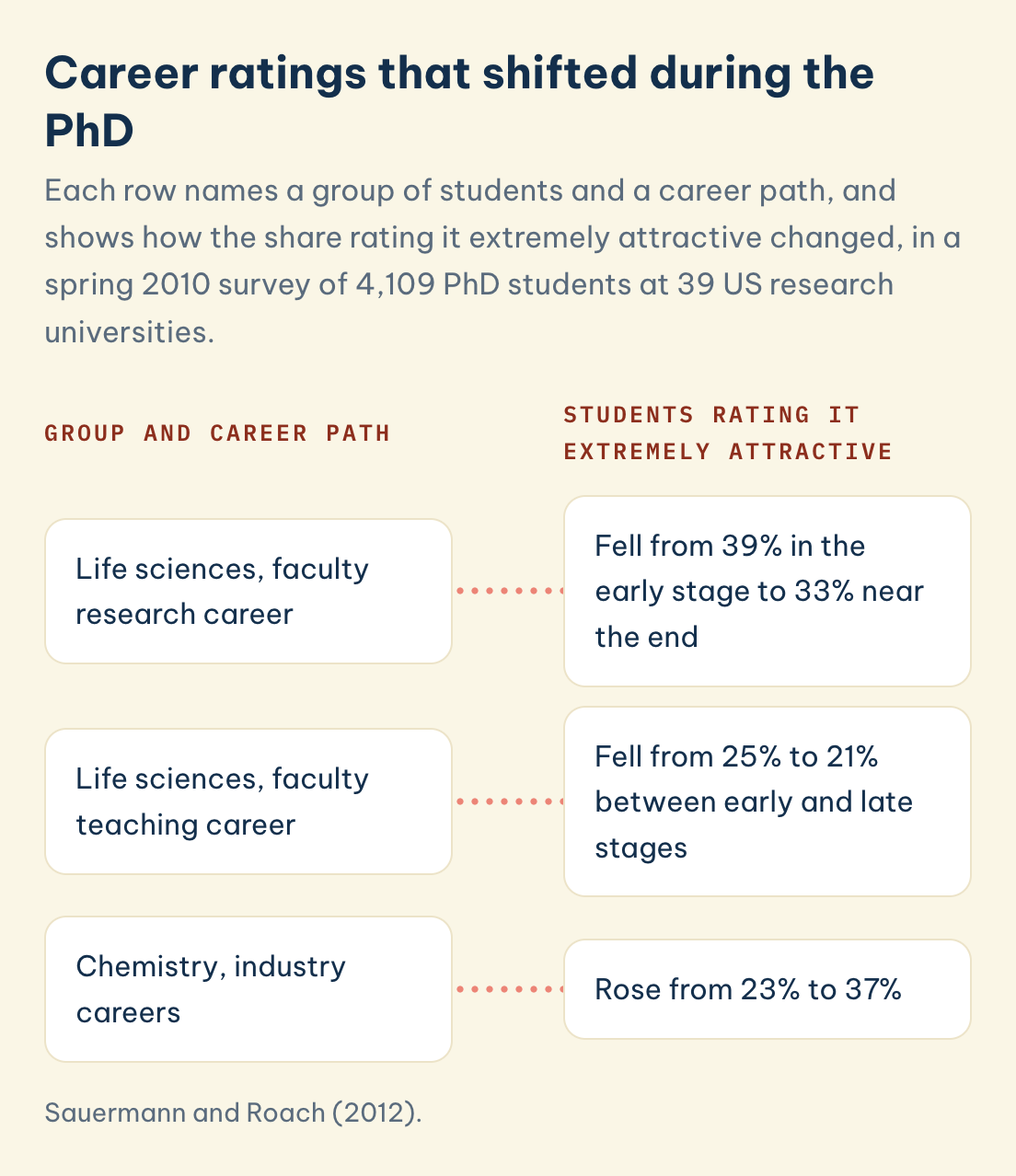
The survey ran in spring 2010 and covered students in the life sciences (59% of the sample), chemistry (17.7%) and physics (23.2%), with an average time in the programme of 3.7 years (Sauermann & Roach, 2012). In the life sciences, 53% of students still gave their highest rating to faculty research, but the share finding a faculty teaching career extremely attractive declined from 25% to 21% between early and late stages. In chemistry, the share rating industry careers extremely attractive rose from 23% to 37%, and the authors report that these shifts occurred even though advisors strongly encouraged academic careers over non-academic ones.
For someone still deciding, the finding is useful in a specific way. The authors conclude that PhD applicants need information that lets them weigh career options before they start, rather than discovering them in year 3 or 4 (Sauermann & Roach, 2012). The limits are clear too: the data describe preferences, not outcomes, and they come from US science students in a single year, so the pattern in the humanities or in Vietnamese institutions may differ.
◆ Question 5 / 6 · Why people start
Why do people start a PhD in the first place?
Direct answer: Usually for several reasons at once. Brailsford (2010) interviewed 11 History PhD holders from an Australasian university and found that they cited improved career prospects, personal development and intrinsic interest in the discipline, often together, rather than one deciding motive.
The study is small and deliberately narrow, 11 History graduates at 1 university, but its central finding matches the wider literature it reviews: "candidates enter the doctorate with multiple motives" (Brailsford, 2010, p. 15). One participant put the topic first: "I did the PhD because of the topic rather than the other way round" (Brailsford, 2010, p. 21). Several participants also acknowledged that starting was risky or uncertain, and described the decision with images such as a leap in the dark, which suggests that the choice was rarely made with a settled plan for what would come after.
Mixed motives are not a warning sign in themselves. The practical lesson is that one of the motives needs to be the research work, because the other motives, such as a title or a career step, can often be reached by other routes, while the thesis examined under Article 22 cannot be completed without sustained interest in the question. The QAA statement makes a related point from the institution's side, noting that some programmes require professional internships to widen candidates' experience beyond academia (QAA, 2020, p. 14).
◆ Question 6 / 6 · A question you can answer
How do you turn "should I do a PhD" into a question you can answer?
Direct answer: Replace it with 3 checkable questions. Can you name a research question you would work on for 3 to 4 years? Does the work you want after the degree require independent research? Where is that work done, given that universities hire a minority of graduates? Answer all 3 in writing.
A workable order takes 4 steps. First, write your research interest as a question in one sentence, then read 2 or 3 recent papers on it to see whether you want to add to that conversation rather than only read it. Second, list 3 roles you would want after the degree and check whether each one asks for independent research, which is the capacity Article 21, clause 1 certifies. Third, decide which programme orientation fits, since Article 18, clause 1 separates research-oriented from application-oriented doctorates. Fourth, test the direction with a supervisor search, because a question that no specialist can recognise is not yet a doctoral project.
Each step also connects to decisions covered elsewhere. How long the commitment runs is set out in how long a PhD programme takes, what the programme costs and who sets each price is in the three price setters of a PhD, and whether your degree matches the programmes you would apply to is in which degree to study for a PhD. If the research question you have in mind comes from your own workplace rather than from the literature, how a DBA differs from a PhD sets out which doctorate that question fits.
If you want a second reader on whether your research direction is ready for doctoral applications, MAAS works with applicants as academic advisors: our experts draft the proposal from your own account of your research and challenge the question, the fit and the timeline, while you review, edit and approve it and make the decision. No one can promise a PhD place or a scholarship, since that decision belongs to the admissions committee and the supervisor. You can see the full pathway in our PhD application guide, and the scope of the advisory work in PhD supervisor search and application strategy.
Frequently asked questions
Is a PhD just a higher level of study than a master's?
No. The Vietnamese circular judges a thesis on whether the candidate researched independently and added something new, and the UK Level 8 descriptor asks for work that expert reviewers would accept, which is a different test from mastering what is already known.
Do most PhD graduates become university lecturers?
Not in the fields that have been measured. Larson et al. (2014) estimated that only 12.8% of US engineering PhD graduates can take a tenure-track post if faculty numbers stay constant.
Is it normal to change career plans during a PhD?
Yes. In a survey of 4,109 US science PhD students, the share of life sciences students rating faculty research extremely attractive fell from 39% to 33% between the early and late stages (Sauermann & Roach, 2012).
Is it a problem to have several reasons for starting a PhD?
Not by itself. Brailsford (2010) found that doctoral candidates typically start with multiple motives, and the useful check is whether interest in the research question is one of them.
Who reviews a doctoral thesis in Vietnam under the new regulation?
Article 22 of Circular 53/2026/TT-BGDĐT sends the thesis to 3 reviewers before the defence, and no more than 1 of them may work at the institution that trained the candidate.
Related MAAS guides
References
Brailsford, I. (2010). Motives and aspirations for doctoral study: Career, personal, and inter-personal factors in the decision to embark on a History PhD. International Journal of Doctoral Studies, 5, 15-27. https://doi.org/10.28945/710
Larson, R. C., Ghaffarzadegan, N., & Xue, Y. (2014). Too many PhD graduates or too few academic job openings: The basic reproductive number R0 in academia. Systems Research and Behavioral Science, 31(6), 745-750. https://pmc.ncbi.nlm.nih.gov/articles/PMC4309283/
Ministry of Education and Training. (2026). Circular 53/2026/TT-BGDĐT on the regulation for graduate admissions and training. Công báo, issue 447, 28 July 2026. https://congbao.chinhphu.vn/van-ban/thong-tu-so-53-2026-tt-bgddt-470098/67203.htm
Quality Assurance Agency for Higher Education [QAA]. (2020). Characteristics statement: Doctoral degree. https://www.qaa.ac.uk/docs/qaa/quality-code/doctoral-degree-characteristics-statement-2020.pdf
Quality Assurance Agency for Higher Education [QAA]. (2024). The frameworks for higher education qualifications of UK degree-awarding bodies. https://www.qaa.ac.uk/docs/qaa/quality-code/the-frameworks-for-higher-education-qualifications-of-uk-degree-awarding-bodies-2024.pdf
Sauermann, H., & Roach, M. (2012). Science PhD career preferences: Levels, changes, and advisor encouragement. PLOS ONE, 7(5), e36307. https://doi.org/10.1371/journal.pone.0036307
A free 20-minute consultation is a conversation about your situation and whether your research direction is ready for doctoral applications.
Book a free consultation ▸