
◆ PhD Admissions
What does PhD stand for, and how does it differ from other doctorates?

Search for the meaning of PhD and the first answers agree on the words, Doctor of Philosophy, then split on everything that follows: whether a PhD is the same thing as a doctorate, which one ranks higher, and whether you write Dr or PhD after your name. The confusion is understandable, because the abbreviation comes from a 19th-century German term and the letters no longer describe the subject most candidates study. Official documents are clearer than the search results. The Quality Assurance Agency for Higher Education [QAA] (2020, p. 3) calls the PhD the main doctoral qualification in the UK, and the Australian Qualifications Framework (n.d.) treats it as one of two forms of Level 10 Doctoral Degree.
Direct answer: PhD stands for Doctor of Philosophy, from the Latin Philosophiae Doctor. It is one type of doctorate, the research doctorate, so it is not higher or lower than "a doctorate". Other doctorates, such as the EdD, DBA and DSc, differ in purpose and in what they certify.
◆ Question 1 / 7 · What PhD stands for
What does PhD literally stand for?
Direct answer: PhD is the abbreviation of Doctor of Philosophy. The letters come from the Latin Philosophiae Doctor, and the University of Oxford (n.d.) traces the initials to the German term philosophiae doctor used in the 19th century. Oxford anglicised the title to Doctor of Philosophy and abbreviates it DPhil.
The history explains why the initials differ between countries. Yale's Graduate School of Arts and Sciences (n.d.) records that in 1861 Yale awarded three PhDs, the first in the United States. Oxford followed a different route: Ross (2010) reports that the Oxford DPhil was established by statute in 1917 and first awarded in 1920. The University of Oxford (n.d.) tells the same story from its own side: the German-derived title was rendered in English as Doctor of Philosophy, and the shortened form that resulted is DPhil.
Today the two abbreviations name the same kind of degree. QAA (2020, p. 19) states that "the title DPhil is used for subject specialist doctorates at a small number of providers, as an alternative to the title PhD." Whether the certificate says PhD or DPhil therefore tells you about the university's tradition, not about the level of the work.
◆ Question 2 / 7 · The h in PhD
What does the h in PhD stand for?
Direct answer: The h stands for Philosophiae, the Latin word that gives Philosophy its place in the title. The letters P and h are the first two letters of Philosophiae, and D stands for Doctor. The abbreviation is therefore a Latin inheritance.
The "philosophy" in the title is not a statement that the candidate studied philosophy. In its older and broader sense the word meant the love of knowledge and learning, and the doctorate was first a degree for people who showed they could advance learning in any field. That explains why a chemist, a historian and an economist can all hold a Doctor of Philosophy. As a general explanation it is widely accepted, though universities word it differently, so check the history page of your own institution if the exact phrasing matters for a formal document.
The practical consequence is simple. Nothing in the letters tells you the discipline, the country or the length of the programme. The discipline appears on the certificate or transcript, and the subject area is named in the thesis title, so someone reading "PhD" on a CV learns the type of degree and nothing more about the field.
◆ Question 3 / 7 · PhD vs doctorate
How is a PhD different from a doctorate?
Direct answer: A doctorate is the general level and a PhD is one kind of doctorate. All UK doctorates, whatever their form, require the candidate's main work to demonstrate an original contribution to knowledge, and the PhD is the research form of that level, not a separate level above it.
The QAA statement frames the relationship in these terms. It says that "the PhD (or DPhil in some universities) is the main doctoral qualification in the UK" (QAA, 2020, p. 3), and that "an example of a subject specialist doctorate is the Doctor of Philosophy (PhD or DPhil, used interchangeably). Subject specialist doctorates are by far the most common form of doctorate in the UK" (QAA, 2020, p. 6). Read together, these passages describe "doctorate" as a family and PhD as its largest member.
The Australian Qualifications Framework (n.d.) draws the same line from a different angle. It places the Doctoral Degree at Level 10 and describes two forms: "The research Doctoral Degree (typically referred to as a Doctor of Philosophy) makes a significant and original contribution to knowledge; the professional Doctoral Degree (typically titled Doctor of [field of study]) makes a significant and original contribution to knowledge in the context of professional practice." In both systems, "doctorate" is the umbrella and "PhD" is a named member of it.
◆ Question 4 / 7 · Which is higher
PhD and doctorate: which is higher?
Direct answer: Neither is higher. A PhD and a professional doctorate sit at the same qualification level, and both must make an original contribution to knowledge. Only the higher doctorates, such as the DSc and DLitt, are awarded at a level above them, and those are not taught or supervised programmes.
In the UK, the QAA (2020, pp. 9-10) describes higher doctorates as a higher level awarded for a substantial body of published original research of distinction over a significant period, or as honorary awards. A candidate does not enrol in a higher doctorate in the way they enrol in a PhD. In Australia the Doctoral Degree sits at Level 10 of the framework, and both the research and the professional form are placed there (Australian Qualifications Framework, n.d.).
So the question "which is higher" usually hides a different question: which suits my goal. A PhD trains you to design and carry out independent research, usually on a question you define with a supervisor. A professional doctorate asks a similar standard of originality but applies it to practice in a profession. Employers and universities read the two as different kinds of evidence, which matters more than any ranking between them. If you are choosing between the two routes, our guide on how a DBA differs from a PhD sets out the research-question test in detail.
◆ Question 5 / 7 · Types of doctorate
What types of doctorate degrees are there?
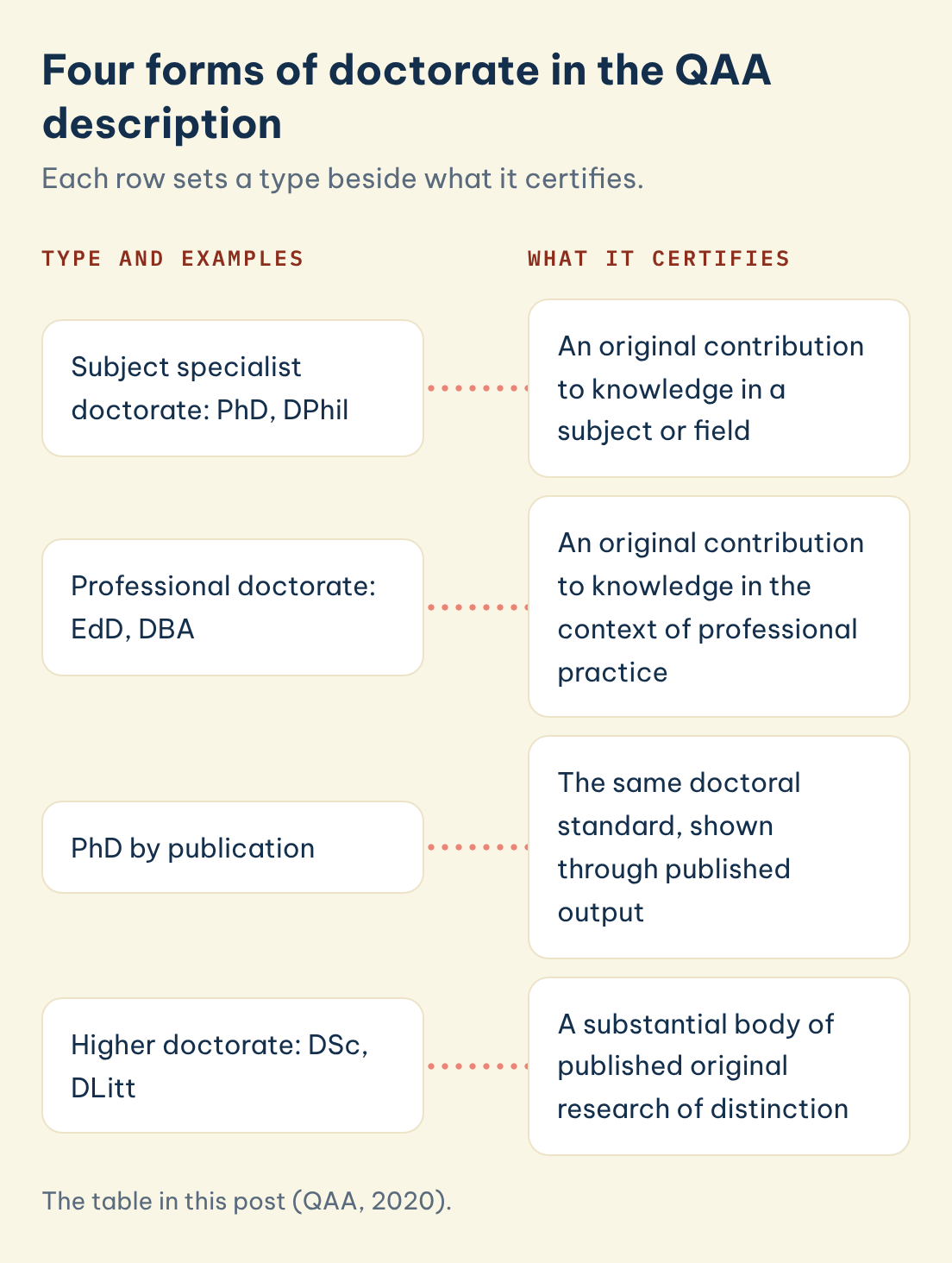
Direct answer: Four forms appear in the QAA description: the subject specialist doctorate (PhD or DPhil), the professional doctorate (such as EdD or DBA), the PhD by publication, and the higher doctorate (DSc, DLitt). The first three share one standard of original contribution.
Four forms of doctorate in the QAA description
Each row sets a type beside what it certifies.
Type and examples
What it certifies
Subject specialist doctorate: PhD, DPhil
An original contribution to knowledge in a subject or field
Professional doctorate: EdD, DBA
An original contribution to knowledge in the context of professional practice
PhD by publication
The same doctoral standard, shown through published output
Higher doctorate: DSc, DLitt
A substantial body of published original research of distinction
Save this figure
| Type | Examples | Typical candidate | What it certifies |
|---|---|---|---|
| Subject specialist (research) doctorate | PhD, DPhil | Someone who wants a research career or a deep specialism | An original contribution to knowledge in a subject or field |
| Professional doctorate | EdD, DBA, "Doctor of..." | An experienced professional in business, education, engineering, law, nursing or psychology | An original contribution to knowledge in the context of professional practice |
| PhD by publication | PhD | A researcher whose published work already forms a body of research | The same doctoral standard, shown through published output |
| Higher doctorate | DSc, DLitt | An established scholar, or an honorary recipient | A substantial body of published original research of distinction |
The QAA (2020, p. 8) says professional doctorates use the title "Doctor of..." and are designed for professions including business, education, engineering, law, nursing and psychology, with the EdD and the DBA as examples. It also notes that a PhD by publication exists (QAA, 2020, pp. 7-8). The word "regardless" in the QAA statement carries the point of this table: all UK doctorates, regardless of their form, require the main focus of the candidate's work to demonstrate an original contribution to knowledge in their subject, field or profession (QAA, 2020, p. 3).
◆ Question 6 / 7 · Dr or PhD
Can someone with a PhD use the title Doctor, and is it better to use Dr or PhD?
Direct answer: A person who holds a PhD may use the title Dr in academic contexts, and the letters PhD can be placed after the name. Style conventions differ by institution, country and publication, so follow the guidance of the organisation where the name will appear.
The two forms do different jobs. "Dr" is a title placed before the name and is used in address, on correspondence and in formal introductions. "PhD" is a post-nominal placed after the name, and it states the qualification itself. Many CVs and publications use one or the other, and writing both together, as in "Dr Jane Smith, PhD", is regarded as redundant in some style guides and acceptable in others. No single rule applies everywhere, so treat any claim of one universal convention with caution.
A sensible approach has two parts. For academic correspondence and conference programmes, use "Dr" before the name, because it is brief and expected. For a CV, a byline or a professional biography where the type of doctorate matters, put the letters after the name, so that a reader can tell a PhD from an EdD or a DBA at a glance. If a journal, university or employer publishes a style guide, that guide decides.
◆ Question 7 / 7 · Which fits you
Which doctorate fits you, and who can help you decide?
Choosing between a PhD and a professional doctorate depends on whether your question comes from a literature or from a workplace, and on the career you want afterwards. If you are weighing the two, MAAS works as an academic advisor alongside you: our experts give advice on choosing between a PhD and a professional doctorate, help you test your research direction, and prepare application documents from your own research and goals, while you review, edit and approve everything and submit your own applications. No one can promise a place or a scholarship, because that decision belongs to the admissions committee and the supervisor. The scope of the advisory work is set out under PhD supervisor search and application strategy, and the wider pathway is in our PhD application guide. For the decision that comes before this one, see should you do a PhD, and what the degree certifies.
Frequently asked questions
What does PhD stand for?
Doctor of Philosophy. The initials come from Latin, and Oxford's alumni history links them to a German academic title of the 19th century (University of Oxford, n.d.).
Is a PhD a doctorate?
Yes. The PhD is the main doctoral qualification in the UK (QAA, 2020, p. 3), and in Australia the research Doctoral Degree is typically referred to as a Doctor of Philosophy (Australian Qualifications Framework, n.d.).
Is a PhD the same as a DPhil?
Yes, in the sense that matters. The QAA (2020, p. 19) says the title DPhil is used at a small number of providers as an alternative to the title PhD, so the two name the same kind of degree.
Which is higher, a PhD or a professional doctorate?
Neither. Both require an original contribution to knowledge, and the difference is the setting: research in a discipline for the PhD, professional practice for the EdD or DBA.
Why is it called Doctor of Philosophy if I study science?
The word philosophy is used in its older sense of love of learning, so the title covers any field. The letters do not describe the discipline you studied.
Should I write Dr or PhD after my name?
Dr goes before the name and PhD goes after it. Conventions vary by institution and publication, so follow the style guide of the place where your name will appear.
What is a higher doctorate such as a DSc?
It is a qualification awarded for a substantial body of published original research of distinction over a significant period, or as an honorary award, often to people who already have a reputation for research in their field (QAA, 2020, pp. 9-10).
Related MAAS guides
References
Australian Qualifications Framework. (n.d.). AQF qualifications. https://www.aqf.edu.au/framework/aqf-qualifications
Quality Assurance Agency for Higher Education. (2020). Characteristics statement: Doctoral degree. https://www.qaa.ac.uk/docs/qaa/quality-code/doctoral-degree-characteristics-statement-2020.pdf
Ross, A. J. (2010). Togas gradui et facultati competentes: The creation of new doctoral robes at Oxford, 1895-1920. Transactions of the Burgon Society, 10(1), 47-70. https://doi.org/10.4148/2475-7799.1084
University of Oxford. (n.d.). 100 years of the DPhil. Oxford Alumni. https://www.alumni.ox.ac.uk/quad/article/100-years-dphil
Yale Graduate School of Arts and Sciences. (n.d.). Mission & history. https://gsas.yale.edu/about/mission-history
Not sure how this guide applies to your own case? Talk it through with MAAS in a free 20-minute consultation.
Book a free consultation ▸