
◆ PhD Admissions
How long is a PhD, and what does that number measure?
Category: admissions
Last updated: 2026-09-08

Ask how long a PhD takes and every source answers with a single number: three years in the United Kingdom, four in Australia, five or six in the United States. The number is real, it is published, and it is almost never the answer to the question the reader is asking. A programme page states a term of registration or a term of funding. The reader wants to know when they will be finished. Those are two different quantities, and university regulations keep them in separate columns on purpose.
Direct answer: The advertised figure is an administrative term, not a forecast. UK research-degree regulations publish three separate numbers for the same degree: a minimum period before you may submit, an expected period that often tracks the funder's term, and a maximum period after which registration lapses. Actual completion sits between the second and the third.
Once you see the three columns, the planning question changes. You are not asking how fast you can work. You are asking which of the three numbers your money runs out under, which one your visa is written against, and which one the university will enforce. Our guide to who decides PhD studentship funding sets out who holds the purse in each system; this article takes the timetable that purse buys.
◆ Section 1 / 6 · UK, US and Australia
How long is a PhD in the UK, the US and Australia?
Direct answer: In the UK the doctorate is a three-year minimum with a four-year maximum at most institutions. Australian and New Zealand doctorates run to a similar shape. United States programmes are longer because they attach coursework and qualifying examinations in front of the research, so a five-year to six-year span is normal rather than exceptional.
The British figures are worth reading in the regulations rather than in a prospectus, because the regulations show the range that the prospectus compresses. The University of Bristol sets a full-time PhD at "a normal minimum of three years and a maximum of four years", and the part-time equivalent at a minimum of six and a maximum of eight. The University of Glasgow expresses the same structure in academic sessions: a minimum of three full-time sessions, and a maximum of four sessions from first registration within which the thesis must be submitted. King's College London publishes a slightly different pair, a minimum submission period of 24 months and a maximum of 48 months full-time, with 48 and 84 months for part-time candidates, which means a part-time candidate at King's has a shorter ceiling than a part-time candidate at Bristol. Swansea University publishes a fourth variant, three years minimum and four maximum full-time, six and seven part-time, and states the governing principle plainly: the maximum submission period will normally be one year more than the minimum candidature period.
Those small divergences matter more than the headline. Two universities both advertising "three years" can enforce ceilings a full year apart, and a candidate who assumes the ceiling is universal will discover otherwise at the point where an extension request is being written rather than at the point where the programme is being chosen. Reading the ceiling before you apply is the same discipline we describe in our guide to reading a PhD admissions page for fit, applied to the calendar instead of to the entry criteria. The calendar has a money side as well, covered in PhD cost and who sets the price.
◆ Section 2 / 6 · Funded period or maximum
What is the difference between a funded studentship period and a maximum registration period?
Direct answer: The funded period is how long somebody pays you. The maximum registration period is how long the university will let you remain enrolled. Neither is a prediction of when the thesis will be finished, and in most systems the funded period ends first, leaving a gap the candidate finances themselves.
Full-time expected period
36 months
or within the duration of research funding if longer
Part-time expected period
72 months
or the funding term
Three periods for one degree at the University of Surrey
Bars run from the minimum to the maximum registration period, in months.
Save this figure
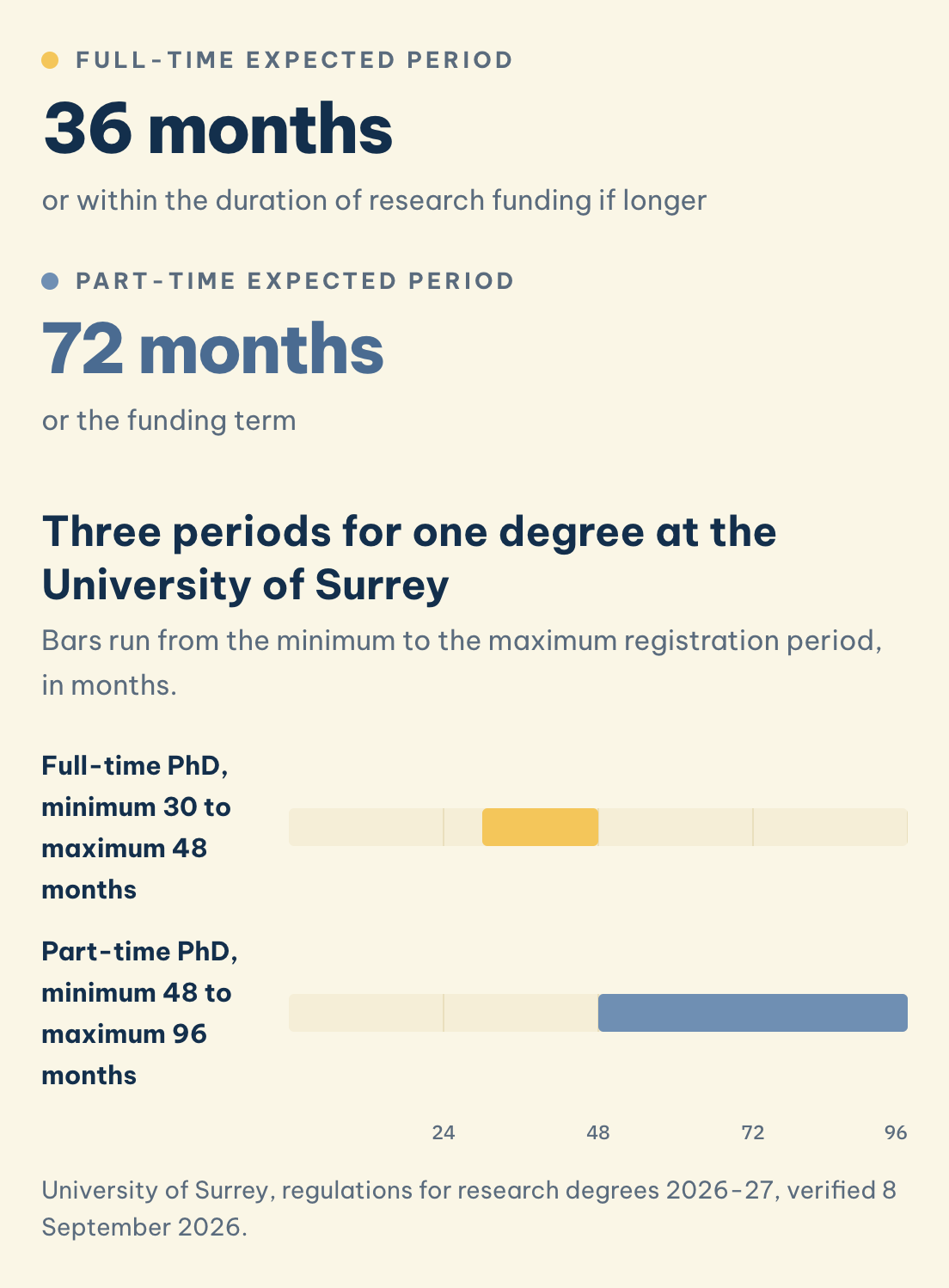
The clearest published statement of the gap comes from the University of Surrey, whose research-degree regulations put three numbers in one table. A full-time PhD carries a minimum period of registration of 30 months, a maximum period of 48 months, and an expected period of "36 months or within the duration of research funding if longer", verified on 8 September 2026. Read the middle column again. The regulation does not state a fixed expected duration at all; it defers to whatever the funder decided. The part-time row does the same thing, with 48 months minimum, 96 months maximum, and an expected period of 72 months or the funding term. The contrast within the same table is instructive: the MPhil rows carry 20 months minimum and 36 months maximum full-time, with no expected period at all, and the EngD carries 45 and 54 months. Only the doctorate is written as a function of the money.
UK Research and Innovation writes the other half of the same arrangement into its training grant conditions. The awarding body sets the parameters, and its guidance states that "Councils expect doctoral projects to be designed and supervised in such a way that Students are able to submit their thesis within the funded period, as defined at the outset of the project", verified on 8 September 2026. The funded period is therefore a design constraint imposed on the supervisor at the moment the project is written, which is well before the candidate exists. That is why the number on the advertisement is stable across candidates of very different speeds. The money attached to it is equally fixed in advance: UKRI set the minimum doctoral stipend at £20,780 for 2025 to September 2026, rising to £21,805 from 1 October 2026, with a London weighting of £23,805 from the same date.
There is a third term nobody advertises, and it belongs to the university rather than the funder. Glasgow's regulations note that any period of thesis-pending status counts towards the maximum period of study, and that an approved suspension extends the maximum by the length of the suspension. So the ceiling moves for illness or parental leave but not for slow progress, and time spent waiting for examiners is charged to the candidate's account.
◆ Section 3 / 6 · How long candidates take
How long do doctoral candidates actually take to finish?
Direct answer: Measured completion sits above the nominal term almost everywhere it has been measured. Danish three-year salaried positions average 3.58 years. Australian graduates who published four or more articles recorded a median of 3.76 full-time-equivalent years. South African doctorates, which carry no comparable national ceiling, average 4.25 years.
The Danish case is the cleanest test, because the programme term and the employment contract are the same object. Wichmann-Hansen and Herrmann (2017) describe a system in which doctoral studentships are three-year full-time salaried positions and a complete financing plan must exist before a candidate can be enrolled, and they report an average completion time of 3.58 years for a three-year programme. A gap of roughly seven months, in the country that has done the most to align funding with duration, is a reasonable floor for what any other system should expect. Their survey covered 1,690 doctoral students at a single research-intensive Danish university, which is a large enough base to make the gap a structural feature rather than a local accident.
Australia gives the second reading. Churchill et al. (2021) drew on 1,143 doctoral graduates from a single Australian university across the period 2000 to 2020, with complete publication data for 707 and time-to-degree data for 664, and treated 0 to 3.99 full-time-equivalent years as "the 'ideal' duration in this context" (p. 700). Graduates in the highest publication category, four or more primary-author articles, recorded a median of 3.76 full-time-equivalent years, so even the fastest and most productive group sits close to the top of the band that the institution calls ideal. A third of that cohort, 33.1%, published four or more papers during candidature and up to 24 months after submission. Publishing during candidature did not lengthen the degree, which contradicts the folk assumption that time spent on papers is time stolen from the thesis. These figures describe people who finished; the share who never finish, and the conditions that predict it, are covered in whether a PhD abroad is hard to get into or to finish.
South Africa supplies the counterfactual, because its doctorate is not built around a funded three-year term in the same way. Van Lill (2024) analysed national higher-education management data for 2000 to 2021 and reported a mean time-to-degree of 4.25 years across the five disciplines studied, with physics the quickest at 4.48 years (SD = 1.69) for the full period, followed by electrical engineering at 4.6 years (SD = 1.99), foundations of education at 4.63 years, sociology at 5.1 years and medical clinical sciences at 5.34 years. Observations longer than 12 years were removed before modelling, so the reported means are already conservative. Where no funder term compresses the calendar, the calendar expands.
◆ Section 4 / 6 · Why a PhD runs long
What makes a PhD run past its advertised length?
Direct answer: Three things dominate. The research design itself, where fieldwork, ethics approval, recruitment or archive access impose waits nobody controls. The mode of enrolment, which is the strongest single predictor in the measured data. And the structure of the programme, where coursework and qualifying examinations sit in front of the research rather than beside it.
The measured evidence puts enrolment mode first. Van Lill (2024) states that "mode of enrolment is the strongest predictor of completion time with part-time students recording a statistically significantly longer time-to-degree when compared to full-time students" (p. 168), and finds that discipline, nationality and institution are also significant while gender, race and commencement age are not. In the fourth model, a graduate in medical clinical sciences finished on average 0.438 years later than one in electrical engineering, and the mean time-to-degree across all observations was 4.25 years. That ordering is useful precisely because it demotes the variables applicants worry about most.
The design factors are the ones a proposal can act on. A project that needs ethics clearance, a recruited sample, a fieldwork season or access to a restricted archive has waiting time built into it that no amount of writing speed removes, and the waiting is concentrated in the first half of the programme where the candidate has least leverage. This is the practical reason to settle the scope of the project before the first year closes, and it is why we treat scope as an admissions-stage question in our guide to narrowing a research direction rather than as something to sort out later.
Programme structure explains most of the transatlantic gap. Where a system admits candidates from a bachelor's degree and requires one to two years of coursework plus comprehensive examinations before the dissertation begins, the total lengthens without anybody working more slowly. Comparing a US figure with a UK figure therefore compares two different objects, and the comparison only becomes meaningful once you subtract the pre-research phase.
◆ Section 5 / 6 · Part-time PhD
How long does a part-time PhD take?
Direct answer: Nominally about double, with a ceiling that varies more between institutions than the full-time ceiling does. Bristol sets six years minimum and eight maximum, Surrey sets 48 and 96 months, King's College London sets 48 and 84 months, Swansea sets six and seven. Funders will fund part-time study, at a reduced rate, and the reduction is proportional.
UKRI's terms state that a part-time award "should not be less than 50% of the full-time equivalent", and its guidance adds that the period of study is expected to reflect the percentage of time spent on doctoral study, with a minimum of 50% full-time equivalent required. The same guidance permits a change of mode of study at any time. Notice what that does to the ceiling: change mode and the maximum period is recalculated, which several UK regulations state explicitly, so a mid-programme switch alters a deadline the candidate may not have been tracking.
The part-time route also carries an evidential warning. Van Lill's finding that part-time enrolment is the strongest predictor of a longer time-to-degree is a statement about elapsed years, not about effort or ability, and it interacts with commencement age in the same models. A candidate choosing part-time study for good reasons should choose it knowing that the elapsed-time cost is the largest measured effect in the literature, and should confirm the specific ceiling their institution enforces rather than assuming it is simply double. Our guide to studying for a PhD while working sets out what that registration category actually changes. Before committing to years of registration, whether you should do a PhD at all is the prior question.
Frequently asked questions
Does a master's degree shorten a PhD?
In systems that admit from a bachelor's degree and then require coursework, entering with a relevant research master's can remove part of the pre-research phase. In systems that admit directly to research, such as the UK, the nominal term does not change, though prior research training can shorten the time spent settling the project. The effect is on the pre-research phase, not on the thesis.
Can I finish earlier than the minimum period?
Rarely, and only by exception. Glasgow's regulations allow the Senate to reduce the minimum period by up to one academic session in exceptional cases, and Surrey's allow a reduction under stated conditions. The minimum exists so that the university can certify a period of supervised research, so early submission is an administrative decision rather than a reward for speed.
What happens if I reach the maximum period without submitting?
You apply for an extension, and the application is judged. Glasgow directs candidates who have not submitted by the maximum period to apply to the College Higher Degrees Committee. Bristol allows a funded full-time student an additional year on the maximum period in defined circumstances. The consequence of refusal is that registration lapses, so this deadline is the one worth tracking.
Is the number on the funder's page or the number in the regulations the binding one?
Both bind, at different points. The funder's term determines when payment stops. The university's maximum period determines when registration stops. Surrey's regulations make the relationship explicit by defining the expected period as the funding duration where that is longer, which is the clearest published acknowledgement that two clocks run at once.
◆ Section 6 / 6 · Where MAAS fits
Where MAAS fits
MAAS works with candidates at the stage where these numbers are still choices rather than constraints. Reading a programme's three periods against a funder's term, and against the shape of the research the candidate actually wants to do, is part of the proposal work in PhD Application Strategy. Your expert drafts the proposal from your own account of your research, and you read, edit and approve it and answer for it in front of the panel. We also press on the parts where the timetable and the research design contradict each other, before an admissions panel does. The wider sequence is set out in our PhD application resource hub.
Matching a candidate to a mentor follows one of two paths. Where our network already includes a suitable specialist, the match is confirmed within 48 hours. Where it does not, MAAS opens a dedicated recruitment round, which normally takes about two weeks.
References
Churchill, M. P., Lindsay, D., Mendez, D. H., Crowe, M., Emtage, N., & Jones, R. (2021). Does publishing during the doctorate influence completion time? A quantitative study of doctoral candidates in Australia. International Journal of Doctoral Studies, 16, 689-713. https://doi.org/10.28945/4875
Van Lill, M. H. (2024). A study of doctoral time-to-degree in selected disciplines at South African public universities. South African Journal of Higher Education, 38(1), 168-188. https://doi.org/10.20853/38-1-6268
Wichmann-Hansen, G., & Herrmann, K. J. (2017). Does external funding push doctoral supervisors to be more directive? A large-scale Danish study. Higher Education, 74(2), 357-376. https://pure.au.dk/ws/files/135210465/Does_external_funding_push_doctoral_supervisors_to_be_more_directive_Accepted_manuscript_2017.pdf
Tools & resources
- University of Surrey, regulations for research degrees 2026-27: https://www.surrey.ac.uk/sites/default/files/2026-08/A2-regulations-for-research-degrees-2026-27.pdf
- University of Bristol, period of study: https://www.bristol.ac.uk/academic-quality/pg/code-of-practice/information/study-period/
- University of Glasgow, regulations for postgraduate research awards: https://www.gla.ac.uk/myglasgow/policy/regulations-current/pgr/
- King's College London, framework for postgraduate research awards: https://www.kcl.ac.uk/assets/arqs/academic-manual/current-year/chapter-6-framework-for-postgraduate-research-awards.pdf
- Swansea University, guide to research degree candidature: https://hwb.swansea.ac.uk/academic-life/academic-regulations/research-guidance/guide-to-research-degree-candidature/
- UK Research and Innovation, standard terms and conditions of training grant: https://www.ukri.org/publications/terms-and-conditions-for-training-funding/ukri-training-grants-standard-terms-and-conditions-of-training-grant/
A free 20-minute consultation is a conversation about your situation and the programmes whose periods you are comparing.
Book a free consultation ▸