
◆ PhD Admissions
What actually makes up the cost of a PhD programme?
Category: admissions
Last updated: 2026-09-10

Most people approach this question the way they would approach a price tag, expecting one number that can be compared across countries and then budgeted for. A doctoral programme does not price itself that way, and the gap between the two mental models is where planning usually breaks. The cost is assembled from three separate streams, each set by a different party, each moving on its own schedule, and only one of them appears on the page you are most likely to read first.
Direct answer: Three parties set the cost, not one. The university sets tuition and publishes two prices for the same programme. The funder caps its contribution, usually at the lower price. Your own progress schedule sets a third stream that appears only if you overrun.
Understanding which party sets which stream matters more than memorising any figure, because the three streams behave differently under pressure. Tuition is fixed and published a year in advance. The funder's contribution is capped by policy and does not rise to meet your circumstances. The third stream is the only one you influence directly, and it is the one nobody budgets for.
◆ Section 1 / 6 · How tuition is charged
How is doctoral tuition charged, and why are there two prices for one programme?
Direct answer: Research tuition is charged per academic year of registration, not per credit, and universities publish separate home and international rates for one programme. At Glasgow for 2026/27 the UK rate is £5,238 while the international Arts rate is £27,720.
Arts gap
£22,482
more per year for an international candidate in Arts than for a home candidate on the identical programme
Science and Engineering gap
£27,972
more per year for an international candidate in Science and Engineering than for a home candidate on the identical programme
Glasgow research tuition per academic year, 2026/27
Each bar shows one annual rate in pounds, with yellow for the UK rate and blue for the international rates. The two cards show how much more an international candidate pays than a home candidate.
Save this figure
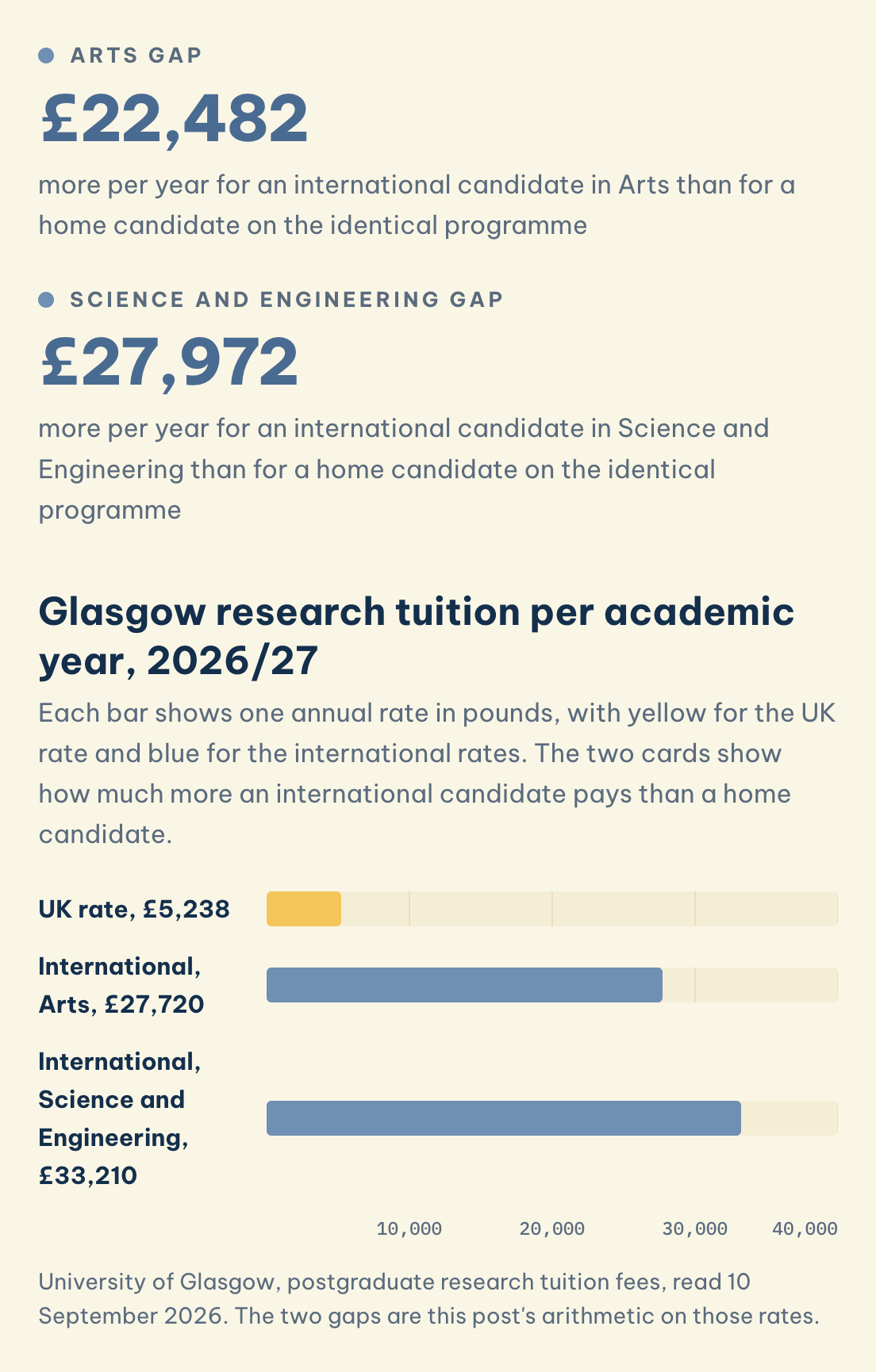
The Science and Engineering international rate at Glasgow is higher still at £33,210, and the clinical rate in Medicine, Dentistry and Veterinary Medicine reaches £50,985. The two-price structure is not a surcharge added on top of a base price. The £27,720 arts rate and the £5,238 home rate are two prices for one degree. It is two distinct rates for one service, and the difference is large enough to dominate every other line in your plan. In the Glasgow figures, an international candidate in Arts pays £22,482 more per year than a home candidate on the identical programme, and in Science and Engineering the gap widens to £27,972. Across a three-year registration that difference alone runs past £67,000 in the arts case.
Glasgow's published rates also move year on year, which is why a figure copied from an older page will mislead you. Glasgow's 2025/26 schedule set the UK rate at £5,006, the Arts and Social Sciences international rate at £26,580 and the Science and Engineering rate at £31,800, so all three lines rose into 2026/27 and the international lines rose by more in absolute terms. Glasgow also offers a 20% tuition discount to eligible self-funded alumni starting a research programme in 2026/27, which is applied without a separate application.
Fee status, not nationality, determines which of the two prices applies to you. Glasgow states that Irish nationals living in the Common Travel Area, EU nationals with settled or pre-settled status, and international candidates with indefinite leave to remain can also qualify for home fee status. That is worth checking before you build any budget, because a status question answered wrongly moves the largest number on your page. New Zealand shows how far fee status can reach, because it grants the home rate to international PhD candidates as a status that depends on the degree label and on living in the country, a condition set out in the guide to New Zealand's domestic PhD fee.
◆ Section 2 / 6 · What the funder pays
What does the funder actually contribute, and where does it stop?
Direct answer: A UK research council studentship pays a stipend plus a fee contribution, but that contribution stops at the home rate. UK Research and Innovation sets the 2026 to 2027 minimum fee at £5,238 and contributes only up to home fee rates.
Read the two figures side by side and the design becomes visible. The UKRI fee contribution of £5,238 matches the Glasgow home rate to the pound, because both are anchored to the same national home fee level. A fully funded international candidate on that studentship therefore still faces the difference between the home rate and the international rate, which is the £22,482 or £27,972 identified above unless the university or the doctoral training partnership covers it separately.
Funded students also keep a minimum of 30 days of annual leave a year under those same terms. The stipend stream is set by the same policy and moves on a published schedule. UKRI's minimum stipend is £20,780 for 2025 to September 2026 and rises to £21,805 from 1 October 2026, with a London weighting of £23,805 from that date. The London weighting stood at £22,780 for 2025 to September 2026 before that increase, so both the base and the weighted figure moved by £1,025. UKRI also states that a provider may not charge additional tuition fees during the funded period, other than some international fees, which is the same boundary expressed from the other direction.
◆ Section 3 / 6 · Admission and admin charges
What do the admission and administrative charges cover?
Direct answer: They pay for the process rather than for the teaching, and they sit outside both the tuition line and most funding packages. Gray (2023) found that first-time international graduate students in the United States pay up to $691 in credential evaluation and visa charges before they enrol.
Gray describes those charges as costs that "are usually not reflected in program fee structures, are non-refundable, and are not covered by financial aid" (Gray, 2023, p. 42). Gray (2023) built that figure by comparing the published charges of two major credential evaluators, Educational Credential Evaluators and World Education Services, and adding visa processing together with the I-901 Student and Exchange Visitor Information System fee. Three properties in that sentence do the work, and each one has a planning consequence. Charges that sit outside the published fee structure will not appear in the comparison you build from programme pages. Charges that are non-refundable become sunk the moment an application fails. Charges that fall outside financial aid stay with you even under a package described as full.
The same category exists on the examination side of the degree. Glasgow's research fee schedule lists a resubmission charge of £540 for a research student and £1,355 for submission for a higher degree by published work, both charged as events rather than as annual fees. The same schedule sets a charge of £790 for submission by staff who hold a staff scholarship, which shows how finely these event charges are segmented. These are small next to tuition, but they behave like the pre-enrolment charges: they arrive at moments when no funder is expecting to pay.
◆ Section 4 / 6 · What a studentship pays
What does a funded studentship actually pay for?
Direct answer: A studentship pays a stipend for living costs plus a fee contribution capped at the home rate, and it is defined by a period rather than a total. UKRI-funded students also receive at least 30 days of annual leave including bank holidays.
The distance between a funded place and a solvent one is well documented. Houkes and Cirillo (2025) surveyed 103 biological anthropology graduate students in the United States with a 29-question instrument and found that nearly all participants depended on some form of financial aid while reporting insufficient stipends and unmet living costs, with 58% having considered leaving the field because of financial pressure. A study of international students in Australia reaches a related conclusion (Mulvey et al., 2023), arguing that financial precarity among international students is differentiated rather than uniform, so a single stipend figure describes very different situations for different people.
A funding letter therefore has one practical reading. It tells you what the funder has undertaken to pay, not what the degree will cost you, and the two documents you need to lay next to each other are the studentship terms and the fee schedule for your own fee status. Whether the total is worth paying is the question in should you do a PhD.
◆ Section 5 / 6 · The cost of overrunning
What does it cost to go past the deadline?
Direct answer: The third stream is triggered by time rather than registration, and your own schedule controls it. Glasgow charges £350 for a thesis submitted after the deadline lapsed, charging part-time study at half of the full-time annual fee, so a longer registration means more billable years.
The regulatory clock behind those charges is public in most systems. Vietnam's Circular 53/2026 sets ceilings on each stage after submission, allowing up to six months for independent review, a further three months if a second review is required, and three months from a satisfactory review to the defence itself. Those limits sit in Article 22 and Article 23 of the circular. Those ceilings define how long the tail of a doctorate can legitimately run, and every month inside that tail is a month of living costs that no funder is still paying.
The overrun stream therefore deserves a line in the budget even though it may never be spent. The first two streams are known a year ahead and cannot be negotiated by you. The third is uncertain, avoidable in part, and arrives at the point where funding has usually stopped.
◆ Section 6 / 6 · Building a cost plan
Building a cost plan you can actually check
Work from the three streams rather than from a single total. Confirm your fee status with the university in writing before you compare programmes, because that answer moves the largest figure. Then read the funding terms for the ceiling rather than the headline, and ask the department in writing who covers any difference between the home and international rate. Finally, price a realistic overrun rather than the minimum registration period.
If you want a second reader on how a specific funding package and fee schedule should change which programmes you apply to, MAAS works with applicants as academic advisors: our experts draft the documents from your own account of your work and challenge the argument and the evidence in them, while you review, edit and approve every document and submit the file yourself. Our guide to who decides PhD studentship funding sets out which party holds the money in each route, and the funding decision in US admissions covers the case where the fee question is settled inside the admission itself. You can see the full pathway in our PhD application guide, and the scope of the advisory work in PhD supervisor search and application strategy.
Frequently asked questions
Is doctoral tuition charged per year or per credit?
In research degrees it is normally charged per academic year of registration, because there is no taught credit load to price. Glasgow publishes a single annual research degree fee for 2026/27 and charges part-time study at half that annual rate, so the total depends on how many years you remain registered.
If I win a full studentship, is my tuition covered?
Not necessarily in full if you are an international candidate. UKRI contributes up to the value of home fee rates, set at £5,238 for 2026 to 2027, and states that an international student may have to contribute to the remainder, so the covering document to ask for is the one that addresses the difference.
Which costs fall outside both tuition and funding?
Pre-enrolment administrative charges and event-based examination charges. Gray (2023) documented up to $691 in credential evaluation and visa costs that are non-refundable and outside financial aid, and Glasgow lists a £540 resubmission fee and a £350 late submission fee as separate line items.
How much does an overrun cost?
It costs additional registration and living costs plus any event-based charge for late submission, which is £350 at Glasgow. Because the post-submission stages themselves have regulated ceilings, a realistic plan prices the tail of the degree rather than only the minimum period.
Does a stipend cover living costs?
It is intended to, but survey evidence says the intention is often not met. Houkes and Cirillo (2025) found insufficient stipends and unmet living costs across a sample of 103 graduate students, with 58% having considered leaving the field for financial reasons.
Related MAAS guides
References
Gray, N. (2023). The invisible hurdle: Hidden costs for first-time, international, graduate students in the United States. Journal of International Students, 13(4), 42–47. https://doi.org/10.32674/jis.v14i3.5355
Houkes, A. E., & Cirillo, L. (2025). Financial barriers to success: Opening the discussion of the financial burdens and graduate student experiences in bioarchaeology and forensic anthropology. American Journal of Biological Anthropology, 188(4), e70182. https://doi.org/10.1002/ajpa.70182
Mulvey, B., Morris, A., & Ashton, L. (2023). Differentiated experiences of financial precarity and lived precariousness among international students in Australia. Higher Education, 87(3), 741–760. https://doi.org/10.1007/s10734-023-01033-9
Tools & resources
- University of Glasgow, postgraduate research tuition fees: https://www.gla.ac.uk/postgraduate/research/fees/
- UK Research and Innovation, get a studentship to fund your doctorate: https://www.ukri.org/what-we-do/developing-people-and-skills/find-studentships-and-doctoral-training/get-a-studentship-to-fund-your-doctorate/
- UK Research and Innovation, terms and conditions for training funding: https://www.ukri.org/publications/terms-and-conditions-for-training-funding/
A free 20-minute consultation is a conversation about your situation and the fee status and funding terms behind the programmes you are comparing.
Book a free consultation ▸