

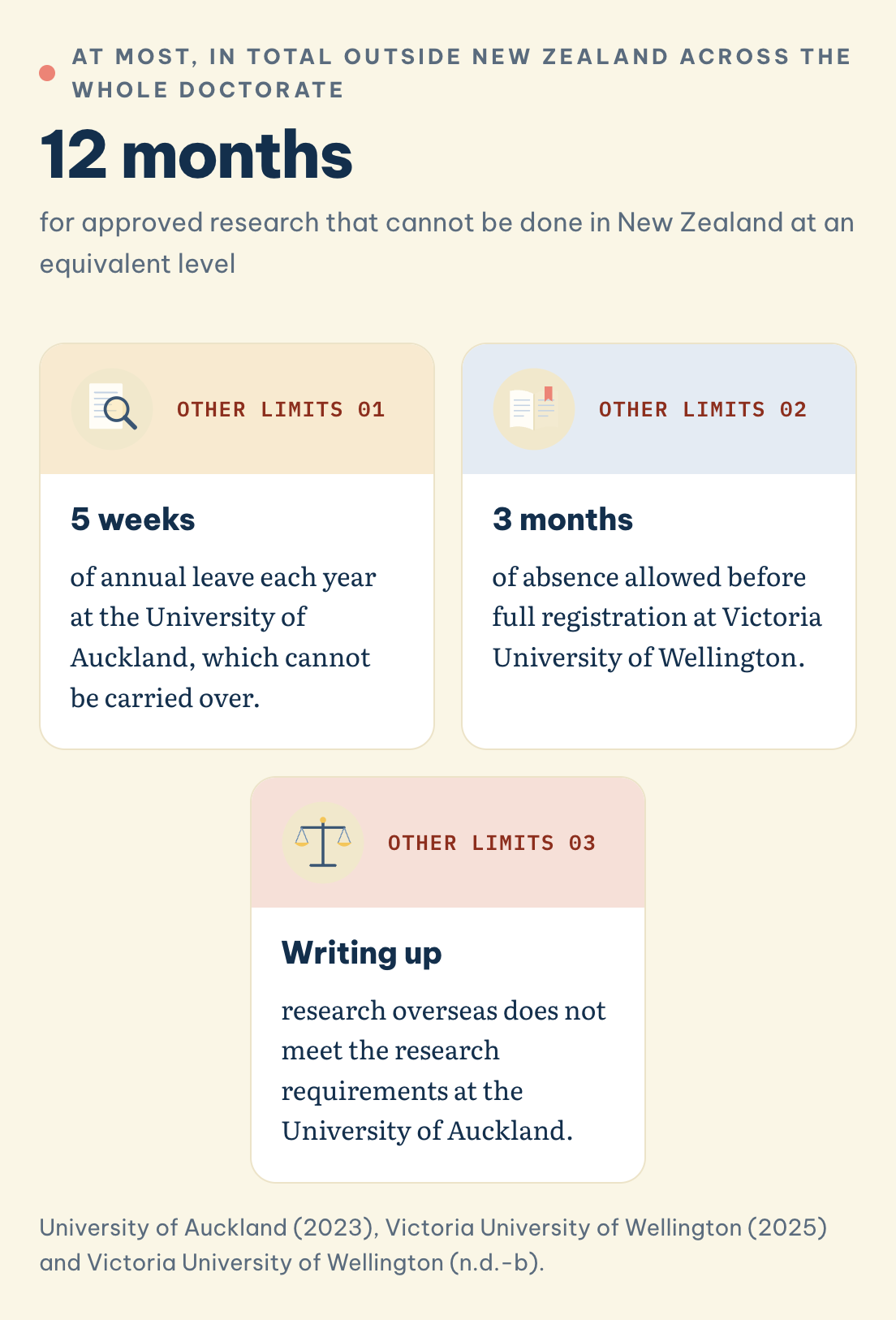
Other limits 01
5 weeks
of annual leave each year at the University of Auckland, which cannot be carried over.
◆ PhD Admissions
Category: admissions
Last updated: 2026-09-23
New Zealand is the rare destination where an international doctoral candidate is charged the same tuition as a citizen, and most pages stop at that sentence. What they leave out is that the lower fee is a status rather than a discount: it attaches to one degree label, it has to be kept by living in the country, and as of August 2026 the government that grants it has confirmed it is reviewing the arrangement.
Direct answer: Yes, if you enrol in a Doctor of Philosophy and live in New Zealand while you study. The University of Auckland lists its 2026 PhD fee at NZ$8,847.60 a year for international and domestic candidates alike, but only while you reside in New Zealand, with no more than 12 months in total overseas for approved research.
Asked the same question on 23 September 2026, Perplexity answered yes, listed the residency condition, and said nothing about the review that RNZ reported on 4 August 2026. That omission is the reason to read the rest of this page before planning a 2027 start around the number.
◆ Section 1 / 7 · PhD fees in New Zealand
Direct answer: For a PhD, the same as for a New Zealander. The University of Auckland charges NZ$8,847.60 a year in 2026, while the same page lists NZ$55,408.80 for international students in its other doctoral programmes. The fee is set per university, so each offer letter is the figure that binds you.
The legal source of the arrangement is short. The Tertiary Education (Domestic Students) Notice 2024, published in the New Zealand Gazette and in force from 14 March 2024, lists among the people who must be treated as if they are not international students "a person who is enrolled in a Doctor of Philosophy programme at a New Zealand university" (Minister of Education, 2024). Immigration New Zealand's operational manual repeats the rule from the visa side, classing PhD students at any New Zealand university as domestic for tertiary fee purposes and exempt from foreign tuition fees (Immigration New Zealand, 2024).
The policy is older than most applicants assume and had a measurable effect. It was announced in 2005 and applied to new PhD enrolments from 2006; Parker (2008, p. 38) reports international doctoral enrolments rising from 693 in 2005 to 1,522 in 2007, and attributes the increase largely to the domestic-fees policy. Two decades later the share is close to half: RNZ (2026) reports 5,265 international PhD students in 2025, or 49% of PhD enrolments.
◆ Section 2 / 7 · Which doctorates qualify
Direct answer: No. The Gazette notice names the Doctor of Philosophy, and universities apply it that narrowly. Victoria University of Wellington (n.d.-a) states that international candidates in a professional doctorate "pay international fees", and the University of Auckland charges NZ$55,408.80 in 2026 for its Doctor of Education, Doctor of Clinical Psychology and other named doctorates.
The distinction is easy to miss because summaries use the word doctorate loosely. Greenberg (2018), writing about New Zealand's university strategy, describes all doctoral students from overseas as charged domestic rates, and presents this as a competitive advantage over Australian universities, where international candidates paid higher fees for the doctorate. The policy documents are narrower than that sentence: Victoria University of Wellington's cotutelle guidelines (n.d.-a, cl. 4.7) state that international candidates "studying for a professional doctorate pay international fees and do not attract SAC funding", and its funding page notes that international Doctor of Musical Arts students pay international fees too (Victoria University of Wellington, 2026).
For a Vietnamese applicant the practical case is education and health. A teacher or a clinician looking at a professional doctorate because it fits a working career is looking at roughly six times the PhD fee at Auckland, and the choice between the two titles is therefore a fee decision as much as a curriculum one.
◆ Section 3 / 7 · Time outside New Zealand
Direct answer: Up to 12 months in total across the whole doctorate, and only for research that cannot be done in New Zealand at an equivalent level. The University of Auckland adds 5 weeks of annual leave each year and supervisor-approved conference travel, and states plainly that writing up overseas does not count as research.
at most, in total outside New Zealand across the whole doctorate
12 months
for approved research that cannot be done in New Zealand at an equivalent level
of annual leave each year at the University of Auckland, which cannot be carried over.
of absence allowed before full registration at Victoria University of Wellington.
research overseas does not meet the research requirements at the University of Auckland.
The residency condition is not in the Gazette notice, which is why it surprises people. It comes from the funding side: Victoria University of Wellington (2025) explains that international candidates are required "under Tertiary Education Commission funding rules ENR006 and ENR007" to be resident in New Zealand during their studies, and that the universities "have agreed to interpret the government's funding rules" as a 12-month cap on absences for approved research. In other words, the enrolment label makes you domestic, and your address keeps you domestic.
The University of Auckland's policy, approved on 11 December 2023, spells out the edges. The cap "cannot be pro-rated", so it is 12 months whether you study full-time or part-time; annual leave "cannot be carried over" and cannot be used for thesis work; and on the question most Vietnamese candidates will ask, "the writing up of research overseas does not meet the research requirements" (University of Auckland, 2023, cl. 5a). Victoria University of Wellington's doctoral regulations add that absence before full registration is limited to 3 months (Victoria University of Wellington, n.d.-b, cl. 9.2).
The 12-month cap is where a Vietnam-focused thesis needs arithmetic before it needs a supervisor. A social science project built on interviews in Vietnam, a survey season in two provinces and a return visit to validate findings can spend its 12 months quickly, and a cotutelle with a Vietnamese university has to fit its partner-institution time inside the same cap (Victoria University of Wellington, n.d.-a, cl. 4.8). The pandemic period shows the rule was relaxed only when return was impossible: Qi, Skyrme and White (2024) document doctoral students enrolled as internal students at a New Zealand university who were stranded in China by the border closure in 2020 and continued at a distance, and the University of Auckland's policy (2023) carves out time spent offshore under the COVID-19 border restrictions as an approved exception rather than as a change to the 12-month rule.
◆ Section 4 / 7 · If you exceed the limit
Direct answer: You move to international fees for the rest of the degree. The University of Auckland's policy says a candidate who loses eligibility pays international fees from the date the most recent domestic fee payment was due "and for the remainder of the enrolment regardless of whether the candidate returns to New Zealand".
The loss is not reversible by coming back, which makes the 12-month figure a budget rather than a guideline. Clause 8 of the same policy states that the eligibility criteria are "set by the New Zealand Government" and are "non-negotiable" (University of Auckland, 2023), so a supervisor's goodwill cannot restore the status once it is gone. The university's fee page repeats the rule for applicants: to pay the domestic PhD fee "you must reside in New Zealand for the duration of your doctoral programme" (University of Auckland, n.d.-a).
Some universities allow an international doctorate to be taken largely offshore from the start, but at the other price. Victoria University of Wellington's guideline for offshore international doctoral students states that such candidates are charged the international rate, which it describes as approximately four times the domestic rate, and that they are expected to support themselves financially (Victoria University of Wellington, n.d.-c, cl. 6.1). The offshore route exists, then, but it is a different product from the one the headline advertises.
◆ Section 5 / 7 · The policy review
Direct answer: The policy is under review, and nothing has changed yet. RNZ reported on 4 August 2026 that the scheme cost about NZ$69 million in 2025, up nearly a quarter, that the Budget capped next year's funding at 2024's NZ$56 million as a "soft cap", and that the Tertiary Education Minister confirmed the ministry was reviewing the arrangement.
The numbers behind the review are specific. RNZ (2026) reports that 80% of the 5,265 international PhD students enrolled in 2025 came from Asia, against 5,390 domestic doctoral students, that the scheme cost NZ$55 million in 2019, just over NZ$43 million in 2022 and NZ$56 million in 2024, the level at which next year's funding is now capped, and quotes Minister Penny Simmonds saying the cost of the current settings "has grown by more than 20 percent a year over the past two years". The same report says Universities New Zealand chair Neil Quigley described officials as talking to universities, "but it was not yet clear what might change or when".
What an applicant can do with an unfinished review is narrow and worth doing. The University of Auckland's fee page frames the domestic rate as applying to a "new international PhD student", and in September 2026 it lists the 2027 international PhD fee only by reference to the 2026 figure. When the policy began, NZPA reported in 2006 that it covered new enrolments only and that existing international candidates at Canterbury still paid about NZ$22,900 (New Zealand Herald, 2006). Whether a future change would protect candidates already enrolled is not known, so the useful step is to ask the graduate school, in writing and before you accept an offer, which fee status your offer letter commits the university to for the full enrolment.
◆ Section 6 / 7 · Fees versus funding
Direct answer: No. The domestic rate lowers the tuition bill, but it pays nothing towards living costs or the separate Student Services Fee. Living costs are covered separately, by a university doctoral scholarship, a project grant held by your supervisor, a government scholarship from home, or your own savings, and each of those has its own deadline and conditions.
Even the tuition bill is not the whole invoice, since the University of Auckland adds a Student Services Fee estimated at NZ$1,132.80 for full-time study in 2026 (University of Auckland, n.d.-a). The distinction between fees and funding matters because the two are bundled on scholarship pages, and at one university the bundle depends on the fee status. The University of Auckland's doctoral scholarship for international students provides a tax-free stipend of up to NZ$35,468 a year in 2026 for up to 42 months of full-time study, plus tuition fees "for international students who are eligible to study under the domestic fees policy" (University of Auckland, n.d.-b). Losing the status can therefore change the value of the scholarship, not only the size of the invoice. Tertiary Education Union president Ti Lamusse made the connection explicit when RNZ asked about the review: if a grant includes a PhD student's scholarship, "it's a heck of a lot more expensive if you're paying for the international fees" (RNZ, 2026). For you, that means the fee status and the funding offer should be read together, because a change to one alters what the other is worth.
◆ Section 7 / 7 · What this changes
The question to bring to a first conversation with a New Zealand supervisor is not only whether they will take you. It is how many months of your project need to happen outside New Zealand, whether that number fits inside 12, and what fee status your offer letter guarantees if the review changes the settings after you enrol. A PhD with fieldwork mostly in New Zealand, or a few months in Vietnam, fits the arrangement well. A project that depends on a long data season at home, or a professional doctorate, needs different numbers.
If you are still comparing destinations, the PhD application resource hub sets out how the admission routes differ before fees enter the picture. When the destination is settled and the next task is a proposal whose fieldwork plan a New Zealand supervisor will accept, MAAS works with you through PhD application strategy: your expert drafts the proposal from your own account of your research, you review, edit and approve it and attend the interviews, and the expert challenges the design, the timeline and the fit. Where MAAS's network already includes a suitable expert, MAAS introduces them within 48 hours, and where it does not, MAAS opens a dedicated search, which usually takes about two weeks.
Greenberg, R. D. (2018). Making universities grow: The New Zealand experience. In J. Valsiner, A. Lutsenko, & A. Antoniouk (Eds.), Sustainable futures for higher education (Cultural Psychology of Education, Vol. 7, pp. 99-107). Springer. https://doi.org/10.1007/978-3-319-96035-7_10
Immigration New Zealand. (2024). U3.35 Definition of a 'domestic student'. Operational manual. Retrieved September 23, 2026, from https://www.immigration.govt.nz/opsmanual/84134.htm
Minister of Education. (2024). Tertiary Education (Domestic Students) Notice 2024 (Notice No. 2024-go1042). New Zealand Gazette. https://gazette.govt.nz/notice/id/2024-go1042
New Zealand Herald. (2006, March 22). Plan to lure university researchers backfires. https://www.nzherald.co.nz/nz/plan-to-lure-university-researchers-backfires/5SIXHIDH2MOAMKZCOJ6FTFKLMI/
Parker, B. (2008). International education and economic transformation. Policy Quarterly, 4(3), 37-43. https://doi.org/10.26686/pq.v4i3.4266
Qi, G. Y., Skyrme, G., & White, C. (2024). Developing a distance-based doctoral supervisory model: Inquiry over disrupted trajectories. Distance Education, 45(1), 187-204. https://doi.org/10.1080/01587919.2023.2198483
RNZ. (2026, August 4). Cost blowout puts fees for foreign PhD students under review. https://www.rnz.co.nz/news/education/875736/cost-blowout-puts-fees-for-foreign-phd-students-under-review
University of Auckland. (2023). PhD domestic tuition fees policy. Retrieved September 23, 2026, from https://www.auckland.ac.nz/en/about-us/about-the-university/policy-hub/research-innovation/doctoral-study/application-candidature-registration/phd-domestic-tuition-fees-policy.html
University of Auckland. (n.d.-a). Doctoral fees. Retrieved September 23, 2026, from https://www.auckland.ac.nz/en/study/fees-and-money-matters/tuition-fees/doctoral-fees.html
University of Auckland. (n.d.-b). Doctoral scholarships for international students. Retrieved September 23, 2026, from https://www.auckland.ac.nz/en/study/scholarships-and-awards/scholarship-types/scholarships-for-international-students/doctoral-scholarships-for-international-students.html
Victoria University of Wellington. (2025). International students' information. Faculty of Graduate Research. Retrieved September 23, 2026, from https://www.wgtn.ac.nz/fgr/current-phd/international
Victoria University of Wellington. (2026). Fees, funding, and scholarships. Faculty of Graduate Research. Retrieved September 23, 2026, from https://www.wgtn.ac.nz/fgr/apply/funding
Victoria University of Wellington. (n.d.-a). Guidelines on cotutelle degrees and other doctoral study overseas. Retrieved September 23, 2026, from https://www.wgtn.ac.nz/documents/policy/academic/cotutelle-guidelines.pdf
Victoria University of Wellington. (n.d.-b). Doctoral regulations: For PhD and other doctorates with theses. Retrieved September 23, 2026, from https://www.wgtn.ac.nz/documents/policy/research-policy/doctoral-regulations.pdf
Victoria University of Wellington. (n.d.-c). Guideline for enrolment of international doctoral students who wish to undertake a doctorate offshore. Retrieved September 23, 2026, from https://www.wgtn.ac.nz/documents/policy/academic/guideline-for-enrolment-of-international-phd-students-who-are-offshore.pdf
A free 20-minute consultation is a conversation about your situation and the New Zealand fee conditions that apply to your project.
Book a free consultation ▸