
Category: admissions
Last updated: 2026-09-20

We put the same question to Google and Perplexity on 2026-09-20: do you need a supervisor before applying for a PhD in Canada? Google's top result and Perplexity both answered that it varies by department, which is true and is also where both answers stopped. Neither explained the money behind the rule. That gap matters for an applicant in Vietnam, because the national scholarship most people search for cannot be used to get in at all, and the package that can is promised by the graduate programme rather than by the professor you are writing to.
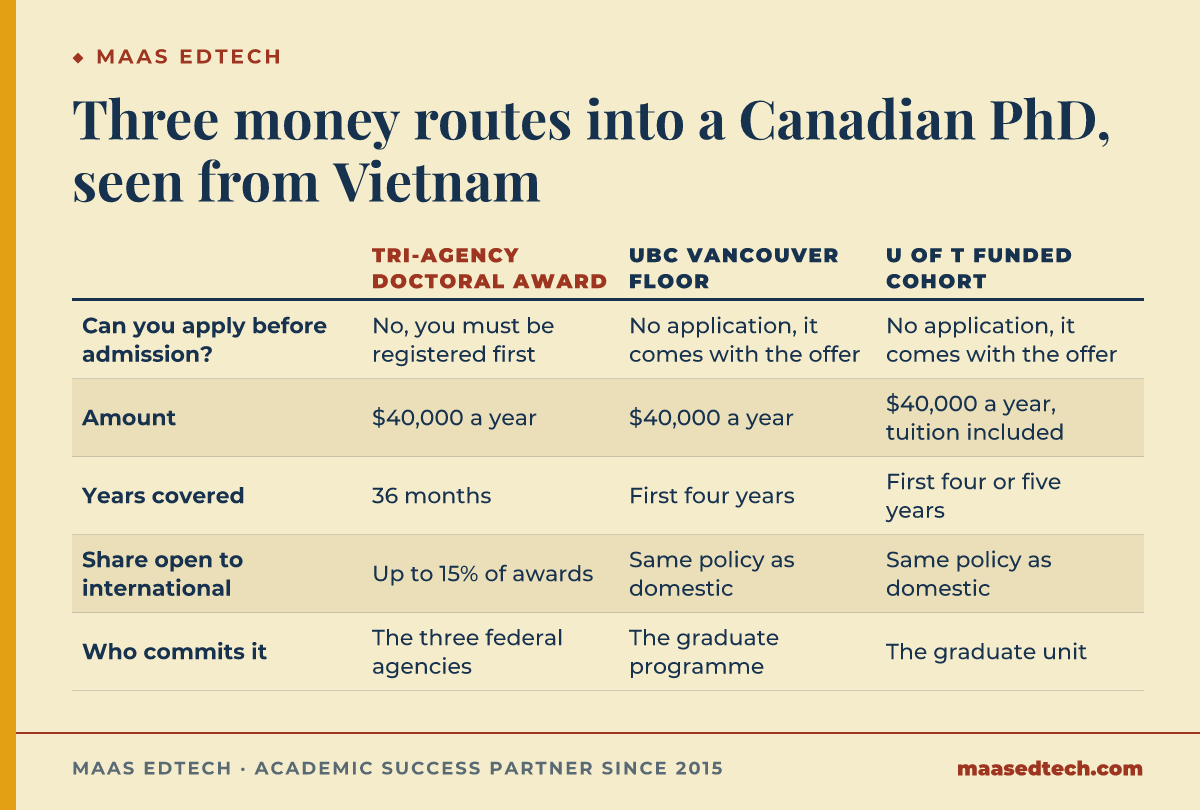
Direct answer: For an international applicant the door is opened by a university's guaranteed minimum funding package, not by a national award. Canada's tri-agency doctoral scholarship is closed to international candidates not yet registered at an eligible Canadian institution by its deadline, and reserves at most 15% of awards for them (Natural Sciences and Engineering Research Council of Canada, n.d.).
Can an international applicant win a Canadian doctoral scholarship before admission?
Direct answer: No. The award is worth $40,000 a year for 36 months, but eligibility turns on status: anyone outside the citizen, permanent resident and protected person categories has to hold a place in a Canadian doctoral programme first, which puts the competition after entry rather than before it (Natural Sciences and Engineering Research Council of Canada, n.d.).
That registration clause reverses the order most applicants assume. The scholarship is something you compete for once you are inside, not a ticket in. Two further limits sit beside it. Up to 15% of awards are available to international applicants, and a candidate may apply to the programme a maximum of three times, with no more than 36 months of full-time doctoral study completed by 31 December of the application year. The agency deadline is 17 October, but candidates registered at an institution holding a quota apply through that institution, whose internal deadline the agency describes as often significantly earlier. The programme that used to sit above this one for international candidates has closed: the Vanier Canada Graduate Scholarships site now states that applications are no longer accepted and directs candidates to the harmonised doctoral programme instead. Advice written before that change, including advice repeated by AI assistants, still points applicants at a competition that no longer exists.
What is a minimum funding package, and who promises it?
Direct answer: A minimum funding package is a floor written into university policy and owed to every full-time doctoral student for a set span of years. On UBC's Vancouver campus the figure reaches $40,000 annually across years one to four from September 2026, with no separate rate for international candidates (University of British Columbia, n.d.-a).
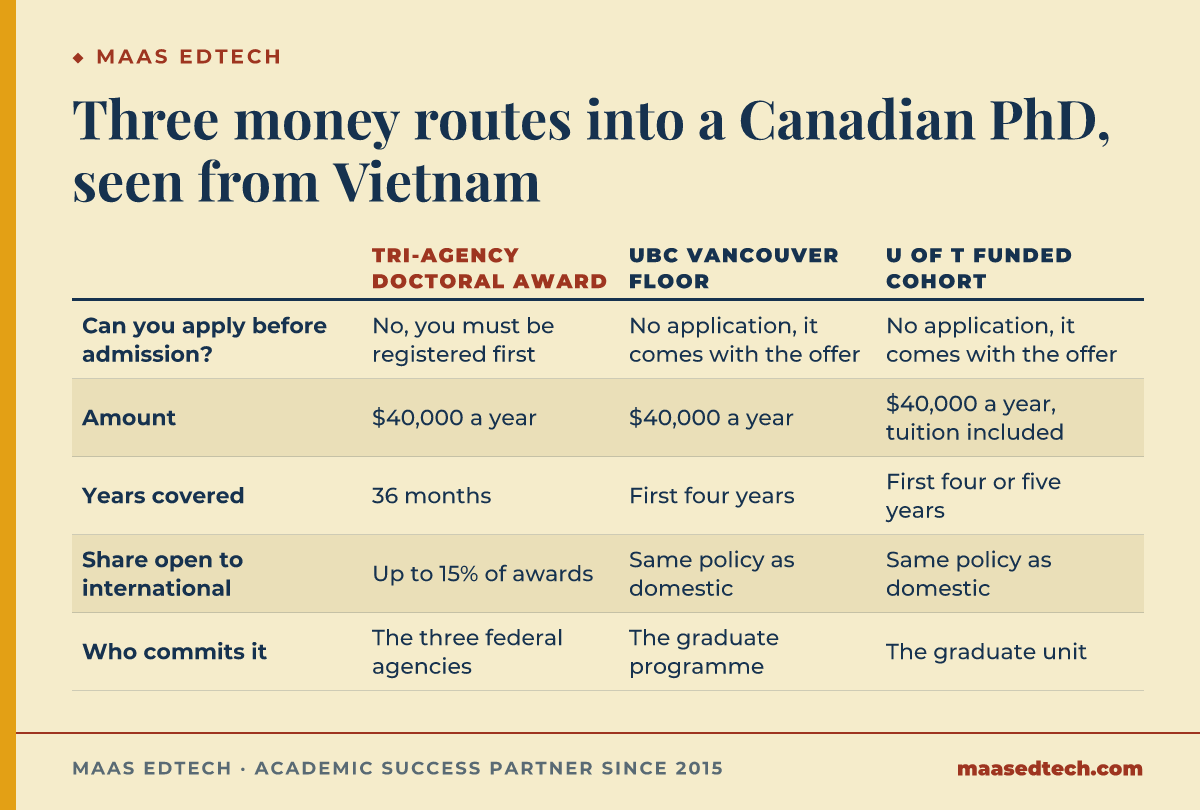
The floor is a policy with a history, which is why it can be read as a commitment rather than a marketing line. UBC introduced the policy in September 2018 at $18,000, raised it to $22,000 in September 2021 and to $24,000 in September 2024, and the Graduate Council reviews it annually. The package may combine internal or external awards, teaching-related work, research assistantships and graduate academic assistantships, and students at UBC Vancouver currently receive an average of $41,000. The UBC Academic Calendar sets out the condition attached to the guarantee: it is an annual commitment spanning three academic terms a year for four years, and it holds only while the student stays registered full time (University of British Columbia, n.d.-b). The University of Toronto works the same way under a different name. From Fall 2025 its base funding commitment for every PhD student in the funded cohort, meaning the first four or five years, is $40,000 inclusive of tuition, and the university describes this as raising the minimum that all doctoral students receive rather than adding a competitive award (University of Toronto, 2024). Nelson et al. (2026), drawing on the 2018 National Graduate Survey, note that entry routes and outcomes in Canadian doctoral education are far from uniform across disciplines, so the floor is best read per graduate unit rather than per country.
Why does the supervisor have to agree before the application is processed?
Direct answer: Because the body that owes the floor is also the body that has to find the cash, and part of that cash sits in individual research accounts. Naming a willing academic is how a department demonstrates, before your file moves, that it can honour a promise it has already published (University of Toronto, n.d.).
Read in that light, the departmental rule stops being a formality. The University of Toronto states that accepted students receive funding from their graduate unit, meaning from their supervisor, department and Faculty. The University of Saskatchewan puts the consequence plainly: if a programme requires you to have a potential supervisor before applying, your application will not be processed without their approval. The University of Toronto adds that decisions about the availability, composition and annual amount of graduate funding are made primarily at Faculty and graduate unit level rather than by the university overall, and that the base commitment is supported mainly by divisional sources such as research grants and fellowships administered by individual faculties and units. A professor who tells you the topic is interesting but there is no funding this year is therefore not being evasive; that sentence is a statement about a budget line, and it is the same answer the admissions file would give. Wichmann-Hansen and Herrmann (2017), in a large Danish study, found that external project funding shapes how directive supervisors become, which is a reminder that whose grant pays for a doctorate has consequences well past the offer letter.
Whose signature makes a funding commitment real?
Direct answer: The graduate programme's, not the professor's. UBC instructs its own faculty that an offer letter "should not be solely from the supervisor as the financial package is ultimately the responsibility of the graduate program" (University of British Columbia, 2026, p. 8), which makes a warm email a signal of interest rather than a commitment of money.
The handbook instruction is the most useful line an applicant can carry into the waiting period, because it converts a vague hope into a document check. An encouraging email from a professor is an academic signal, and it is often a necessary one, but it is not the funding commitment. The sample offer letters sit in Appendix 1 of that handbook. The commitment arrives in two parts: a letter from the Dean of Graduate and Postdoctoral Studies stating the minimum level, followed by a programme letter setting out the specific package. The sample letters in the same handbook show what that package looks like in practice, including a department fellowship, a Faculty award and a teaching assistantship adding up to the floor, and they include a standard condition that the student apply annually to the tri-agency competition if eligible, with the departmental grant reduced by the amount of any external award won. An applicant who reads only the headline figure will be surprised by that last clause; an applicant who reads the letter will not.
What does the floor leave after tuition?
Direct answer: Less than the headline suggests, and noticeably less for international students. Surveying 140 Canadian programmes in ecology, biology and physics, Fraass et al. (2025) found only two whose stipends still met cost-of-living measures once tuition and fees had been subtracted, which is why a guaranteed figure should be read as gross rather than spendable.
The stipend survey by Fraass et al. (2025) is the clearest published check on what a minimum package means in practice, and its 140 programmes cover the disciplines where guaranteed packages are most common. Fraass et al. (2025) report that "approximately 33% of a minimum stipend is returned to the university in tuition and fees by a domestic Canadian student and 76% (59% median) by an international student" (Fraass et al., 2025, Abstract), and that the average minimum stipend fell short of the poverty threshold by about CAD 9,584 for domestic students and CAD 16,953 for international students once fees were paid. Their data were collected before the 2025 and 2026 increases described above, so the gap at UBC and Toronto is narrower today than the study describes, but the structure they identify has not changed: a guaranteed package is a gross figure from which tuition is paid, and the international share of that deduction is the larger one. This matters beyond budgeting. DeClou (2016), analysing Youth in Transition Survey data on Canadian graduate programmes, found that conditions around a student, rather than admission credentials alone, shape who withdraws before completion, and reads the packages themselves as a recruitment instrument: "Providing funding packages is a good way to recruit students from all backgrounds and may help increase access for underrepresented groups, an ongoing priority of certain governments" (DeClou, 2016, p. 191). For a comparison with another country's funding and fee conditions, see PhD in New Zealand.
What should an applicant in Vietnam do differently?
Direct answer: Put the reading before the writing. Work through the graduate school's minimum funding policy, then the department's own supervisor rule, then the internal deadline for the national competition, and treat any reply from an academic as one input into a decision that the graduate unit, not that person, will eventually set down on paper.
Three checks cover most of the ground. Open the faculty of graduate studies page for each shortlisted university and find whether a published floor exists, what it is worth and how many years it covers, because that number is the realistic funding picture for someone who cannot apply for the national award until after registration. Open the specific department page rather than the university's general advice, since the supervisor requirement is set there and, as Perplexity's own answer showed on 2026-09-20, neighbouring departments at the same university differ. Finally, note that if you are admitted and later become eligible to apply through your institution, the internal deadline arrives well before the agency's 17 October date, which makes the tri-agency competition a first-year task rather than an application-year one.
If you want a second reader while you compare programmes and prepare the proposal, MAAS works with applicants as academic advisors. You choose the universities and supervisors, sit the interviews and make each decision. Our experts draft the proposal and the approach letters from your own account of your research and challenge the fit, the funding evidence and the reading behind each choice, while you review, edit, approve and submit them yourself. No one can promise admission or a scholarship, because those decisions belong to the university. When our network already includes a suitable expert, matching takes about 48 hours; when it does not, MAAS opens a dedicated search that usually runs about two weeks. The scope of that advisory work is described in PhD supervisor search and application strategy, and the full pathway is in the PhD application guide.
Frequently asked questions
Are there fully funded PhDs in Canada for international students?
Yes, in the sense that several universities guarantee a minimum package to domestic and international doctoral students alike. UBC Vancouver guarantees $40,000 for each of the first four years from September 2026, and the University of Toronto guarantees $40,000 inclusive of tuition to students in the funded cohort. The guarantee comes from the university, not from a national competition.
Do you get paid to do a PhD in Canada?
You receive a funding package rather than a salary, usually combining awards, a teaching assistantship and a research assistantship. Tuition and fees are paid out of it, and Fraass et al. (2025) found that an international student returns about 76% of a minimum stipend to the university in tuition and fees.
Can I apply for the Canada Graduate Research Scholarship from Vietnam?
Not before you are registered. An applicant who is not a citizen, permanent resident or protected person must be registered in a doctoral programme at an eligible Canadian institution by the application deadline, and up to 15% of awards are available to international applicants.
Is the Vanier scholarship still open?
No. The Vanier Canada Graduate Scholarships site states that applications are no longer accepted and refers candidates to the Canada Graduate Research Scholarship – Doctoral programme.
Do all Canadian PhD programmes require a supervisor before you apply?
No, and the rule is set by the department rather than the country. Where it applies, the University of Saskatchewan states that an application will not be processed without the potential supervisor's approval, so the requirement has to be checked on the specific programme page.
Related MAAS guides
- PhD application: the full pathway
- Who decides PhD studentship funding?
- Where does the funding decision sit in US PhD admissions?
- PhD in Germany: find a supervisor or join a structured programme?
References
DeClou, L. (2016). Who stays and for how long: Examining attrition in Canadian graduate programs. Canadian Journal of Higher Education, 46(4), 174-198. https://cjhe.journals.publicknowledgeproject.org/index.php/cjhe/article/download/185181/pdf/201442
Fraass, A., Bailey, T. J., Karunakumar, K., & Wishart, A. E. (2025). Canadian natural science graduate stipends lie below the poverty line. PLOS ONE, 20(5), e0313972. https://doi.org/10.1371/journal.pone.0313972
Nelson, J., Walters, D., Jones, A. Q., & Jacobs, S. (2026). PhD pathways in Canada: Sociodemographic and disciplinary influences that impact pathway, duration, and outcomes. International Journal of Higher Education, 15(1), 34. https://doi.org/10.5430/ijhe.v15n1p34
Natural Sciences and Engineering Research Council of Canada. (n.d.). Canada Graduate Research Scholarship - Doctoral program. Retrieved 2026-09-20, from https://www.nserc-crsng.gc.ca/students-etudiants/pg-cs/cgsd-bescd_eng.asp
University of British Columbia. (n.d.-a). Minimum funding policy for PhD students. Retrieved 2026-09-20, from https://www.grad.ubc.ca/awards/minimum-funding-policy-phd-students
University of British Columbia. (n.d.-b). Minimum funding for Ph.D. students. UBC Academic Calendar. Retrieved 2026-09-20, from https://vancouver.calendar.ubc.ca/faculties-colleges-and-schools/faculty-graduate-and-postdoctoral-studies/awards-and-scholarships/minimum-funding-phd-students
University of British Columbia. (2026). Handbook on the minimum funding policy for PhD students. https://www.grad.ubc.ca/sites/default/files/doc/page/2026-04-02_Faculty%20handbook%20for%20minimum%20funding%20policy.pdf
University of Toronto. (n.d.). How funding works: Research-stream programs. School of Graduate Studies. Retrieved 2026-09-20, from https://www.sgs.utoronto.ca/awards-funding/how-funding-works-research-stream/
University of Toronto. (2024, November 12). U of T to increase base funding for PhD students to $40,000 per year. https://www.utoronto.ca/news/u-t-increase-base-funding-phd-students-40000-year
Wichmann-Hansen, G., & Herrmann, K. J. (2017). Does external funding push doctoral supervisors to be more directive? A large-scale Danish study. Higher Education, 74(2), 357-376. https://doi.org/10.1007/s10734-016-0052-6