
◆ PhD Admissions
Where does the funding decision sit in US PhD admissions?
Category: admissions
Last updated: 2026-09-07

Applicants coming to the United States from a British or Australian frame of reference usually go looking for a second form. They have found the programme, they have found the deadline, and now they want the scholarship page: the separate application, the separate closing date, the separate selection panel. In most funded American doctoral programmes that page does not exist, and its absence is not an oversight.
Direct answer: In the United States the funding decision is made inside the admission decision, by the academic department, at the same meeting and against the same file. A survey of graduate school staff found that responsibility for doctoral admissions decisions sat with academic departments 78% of the time (Kent & McCarthy, 2016). There is no second envelope to prepare.
In that same survey only 10% of respondents placed doctoral admissions authority with the graduate school, which is why the department page and not the university scholarship page is the document that governs your money (Kent & McCarthy, 2016). Everything you can still influence therefore has to be inside the one file you already submitted, and that single fact reorganises the work. If money and admission travel together, then the lever is which programmes you apply to and what your file says about fit, not what you write in a scholarship essay that no one has asked you for.
◆ Question 1 / 5 · No separate scholarship form
Why is there no separate scholarship form in most US doctoral programmes?
Direct answer: Because the department is spending its own teaching and research budget on you. A funded American doctoral offer is typically a package rather than a prize, bundling a stipend, tuition, fees and health insurance premiums into the admission itself, and often carrying a guaranteed funding period measured in years rather than a single award.
Duke University's Graduate School describes exactly that shape, listing a stipend, tuition coverage, fees coverage and coverage of health insurance premiums inside a five-year guaranteed funding period, with 12-month stipends since the 2022-2023 academic year, as verified on 7 September 2026. Read what that structure implies. A department that guarantees five years of stipend, tuition and insurance to every admitted doctoral student has bound the size of its incoming class to the size of its budget. It cannot admit more people than it can pay, so admission and funding stop being two questions and become one.
Angrist and colleagues describe the same coupling from inside one programme's data, writing that admission decisions "reflect applicants' prospects for outside funding and department financial constraints" (Angrist et al., 2026, p. 6). That paper is a working paper and states plainly that it has not been peer-reviewed, so treat the sentence as a description of practice rather than as an established finding.
◆ Question 2 / 5 · What funding looks at
What does the funding decision actually look at?
Direct answer: Largely the same documents as the admission decision, weighted a little differently. In the Council of Graduate Schools survey, the materials named most important at the funding phase of doctoral admissions were letters of recommendation at 40%, followed by transcripts and the research statement (Kent & McCarthy, 2016).
Letters at the final admissions stage
67%
of respondents named letters for doctoral applicants at the final admissions stage of the same survey
Statement at the final admissions stage
64%
of respondents named the statement for doctoral applicants at the final admissions stage of the same survey
What the funding phase of US doctoral admissions reads
Share of graduate school staff naming each material as most important at the funding phase of doctoral admissions, in percent.
Save this figure
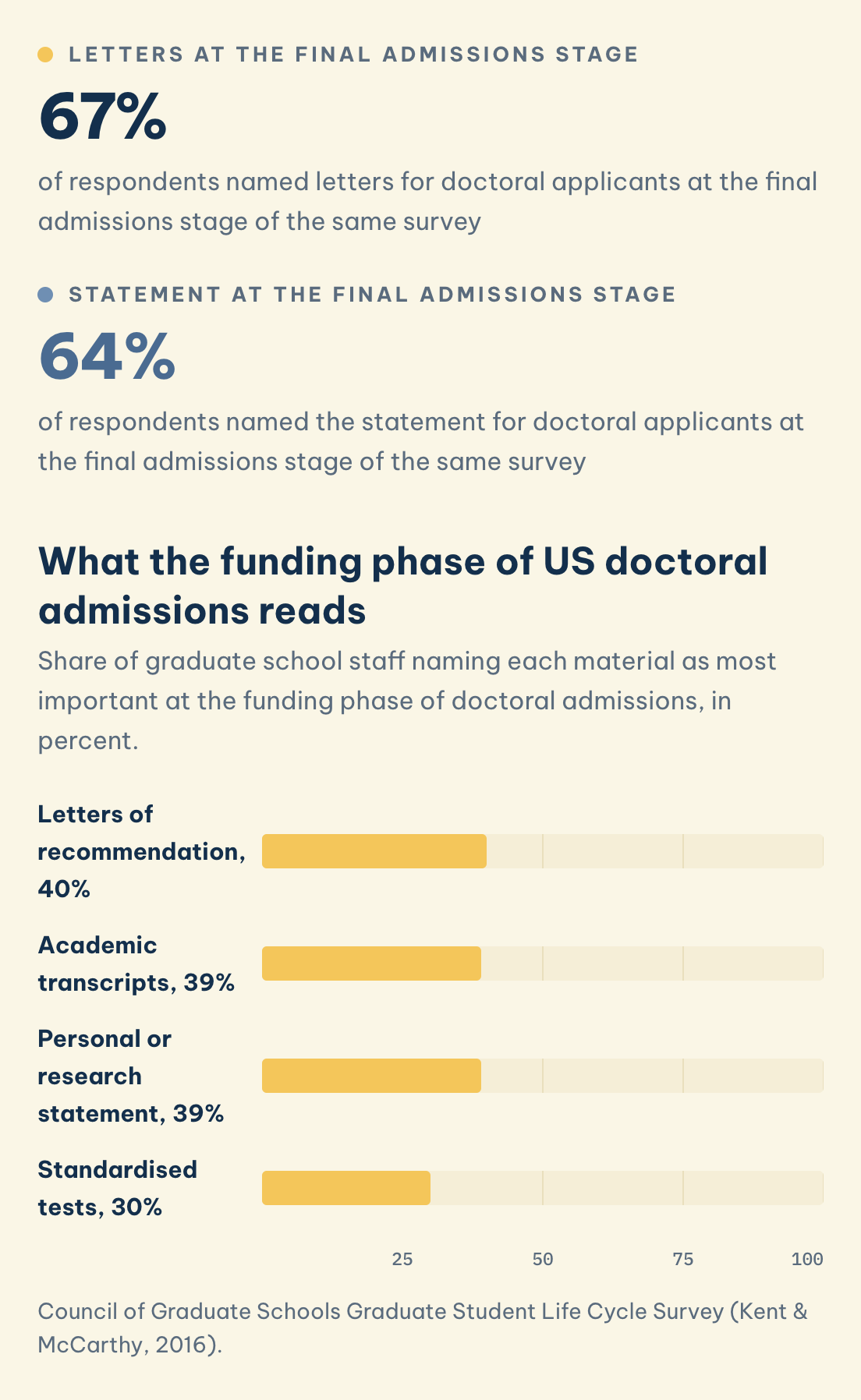
The full set of figures at that phase runs letters at 40%, academic transcripts at 39%, the personal or research statement at 39%, and standardised tests at 30% (Kent & McCarthy, 2016). Compare those figures with the same survey's final admissions stage, where letters were named by 67% and the statement by 64% for doctoral applicants (Kent & McCarthy, 2016). The materials repeat. Nothing new is introduced at the funding stage, which is exactly what you would expect if the funding conversation happens over an already-open file.
There is a practical consequence for anyone hoping to compensate later. You cannot strengthen a scholarship case after submission by adding a document, because the committee is not opening a second round of evidence. Whatever is going to argue for your funding is already in the file, which is why our guide to reading a PhD admissions page treats the programme's own description of fit as a funding document and not only an eligibility document.
◆ Question 3 / 5 · Easier or harder
Does the fused decision make funding easier or harder to get?
Direct answer: Neither, but it changes what a rejection means. Because the number of funded places is set before anyone is read, the committee is drawing a line to hit a target cohort size rather than measuring you against a fixed scholarship bar that exists independently of this year's budget.
Posselt (2016) opens her study of ten doctoral programmes with a committee that settles on a rating threshold because that threshold "would give them their desired cohort size: the lucky 13", against a national doctoral admission rate she reports as 18%. This is the part that most reframes the experience of being turned down. A threshold chosen to produce thirteen offers is a statement about capacity, and a candidate one place below it has not failed a standard that exists independently of the year's budget.
Posselt (2014) also documents how the money changes the reading itself. In her fieldwork across ten highly selective programmes, built on 86 interviews and 22 hours of observation of admissions committee meetings, she found that "particularly when cohorts were small and/or programs provided full financial support, each enrolled student represented a significant financial investment, so admissions was compared to 'risk-taking,' 'risk aversion,' and 'gambling'" (p. 496). Where the department pays, the department reads for risk, and a file that answers the question of whether this person will finish is doing funding work even when it never mentions money.
Two limits belong with that evidence. Posselt studied highly selective programmes in three research universities, so the pressure she describes is sharpest at the top of the distribution. And her outcome is the deliberation itself, not the later success of the students admitted.
◆ Question 4 / 5 · UK and Australia compared
How is this different from the United Kingdom and Australia?
Direct answer: In both of those systems the money has its own gate, run by the university rather than by the funder, and that gate is a second event you have to find. Neither funder takes applications from students at all, so what differs is how many selections the provider itself runs.
UK Research and Innovation states that it gives training grants to providers who use them to offer studentships and that "students cannot apply directly to UKRI", as verified on 7 September 2026. The Australian Department of Education says the same of its Research Training Program: "RTP scholarship applications cannot be made through the Department of Education", and prospective students must contact an eligible higher education provider directly, as verified on 7 September 2026.
So the shared feature across all three systems is that you never write to the funder. Government aid schemes break that pattern outright: in the Taiwan Scholarship and Australia Awards routes the funder is exactly who you write to, as our guide to who screens a government PhD scholarship first sets out. A fourth system sharpens the contrast further: in China's government scholarship route the academic yes is a document you must obtain before you may apply at all, as our guide to what a Chinese supervisor signs in a CSC application sets out. What differs is whether the provider runs one selection or two. In the United States the department usually runs one. In the United Kingdom and Australia the provider commonly runs a separate scholarship competition alongside or after admission, with its own timetable, which is the second form the American system does not have.
The numbers attached to each system are public and worth reading before you compare offers. UKRI sets a minimum stipend of £21,805 from 1 October 2026, up from £20,780, and contributes a minimum fee of £5,238 for the 2026 to 2027 academic year, adding that it "only contributes up to the value of home fee rates" so international students may have to make a contribution to their fees as verified on 7 September 2026. The Australian RTP full-time base stipend rate is $34,315 for 2026 and $35,550 for 2027, with maximum rates of $53,608 and $55,537 respectively, and RTP scholarships run for a minimum of 3 and a maximum of 4 years for a full-time research doctorate as verified on 7 September 2026.
Notice that the British and Australian figures are floors and ranges set centrally, while the American figure is a package set by one department. That is the same difference again, seen from the side of the money rather than the side of the form.
◆ Question 5 / 5 · What to do differently
What should you do differently if you are applying to the US?
Direct answer: Treat programme selection as the funding strategy, because in a fused system the only funding variable you control before the deadline is which departments read your file. A department that cannot fund its cohort will not fund you regardless of how the application is written.
Three consequences follow, and each of them lands before submission rather than after.
Read each programme's own funding statement rather than the university's general scholarship page, since the guarantee, its length and its conditions are set at department level. Where a programme publishes a guaranteed funding period, that sentence tells you both what you are being offered and how many people they can afford to admit.
Write the file so it answers the risk question the money creates. Posselt's committees were weighing investment, so evidence that you can carry a long project through, which is the same evidence that argues for your fitness to be admitted, is doing double duty.
And do not build your timeline around a scholarship deadline that does not exist. Our guide to PhD scholarship deadlines sets out why the binding constraint is the state your file has to reach, and in the fused American case that constraint collapses entirely onto the admission deadline.
If you want a second reader on how a specific programme's funding statement should change what your application argues, MAAS works with applicants as academic advisors: our experts draft the documents from your own account of your work and challenge the argument and the evidence in them, while you review, edit and approve every document and submit the file yourself. You can see the full pathway in our PhD application guide, and the scope of the advisory work in PhD supervisor search and application strategy.
Frequently asked questions
Do I need to apply separately for funding at a US university?
In most funded doctoral programmes, no. The department decides admission and first-year support together, and departments held primary responsibility for doctoral admissions decisions 78% of the time in the Council of Graduate Schools survey (Kent & McCarthy, 2016). Some universities run additional internal fellowship competitions on top, so read the programme page for that specific programme.
Is an American offer without funding a real offer?
It is an admission, but not a funded one, and the two should never be read as the same thing. Ask in writing what support is attached, for how many years, and what conditions renew it before you compare it with a UK or Australian offer.
Which system pays more?
The figures are not directly comparable because they cover different things. UKRI's minimum stipend is £21,805 from October 2026 with a £5,238 minimum fee contribution, and Australia's RTP base rate is $34,315 for 2026, while an American package is set per department and typically bundles tuition, fees and health insurance with the stipend.
Can international students get funded doctoral places?
Yes in all three systems, with different constraints. UKRI notes that its funding covers only home fee rates, so an international student may owe the difference, and the American package varies by department, so the question has to be asked of each programme separately.
Does the fused US decision mean my research proposal matters less?
It means it is read for a different purpose. In a system where you are admitted to a programme before your dissertation topic is fixed, the proposal is evidence about how you think rather than a contract, which is a distinct use from the British and Australian project-matching route.
Related MAAS guides
References
Angrist, J., Diederichs, M., & Ellison, G. (2026). Will the university endowment tax slow scientific progress? Evidence from elite economics PhD programs (Working Paper No. 35244). National Bureau of Economic Research. https://www.nber.org/papers/w35244
Kent, J. D., & McCarthy, M. T. (2016). Holistic review in graduate admissions: A report from the Council of Graduate Schools. Council of Graduate Schools. https://cgsnet.org/wp-content/uploads/2022/01/CGS_HolisticReview_final_web.pdf
Posselt, J. R. (2014). Toward inclusive excellence in graduate education: Constructing merit and diversity in PhD admissions. American Journal of Education, 120(4), 481–514. https://doi.org/10.1086/676910
Posselt, J. R. (2016). Inside graduate admissions: Merit, diversity, and faculty gatekeeping. Harvard University Press.
Tools & resources
- Duke University Graduate School, financial support for PhD students: https://gradschool.duke.edu/financial-support/
- UK Research and Innovation, support for UKRI-funded students: https://www.ukri.org/what-we-do/developing-people-and-skills/find-studentships-and-doctoral-training/get-a-studentship-to-fund-your-doctorate/
- Australian Government Department of Education, Research Training Program: https://www.education.gov.au/research-block-grants/research-training-program
A free 20-minute consultation is a conversation about your situation and the programmes you are considering.
Book a free consultation ▸