
◆ PhD application
When is the real deadline for PhD scholarship funding?
There is a particular kind of message that arrives in an advisor's inbox every February, and it arrives from applicants to the United Kingdom, Australia, Canada and the Netherlands alike. The applicant submitted on time, has an offer or expects one, and has just discovered that the funding they were counting on closed 3 or 4 weeks ago. Nothing went wrong in the ordinary sense. They met the deadline they knew about.
The mistake is not lateness. It is that the date they were working towards was never the date that governed them. In the 3 schemes examined below, at the University of Edinburgh, Imperial College London and the University of Birmingham, the binding date sits earlier than the one on the funding page.

◆ Question 1 / 5 · Why the deadline misleads
Why does meeting the programme deadline not protect your funding?
Direct answer: Because most scholarships require your application to already be in a particular state before you are permitted to apply for the money, and reaching that state takes time you have not budgeted. Admission and funding are usually decided by different bodies on different calendars, and the funding body almost always requires evidence that admission has already advanced.
That requirement is what pulls your real starting date forward, sometimes by months.
A published example makes the shape visible. The Edinburgh Doctoral College Scholarship, checked on 19 August 2026 for 2026 entry, lists two dates: a PhD programme application deadline of 19 January 2026 and a scholarship application deadline of 2 February 2026. The scholarship closes later, which is exactly why the arrangement catches people out. The page states that applicants must have already applied for admission to be considered, and adds that after submitting an admission application it can take up to 5 working days for system checks to complete and for access to the scholarship form to be granted (University of Edinburgh, n.d.).
Read those three facts together and the later date stops being reassuring. The scholarship form cannot be opened by someone who has not yet applied, and access is not instant. An applicant who plans to submit everything in the last week of January has planned a sequence that cannot physically run, because 5 working days of checks will not fit inside the 4 days remaining.
◆ Question 2 / 5 · No application form
What if a scholarship has no application form?
Direct answer: Then the funding deadline still exists, but it is printed on the admissions calendar rather than on a funding page, and the action it requires is a box inside your admission form.
Some schemes have no separate application, because the department nominates candidates from the admission pool. Cambridge, Oxford and Imperial College London all run at least 1 scheme on this model. Imperial College London describes its President's PhD Scholarships process in its own words: "You should submit your application for admission to study at Imperial through our online admissions system and your department will put you forward for the scholarship based on academic merit and potential" (Imperial College London, n.d.).
Reading a nomination-based scheme like this as "no deadline" would be a mistake, since the 3 rounds below are hard cut-offs. The same page, checked on 19 August 2026, states that applications are considered at three points in the academic year, and lists all 3: apply by 3 November 2025 for a decision by 31 January 2026, by 12 January 2026 for a decision by 31 March 2026, or by 2 March 2026 for a decision by 31 May 2026. It also requires you to select the scheme in the funding section of the additional questions tab within the online application form (Imperial College London, n.d.).
Read that carefully and two things follow. Missing a round is not fatal here, because 2 more follow inside the same cycle, and it is worth knowing that before you panic or give up. But the round you land in is decided entirely by when your admission application arrives, and the thing that puts you in contention at all is a selection inside a form that most applicants fill in while thinking about admission rather than about money. A funding opportunity worth 3 or 4 years of fees and stipend can be lost by leaving 1 box unticked.
◆ Question 3 / 5 · The most demanding version
What does the most demanding version look like?
Direct answer: 3 nested requirements, where you need an offer, then an internal nomination, then a separate application to the external funder on the funder's own calendar.
Three nested requirements in the most demanding version
Tap a requirement to see what it asks of you. This is the Birmingham example from the post, shown for its structure.
Step 1 of 3
Offer
An unconditional offer of admission, or a conditional offer where the only outstanding conditions are completing the current degree and approval under the Academic Technology Approval Scheme (ATAS).
Step 2 of 3
Nomination
Contact your proposed primary supervisor before 6 February 2026 to express interest in nomination. Colleges then shortlist and nominate.
Step 3 of 3
Funder
Submit a separate application directly to the China Scholarship Council in Beijing, by that body's own deadline.
Save this figure
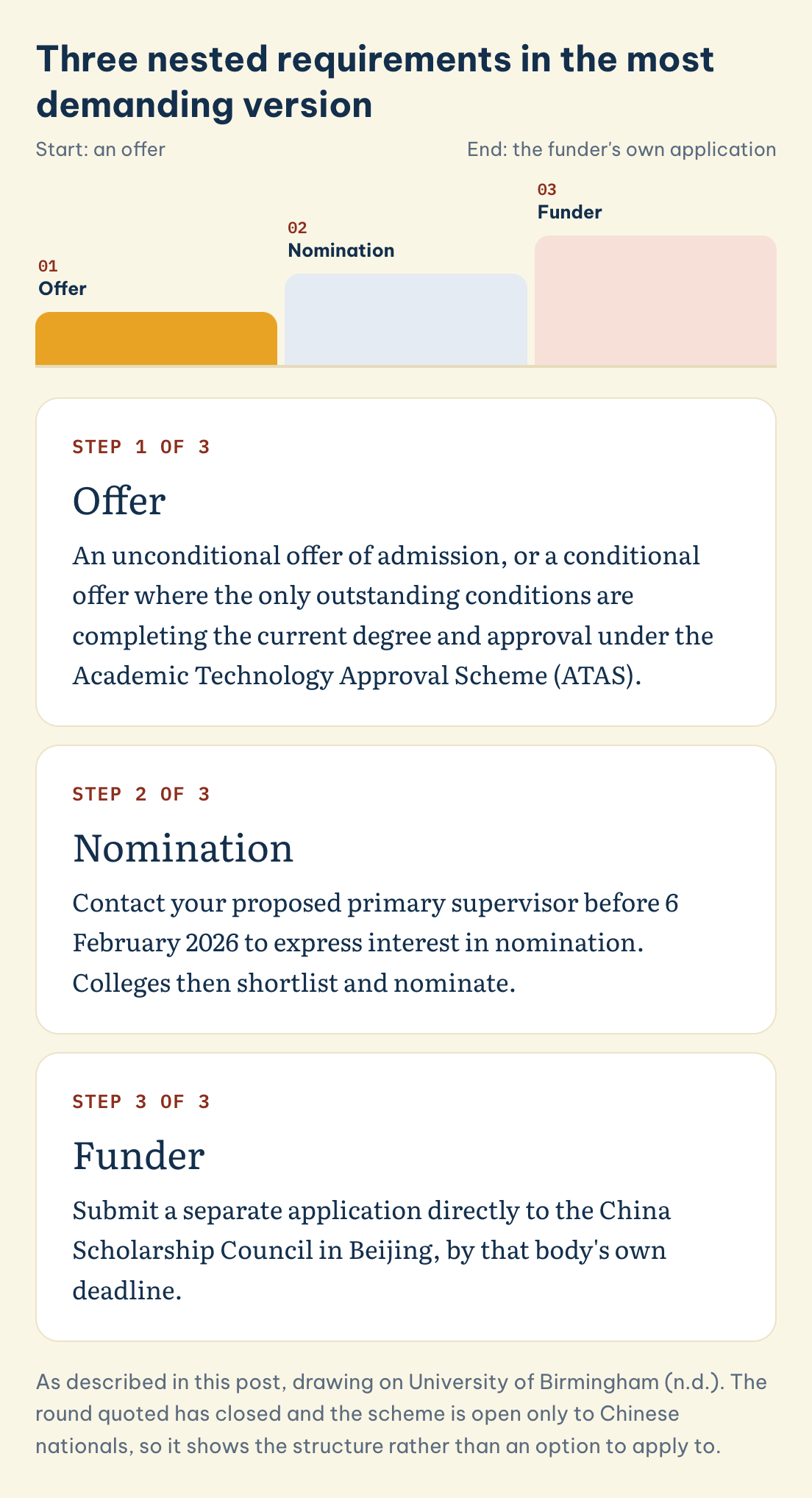
Jointly funded schemes stack the conditions. The Birmingham scheme run with the China Scholarship Council, checked on 19 August 2026 for 2026 entry, requires an unconditional offer of admission, or a conditional offer where the only outstanding conditions are completing the current degree and approval under the Academic Technology Approval Scheme, known as ATAS. It asks candidates to contact their proposed primary supervisor before 6 February 2026 to express interest in nomination. Colleges then shortlist and nominate, and the page also instructs candidates to submit a separate application directly to the China Scholarship Council in Beijing by that body's own deadline (University of Birmingham, n.d.). Two limits on this example: the round quoted here has since closed, and the scheme is open only to Chinese nationals. It is reproduced because the structure recurs across jointly funded schemes, not because you can apply to it.
Count backwards through that chain and the practical starting point is not February, but roughly October or November of the preceding year. An unconditional offer requires a completed application, which requires a proposal of 1,500 to 2,000 words that a supervisor is willing to back, which requires the supervisor conversation to have happened earlier still, usually 3 to 6 months before the funding page even opens.
◆ Question 4 / 5 · Which date to use
So what date should you actually be working from?
Direct answer: The earliest date at which any prerequisite must already be satisfied, not the last date printed on the funding page.
Three gate designs, and what really binds you
Tap a gate design to see what is printed and what actually binds you.
Two applications, two deadlines
What is printed: the later scholarship date. What actually binds you: the admission date, plus the processing delay before the scholarship form opens.
No scholarship form, department nominates
What is printed: consideration rounds, listed on the admissions or funding page rather than on a form. What actually binds you: the admission deadline of the round you want to be in, plus any box you must tick inside the application.
Offer plus nomination plus external funder
What is printed: the external funder's deadline. What actually binds you: the date by which an offer and a nomination must already exist.
Save this figure
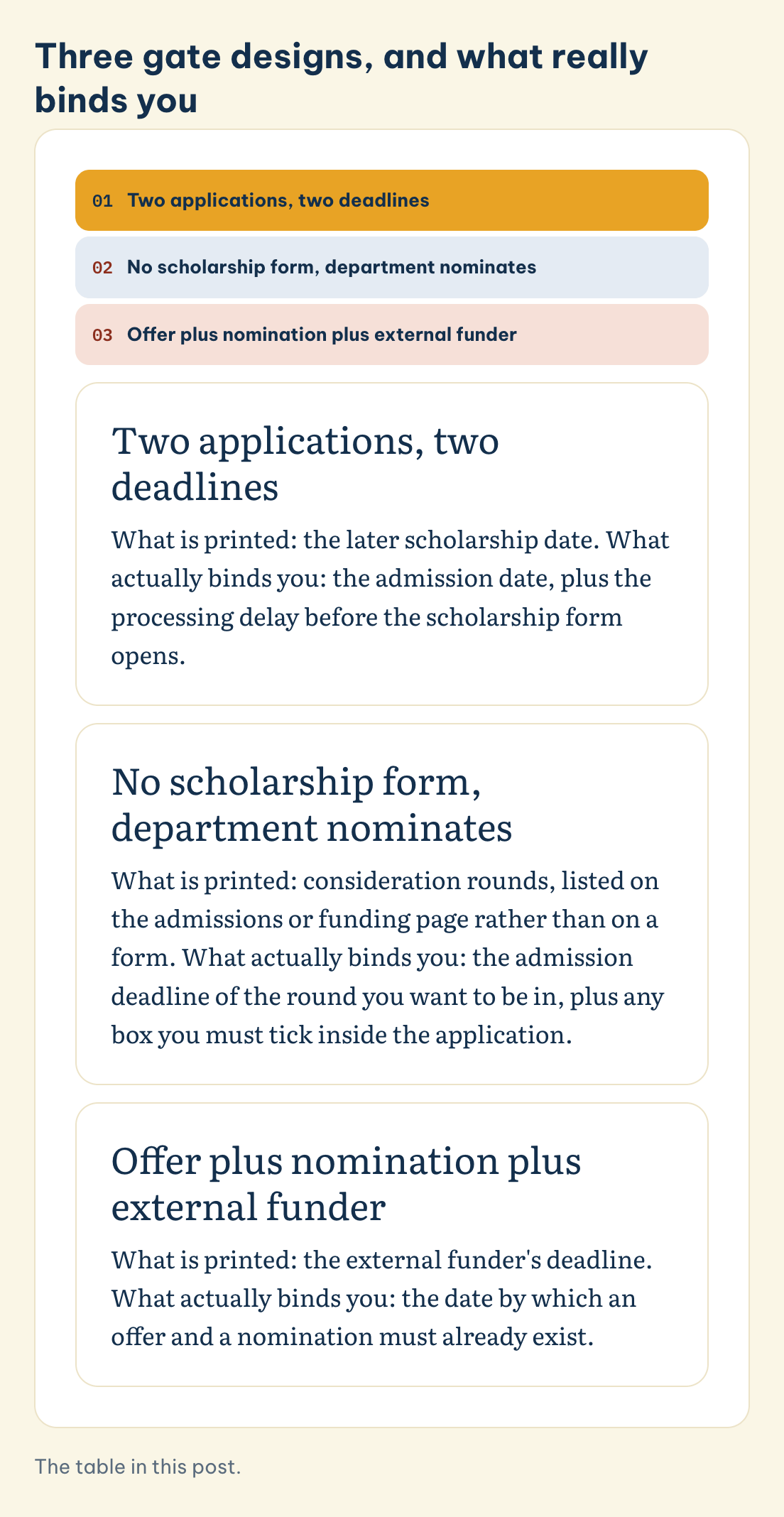
The 3 patterns above differ in their details but share one structure: the money has an entry condition, and the entry condition has its own lead time. Read those conditions closely, since many describe what the funder may pay for rather than applicant strength. Your binding date is the funding deadline minus everything that must exist before you may act on it. For the Edinburgh case above, that subtraction moves the working date from 2 February back past 19 January.
| Gate design | What is printed | What actually binds you |
|---|---|---|
| Two applications, two deadlines | The later scholarship date | The admission date, plus the processing delay before the scholarship form opens |
| No scholarship form, department nominates | Consideration rounds, listed on the admissions or funding page rather than on a form | The admission deadline of the round you want to be in, plus any box you must tick inside the application |
| Offer plus internal nomination plus external funder | The external funder's deadline | The date by which an offer and a nomination must already exist |
3 questions, asked of the department by email, resolve almost all of this. Question 1 is whether this funding requires a separate application, or whether the department nominates from the admission pool. Question 2, if it nominates, is which admission round feeds which nomination round. Question 3 is what state the application must be in, and by when, for you to be eligible at all.
Those questions are answerable, and the answers are specific to the department rather than to the university, which is why asking 2 departments at the same university can produce 2 different calendars. The Quality Assurance Agency for Higher Education expects this information to be published, but it does not standardise where. That last point matters: faculty-level and school-level funding often runs on its own calendar, sometimes 6 or 8 weeks apart from the central one, and is advertised on its own pages, which is why the central scholarships page can be an incomplete picture of what is available to you. In the United Kingdom this is compounded by the doctoral training partnerships run through UK Research and Innovation, where the funding body is a consortium rather than the university itself, and where the Economic and Social Research Council and the Arts and Humanities Research Council keep separate calendars.
◆ Question 5 / 5 · Government scholarships
Does the same logic apply to government scholarships from your own country?
Direct answer: In principle yes, and the coordination problem is harder because 2 institutions in 2 systems must both be satisfied.
Government schemes typically require evidence of admission or of supervisor support before they will assess you. The Vietnamese state scheme run under Project 89, the Chevening awards administered by the Foreign, Commonwealth and Development Office, the Fulbright Program, the Australia Awards and the Deutscher Akademischer Austauschdienst all work this way, while the university requires a complete application, including 2 academic references, before it will issue anything of the kind. The 2 calendars are set independently and neither adjusts for the other, so the applicant is the only person holding both, sometimes across a time difference of 6 or 7 hours.
One caution belongs here. National scheme rules, eligibility conditions and closing dates are revised from cycle to cycle, and a rule you read in a forum post or a blog from a previous year may no longer hold. Read the current cycle's own announcement from the awarding body, published for that intake year, and treat everything else, including this article, as a description of the mechanism rather than as a source for the dates, since a scheme can move its closing date by 4 or 6 weeks between cycles.
Frequently asked questions
If I miss the funding round, is it worth applying anyway?
Often yes, but decide it deliberately rather than by default. Ask the department whether a later admission round still feeds a nomination round in the same intake year, and whether deferring entry by one cycle would put you back in contention. Both are ordinary questions, and departments usually answer them within 5 working days.
Should I apply for admission before my proposal feels finished?
No, and this is where the timing pressure does real damage. A weak application submitted early to catch a funding round competes against strong ones for the same money, and a competitive scheme may fund 5 or 10 places from several hundred applicants. The response to a tight calendar is to start the proposal 2 or 3 months earlier, not to submit a draft before it can carry your case.
Can I apply to several funding schemes at one university?
Sometimes, and sometimes accepting one closes off others. Some schemes state that acceptance bars you from further funding applications at the same institution, and a few cap you at 2 or 3 applications per cycle. Check the terms of each scheme before you commit to 1.
How does MAAS help with this part?
A MAAS mentor maps the funding gates for the 6 to 10 departments on your shortlist, works backwards to the date each prerequisite must exist by, and pressure-tests the proposal that the whole chain depends on. Your expert drafts the proposal from your own account of your research, you review, edit and approve it, and you submit your own applications, all 6 or 10 of them. The engagement is described on the PhD application strategy service page.
How long does it take to be paired with a mentor?
You are paired within 48 hours when our network already covers that field. If it does not, MAAS opens a dedicated recruitment round for your case, which usually takes about 2 weeks.
Funding is not a reward attached to admission. It is a separate competition running on a calendar that assumes your admission is already underway, often by 4 to 8 weeks, and the applicants who lose it most often are not the weakest ones by any academic measure. They are the ones who read a single date and believed it applied to them.
For the full sequence of a PhD application, from proposal to outreach, see the PhD application guide.
References
Imperial College London. (n.d.). President's PhD scholarships. Retrieved August 19, 2026, from https://www.imperial.ac.uk/study/fees-and-funding/postgraduate-doctoral/grants-scholarships/presidents-phd/
University of Birmingham. (n.d.). China Scholarship Council: University of Birmingham PhD scholarships. Retrieved August 19, 2026, from https://www.birmingham.ac.uk/study/scholarships-funding/china-scholarship-council-university-of-birmingham-phd-scholarships
University of Edinburgh. (n.d.). Edinburgh Doctoral College Scholarship. Edinburgh College of Art. Retrieved August 19, 2026, from https://www.eca.ed.ac.uk/scholarship/edinburgh-doctoral-college-scholarship
A free 20-minute consultation with a MAAS adviser, to talk through the funding gates on your shortlist.
Book Free Discovery ▸