
◆ PhD Admissions
What do PhD scholarship eligibility rules describe?
Category: admissions
Last updated: 2026-09-01

An applicant reads a funding page, finds a line saying candidates must be under 35, and reads it the way they read every other line on the page: as a bar they either clear or fail to clear. That reading is reasonable for an academic requirement, and it is the wrong reading here. A GPA threshold is a statement about the applicant. An age ceiling on a government fellowship is a statement about what the ministry funding it was set up to buy. The two look identical on the page, they sit in the same bulleted list, and only one of them can be answered with a stronger file.
Direct answer: Most PhD scholarship eligibility conditions describe the obligations attached to the money rather than the ability of the person applying. Nationality clauses, age ceilings, priority-field lists and return-service commitments follow from the funder's purpose, which means a stronger academic record cannot offset them. Academic conditions can be traded against each other; conditions derived from the funder's mandate cannot.
◆ Question 1 / 5 · What is the difference
What is the difference between scholarship eligibility and programme admission requirements?
Direct answer: Programme admission requirements describe whether you can do doctoral work, and a selection panel weighs them together, so weakness in one can be balanced by strength in another. Scholarship eligibility conditions describe who the funder is permitted to pay. They are checked as a filter before any academic judgement happens, and no amount of research strength changes the answer.
Scholarship schemes and loan schemes: how often each sets a condition
Each row gives the share of 51 scholarship schemes and of 25 loan schemes, from middle and low income countries, with the condition (Todua, 2017).
Condition
Share of schemes
Selected on academic merit
Scholarship schemes 64.71%, loan schemes 48.00%
Restricted to graduate or postgraduate study
Scholarship schemes 56.86%, loan schemes 20.00%
Recipients required to return home after graduation
Scholarship schemes 54.9%, loan schemes 8.00%
Save this figure
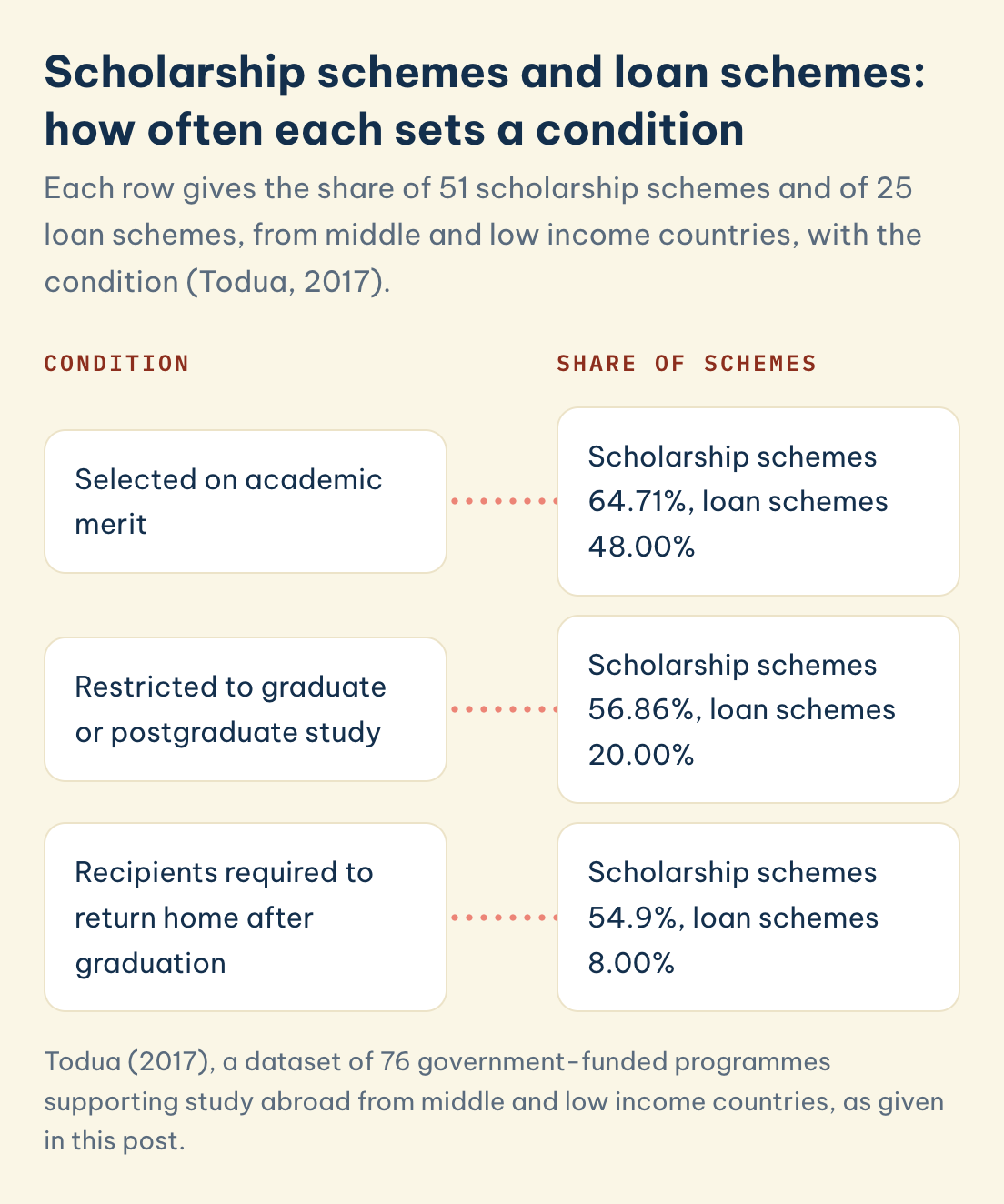
Todua (2017) assembled a dataset of 76 government-funded programmes supporting study abroad from middle and low income countries, of which 51 were scholarship schemes and 25 were loan schemes. Comparing the two forms of aid isolates the effect neatly, because the academic work being funded is identical and only the financing instrument changes. Among the scholarship schemes, 64.71% selected on academic merit, 56.86% were restricted to graduate or postgraduate study, and 54.9% required recipients to return home after graduation; among the loan schemes, the same three figures were 48.00%, 20.00% and 8.00%. The return requirement is nearly seven times more common when the state gives rather than lends. Nothing about the students explains that gap. The instrument explains it.
Which body wrote the condition is a separate question from which body decides your case, and our guide to who decides a PhD studentship sets out the three routes the money travels and who holds the decision on each. The practical consequence is a change in the first question you ask of any funding page. Instead of asking whether you meet the condition, ask what the condition is doing there. A minimum English score is doing academic work; it predicts whether you can follow a seminar. A clause restricting awards to nationals of a listed set of countries is doing budgetary and diplomatic work, and it will still be there when your proposal improves.
◆ Question 2 / 5 · Why do funders attach
Why do funders attach conditions that have nothing to do with research ability?
Direct answer: A scholarship is a spending line with a stated purpose written into the fund's own rules. Governments use conditions to manage where the trained researcher ends up, which fields get strengthened, and which institutions the money flows through. Those aims produce eligibility text that reads like a description of the applicant but is really a description of the mandate.
The France Excellence Eiffel programme states its purpose openly. Campus France records that the scheme "was established by the French Ministry for Europe and Foreign Affairs to enable French higher education institutions to attract top foreign students", targeting "future foreign decision-makers of the private and public sectors, in priority areas of study", with age limits of 29 at master's level and 35 at doctoral level; verified on 1 September 2026. Read the purpose first and the age ceiling stops being arbitrary: a programme built to place people in senior positions over a career is buying working years, not credentials.
Return-service conditions work the same way and have measurable effects. Kahn and MacGarvie (2013) tracked 249 Fulbright foreign fellowship recipients who began doctoral study in the United States between 1993 and 1996 and graduated between 1993 and 2005, against 249 matched foreign-born scientists without a return obligation. The return-service obligation in that programme is attached to the award itself rather than to the recipient's qualifications. The obligation raised the probability of returning home by 46 percentage points for researchers from low-income countries. Krannich and Hunger (2022) studied a German scholarship organisation founded in the 1950s that has funded more than 10,000 students and researchers from the Global South and currently supports around 450 scholars a year, tracing alumni across 6 countries. Return is a precondition of the signed contract there, the organisation pays the return travel and relocation costs, and recipients who stay must repay the full award. These clauses are enforcement mechanisms for a policy goal, and they are not negotiable in the way a supervisor's opinion of your methodology is.
The clearest illustration sits in the European Union's Marie Sklodowska-Curie Doctoral Networks. Candidates "can be of any nationality", which reads as an open door, and are then bound by a mobility rule: they "must not have resided or carried out their main activity (work, studies, etc.) in the country of the recruiting organisation for more than 12 months in the 36 months immediately before their recruitment date". The consortium applying must itself contain at least 3 independent legal entities in different countries, fellowships run 3 to 36 months and up to 48 months for Joint Doctorates, a project may last up to 4 years and up to 5 years for a Joint Doctorate, each beneficiary must recruit at least 1 doctoral candidate, applicants must not already hold a doctoral degree on the recruitment date, and Industrial Doctorate candidates must spend at least 50% of their time outside academia; verified on 1 September 2026. Not one of those clauses says anything about whether a given researcher is good. They say what a mobility instrument is for.
◆ Question 3 / 5 · Can a strong research record
Can a strong research record compensate for failing an eligibility condition?
Direct answer: No, when the condition is derived from the funder's mandate. Citizenship, age, discipline lists, employer nomination and residency clauses are checked mechanically, usually by administrative staff with no discretion. A strong record can compensate only inside the competitive stage, and only for applicants the filter has already let through.
This distinction matters because the two stages reward completely different work. Preparing for the filter means finding a fund whose purpose your circumstances already satisfy, which is a search problem. Preparing for the competitive stage means making the file stronger, which is a writing problem. Applicants who conflate them spend months improving a proposal for a fund that was never going to be allowed to pay them.
The competitive stage carries its own distortions worth knowing about. Pérez Mejías, Chiappa and Guzmán-Valenzuela (2018) used a causal path analysis mediation model on a Chilean government fellowship programme that took international university rankings as its main awarding criterion, and concluded that "the use of international rankings as an awarding criterion tends to reinforce the position of privilege of individuals who accrued educational advantages in high school, as well as the disadvantages of those less fortunate who experienced fewer prior educational opportunities" (Pérez Mejías et al., 2018, p. 17). A ranking-based rule looks like a measure of the candidate. It largely measures which school the candidate attended at 15.
◆ Question 4 / 5 · Who is the applicant
Who is the applicant in the first place?
Direct answer: In several major schemes, the student is not the applicant at all. The institution nominates and submits, and a student who prepares a personal application is preparing a document nobody will receive. Checking who submits is a cheaper first step than checking whether you qualify.
UK Research and Innovation states this plainly for the studentships it funds: "Students cannot apply directly to UKRI. You will need to apply to the provider offering the studentship." The money reaches universities as training grants, and the university selects. UKRI publishes what the grant must cover, including a minimum stipend that rises from £20,780 to £21,805 between the 2025 to 2026 and 2026 to 2027 academic years, a London weighting of £23,805 for 2026 to 2027, and a minimum fee contribution of £5,238, while noting that it "only contributes up to the value of home fee rates", so an international student may owe a fee difference; verified on 1 September 2026. The Eiffel programme is stricter still: "Only applications submitted by French higher education institutions are accepted", with the 2026 round closing on 8 January 2026 and results published from 30 March 2026.
For an applicant, this reframes the work. Where the institution submits, the person who decides whether your name goes forward is inside a department, and the correspondence that matters is the correspondence with them, not with the fund. Our guide on narrowing a research direction covers the groundwork that makes a department willing to nominate, and the PhD application resource hub sets out how the pieces fit together across a full cycle.
◆ Question 5 / 5 · How should you read
How should you read a funding page differently?
Direct answer: Sort every listed condition into two columns before doing anything else. Column one holds conditions about your academic work, where effort changes the outcome. Column two holds conditions about who the fund may pay, where effort changes nothing and only choosing a different fund does. Work column two first, because it decides whether column one is worth starting.
The sort is quick and it is unforgiving. Nationality, age, current employer, country of residence, required nomination, priority discipline lists and post-award service commitments all belong in column two. Degree class, research experience, proposal quality, language scores and references belong in column one, with the caveat that language thresholds are sometimes fixed by rules outside the department, in which case they behave like column two. When a page gives you three column-two conditions you cannot satisfy, you have learned something valuable in ten minutes rather than after ten weeks of drafting.
One habit makes this reliable: read the fund's statement of purpose before reading its criteria, and expect the criteria to be a translation of the purpose into rules. Where no statement of purpose is published, look at who administers the money and what that body exists to do. An advisory team can pressure-test that reading with you, and MAAS works through it with applicants as part of PhD supervisor and funding search support, where the search question and the writing question are handled as separate pieces of work rather than one undifferentiated pile.
Frequently asked questions
Can I apply for a PhD scholarship without any published papers?
Often yes, but it depends which column the requirement sits in. Where a published paper appears as an entry condition set by the fund, it is checked mechanically. Where it appears among selection criteria, a panel weighs it against your proposal, master's thesis and references. Determining which applies is the first step, and our article on published-paper requirements works through how to tell.
Is there a GPA that guarantees eligibility for PhD funding?
No single figure applies across systems, and any number you find quoted is specific to one scheme in one year. Treat a published minimum as a floor for the filter, not as a target for the competition, because meeting the floor only earns you a place in the pool.
Do all PhD scholarships require you to return to your home country?
No. In Todua's (2017) dataset, 54.9% of government scholarship schemes carried a return requirement, which means close to half did not. Where the requirement exists, it is usually a contractual term with a repayment penalty attached, so read the contract rather than the marketing page.
Should I apply for funding and admission at the same time?
That depends on the structure of the scheme, and the sequencing question is separate from the eligibility question. Our article on scholarship deadlines sets out the three shapes these funding gates take and what each one requires of you before you are permitted to apply.
Do age limits apply everywhere?
No. They are common in government-sponsored mobility schemes with a national development purpose, such as Eiffel, and uncommon in research-council studentships attached to a specific project. This is a clear illustration of the wider point: the condition follows the purpose of the money.
References
Kahn, S., & MacGarvie, M. (2013). Do return requirements increase international knowledge diffusion? Evidence from the Fulbright program. World Intellectual Property Organization. https://www.wipo.int/edocs/mdocs/mdocs/en/wipo_ip_econ_ge_6_13/wipo_ip_econ_ge_6_13_ref_macgarvie.pdf
Krannich, S., & Hunger, U. (2022). Should they stay or should they go? A case study on international students in Germany. Comparative Migration Studies, 10(1), 39. https://doi.org/10.1186/s40878-022-00313-0
Pérez Mejías, P., Chiappa, R., & Guzmán-Valenzuela, C. (2018). Privileging the privileged: The effects of international university rankings on a Chilean fellowship program for graduate studies abroad. Social Sciences, 7(12), 243. https://doi.org/10.3390/socsci7120243
Todua, G. (2017). Financing education abroad: A developing country perspective (CERGE-EI Working Paper Series No. 608). CERGE-EI. https://www.upces.cerge-ei.cz/pdf/wp/Wp608.pdf
Tools & resources
- Campus France, France Excellence Eiffel scholarship programme: https://www.campusfrance.org/en/eiffel-scholarship-program-of-excellence
- UK Research and Innovation, guidance for funded postgraduate research students: https://www.ukri.org/what-we-do/developing-people-and-skills/find-studentships-and-doctoral-training/get-a-studentship-to-fund-your-doctorate/
- European Commission, Marie Sklodowska-Curie Actions Doctoral Networks: https://marie-sklodowska-curie-actions.ec.europa.eu/actions/doctoral-networks
A free 20-minute consultation is a conversation about your situation and the funding you are considering. In the PhD application service, an expert drafts your application documents and you review, edit, approve and submit them.
Book a free consultation ▸