
◆ PhD Admissions
Who screens an Australia PhD scholarship first, versus Taiwan's?
Category: admissions
Last updated: 2026-09-07

Most guidance about doctoral funding, including an Australia PhD scholarship, assumes the university is the building where your file is read. For the two government schemes Vietnamese applicants ask about most, the Taiwan Scholarship and Australia Awards, that assumption points at the wrong address. The first person to read your scholarship file works in your own country, and in one of the two schemes they will interview you before any Taiwanese or Australian academic has seen your name.
Direct answer: In both schemes the first screen sits outside the university and inside your country of citizenship. Taiwan routes the application to its local representative office, which reviews it and interviews candidates. Australia routes it to a country programme run by its foreign ministry. The pool you are compared against is therefore national, not global.
That single structural fact reorganises the work, because it changes who your file is written for. A departmental committee reads for whether you can finish a thesis. A diplomatic mission or an aid programme reads for something else entirely, and the terms attached to the money are written into a contract rather than into the selection criteria. Our guide to who decides PhD studentship funding sets out the three funding routes in general; this article takes the two government routes that behave least like the rest. Japan's MEXT research student scholarship also starts at an embassy, and there the status named on a university's letter of provisional acceptance shapes the scholarship period, as explained in our guide to the MEXT scholarship and kenkyusei status.
◆ Question 1 / 6 · The Taiwan MOE timeline
What does the Taiwan MOE selection timeline actually look like?
Direct answer: Six steps, beginning at a diplomatic mission rather than a campus. The Ministry of Education's published process asks you to send the application to the local overseas mission, attend an interview run by that mission, supply a copy of your admission notice, receive a scholarship certificate, then register at the university that pays the allowance.
Read the order of those steps carefully, because it contains an instruction most applicants miss. The Ministry of Education states that you should "apply separately for admission to a university or college in Taiwan", as verified on 7 September 2026. Two applications run in parallel, on two timetables, judged by two bodies that do not share a decision. The mission decides whether you get the money. The university decides whether you get the place. Neither can substitute for the other, and step three exists precisely because the mission needs proof that the second track succeeded.
The interview at step two is the part with no equivalent in the systems covered elsewhere in this cluster. It is conducted by consular staff, not by a research supervisor, which means the questions it can competently ask are about your plan, your record and your reasons for choosing Taiwan rather than about the methodological detail of your project. Our guide to what a Chinese supervisor signs in a CSC application describes a route where the academic yes is a required document; Taiwan inverts that sequence, putting the state's yes first and the academic yes second.
◆ Question 2 / 6 · Taiwan criteria and money
What are the Taiwan MOE selection criteria and entitlements?
Direct answer: The published guidelines set a qualification test, a funding ceiling and a language condition rather than a scoring rubric. Applicants must be foreign nationals holding a secondary or post-secondary qualification, showing excellent academic performance and good moral character, and students from Mainland China, Hong Kong and Macao are not eligible.
Tuition ceiling
NTD 40,000
up to, each semester, towards approved tuition and miscellaneous expenses
Doctoral duration
4 years
of award, with the total across all awards not to exceed five years
What the Taiwan Ministry of Education scholarship pays
Monthly living allowance in NTD.
Save this figure
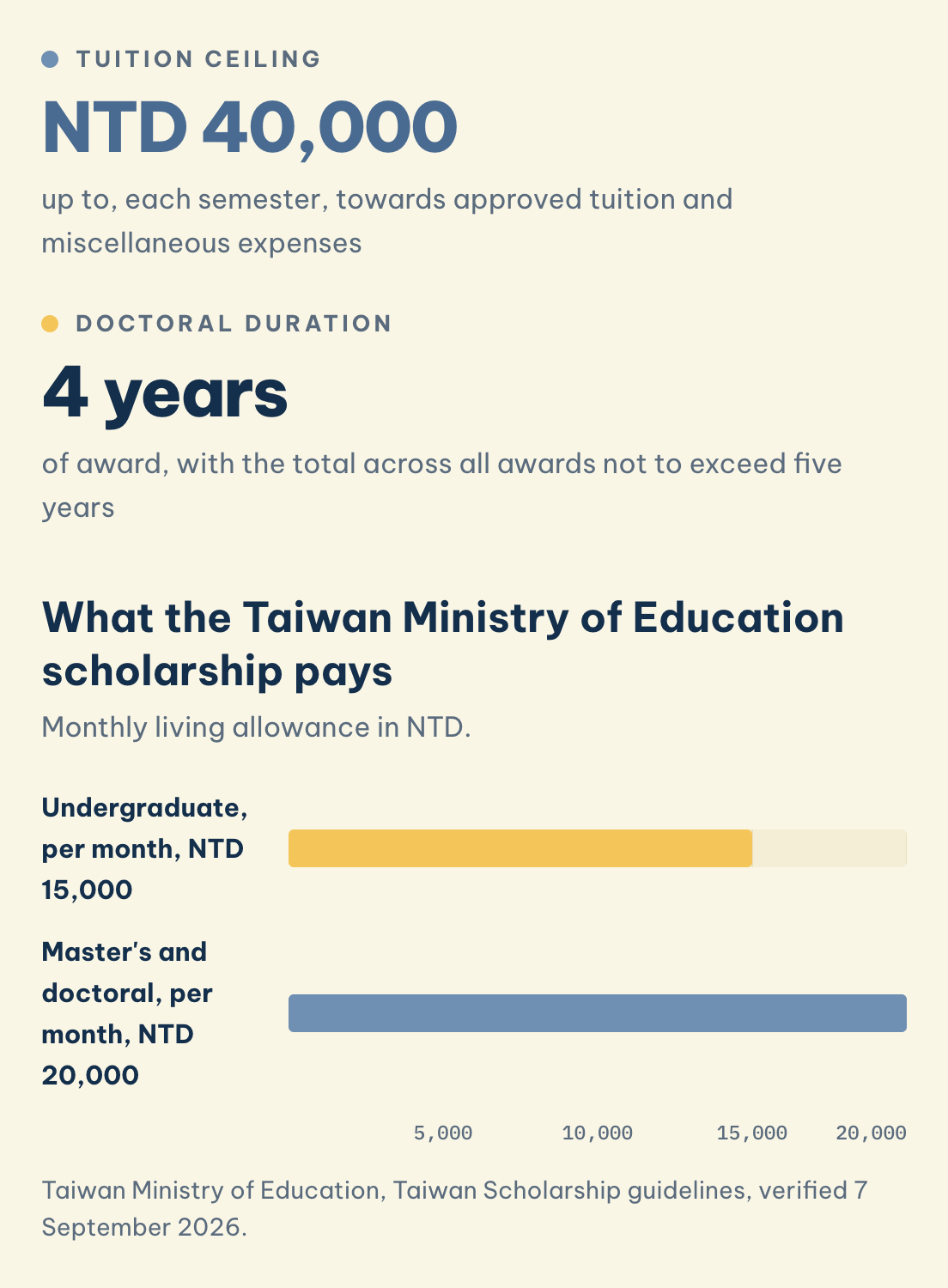
The money is defined precisely enough to plan against. For a master's or doctoral recipient the Ministry of Education pays a living allowance of NTD 20,000 per month, against NTD 15,000 for an undergraduate, and pays up to NTD 40,000 each semester towards approved tuition and miscellaneous expenses, with any excess payable by the student to the university, as verified on 7 September 2026 in the guidelines updated on 10 February 2026. The award year runs from 1 September to 31 August, the doctoral duration is four years, and the total across all awards may not exceed five years.
Two conditions sit outside the money and are easy to overlook. Where a programme is not taught entirely in English, the applicant must submit a TOCFL result at Level 3 or above, and if the local representative office does not run TOCFL testing, the recipient must sit and pass it at their own expense by the end of the first semester after arrival. Employment is capped at 20 hours per week outside vacations, with a permit valid for six months per semester. The parallel MOFA scholarship pays NTD 28,000 per month for a degree programme, and NTD 33,000 for a language enrichment programme, but restricts eligibility to countries with diplomatic relations with Taiwan or recognised by MOFA as having friendly relations, which is a nationality gate rather than an academic one. Its award year starts on 1 August of the first year of study, runs for four years at doctoral level within the same five-year total, requires a TOCFL certificate at Level 2 or above for Chinese-taught degrees, and covers one return economy-class airfare while providing no other subsidy during the stay. All MOFA applications, like the Ministry of Education ones, must be submitted to the local Taiwan Representative Office, as verified on 7 September 2026.
◆ Question 3 / 6 · Australia Awards terms
What are the Australia Awards obligations and scholarship terms?
Direct answer: Australia Awards is an aid instrument, and its terms follow from that. The Department of Foreign Affairs and Trade describes the awards as long-term awards that aim to contribute to the development needs of Australia's partner countries in line with bilateral and regional agreements, and successful applicants sign a contract with the Commonwealth of Australia.
The most consequential clause is not about money at all. DFAT states that scholars "are required to leave Australia for a minimum of two years after completing their scholarship" and that "failure to do so will result in the scholar incurring a debt for the total accrued cost of their scholarship", as verified on 7 September 2026. A doctoral scholar contemplating a postdoctoral position in Australia is therefore looking at a contractual bar, not a visa question, and the penalty is denominated in the full value of everything the award paid for.
What the award pays for is unusually broad, which is the other side of the same aid logic. The published benefits include full tuition fees, a return economy airfare, a one-off establishment allowance, a fortnightly Contribution to Living Expenses, a compulsory Introductory Academic Program before formal study begins, Overseas Student Health Cover for the award holder, pre-course English where deemed necessary, and for research awards a fieldwork airfare where fieldwork is compulsory. Notice that an aid programme funds the transition into study and the return home, categories a departmental stipend does not usually recognise.
One further term now governs the writing itself. DFAT's application guidance states that applicants "may only use AI for basic tasks like spelling, grammar and organising ideas", that AI "must not be used to write, improve or paraphrase any part of your application", and that misuse may result in disqualification, as verified on 7 September 2026. That rule sits close to the boundary MAAS works within, and it is worth reading before you accept help of any kind on an Australia Awards form.
◆ Question 4 / 6 · Why your passport matters
Why does the country you hold a passport from change the process?
Direct answer: Because in the Australian scheme the country profile, not the central page, is the operative document. DFAT directs applicants to select their country of citizenship or residency from the list of participating countries for specific information on eligibility, priority areas and how to apply, and states that opening and closing dates are set per country.
The consequences are practical. Some countries allow online application through the Online Australia Scholarships Information System while others require hard copy, and Indonesia and the Philippines do not use that system at all. Vietnam appears on the participating list with its own intake information, and DFAT notes that from 2027 additional scholarships will be available for Vietnam funded through the Australian Government's Southeast Asia Maritime Partnerships, as verified on 7 September 2026. Priority areas are named at country level, which means a research topic that is competitive from one passport may be outside the funded fields from another. At the far end of this spectrum is a scheme whose first test is a country list, and Can Vietnamese students apply for a Commonwealth PhD scholarship? shows what that looks like on the page.
The country profile is where the framing of eligibility we set out in what a scholarship eligibility list actually describes becomes concrete rather than abstract. A priority sector is not a judgement about your discipline. It is a line in a bilateral agreement, and no amount of academic strength moves it.
◆ Question 5 / 6 · Post-award obligations
What do post-award obligations look like across government schemes?
Direct answer: Return conditions are the norm in government scholarship design, and they vary in length and enforcement rather than in principle. The scholarly record documents obligations ranging from a two-year absence requirement to a contractual service period of several years, usually backed by repayment of the full award.
Kazakhstan's Bolashak programme, established in 1993, had awarded over 14,000 full scholarships at the time of Jonbekova's (2023) study, and its alumni are contractually obliged to return and work in Kazakhstan for three to five years depending on the nature and length of the programme. Jonbekova interviewed 67 alumni and found that while they held strong patriotic commitment, underdeveloped industries, economic volatility and top-down bureaucracy in workplaces limited what they could actually contribute on return, which is a finding about the destination rather than about the scholars.
Ecuador's programme, introduced in 2007, sets a harder ratio. As Sanna puts it, the model "stipulates a compulsory return to the home country with the obligation of working 'at home' for double the length of time that they spent abroad" (Sanna, 2022, p. 262). Students who do not meet that condition must repay the entire cost of the award, against a reported return rate of about 90%. Taiwan's picture is different again, because the MOFA-linked TaiwanICDF scheme studied by Lin (2024) is tied to Official Development Assistance and works through 23 Taiwanese partner universities; that study rests on 18 interviews across nine cohorts of a programme with 63 graduates, so it describes one programme closely rather than the system broadly.
Lin (2024) also dates the fund itself: TaiwanICDF was established in 1997 to work with partner countries through technical cooperation, lending and investment, international education and training, and humanitarian assistance. Jonbekova (2023) reads her interview data against the four pathways to social change set out by Dassin and colleagues in 2018, and reports that the Bolashak programme stopped funding undergraduate study after 2011 to concentrate on graduate programmes and internships.
Three limits belong with this evidence. None of these studies examines the Taiwan Scholarship or Australia Awards doctoral cohorts directly, the samples are small and interview-based, and each programme sits in its own policy history. What the literature supports is the general shape, that government money buys a claim on where you work afterwards, not a numerical prediction about either scheme.
Not every condition waits until after the degree. Hungary's Stipendium Hungaricum, which Vietnamese applicants also reach through a national nominating authority, places its main condition in the middle of the award: the second two years of a doctoral scholarship are paid only after a pass at the complex exam that closes the fourth semester, and a candidate who fails it twice loses student status and the scholarship on the same day.
◆ Question 6 / 6 · What to do differently
What should you do differently for a government scheme?
Direct answer: Split the work into two files on two timetables and settle the contract question before the academic one. Confirm which body screens first for your citizenship, then check whether the scheme's post-award conditions are compatible with the career you are actually planning.
Language is the third file, and on some schemes it carries a cancellation clause rather than a preference. Korea's Global Korea Scholarship sets three separate TOPIK thresholds that score the application, exempt the holder from a language year, and decide whether the degree place can be taken up at all.
Concretely, that means four checks, and the first two are calendar work rather than writing. Find your country's page and closing date rather than the scheme's global page. Establish whether the scholarship application and the admission application are separate, as they are in Taiwan. Read the return clause before you write a single paragraph, because a two-year absence requirement changes the value of the award for anyone aiming at an academic post in the host country. And write the file for the body that reads it first, which for these two schemes is not a research committee.
Where MAAS works on this is the second file, the academic one. Our experts draft the research proposal from your own account of your research and stress-test the supervisor shortlist, while you review, edit and approve every document, submit the application yourself and sit every interview. Matching timing depends on the network: where a suitable adviser is already in the MAAS network, matching is confirmed within 48 hours, and where no suitable adviser is available, MAAS opens a dedicated recruitment round that usually takes about two weeks. The full route through a doctoral application is mapped in our PhD application pathway, and the adviser side is described on the PhD supervisor search service page.
Frequently asked questions
Do I apply to the Taiwan university or to the scholarship first?
Both, in parallel. The Ministry of Education's process starts with the application to the local overseas mission and instructs you to apply separately for admission to a university or college in Taiwan, then to supply a copy of the admission notice to the mission at step three.
Does the Taiwan Scholarship require Chinese?
Only for programmes not taught entirely in English, where a TOCFL certificate at Level 3 or above is required. If the local representative office does not organise TOCFL testing, the recipient must pass it at their own expense by the end of the first semester after arriving.
Can I stay in Australia after an Australia Awards doctorate?
Not for at least two years. DFAT requires scholars to leave Australia for a minimum of two years after completing the scholarship, and failure to do so results in a debt for the total accrued cost of the award.
Are Australia Awards open to every country?
No. Eligibility, priority areas, application method and dates are set in a country profile, and applicants apply through their country of citizenship or residency, so the terms differ from one passport to another.
Can I use AI tools on an Australia Awards application?
Only for spelling, grammar and organising ideas. DFAT states that AI must not be used to write, improve or paraphrase any part of the application and that misuse may result in disqualification.
Related MAAS guides
References
Jonbekova, D. (2023). Government scholarships for international higher education: Pathways for social change in Kazakhstan. Higher Education. https://doi.org/10.1007/s10734-023-01034-8
Lin, W. (2024). Humanistic and diplomatic implications of international scholarship schemes in Taiwan: An analysis. Humanities and Social Sciences Communications, 11, 1651. https://doi.org/10.1057/s41599-024-04164-1
Sanna, A. (2022). Fighting brain drain: The Ecuadorian scholarship. Athens Journal of Business & Economics, 8(3), 261–276. https://doi.org/10.30958/ajbe.8-3-4
Tools & resources
- Taiwan Ministry of Education, Taiwan Scholarship guidelines and application process: https://taiwanscholarship.moe.gov.tw/
- Australian Government Department of Foreign Affairs and Trade, Australia Awards Scholarships: https://www.dfat.gov.au/people-to-people/australia-awards/australia-awards-scholarships
- Australia Awards participating countries and country profiles: https://www.dfat.gov.au/people-to-people/australia-awards/participating-countries
A free 20-minute consultation is a conversation about your situation and the scheme you are looking at.
Book a free consultation ▸