
◆ PhD Admissions
MEXT PhD scholarship: must you start as a kenkyusei research student?
Category: admissions
Last updated: 2026-09-15

Most explanations of the MEXT research student scholarship treat kenkyusei, the non-degree research student period, as a standard first step before a PhD in Japan. The 2027 application guidelines point somewhere more specific. The status written on your letter of provisional acceptance, regular student or non-regular student, decides whether an extra graduate entrance examination sits inside your scholarship period, and MEXT states that "Non-regular students cannot extend the scholarship period as long as they stay in non-regular courses" (Ministry of Education, Culture, Sports, Science and Technology, 2026, p. 4).
Direct answer: No. Under the 2027 MEXT research student guidelines, an applicant whose letter of provisional acceptance names a regular doctoral course is placed directly in that course without a non-regular period. Kenkyusei status applies when the letter names a non-regular place, and that funding ends in March 2029 unless you pass a graduate entrance examination and MEXT approves an extension.
◆ Question 1 / 6 · What kenkyusei means
What is a kenkyusei research student in Japan?
Direct answer: A kenkyusei is a non-degree research student attached to a faculty member. The University of Tokyo's School of Science states that research students are not entitled to any degree, normally stay 6 months and may extend with supervisor approval up to a total of 2 years (The University of Tokyo, Graduate School of Science, n.d.).
The University of Tokyo's Graduate School of Science describes research students as people who carry out research under a faculty member without being entitled to receive any degree or qualification, and who in principle cannot attend classes or earn credits (The University of Tokyo, Graduate School of Science, n.d.). The standard period is 6 months, extendable with the supervisor's approval, with a total that does not exceed 2 years. The same page states that applicants can apply directly to the master's or doctoral programme without first being research students, and that few scholarships are available to research students.
The Graduate School of Information Science and Technology at the same university describes the period as one usually spent preparing for the entrance examination, and warns that research student status "does not guarantee" entry to a degree programme (The University of Tokyo, Graduate School of Information Science and Technology, n.d.). Li and Date (2025) found how common the professor-first route is for self-funded applicants: of 91 research student guidelines analysed at 7 former imperial national universities, 83 required the host professor's prior informal consent before an application, and 50 of those 83 added a faculty committee screening after that consent.
◆ Question 2 / 6 · The letter that decides
Which letter decides whether MEXT places you as kenkyusei?
Direct answer: The letter of provisional acceptance decides it. MEXT asks applicants to request the letter as a regular or a non-regular student, states that the letter "will greatly influence final selection results", and places anyone holding a regular-course letter directly in that course (Ministry of Education, Culture, Sports, Science and Technology, 2026, pp. 8-9).
Section 11 of the 2027 guidelines opens with a blunt sentence: "A letter of provisional acceptance will greatly influence final selection results" (Ministry of Education, Culture, Sports, Science and Technology, 2026, p. 8). Applicants who pass the first screening request the letter as a regular or a non-regular student in graduate school, may contact at most 2 universities at the same time, may hold at most 2 letters, and must make every request by Tuesday, September 1, 2026, because contact on September 2 or later is not permitted. Universities generally need about 1 month to issue a letter, so requests are best made well before that date.
Section 12 then sets out the consequence. Placement is made at the university that issued the letter, a national university option is prioritised over private or non-national public universities because of budget restrictions, and "Applicants who receive a letter of provisional acceptance to the regular course at a graduate school will be directly placed in the said regular course without going through the period of the non-regular student" (Ministry of Education, Culture, Sports, Science and Technology, 2026, p. 9). An applicant without any letter can still submit the placement preference form, but arrival is then restricted to the October term.
◆ Question 3 / 6 · Non-regular status and the exam
Why does non-regular status put an exam inside the scholarship clock?
Direct answer: Non-regular funding has a fixed end. Grantees arriving in April or October 2027 are funded only until the end of March 2029, cannot extend while they stay non-regular, and need both a passed entrance examination for a regular degree course and MEXT approval to extend (Ministry of Education, Culture, Sports, Science and Technology, 2026, pp. 3-4).
For non-regular students, section 4 sets the scholarship period from April 2027, or September or October 2027, until the end of March 2029, and the first 6 months go to Japanese language preparatory education for those who need it (Ministry of Education, Culture, Sports, Science and Technology, 2026, p. 3). A grantee who arrives in October 2027 and needs that language course therefore has about 12 months of research-student time left before the funding ends. Regular students are funded for the standard period of their degree course, which section 13 sets at 3 years for a doctoral course after a master's degree and, at most universities, 4 years in medicine, dentistry, veterinary science and 6-year pharmacy programmes (Ministry of Education, Culture, Sports, Science and Technology, 2026, p. 10).
Section 5 lists three conditions on extension. The extension is permitted only if the grantee has passed an entrance examination for a regular degree course, non-regular students cannot extend while they remain non-regular, and a student admitted to an advanced course without MEXT's approval for extension can continue only as a privately financed student (Ministry of Education, Culture, Sports, Science and Technology, 2026, p. 4). Entrance examinations normally assess foreign language competence, the specialised subject, thesis plans and an interview, and section 6 adds that the examination fee is waived but is "borne by the grantees if they cannot proceed to the master's or doctoral course or cannot be admitted to the university" (p. 4).
◆ Question 4 / 6 · Monthly pay
How much does MEXT pay research students each month?
Direct answer: The 2027 guidelines set 143,000 yen per month for preparatory and non-regular students, 144,000 yen for regular master's students and 145,000 yen for regular doctoral students, plus 2,000 or 3,000 yen in designated regions. Tuition, matriculation and examination fees are waived (Ministry of Education, Culture, Sports, Science and Technology, 2026, p. 4).
Regional supplement
2,000 or 3,000 yen
added in designated regions
Gap between the three rates
2,000 yen
at most, between the three monthly rates
What MEXT pays research students each month
Each bar shows the monthly allowance in yen set by the 2027 guidelines for one status.
Save this figure
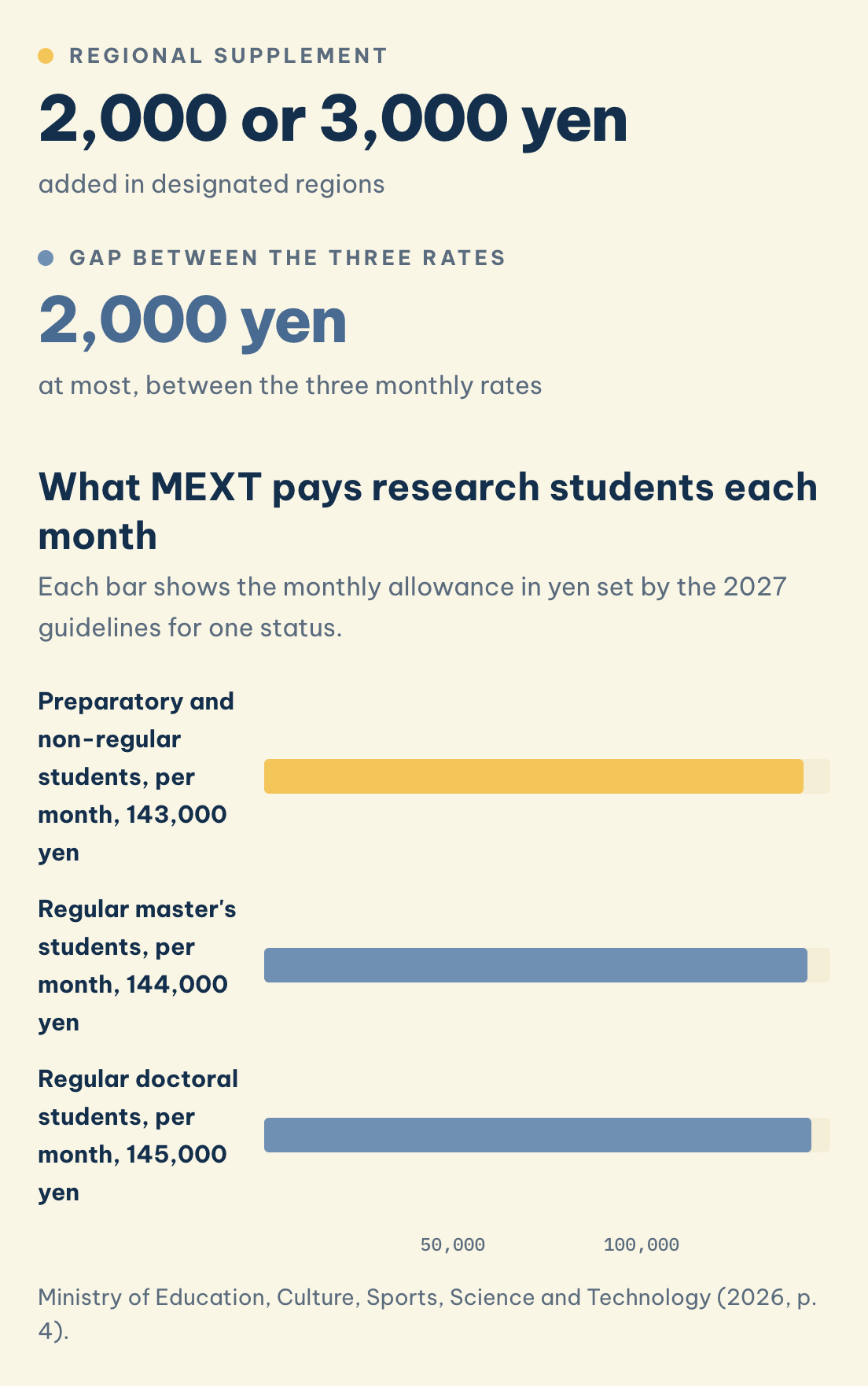
The three monthly rates of 143,000, 144,000 and 145,000 yen differ by at most 2,000 yen, so the stipend itself is not the reason to prefer one status over another. The practical difference lies in duration. A regular doctoral place is funded for the standard period of the course, while a non-regular place is funded to March 2029 and then depends on an examination result. The guidelines also warn that the amounts may change each fiscal year because of the Japanese government budget, and that payment is suspended for any extended absence from the university (Ministry of Education, Culture, Sports, Science and Technology, 2026, p. 4).
The Study in Japan portal summarises the same research student scholarship as open to applicants under 35, which matches the guideline condition of a birth date on or after April 2, 1992, and it lists a monthly amount of 143,000 to 145,000 yen (Japan Student Services Organization, n.d.). MEXT also sets one eligibility condition that matters for anyone thinking of kenkyusei as a low-commitment trial: applicants who have no intention of obtaining a degree in Japan are ineligible (Ministry of Education, Culture, Sports, Science and Technology, 2026, p. 3).
◆ Question 5 / 6 · The embassy route
Is the MEXT PhD scholarship hard to get through the embassy route?
Direct answer: The MEXT research student scholarship is selective at two stages. The Japanese diplomatic mission screens documents, written Japanese and English examinations and an interview, and MEXT runs a second screening from November 2026. Only applicants who pass the first screening request a letter of provisional acceptance, which weighs heavily in the final selection.
The embassy route and the university route are separate channels. The Study in Japan portal explains that the embassy route begins with an application to the Japanese embassy or consulate in your country, while university recommendation is possible only at universities that MEXT has approved and allocated places to (Japan Student Services Organization, n.d.). Under the 2027 embassy timeline, the call opens around mid-April 2026, first screening runs from early May to late July, letter requests close on September 1, 2026, the placement preference form follows from mid-September to early October, MEXT's second screening starts in November 2026, and final results arrive between January and early March 2027 (Ministry of Education, Culture, Sports, Science and Technology, 2026, pp. 5-6).
The guidelines also set the order of contact. On the embassy route, applicants "should first contact the division of international student affairs at the university (not an academic advisor you wish to be supervised by)", and anyone rejected by one faculty member should not approach another faculty member at the same university (Ministry of Education, Culture, Sports, Science and Technology, 2026, p. 8). The informal professor consent that Li and Date (2025) documented is standard in the self-funded research student process, and some graduate schools still expect it from MEXT applicants: the University of Tokyo's School of Science notes that a supervisor's consent does not guarantee a letter of provisional acceptance (The University of Tokyo, Graduate School of Science, n.d.). What the guidelines fix is the order of contact, not whether the professor is involved at all.
◆ Question 6 / 6 · Before you request a letter
What should you check before you request a letter?
Direct answer: Check which status the letter will name, whether a regular doctoral place is realistic at that university, and how long the funding lasts under each status. A non-regular letter can still be the right choice, but only if you plan for the entrance examination and the March 2029 end date from the start.
Three checks help. First, read the graduate school's own admission rules to see whether international applicants can enter the doctoral course directly, as the University of Tokyo's School of Science allows (The University of Tokyo, Graduate School of Science, n.d.). Second, compare the timing of that school's entrance examinations with the scholarship period; the Graduate School of Information Science and Technology lists application windows of April 20 to May 8, 2026 for October 2026 entry and October 19 to November 6, 2026 for April 2027 entry, with a 9,800 yen examination fee (The University of Tokyo, Graduate School of Information Science and Technology, n.d.). Third, prepare for the language environment. Rakhshandehroo (2018) interviewed 9 English-speaking graduate international students at a leading Japanese university, most of them PhD students and many funded by MEXT, and found that many had arrived with little Japanese and that the English support they received depended heavily on their supervisors.
Motivation also deserves a clear answer before the research plan is written. Futagami (2021) surveyed doctorate recipients from 7 Japanese research-intensive universities and found that 50 of 66 respondents, or 76%, chose Japan for its high research or education level, well ahead of liking Japan or obtaining a scholarship. A research plan that shows why that particular laboratory fits your question is closer to what reviewers read for than a plan built around the scholarship itself. The general timing of doctoral study is covered in how long a PhD programme takes, and screening order in other government schemes in who screens government PhD scholarships first.
If you want a second reader while you weigh a regular or non-regular place and prepare the research plan, MAAS works with applicants as academic advisors. You choose the universities and make every decision. Our experts draft the research plan from your own account of your research and challenge the fit, the timeline and the evidence behind each choice, while you review, edit, approve and submit it yourself. No one can promise a MEXT scholarship or a doctoral place, since those decisions belong to the diplomatic mission, MEXT and the accepting university. You can see the full pathway in our PhD application guide, and the scope of the advisory work in PhD supervisor search and application strategy.
Frequently asked questions
Is kenkyusei the same as being a PhD student?
No. Research students at the University of Tokyo's School of Science are not entitled to a degree and in principle cannot earn credits, so doctoral candidacy begins only after admission to the degree course.
Can I go straight into a doctoral course with a MEXT scholarship?
Yes, if your letter of provisional acceptance names a regular doctoral course. The 2027 guidelines state that such applicants are placed directly in that course without a non-regular period.
Who pays the entrance examination fee if I fail after kenkyusei?
The fee is waived for MEXT grantees, but the guidelines state that it is borne by the grantee who cannot proceed to the master's or doctoral course or cannot be admitted.
How many universities can I ask for a letter of provisional acceptance?
You may contact at most 2 universities at the same time and hold at most 2 letters, and the placement preference form lists up to 3 universities.
Does MEXT require Japanese before I arrive?
The guidelines include a written Japanese examination at the first screening and a 6-month preparatory language course for grantees who need it, so the level you bring affects how much of a non-regular period goes to language study.
Related MAAS guides
References
Futagami, T. (2021). On motivations for mobility of international students studying at Japanese research-intensive universities. Journal of Comparative & International Higher Education, 13(1), 82-102. https://doi.org/10.32674/jcihe.v13i1.2100
Japan Student Services Organization. (n.d.). MEXT scholarships. Study in Japan. https://www.studyinjapan.go.jp/en/planning/scholarships/mext-scholarships/
Li, Y., & Date, S. (2025). Adoption of ICT in graduate admissions: A case study on application guidelines for self-funded international research students. Journal for Academic Computing and Networking, 29(1), 228-234. https://doi.org/10.24669/jacn.29.1_0032
Ministry of Education, Culture, Sports, Science and Technology. (2026). Application guidelines: Japanese Government (MEXT) Scholarship for 2027 (Research Students). https://www.studyinjapan.go.jp/en/_mt/2026/04/01-2027_Research_Guidelines_E.pdf
Rakhshandehroo, M. (2018). A qualitative exploration of on-campus experiences of English-speaking graduate international students at a leading Japanese university. Journal of International Students, 8(4), 1831-1847. https://doi.org/10.32674/jis.v8i4.233
The University of Tokyo, Graduate School of Information Science and Technology. (n.d.). Research students. https://www.i.u-tokyo.ac.jp/edu/entra/research_students_e.shtml
The University of Tokyo, Graduate School of Science. (n.d.). Research students. https://www.s.u-tokyo.ac.jp/en/admission/research-students.html
Tools & resources
A free 20-minute consultation is a conversation about your situation and the choice between a regular and a non-regular MEXT place.
Book a free consultation ▸