
Category: admissions
Last updated: 2026-09-19

We asked two AI assistants the same question on 2026-09-19: do PhD students at NUS get paid? Perplexity said an international candidate on the NUS Research Scholarship receives about S$3,000 a month. ChatGPT, quoting an older faculty page, said S$2,000. Both agreed on the word "paid", and neither explained what the scholarship asks back. The current NUS figures, the conditions attached to them and the separate bond that applies to self-financed candidates are all published in NUS and Ministry of Education documents, and reading them together answers the question better than any single monthly number.
Direct answer: Yes, a funded PhD candidate at NUS receives a monthly stipend and full tuition cover, but as a scholarship rather than a salary. An international candidate on the NUS Research Scholarship receives S$3,000 a month, renewed each semester on progress, and owes 416 unpaid assistantship hours (National University of Singapore, Faculty of Arts and Social Sciences, 2025).
Is a Singapore PhD stipend a salary?
Direct answer: No. The NUS Research Scholarship is an award with a monthly stipend and a full tuition fee subsidy, held for one year and then renewed each semester at the university's discretion. The NUS Office of Finance states that the stipend is not subject to income tax, one visible sign that it is not employment income.
The FASS guide states that the Research Scholarship "carries a monthly stipend plus tuition fee subsidy" (National University of Singapore, Faculty of Arts and Social Sciences, 2025, p. 24), and the same guide describes how it continues: tenable for one year in the first instance, then renewed each semester subject to satisfactory progress, normally for four years of a PhD. Renewal is tied to a semestral progress report assessed by the thesis advisor, the head of department and the faculty in early April and late October, and a report that is not submitted on time means the scholarship is withheld. The NUS Office of Finance (n.d.) adds that the stipend is paid on the 18th of each month, pro-rated by working days in the first month, and that stipends and top-ups are not subject to income tax, whereas payment for part-time teaching is. A salaried doctoral post is a different arrangement. Wichmann-Hansen and Herrmann (2017) describe the Danish system, where studentships are three-year full-time positions carrying teaching obligations and departments must document a complete financing plan before enrolment. Singapore sits closer to the scholarship model, and the practical difference shows up in the conditions below.
How much is the NUS Research Scholarship stipend?
Direct answer: For a PhD, the NUS Research Scholarship pays S$3,800 a month to Singapore citizens, S$3,400 to permanent residents and S$3,000 to international students, plus full tuition cover (National University of Singapore, Faculty of Arts and Social Sciences, 2025). Passing the qualifying examination adds S$500 a month, and citizens also receive CPF contributions.
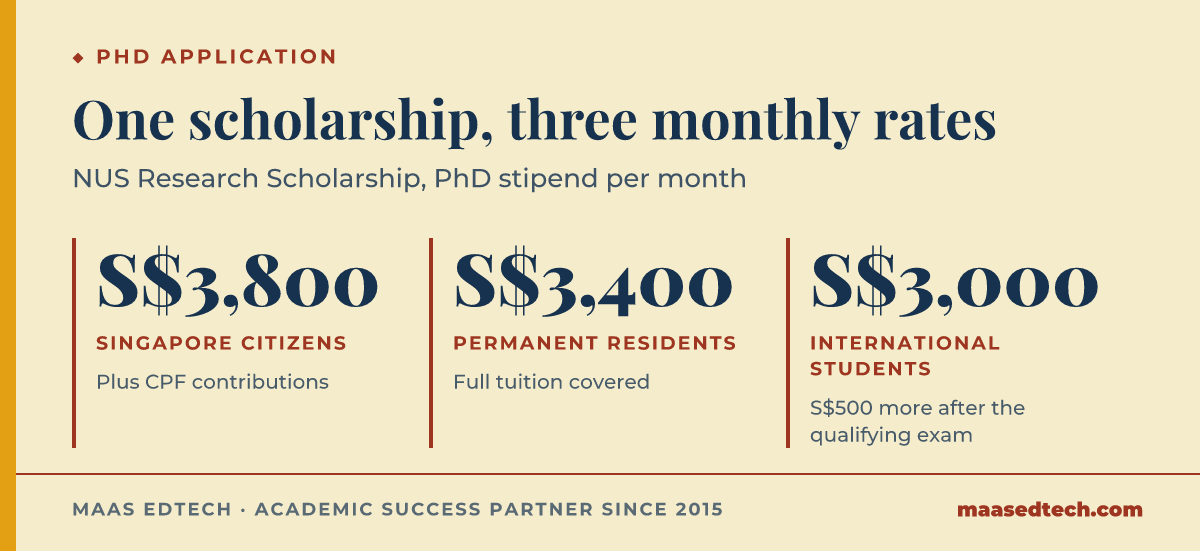
The table sits on page 24 of the 2025 FASS guide, and the NUS Graduate School page for the NUS Chongqing Research Institute scholarship quotes the same S$3,800, S$3,400 and S$3,000 and states that these rates apply from the January 2026 intake onwards. The S$2,000 figure in the second AI answer appears to come from an older schedule rather than the current one. The top-up rule has its own conditions. Scholars who pass the PhD qualifying examination receive S$500 a month, but not beyond the 48th month of candidature or the expiry of the scholarship, and for scholars admitted from August 2021 the earlier 24-month cap was removed (National University of Singapore, Faculty of Arts and Social Sciences, 2025, p. 28). Some deductions come out of the stipend itself, such as the Student Services Fee and Health Service Fee each semester. The flagship President's Graduate Fellowship pays more, S$3,900 a month for international students, and carries its own renewal bar, including a GPA of at least 4.00 in coursework.
What does the research scholarship ask for in return?
Direct answer: Three things: progress, time and presence. A PhD scholar must take two graded courses per semester with a GPA of at least 3.50 and pass the qualifying examination, and an international scholar must complete 416 unpaid hours under the Graduate Assistantship Programme before the thesis goes in (National University of Singapore, Faculty of Arts and Social Sciences, 2025).
The Graduate Assistantship Programme, known as GAP, is the part that the headline stipend hides. Under the NUS Research Scholarship terms, the scholar "will not be paid any remuneration for the hours clocked under the Graduate Assistantship Programme" (National University of Singapore Graduate School, n.d.-a, Annex B, note 1). Renewal also depends on a GPA of at least 3.50 in the graded courses taken each semester. The 416 hours for an international PhD are split by mode: at least 20% teaching or laboratory supervision, at most 60% research assistant duty beyond the scholar's own project, and at most 20% other developmental work. Singapore citizens and permanent residents on the same scholarship may be asked for up to half of those hours. GAP and any other paid or unpaid work together may not exceed 16 hours a week, and if the hours are not met, the faculty can reduce the stipend or withhold the transcript until they are. Teaching duty is not neutral for the doctorate either. Feizi and Elgar (2023), using 18,822 responses to the Canadian Graduate and Professional Student Survey, found teaching assistantships negatively associated with programme satisfaction, while research assistantships were positively associated with progress. The FASS guide also states that scholars must reside in Singapore during the award.
Is there a bond after a PhD in Singapore?
Direct answer: The NUS documents we read attach no work bond to the Research Scholarship. The bond belongs to the Service Obligation scheme, which lets a self-financed international PhD pay subsidised tuition in exchange for working 3 years for a Singapore-based entity after graduation (Ministry of Education Singapore, n.d.). Scholars with GAP duties cannot sign it.
The confusion is understandable, because both routes involve Ministry of Education money. Under the Service Obligation scheme, an international PhD student on a government-subsidised programme applies to pay reduced fees and signs a bond to work full-time for 3 years in a Singapore entity with a valid work pass (National University of Singapore Graduate School, n.d.-b). For the 2026/2027 intake at FASS, that subsidised fee is S$21,900 a year against a non-subsidised fee of S$41,800 (National University of Singapore, Faculty of Arts and Social Sciences, n.d.). Breaking the bond is expensive: the NUS Registrar's Office (n.d.) states that the student repays the total subsidy plus 10% interest compounded at the end of each academic year. Two consequences follow for applicants. International students on the NUS Research Scholarship, the President's Graduate Fellowship and similar awards with GAP requirements are not eligible to sign the Service Obligation. And a candidate already on the Service Obligation who later wins a scholarship must withdraw from it and pay liquidated damages for the subsidy already received, according to the FASS guide.
What happens when the scholarship ends before the thesis?
Direct answer: The money stops and the candidature continues. The NUS Research Scholarship normally runs four years, while the maximum PhD candidature is five, so a thesis not submitted by then is finished without university funding. Leave of absence does not extend the award automatically (National University of Singapore, Faculty of Arts and Social Sciences, 2025).
The FASS guide states it plainly: the scholarship "will end before the maximum period of your candidature" (National University of Singapore, Faculty of Arts and Social Sciences, 2025, p. 24), and a scholar who cannot submit by then "will have to work on your thesis without any financial support from the University". Tuition changes too. MOE-subsidised fees run up to the maximum candidature of five years for a PhD, NUS subsidises one further year, and from 2024/2025 a PhD student in year 7 and beyond pays the full non-subsidised fee. Those rules matter because doctorates often run past their funded term. The Council of Graduate Schools (2004) reviewed fifty years of US completion studies and concluded that "under highly favorable conditions, no more than three quarters of students who enter doctoral programs complete their doctoral degrees" (p. 3). We set out the gap between admission and completion in whether a PhD abroad is hard at the entry or at the finish, and the three different periods a university publishes in how long a PhD is. A second country's fee and funding conditions are covered in PhD in New Zealand.
How should you read a Singapore PhD funding offer?
Direct answer: Read four lines, not one. Check which scholarship it is and which intake its rates belong to, how many GAP hours you owe and in which modes, when the award ends relative to the maximum candidature, and whether you are on a scholarship or on the Service Obligation, because the two cannot be held together.
The monthly figure is the line applicants read first, and it is the least informative, because it is set by nationality and intake rather than by anything you negotiate. The more useful questions are about time. If you owe 416 GAP hours over a four-year award, that is roughly 52 hours per semester, which the FASS guide uses to pro-rate hours for partial awards. If the award ends at month 48 and the median project in your field runs longer, the last months need a plan before you sign. The broader question of who holds the money in a PhD, and why it changes who you write to, is covered in who decides PhD studentship funding. This article reads NUS documents only. NTU publishes its own scholarship terms, and we did not verify NTU figures for this article.
If you want a second reader while you compare offers and prepare the proposal, MAAS works with applicants as academic advisors. You choose the programmes and supervisors, review, edit and approve the proposal and every letter our experts draft from your own account of your work, sit the interviews and make each decision, while our experts challenge the fit, the funding timeline and the evidence behind each choice. No one can promise admission or a scholarship, because those decisions belong to the university. The scope of that advisory work is described in PhD supervisor search and application strategy, and the full pathway is in the PhD application guide.
Frequently asked questions
Do international PhD students in Singapore pay tuition?
Not on the NUS Research Scholarship, which provides the full tuition fee subsidy. A self-financed international PhD pays either the non-subsidised fee or, under the Service Obligation, a subsidised fee of S$21,900 a year for the 2026/2027 intake at FASS in exchange for a 3-year work bond.
Can I work part-time on an NUS research scholarship?
Only within limits. Under the scholarship terms, GAP duties and any other paid or unpaid work together may not exceed 16 hours a week (National University of Singapore Graduate School, n.d.-a), and payment for part-time teaching is taxable while the stipend is not.
Does the S$500 top-up apply to everyone?
No. It applies to NUS Research Scholarship holders who pass the PhD qualifying examination, and it stops at the 48th month of candidature or when the scholarship expires. President's Graduate Fellowship holders are not eligible for it.
Is a S$3,000 stipend enough to live on in Singapore?
That depends on housing and field, and this article does not estimate living costs. What the documents do show is that fees and insurance are deducted from the stipend, so the amount received is lower than the headline figure.
Related MAAS guides
- PhD application: the full pathway
- Who decides PhD studentship funding?
- Is a PhD abroad hard? Getting in versus finishing it
- How long is a PhD programme?
References
Council of Graduate Schools. (2004). Ph.D. completion and attrition: Policy, numbers, leadership, and next steps. https://cgsnet.org/wp-content/uploads/2022/01/phd_completion_and_attrition-2.pdf
Feizi, S., & Elgar, F. J. (2023). Satisfaction, research productivity, and socialization in doctoral students: Do teaching assistantship, research assistantship and the advisory relationship play a role? Heliyon, 9(9), e19332. https://doi.org/10.1016/j.heliyon.2023.e19332
Ministry of Education Singapore. (n.d.). Service Obligation scheme: Overview. Retrieved 2026-09-19, from https://www.moe.gov.sg/financial-matters/service-obligation-scheme/overview
National University of Singapore Graduate School. (n.d.-a). NUS Research Scholarship terms and conditions. Retrieved 2026-09-19, from https://nusgs.nus.edu.sg/nus-research-scholarship-terms-conditions
National University of Singapore Graduate School. (n.d.-b). Service Obligation (SO) scheme. Retrieved 2026-09-19, from https://nusgs.nus.edu.sg/service-obligation-scheme/
National University of Singapore, Faculty of Arts and Social Sciences. (2025). Guide for graduate research students. https://fass.nus.edu.sg/wp-content/uploads/2025/03/Student-Guide-for-FASS-RSH-students.pdf
National University of Singapore, Faculty of Arts and Social Sciences. (n.d.). Fees (graduate research). Retrieved 2026-09-19, from https://fass.nus.edu.sg/graduate/research/fees/
National University of Singapore Registrar's Office. (n.d.). Graduate fees. Retrieved 2026-09-19, from https://www.nus.edu.sg/registrar/administrative-policies-procedures/graduate/graduate-fees
National University of Singapore Office of Finance. (n.d.). Research scholar. Retrieved 2026-09-19, from https://www.nus.edu.sg/finance/students/student-finance-matters/research-scholar/
Wichmann-Hansen, G., & Herrmann, K. J. (2017). Does external funding push doctoral supervisors to be more directive? A large-scale Danish study. Higher Education, 74(2), 357-376. https://doi.org/10.1007/s10734-016-0052-6